forgetting the fifth

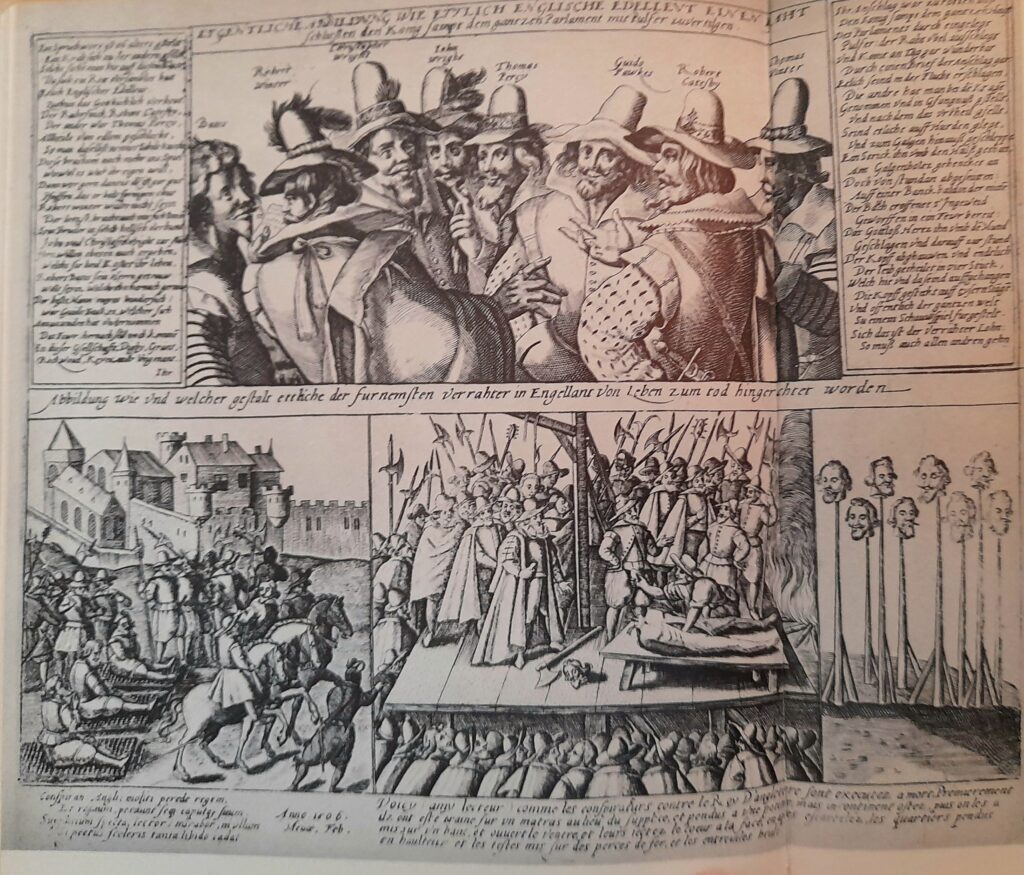
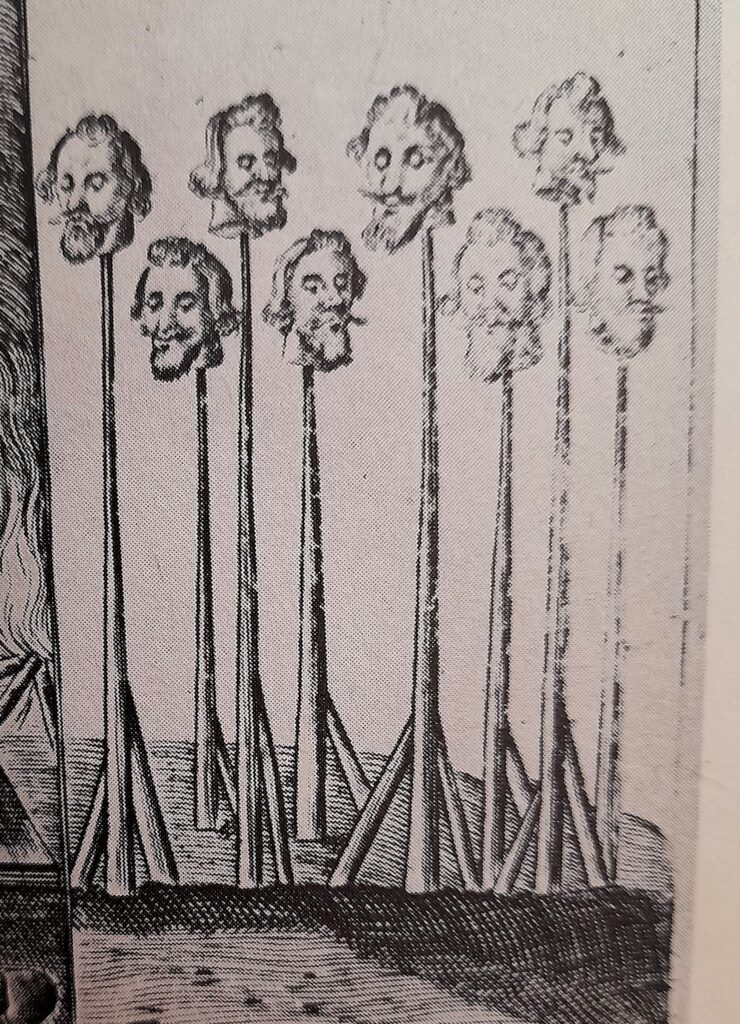
Crispijn van de Passe’s complete engraving including the arrest, torture and execution of the conspirators (1606)

When I wrote the first version of this a couple of years ago, I started by saying – though without a huge amount of confidence – that even now (or then) most British kids knew the first line of the rhyme that begins, Remember, Remember, the 5th of November, even if they didn’t know the rest of it. I’m even less sure that’s true now. The segue between Halloween and Christmas is imperceptible now, mostly because there is no segue to perceive. This year, for the first time that I’ve noticed (I’m not saying it was the first time it’s happened), shops put out their aisles of Halloween and Christmas junk simultaneously at the beginning of October. And – and this has probably happened every year for a while – Christmas-themed adverts began screening on TV on the first of November.

Traditions always come and go and it’s interesting to see how quickly they can become established – I deliberately didn’t use the phrase “the Christmas adverts” above, but it is now a thing, an annual event almost that is discussed in newspapers (themselves a sort of tradition whose days are surely numbered?) and on TV as if they are news. It seems ironic though that the phrase “spooky season” has become established in popular usage in almost the same way as ‘the festive season,’ at a time when the UK’s spookiest celebration has died away and the ‘season’ the phrase refers to is essentially one evening.

Kids not knowing more than the first (or first two –  “Remember, Remember, the 5th of November/Gunpowder, treason and plot”) lines of that old rhyme is nothing new: even when I was a child – at which point November the 5th was still a date that seemed on a par, magnitude-wise with Halloween (in fact in some ways Halloween felt like a warm-up for November 5th, which was more spectacular) I was extremely sketchy on where the verse goes after that and even now I’d have to look it up to find out.

 What I always liked about November the 5th as a child – not that I would have thought to put it this way – was its ambiguity. It was a celebration, clearly, but a celebration with something like Halloween’s horrific overtones. And Guy Fawkes was its star, but it would be wrong to call him its hero – you don’t burn heroes in effigy. But then calling him a villain doesn’t really work either. A villain that you’re introduced to, not by their evil deeds, like Dracula or Hitler, but by watching them, already defeated, being burned to death, can only be so scary. There was also a kind of veneration of the effigy – then just known as the Guy (which was vanishing even when I was quite young), where having a really good, lifelike Guy to burn made the night especially satisfying. So children kind of liked him. As a ritual, it was satisfying; Fawkes was not like Freddy Kruger or Jason Vorhees – once Guy was burned, he stayed burned, until next year. It’s obviously reactionary too – a ritual that celebrates the destruction of a rebel and the preservation of the status quo. But at the same time, the aim of the rebel was not some kind of egalitarian peasant’s revolt, but the replacement of a repressive Protestant monarchy with a repressive Catholic one; so it’s nicely complicated.

The burning is itself interesting – a kind of cleansing ritual that feels related to the 17th century in which Fawkes died – and most associated with the execution of witches. But although it’s period-appropriate, it’s notably not how the real Guy was killed. It was perhaps chosen for the slightly prosaic reason that it was related to another now-dead seasonal tradition; in the days before local councils in Britain sent squads armed with shovels and sacks around parks to tidy up and collect dead leaves, the leaves used to be swept into piles and burned. The smell of smouldering foliage was once as much a part of the autumn-to-winter transition as early sunsets and morning mists. In that sense, Guy Fawkes had almost become a surrogate elemental like the Easter Bunny; but a symbol not of Spring and rebirth/renewal but of the death of nature and the welcoming of winter as its dark days began to encroach. Being bound to the season and the ritual, annually entering the celebrations as a prisoner, defeated but not yet despatched, he could be seen as kind of a sad and sympathetic figure. But I’m getting ahead of myself.
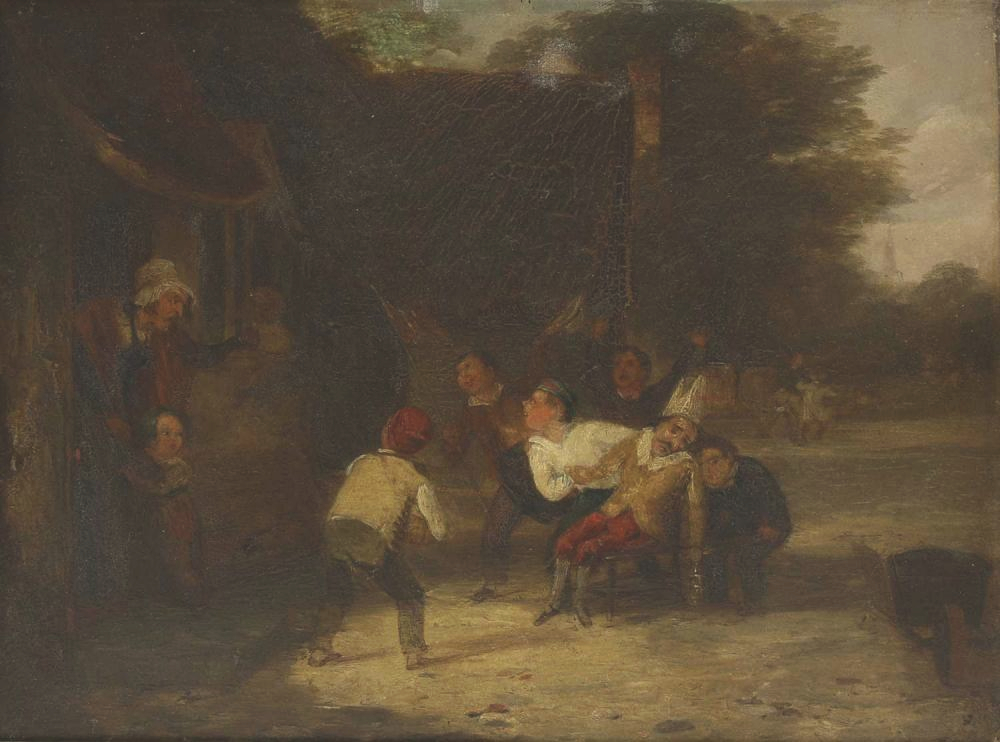
a murky, mid-19th century painting of children with a ‘Guy’, painted by Thomas Webster (1800 – 1886)
November the 5th – known variously, as late as the 1980s and among older people even today, as “Bonfire Night,” “Fireworks Night” and “Guy Fawkes Night” is no longer anything like as big as Halloween. Halloween itself is in some ways – commercially and in on online sense, socially – bigger than ever. At the same time, in the UK it’s become quite diminished as a folkloric, British celebration, reduced instead to an opportunity for adults to dress in a humorous/sexy way and for kids to the trade a stock phrase (or more romantically, a magic code) in return for some sweets. The November 5th I remember felt as ancient and immutable as Christmas, Easter or Yugoslavia – but like at least one of those it was actually in the late stages of a transitional and final phase – along, perhaps, with a more community-centric way of life more generally.

I thought I remembered the Ladybird book – a hugely popular series of small-format books for young children published from the 1940s to the 80s – devoted to the Gunpowder Plot, but now that I look it up I’m not so sure. The pictures look possibly familiar, but I don’t remember James I being referenced in the title and I don’t remember ever seeing Fawkes referred to as ‘Guy Fox’  as per the text. But the fact that I do remember having a Gunpowder Plot book and this not being it only testifies to the popularity of the story.
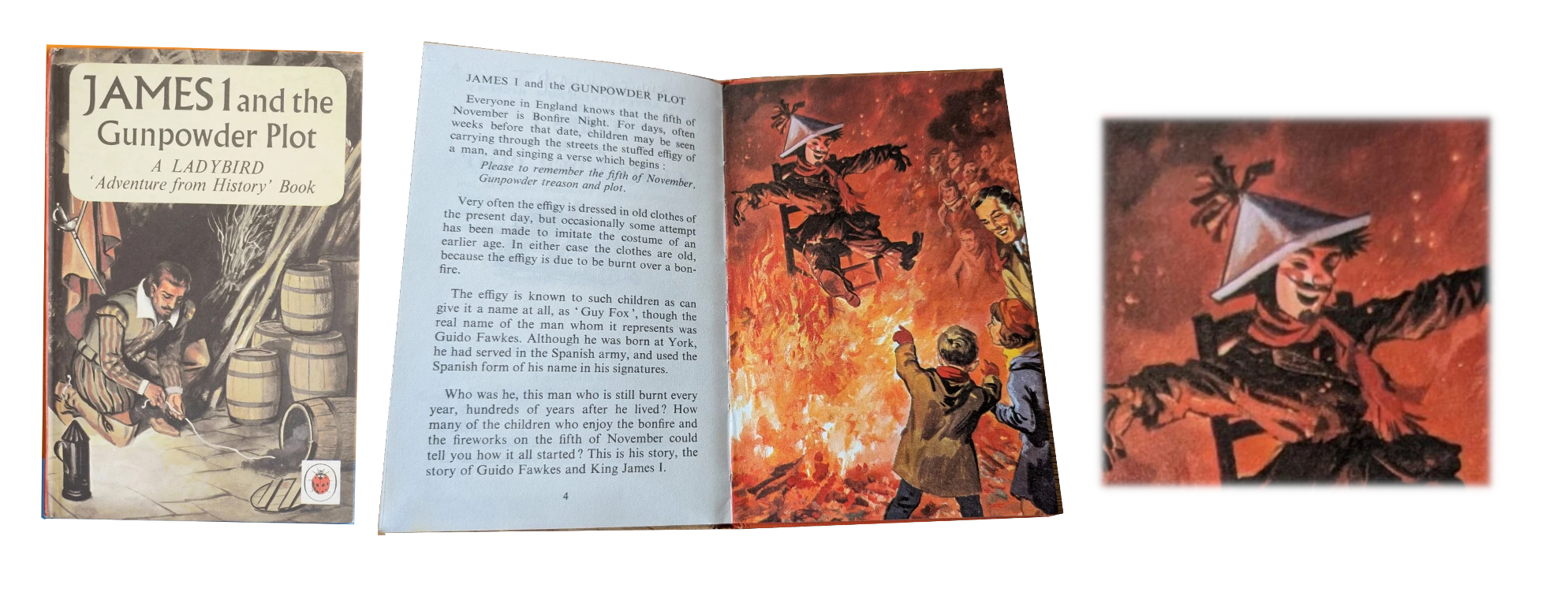
popular 1960s Ladybird book for young children
In my earliest memories of Bonfire Night, people tended to have bonfires in their gardens – not everyone (my family never did, even when we had a garden) – usually a few families would congregate in whichever friend or neighbour’s garden was biggest. Generally, there was an effigy of Guy Fawkes to put on the fire – by then really just any kind of human shaped figure. The 17th century costume was in all but the most extravagant cases limited to a tall paper hat, though I do remember once seeing shoes with cardboard, silver-painted buckles, which was a nice touch. Generally, some fireworks would be set off – a handful of rockets and maybe a Roman Candle (always a sadly inferior firework, to child-me) and a Catherine Wheel.

That’s the time – early 80s presumably – that my most vivid Guy Fawkes memories come from. Mostly they are cornily nostalgic memories; wrapping potatoes in foil and putting them in the edge of the bonfire – when they came out, they usually still had a raw-ish look, but occasionally were completely charred; both ways you could somehow taste the foil and yet they were delicious – or toasting marshmallows. There was that strange (sometimes slightly nauseating) sensation where the front of your face and body were almost too hot from the glare of the fire while your back was freezing from the November night air. Kids messed around (more or less carefully, or at least I don’t remember any burns or accidents) with sparklers, making shapes or trying to write things in the air.
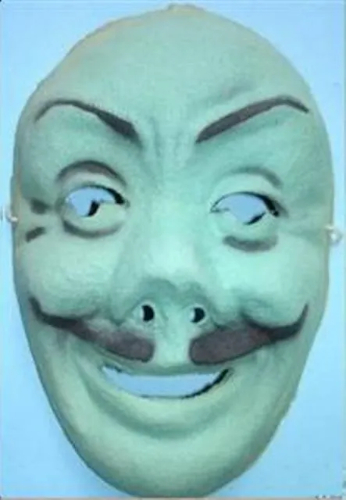
1960s Guy Fawkes mask of the type that inspired David Lloyd, artist of V for Vendetta
Less corny are the more peculiar, Wicker Man-like memories of watching the Guy itself as it caught fire; which makes me realise how rarely – thankfully – people watch a human (shaped) figure burst into flames. A surreal experience really – and the better or more realistic the Guy, the more exciting it all was; which is far more disturbing to consider as an adult than it ever was to watch as a child.  As mentioned above, the historical Guy Fawkes wasn’t executed by burning. He was sentenced to be hanged, drawn and quartered, but thankfully, due to the ineptitude (or possibly the mercy) of the executioner, he died during the hanging and so escaped the fate shared by three of his fellow conspirators on the 21st of January, 1606. They, like Fawkes were hanged, but they were cut down while still alive before having their genitals cut off and intestines pulled out (preferably while aware enough to see it), before being beheaded and cut into four pieces which were then prominently displayed in the city. All of which would all be a bit difficult to turn into an annual ritual for kids.

the ultimate fate of the Gunpowder Plot conspirators, as depicted by Crispijn van de Passe in 1606
But even if hanging a Guy had been less impractical, it would anyway be far less spectacular on a dark winter evening than burning one on a bonfire. But the burning of the Guy was the culmination of the Guy Fawkes celebration, not the totality of it. More so than Halloween, the lead up to November the 5th and the sense of growing excitement was a part of the whole occasion. For a week or so before the night itself, the bonfires would be built, most excitingly the big municipal ones. A pile of old furniture and assorted wooden rubbish and cardboard boxes would appear in the local park, getting bigger daily – this practice pretty much stopped during my teens when I was less interested, so my knowledge of where the stuff came from and who was involved in organising it is shadowy. Part of the ritual, at least in the 80s – prompted by the popular BBC kids’ TV show Blue Peter – was also the daily checking of the future bonfire for hedgehogs, to ensure that the only victim of the fire was a surrogate human.

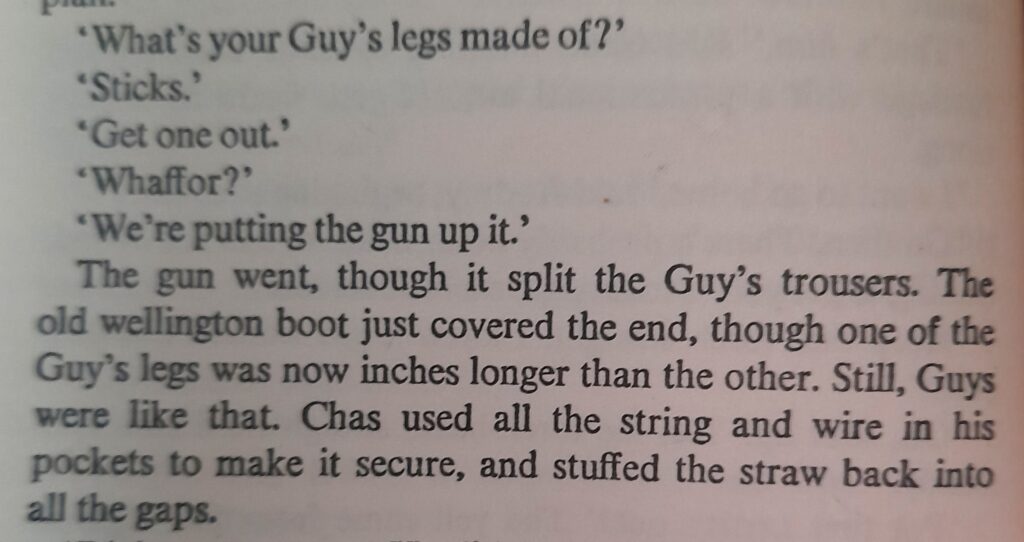
Guy Fawkes lore in Robert Westall’s The Machine Gunners (1975)
There was also the constructing of the Guy itself. I’m not sure now if I actually remember people going door to door asking for ‘a Penny for the Guy,’ in the build-up to Guy Fawkes Night, or if that’s something I just know about from books, TV and the reminiscences of my parents and other older people. This involved the highly unlikely-since-the-90s spectacle of kids or teenagers going door to door, collecting money or more often, old clothes in order to make the best possible effigy to burn. I do remember my parents donating old clothes for the purpose, but the circumstances are too vague to be sure. I do know that as I got older, the family bonfire parties and fireworks in the garden gave way to bigger and more spectacular (and therefore initially far more exciting) municipal fireworks displays and bonfires in parks. By the early 1990s, these were becoming less impressive and the Guy – the best or at least the most unique and strangest part of the whole thing – was often missed out altogether. Regulations about the use of fireworks got tighter – admittedly for good reasons – and fireworks themselves therefore became much harder to get and more expensive. And then at some point, more or less unnoticed by my teenage self, the whole thing just stopped happening. But bonfire/fireworks/Guy Fawkes night lives on in two strange ways.

Firstly, fireworks. For decades, November 5th was the occasion for fireworks in the UK and even though latterly New Year has taken that place, there seems to be some kind of residual racial memory in the country’s youth (not just its youth; the advertising of fireworks, albeit in a severely compromised way, still begins in October) and fireworks are randomly set off for the few days either side of November 5th – I saw/heard some last night. Somewhere, perhaps in the more aggressively conservative parts of the UK, there must still be council-run fireworks displays on the 5th too, but there definitely aren’t around here.
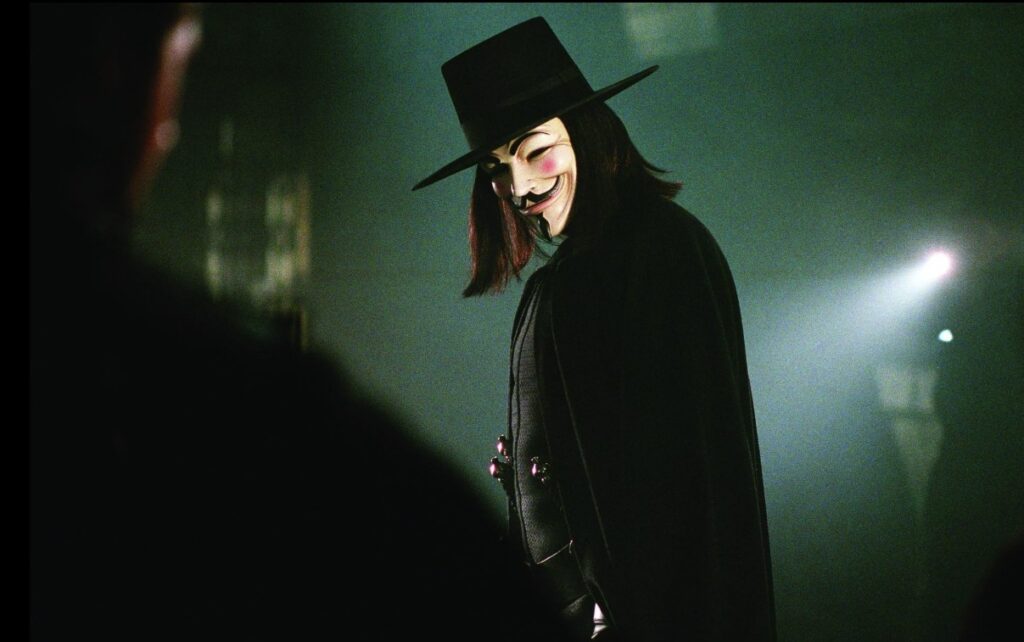
Hugo Weaving in Guy Fawkes regalia as V in V for Vendetta (2005)
Secondly, thanks to James McTeigue/the Wachowskis’ lame 2005 movie adaptation of Alan Moore and David Lloyd’s brilliant 1982-5 comic V For Vendetta and the subsequent appropriation of V’s mask by the ‘hacktivist’ group Anonymous, the iconic face of Guy Fawkes is more famous around the world now than it has ever been. V in the film looks perfect, and the excellent central performance by Hugo Weaving highlights what a missed opportunity it was – but never mind. The film has led to a strange situation where the traditional face of Guy Fawkes (see the Ladybird illustration above) is probably recognised by more people than at any time in history, whereas probably fewer people than ever before know who the mask represents. By the time I was a child, Guy Fawkes masks were no longer (as far as I remember) widely available in shops they had been in Moore & Lloyd’s youth, but children of my generation still have recognised the face (especially with the tall hat) as that of Guy Fawkes.

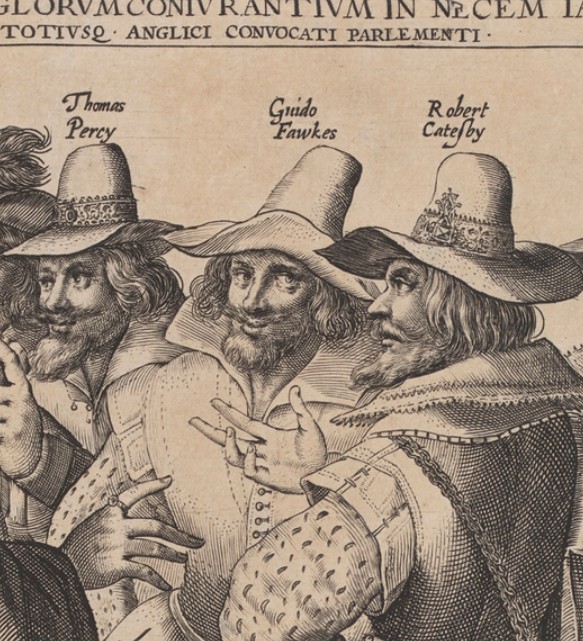
Guido “Guy” Fawkes (centre), c.1606, by Crispijn van de Passe
What everyone knew when I was a kid, and maybe children still know (?), is that Guy Fawkes was a criminal who was caught red-handed with a huge quantity of explosives an was tortured and executed for his part in a plot against the government and monarchy (which in the early 1600s were still inseparable). His capture meant that he became the most high-profile member – although not the leader – of a group who planned to destroy Parliament (specifically the House of Lords) with gunpowder and, in the process, kill the King (James VI/I).

I assume that the instantly recognisable smiling, moustached face immortalised in V ultimately derives from the famous print (c.1606) by the Dutch engraver Crispijn van de Passe, which shows eight of the thirteen conspirators involved in the Gunpowder Plot. It’s the only contemporary depiction of Fawkes, but it wouldn’t have been especially accurate; drawn for an audience in the Netherlands, it shows all of the conspirators with roughly the same face and the artist would never have seen the men himself. Thomas Bates, Robert Winter, Christopher Wright, John Wright, Thomas Percy, Guy Fawkes, the ringleader Robert Catesby and Thomas Winter all look like the archetypal Jacobean gentleman and, perhaps ironically, look very like the standard representation of that other 17th century folk anti-hero, the Witchfinder General Matthew Hopkins. They were wealthy gentlemen and probably looked much, in dress and general appearance, like the men who sat in judgement against them. Although the ‘Catesby Conspiracy’ is a familiar phrase from history books, only one of the men has a famous name – and only he was destined to be burned in effigy for three centuries. Why Guy? He wasn’t the most senior member of the conspiracy – but he was the one who was caught, with the gunpowder near the scene of the crime. And also he had the best and strangest name.

In V for Vendetta, the use of a Guy Fawkes mask for the story’s protagonist – a libertarian anarchist rebelling against a Totalitarian state – was a brainwave of artist David Lloyd which in retrospect seems so obvious that it’s surprising it wasn’t part of the original idea. But though Lloyd’s point of view (sorry, paraphrasing, I don’t have the book in front of me) was that Fawkes should be celebrated, not reviled for trying to blow up Parliament, that only goes so far. Guy Fawkes is fascinating because he’s one of the very few genuine anti-heroes in British history. The goal of Fawkes and his co-conspirators wasn’t the establishment of some kind of egalitarian co-operative, but the restoration of an absolutist Catholic monarchy; a Theocracy in which the King inherits some of the powers of God (specifically, the power to absolve sins – I was an adult before I discovered that ‘absolutist’ didn’t refer to the monarch’s political power).
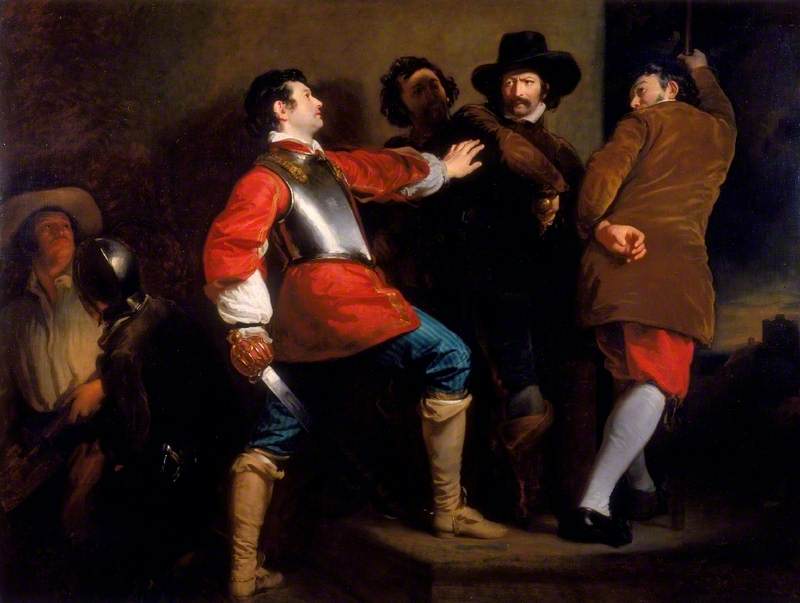
Henry Perronnet Briggs – The Discovery of the Gunpowder Plot and the Taking of Guy Fawkes 1820
Had the conspiracy succeeded, Fawkes probably wouldn’t be particularly famous himself, though Catesby might be. But the conspirators would be among the most important people in British history. They would no doubt be just as reviled by some as Fawkes has been, and also venerated by others, not as martyrs, but saints. And the Britain I’m living in now might well be a Britain where there was never a Civil War (and even if there had been, it wouldn’t have been the same one), that was never a constitutional monarchy – that maybe had no Act of Union and who knows, possibly no British Empire? Or again, a very different British Empire – but whatever, we would now be living in an unimaginably different present.

We can never know; so probably it is still worth remembering the 5th of November, in all its grotesqueness and ambiguity, neither as something to really celebrate or to mourn, but as one of those weird crossroads in history. And worth remembering poor old villainously-heroic Guy Fawkes, who probably foresaw some kind of strange new world, but not the one he would star so prominently in.
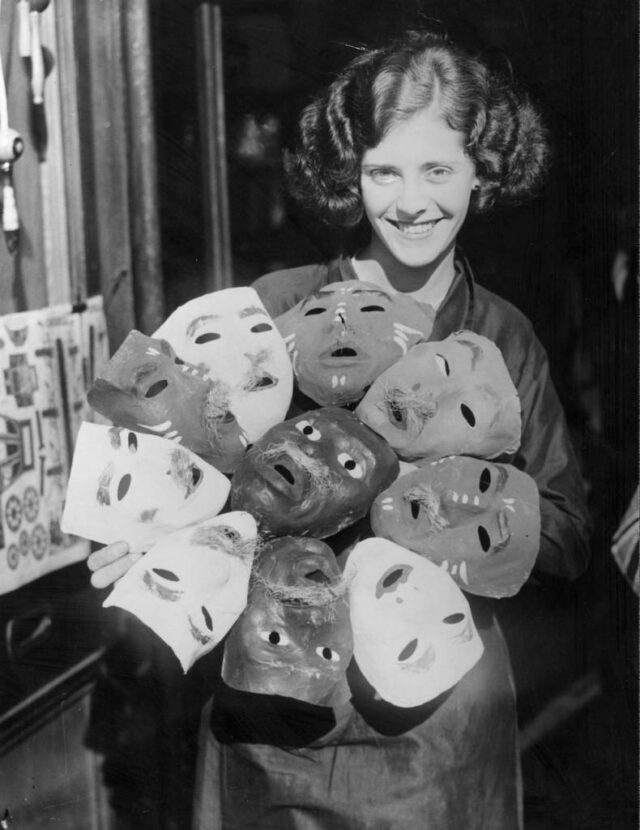
A shop assistant in Slough with a selection of Guy Fawkes masks, October 1934. (Photo by William Vanderson/Fox Photos/Getty Images)

bounders in oiks’ clothing – the reign of the ordinary bloke


“His manner was so friendly that I forgot to put on my cockney accent, and he looked closely at me, and said how painful it must be for a man of my stamp, etc. Then he said, ‘I say, you won’t be offended, will you? Do you mind taking this?’ ‘This’ was a shilling, with which we bought some tobacco and had our first smoke that day. This was the only time in the whole journey when we managed to tap money.”

George Orwell, ‘Hop-Picking’, October 1931. Collected Essays, Journalism and Letters of George Orwell Volume 1 An Age Like This 1920-1940. Penguin, 1968, p. 83

Clearly, the old school tie works, even when it isn’t worn. Incidents like this pop up several times in George Orwell’s writings of the 30s, in articles like “The Spike” and in Down and Out in Paris and London (1933) etc., and they always make him uncomfortable. The reminder of the deference that he was, in his original identity as old Etonian Eric Blair, accustomed to and had been trained for in his daily life was both welcome and unwelcome. Unwelcome, because firstly, it was embarrassing to be ‘unmasked’ in front of people with whom he had become friends precisely because at the level of society at which they existed – and in these writings it is the poorest of the working class or the unemployed and destitute – there were no class distinctions anymore; as he says in Down and Out in Paris and London, regarding a typical London lodging house:

All races, even black and white, mixed in it on terms of equality. There were Indians there, and when I spoke to one of them in bad Urdu he addressed me as ‘tum’ – a thing to make one shudder, if t had been India. We had got below the range of colour prejudice.

George Orwell, Down and Out in Paris and London, Gollancz 1933, p. 150

Though Orwell was sometimes taken aback by the levelling effect that poverty had, he welcomes it too – his occasional unmasking as a “gentleman” was an unpleasant reminder of his abandoned life as a police officer and tool of colonial oppression in Burma. But it was also useful in a way – not just because money and gentle treatment was welcome after weeks or months of hardship, but because it was a stark and simple illustration of exactly the kind of injustice, inequality and disparity he sought to draw attention to with his writing. Orwell is happy to write openly about his deception, partly because it was essentially harmless and necessary, in order to truly experience the kind of life he wanted to write about. But perhaps he was also comfortable doing so because, much as he would have liked to have ‘proletarian’ readers, – and probably did have a few – he was mainly writing for an audience of his peers; the political class who could, if they really wanted to, improve the lives of the vast, faceless mass of unemployed and homeless that they were no doubt aware of, but preferred to think about, if at all, as feckless layabouts who probably deserved their lowly status.

There were of course many working-class readers in the 1930s, possibly even more than there are now, given the enormous output of publishers of what Orwell calls “cheap novels” in that era, not to mention the libraries, newspapers and periodicals designed to cater for every possible niche hobby, that he lists in his 1940 essay ‘Boys’ Weeklies‘. In fact, he notes in Down and Out in Paris and London, that even the unemployed, homeless underclass of itinerant tramps were voracious readers of Buffalo Bill novels and the like, whenever they could get hold of them. Of course, even the most ‘proletarian’ newspapers and publishing houses were owned in the 1930s by people with backgrounds similar to Orwell’s – and by and large they still are. Likewise, at that point it would probably have seemed natural that it was this same class who were to be found running the more recently established broadcasters, notably the BBC. Natural, because before WW2, the role of the upper class was still very much seen as ‘the management’ of the British Empire with the middle class as administrators, but both far outnumbered by the working class who did the work (well, management and administration are work too, but you know what I mean).

What might – or on reflection, might not – have surprised Orwell is that 70+ years after his death, when class differences have been (or appear to have been) diminished, the leaders, for a while, of the relatively extreme left and right-wings of British politics and who appealed openly to the working classes should have been ex-public schoolboys called Nigel and Jeremy. It might surprise him too, to find that members of the openly-elitist public-school educated minority to which he belonged would still be going around pretending to be ‘ordinary blokes,’* almost like he did, in newspapers and especially on television. There are differences in the 21st century; the working class, although now interchangeable to a far greater extent with the middle class, are by virtue of numbers, the main demographic catered to by TV and so whereas Orwell was trying to blend with his social inferiors to prove a point to his peers, undercover toffs today are mostly trying to blend with them in order to appeal directly to, and ultimately financially benefit from, those working class people.

* even as a working class person I inwardly cringe writing “ordinary bloke,” but I think it’s the correct phrase in this instance for what these people think they represent. But bloody hell, “ordinary bloke” – from here on in I’ll just write “OB”

Some observations; the incognito upper class type seems mostly to be a male thing. The female counterparts of these kinds of commentators and presenters are there – Kirstie Allsop or Mary Berry spring to mind, but unlike the men they seem content to be unselfconsciously posh, which is fair enough.

There are various different versions of the type. Some are benign and essentially innocent; people who, one assumes, would have been dropouts whether or not opportunities in TV beckoned and whose scruffy clothes and sloppy speech were probably originally adopted to annoy their parents or just as a way of opting out of the expectations that come along with class privilege (but you get to keep the privilege anyway, so… )

Since at least the 1960s, the pop and rock music business has always been full of these kind of people – and since the 60s too, their opposite has existed; the vastly wealthy who weren’t born into an upper class background. It’s possible that these people, rock stars and entrepreneurs act in some ways as role models to the posh OBs

.

on the left, the standard uniform of the privately-educated “ordinary bloke” On the right, the more raffish, bohemian version of the same. Big posh expensive scarf optional but works with either.

The kind of TV shows made by the benign-dropout demographic tend to reflect a somewhat genteel outsider status* and are often geared towards niche hobbies and interests, so that the whole thing has the aura of the upper class dilletante of the 20s, dabbling in publishing modernist poetry or abstract art. This is a public role in a way, but although it allows the presenter to share his views on the world and life in general, it feels essentially more like a sharing of enthusiasms than anything overtly or covertly patronising or manipulative.

*I do realise that every word of this is probably wildly unfair and doesn’t take into account any of the genuine struggles that come with class expectations etc: oh well.

Where it feels less benign and perhaps more deceptive is when the “OB”-ness of the presenter is an embodiment of what he thinks an actual “ordinary bloke” is like. Perhaps not surprisingly, the evidence suggests that the posh public schoolboy assumes that the OB is what the tabloid press – also, it should be noted, owned by posh ex-public schoolboys – tries to condition them to be. No doubt there are working class people who are old fashioned, conservative, unreconstructedly misogynistic, knee-jerk racist xenophobes, impatient with anything that might seem effete – but it’s also clear that the tabloid press wants them to be that way and does what it can to continue and spread these attitudes. Which is logical enough; the whole point of the class system is to preserve itself and ensure the survival of privilege, blood lines and all that crap. An interesting question – which I don’t know the answer to – is whether it is it self-awareness or self-deception that makes the ersatz OB hide his upper-class accent for TV purposes. Either way it’s probably a wise move, because if there’s one thing that seems risibly effete to the kind of proletarian the tabloid press imagines, it’s the particular kind of upper class speech nurtured in the most expensive and exclusive public schools.

It seems that on the whole, the public is pretty much okay with the fake OB as entertainer and cultural commentator; except for those regular instances when he goes “too far.” But the whole raison d’etre of this kind of public figure is to test the boundaries of what is acceptable, always with the safety net that the whole persona is so obviously contrived that nothing they say can ever be taken seriously, surely? But it’s notable that the self-consciously “outrageous” incidents that pop up from time to time, that seem to simultaneously mark out where those boundaries are and make reactionary attitudes just a little bit more acceptable, always come from the same place. It’s that sweet spot where the tabloid-owner’s classist projection of the “ordinary bloke” – impatient with having to respect people, constantly at war with ‘political-correctness-gone-mad’ – happens to coincide and blend with the underlying upper class snobbery and prejudice that we aren’t supposed to notice, because of that bluff OB exterior. Class prerogatives, racism, classism, the fear of privilege being eroded, the snooty, outraged ‘don’t-you-know-who-I-am?’ loathing of having to deal with or, god forbid, defer to social or racial inferiors; the fear of change. But never mind, it’s all just a joke, innit, and if you take it seriously then you are a puritanical killjoy and who would ever want to be that? No self-respecting ordinary bloke, anyway.