forgetting the fifth

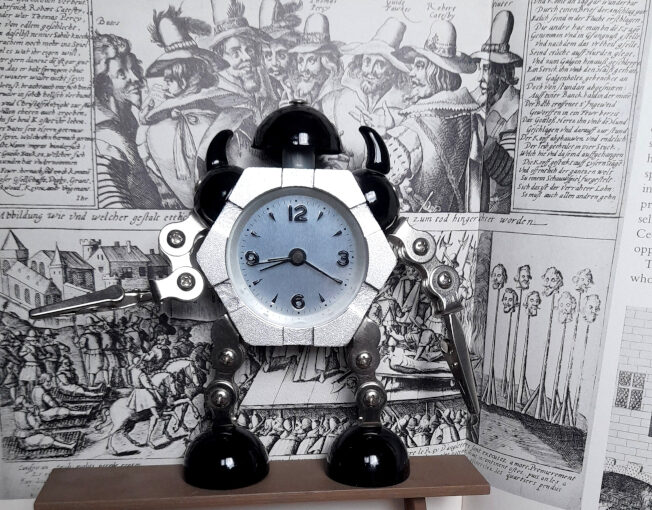
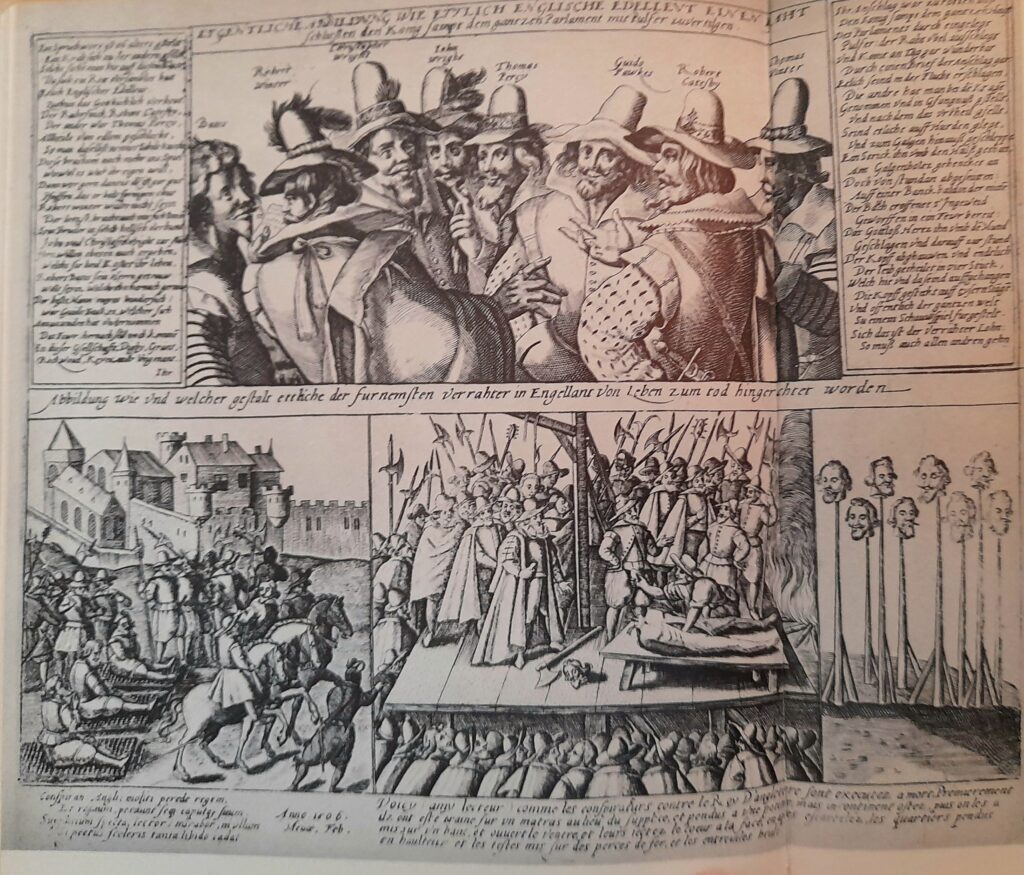
Crispijn van de Passe’s complete engraving including the arrest, torture and execution of the conspirators (1606)

When I wrote the first version of this a couple of years ago, I started by saying – though without a huge amount of confidence – that even now (or then) most British kids knew the first line of the rhyme that begins, Remember, Remember, the 5th of November, even if they didn’t know the rest of it. I’m even less sure that’s true now. The segue between Halloween and Christmas is imperceptible now, mostly because there is no segue to perceive. This year, for the first time that I’ve noticed (I’m not saying it was the first time it’s happened), shops put out their aisles of Halloween and Christmas junk simultaneously at the beginning of October. And – and this has probably happened every year for a while – Christmas-themed adverts began screening on TV on the first of November.

Traditions always come and go and it’s interesting to see how quickly they can become established – I deliberately didn’t use the phrase “the Christmas adverts” above, but it is now a thing, an annual event almost that is discussed in newspapers (themselves a sort of tradition whose days are surely numbered?) and on TV as if they are news. It seems ironic though that the phrase “spooky season” has become established in popular usage in almost the same way as ‘the festive season,’ at a time when the UK’s spookiest celebration has died away and the ‘season’ the phrase refers to is essentially one evening.

Kids not knowing more than the first (or first two –  “Remember, Remember, the 5th of November/Gunpowder, treason and plot”) lines of that old rhyme is nothing new: even when I was a child – at which point November the 5th was still a date that seemed on a par, magnitude-wise with Halloween (in fact in some ways Halloween felt like a warm-up for November 5th, which was more spectacular) I was extremely sketchy on where the verse goes after that and even now I’d have to look it up to find out.

 What I always liked about November the 5th as a child – not that I would have thought to put it this way – was its ambiguity. It was a celebration, clearly, but a celebration with something like Halloween’s horrific overtones. And Guy Fawkes was its star, but it would be wrong to call him its hero – you don’t burn heroes in effigy. But then calling him a villain doesn’t really work either. A villain that you’re introduced to, not by their evil deeds, like Dracula or Hitler, but by watching them, already defeated, being burned to death, can only be so scary. There was also a kind of veneration of the effigy – then just known as the Guy (which was vanishing even when I was quite young), where having a really good, lifelike Guy to burn made the night especially satisfying. So children kind of liked him. As a ritual, it was satisfying; Fawkes was not like Freddy Kruger or Jason Vorhees – once Guy was burned, he stayed burned, until next year. It’s obviously reactionary too – a ritual that celebrates the destruction of a rebel and the preservation of the status quo. But at the same time, the aim of the rebel was not some kind of egalitarian peasant’s revolt, but the replacement of a repressive Protestant monarchy with a repressive Catholic one; so it’s nicely complicated.

The burning is itself interesting – a kind of cleansing ritual that feels related to the 17th century in which Fawkes died – and most associated with the execution of witches. But although it’s period-appropriate, it’s notably not how the real Guy was killed. It was perhaps chosen for the slightly prosaic reason that it was related to another now-dead seasonal tradition; in the days before local councils in Britain sent squads armed with shovels and sacks around parks to tidy up and collect dead leaves, the leaves used to be swept into piles and burned. The smell of smouldering foliage was once as much a part of the autumn-to-winter transition as early sunsets and morning mists. In that sense, Guy Fawkes had almost become a surrogate elemental like the Easter Bunny; but a symbol not of Spring and rebirth/renewal but of the death of nature and the welcoming of winter as its dark days began to encroach. Being bound to the season and the ritual, annually entering the celebrations as a prisoner, defeated but not yet despatched, he could be seen as kind of a sad and sympathetic figure. But I’m getting ahead of myself.
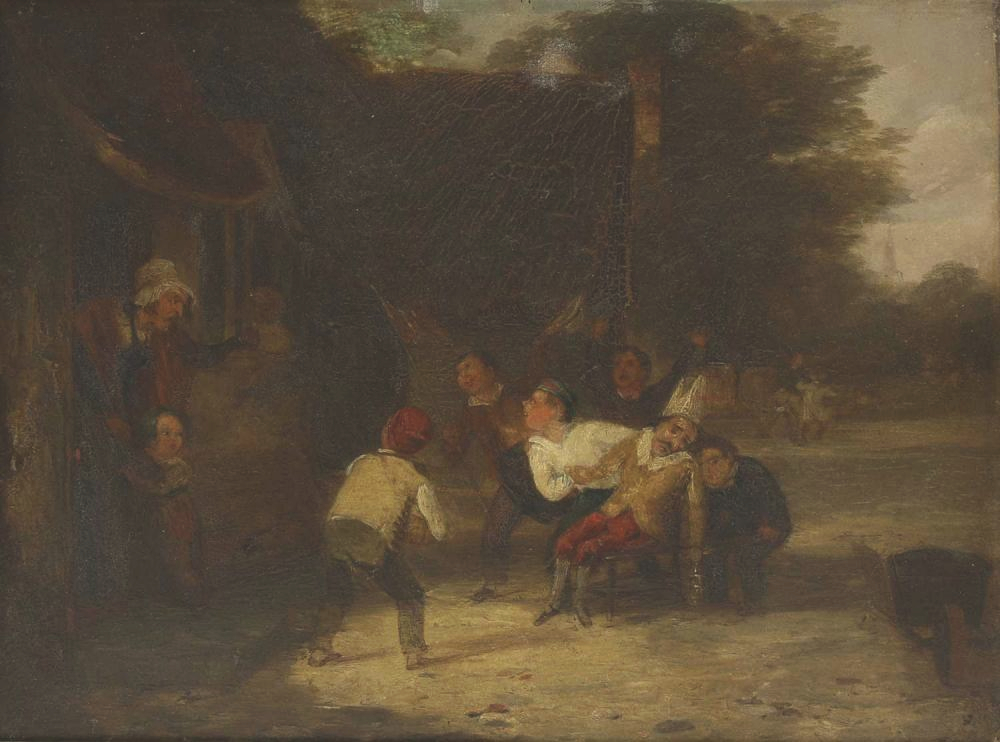
a murky, mid-19th century painting of children with a ‘Guy’, painted by Thomas Webster (1800 – 1886)
November the 5th – known variously, as late as the 1980s and among older people even today, as “Bonfire Night,” “Fireworks Night” and “Guy Fawkes Night” is no longer anything like as big as Halloween. Halloween itself is in some ways – commercially and in on online sense, socially – bigger than ever. At the same time, in the UK it’s become quite diminished as a folkloric, British celebration, reduced instead to an opportunity for adults to dress in a humorous/sexy way and for kids to the trade a stock phrase (or more romantically, a magic code) in return for some sweets. The November 5th I remember felt as ancient and immutable as Christmas, Easter or Yugoslavia – but like at least one of those it was actually in the late stages of a transitional and final phase – along, perhaps, with a more community-centric way of life more generally.

I thought I remembered the Ladybird book – a hugely popular series of small-format books for young children published from the 1940s to the 80s – devoted to the Gunpowder Plot, but now that I look it up I’m not so sure. The pictures look possibly familiar, but I don’t remember James I being referenced in the title and I don’t remember ever seeing Fawkes referred to as ‘Guy Fox’  as per the text. But the fact that I do remember having a Gunpowder Plot book and this not being it only testifies to the popularity of the story.
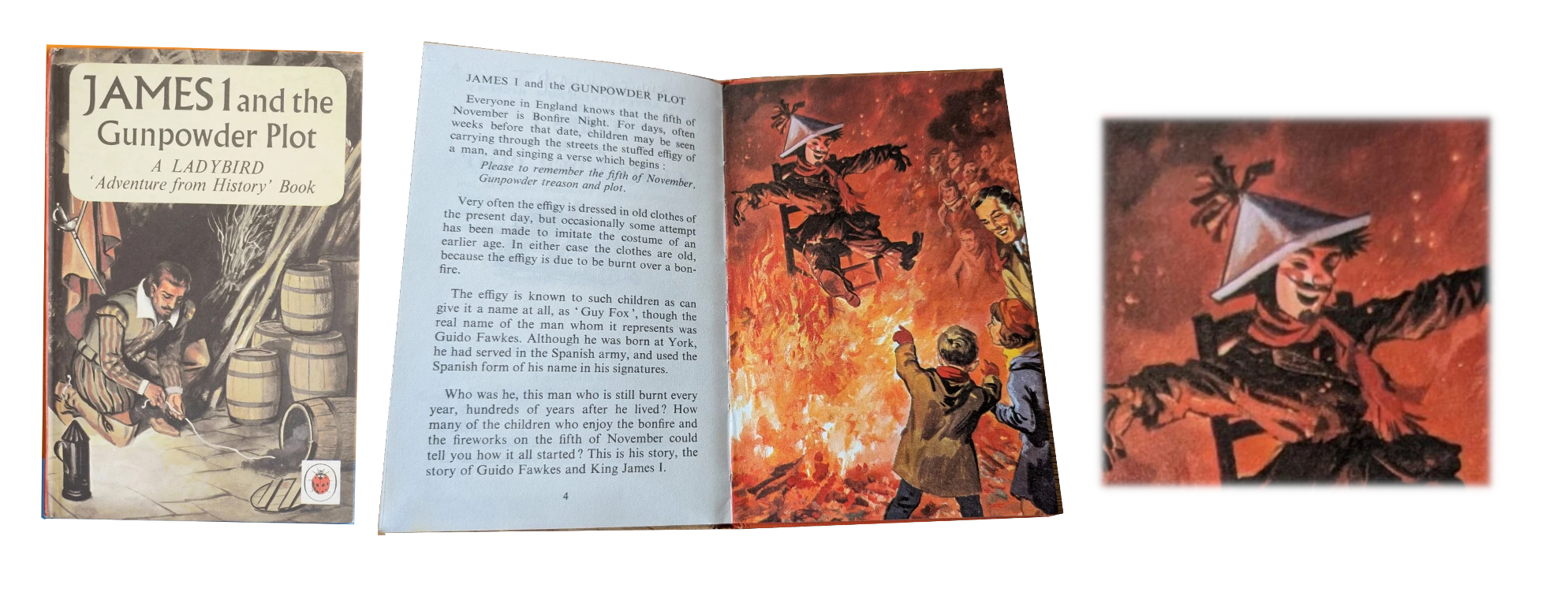
popular 1960s Ladybird book for young children
In my earliest memories of Bonfire Night, people tended to have bonfires in their gardens – not everyone (my family never did, even when we had a garden) – usually a few families would congregate in whichever friend or neighbour’s garden was biggest. Generally, there was an effigy of Guy Fawkes to put on the fire – by then really just any kind of human shaped figure. The 17th century costume was in all but the most extravagant cases limited to a tall paper hat, though I do remember once seeing shoes with cardboard, silver-painted buckles, which was a nice touch. Generally, some fireworks would be set off – a handful of rockets and maybe a Roman Candle (always a sadly inferior firework, to child-me) and a Catherine Wheel.

That’s the time – early 80s presumably – that my most vivid Guy Fawkes memories come from. Mostly they are cornily nostalgic memories; wrapping potatoes in foil and putting them in the edge of the bonfire – when they came out, they usually still had a raw-ish look, but occasionally were completely charred; both ways you could somehow taste the foil and yet they were delicious – or toasting marshmallows. There was that strange (sometimes slightly nauseating) sensation where the front of your face and body were almost too hot from the glare of the fire while your back was freezing from the November night air. Kids messed around (more or less carefully, or at least I don’t remember any burns or accidents) with sparklers, making shapes or trying to write things in the air.
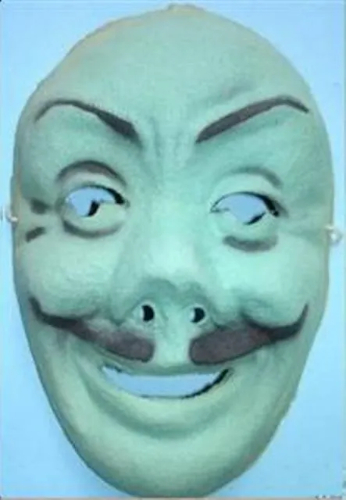
1960s Guy Fawkes mask of the type that inspired David Lloyd, artist of V for Vendetta
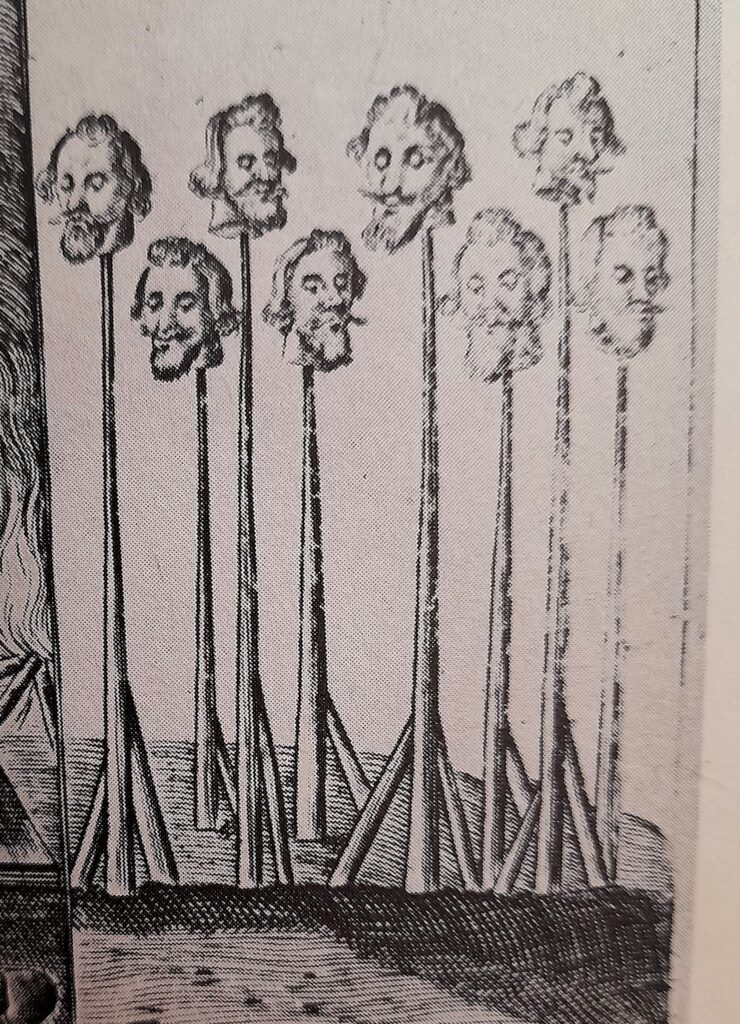
Less corny are the more peculiar, Wicker Man-like memories of watching the Guy itself as it caught fire; which makes me realise how rarely – thankfully – people watch a human (shaped) figure burst into flames. A surreal experience really – and the better or more realistic the Guy, the more exciting it all was; which is far more disturbing to consider as an adult than it ever was to watch as a child.  As mentioned above, the historical Guy Fawkes wasn’t executed by burning. He was sentenced to be hanged, drawn and quartered, but thankfully, due to the ineptitude (or possibly the mercy) of the executioner, he died during the hanging and so escaped the fate shared by three of his fellow conspirators on the 21st of January, 1606. They, like Fawkes were hanged, but they were cut down while still alive before having their genitals cut off and intestines pulled out (preferably while aware enough to see it), before being beheaded and cut into four pieces which were then prominently displayed in the city. All of which would all be a bit difficult to turn into an annual ritual for kids.

the ultimate fate of the Gunpowder Plot conspirators, as depicted by Crispijn van de Passe in 1606
But even if hanging a Guy had been less impractical, it would anyway be far less spectacular on a dark winter evening than burning one on a bonfire. But the burning of the Guy was the culmination of the Guy Fawkes celebration, not the totality of it. More so than Halloween, the lead up to November the 5th and the sense of growing excitement was a part of the whole occasion. For a week or so before the night itself, the bonfires would be built, most excitingly the big municipal ones. A pile of old furniture and assorted wooden rubbish and cardboard boxes would appear in the local park, getting bigger daily – this practice pretty much stopped during my teens when I was less interested, so my knowledge of where the stuff came from and who was involved in organising it is shadowy. Part of the ritual, at least in the 80s – prompted by the popular BBC kids’ TV show Blue Peter – was also the daily checking of the future bonfire for hedgehogs, to ensure that the only victim of the fire was a surrogate human.

Guy Fawkes lore in Robert Westall’s The Machine Gunners (1975)
There was also the constructing of the Guy itself. I’m not sure now if I actually remember people going door to door asking for ‘a Penny for the Guy,’ in the build-up to Guy Fawkes Night, or if that’s something I just know about from books, TV and the reminiscences of my parents and other older people. This involved the highly unlikely-since-the-90s spectacle of kids or teenagers going door to door, collecting money or more often, old clothes in order to make the best possible effigy to burn. I do remember my parents donating old clothes for the purpose, but the circumstances are too vague to be sure. I do know that as I got older, the family bonfire parties and fireworks in the garden gave way to bigger and more spectacular (and therefore initially far more exciting) municipal fireworks displays and bonfires in parks. By the early 1990s, these were becoming less impressive and the Guy – the best or at least the most unique and strangest part of the whole thing – was often missed out altogether. Regulations about the use of fireworks got tighter – admittedly for good reasons – and fireworks themselves therefore became much harder to get and more expensive. And then at some point, more or less unnoticed by my teenage self, the whole thing just stopped happening. But bonfire/fireworks/Guy Fawkes night lives on in two strange ways.

Firstly, fireworks. For decades, November 5th was the occasion for fireworks in the UK and even though latterly New Year has taken that place, there seems to be some kind of residual racial memory in the country’s youth (not just its youth; the advertising of fireworks, albeit in a severely compromised way, still begins in October) and fireworks are randomly set off for the few days either side of November 5th – I saw/heard some last night. Somewhere, perhaps in the more aggressively conservative parts of the UK, there must still be council-run fireworks displays on the 5th too, but there definitely aren’t around here.
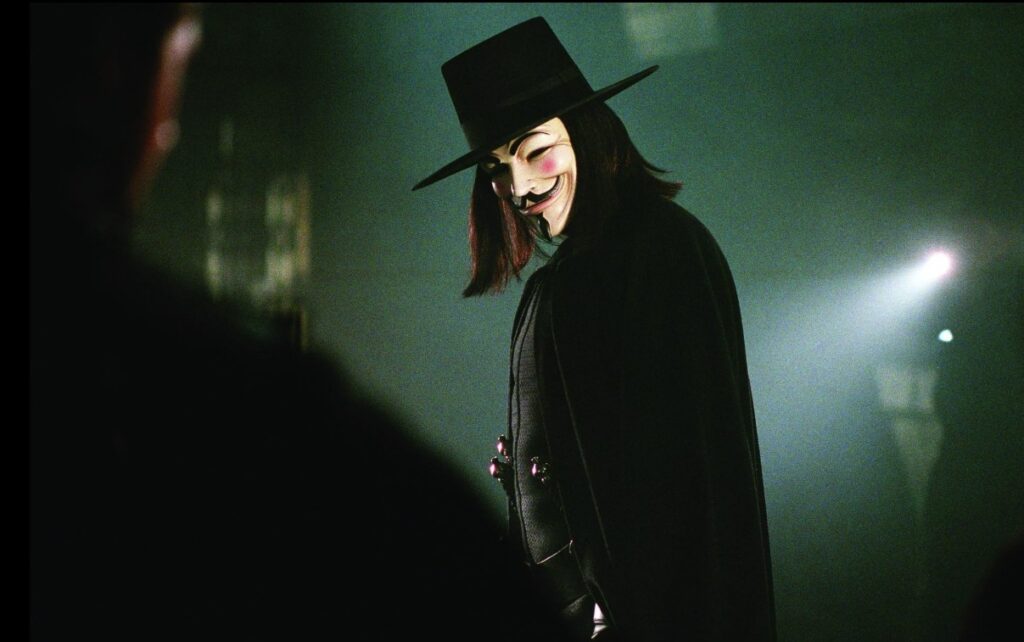
Hugo Weaving in Guy Fawkes regalia as V in V for Vendetta (2005)
Secondly, thanks to James McTeigue/the Wachowskis’ lame 2005 movie adaptation of Alan Moore and David Lloyd’s brilliant 1982-5 comic V For Vendetta and the subsequent appropriation of V’s mask by the ‘hacktivist’ group Anonymous, the iconic face of Guy Fawkes is more famous around the world now than it has ever been. V in the film looks perfect, and the excellent central performance by Hugo Weaving highlights what a missed opportunity it was – but never mind. The film has led to a strange situation where the traditional face of Guy Fawkes (see the Ladybird illustration above) is probably recognised by more people than at any time in history, whereas probably fewer people than ever before know who the mask represents. By the time I was a child, Guy Fawkes masks were no longer (as far as I remember) widely available in shops they had been in Moore & Lloyd’s youth, but children of my generation still have recognised the face (especially with the tall hat) as that of Guy Fawkes.

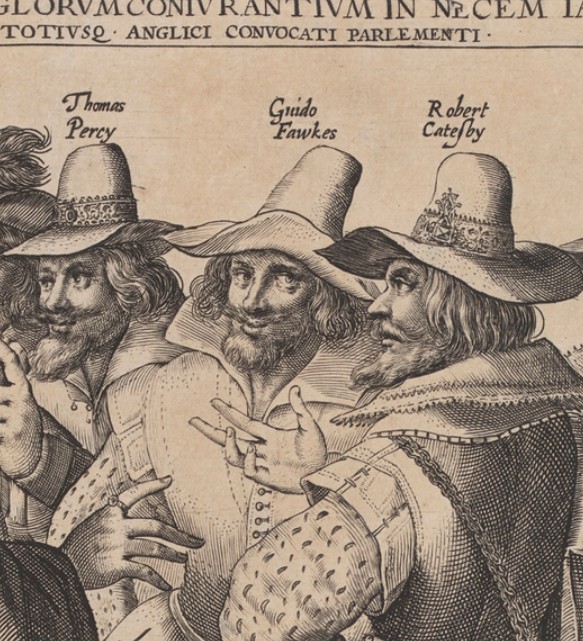
Guido “Guy” Fawkes (centre), c.1606, by Crispijn van de Passe
What everyone knew when I was a kid, and maybe children still know (?), is that Guy Fawkes was a criminal who was caught red-handed with a huge quantity of explosives an was tortured and executed for his part in a plot against the government and monarchy (which in the early 1600s were still inseparable). His capture meant that he became the most high-profile member – although not the leader – of a group who planned to destroy Parliament (specifically the House of Lords) with gunpowder and, in the process, kill the King (James VI/I).

I assume that the instantly recognisable smiling, moustached face immortalised in V ultimately derives from the famous print (c.1606) by the Dutch engraver Crispijn van de Passe, which shows eight of the thirteen conspirators involved in the Gunpowder Plot. It’s the only contemporary depiction of Fawkes, but it wouldn’t have been especially accurate; drawn for an audience in the Netherlands, it shows all of the conspirators with roughly the same face and the artist would never have seen the men himself. Thomas Bates, Robert Winter, Christopher Wright, John Wright, Thomas Percy, Guy Fawkes, the ringleader Robert Catesby and Thomas Winter all look like the archetypal Jacobean gentleman and, perhaps ironically, look very like the standard representation of that other 17th century folk anti-hero, the Witchfinder General Matthew Hopkins. They were wealthy gentlemen and probably looked much, in dress and general appearance, like the men who sat in judgement against them. Although the ‘Catesby Conspiracy’ is a familiar phrase from history books, only one of the men has a famous name – and only he was destined to be burned in effigy for three centuries. Why Guy? He wasn’t the most senior member of the conspiracy – but he was the one who was caught, with the gunpowder near the scene of the crime. And also he had the best and strangest name.

In V for Vendetta, the use of a Guy Fawkes mask for the story’s protagonist – a libertarian anarchist rebelling against a Totalitarian state – was a brainwave of artist David Lloyd which in retrospect seems so obvious that it’s surprising it wasn’t part of the original idea. But though Lloyd’s point of view (sorry, paraphrasing, I don’t have the book in front of me) was that Fawkes should be celebrated, not reviled for trying to blow up Parliament, that only goes so far. Guy Fawkes is fascinating because he’s one of the very few genuine anti-heroes in British history. The goal of Fawkes and his co-conspirators wasn’t the establishment of some kind of egalitarian co-operative, but the restoration of an absolutist Catholic monarchy; a Theocracy in which the King inherits some of the powers of God (specifically, the power to absolve sins – I was an adult before I discovered that ‘absolutist’ didn’t refer to the monarch’s political power).
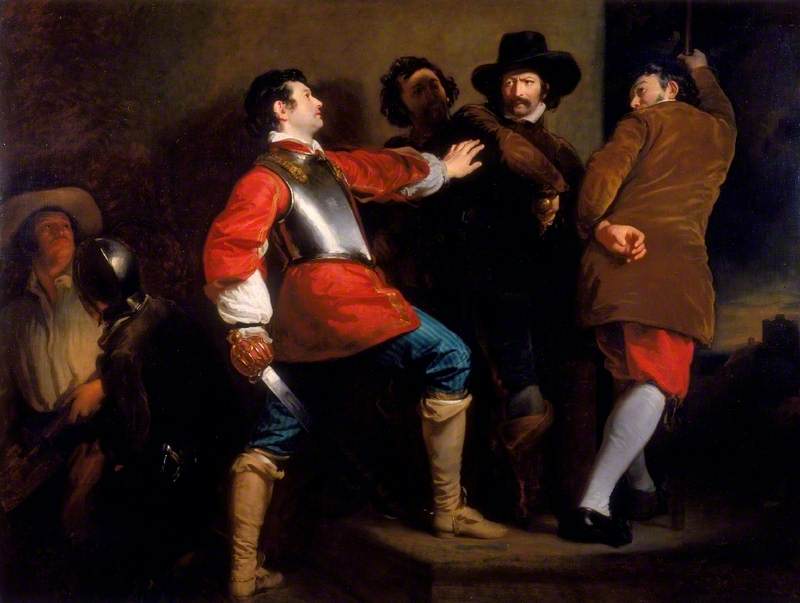
Henry Perronnet Briggs – The Discovery of the Gunpowder Plot and the Taking of Guy Fawkes 1820
Had the conspiracy succeeded, Fawkes probably wouldn’t be particularly famous himself, though Catesby might be. But the conspirators would be among the most important people in British history. They would no doubt be just as reviled by some as Fawkes has been, and also venerated by others, not as martyrs, but saints. And the Britain I’m living in now might well be a Britain where there was never a Civil War (and even if there had been, it wouldn’t have been the same one), that was never a constitutional monarchy – that maybe had no Act of Union and who knows, possibly no British Empire? Or again, a very different British Empire – but whatever, we would now be living in an unimaginably different present.

We can never know; so probably it is still worth remembering the 5th of November, in all its grotesqueness and ambiguity, neither as something to really celebrate or to mourn, but as one of those weird crossroads in history. And worth remembering poor old villainously-heroic Guy Fawkes, who probably foresaw some kind of strange new world, but not the one he would star so prominently in.
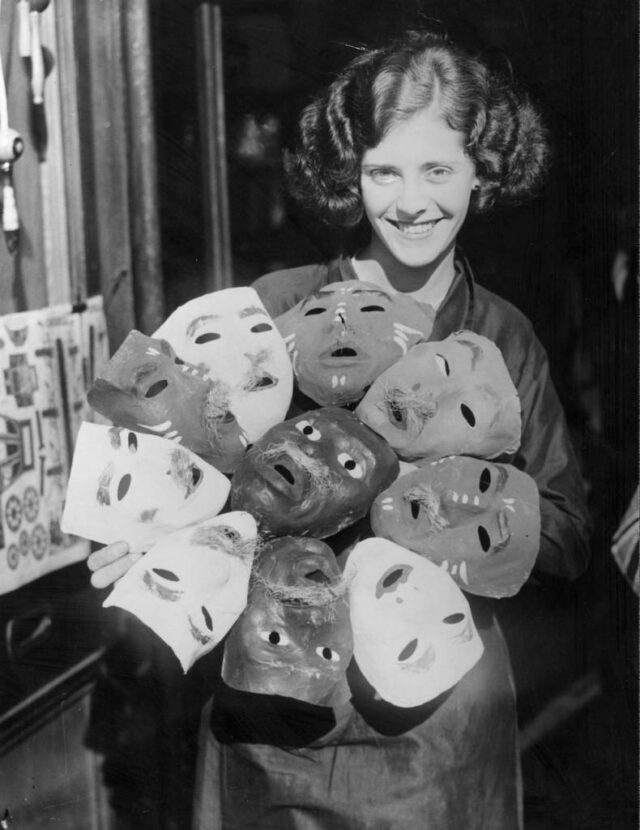
A shop assistant in Slough with a selection of Guy Fawkes masks, October 1934. (Photo by William Vanderson/Fox Photos/Getty Images)

forget my fate: saints and sex workers; the art of violence & martyrdom

In a way, this article concerns religious art, though the person who wrote it has no religious beliefs whatsoever. But when people really, passionately, even if unconsciously, believe – in a religion, a philosophy, an idea – that belief imbues the works they create with the power of human feeling. Art, music, architecture, literature, objects; that power that is retained whether or not the observer accepts or understands the ideas that are living within those things. That’s my opinion anyway; I may not believe in the supernatural, but I do believe the ‘natural’ contains magic of its own.

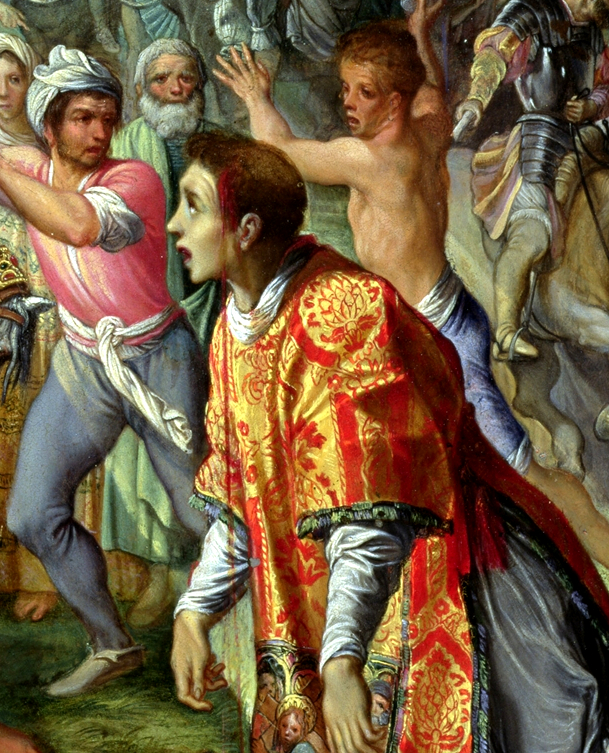
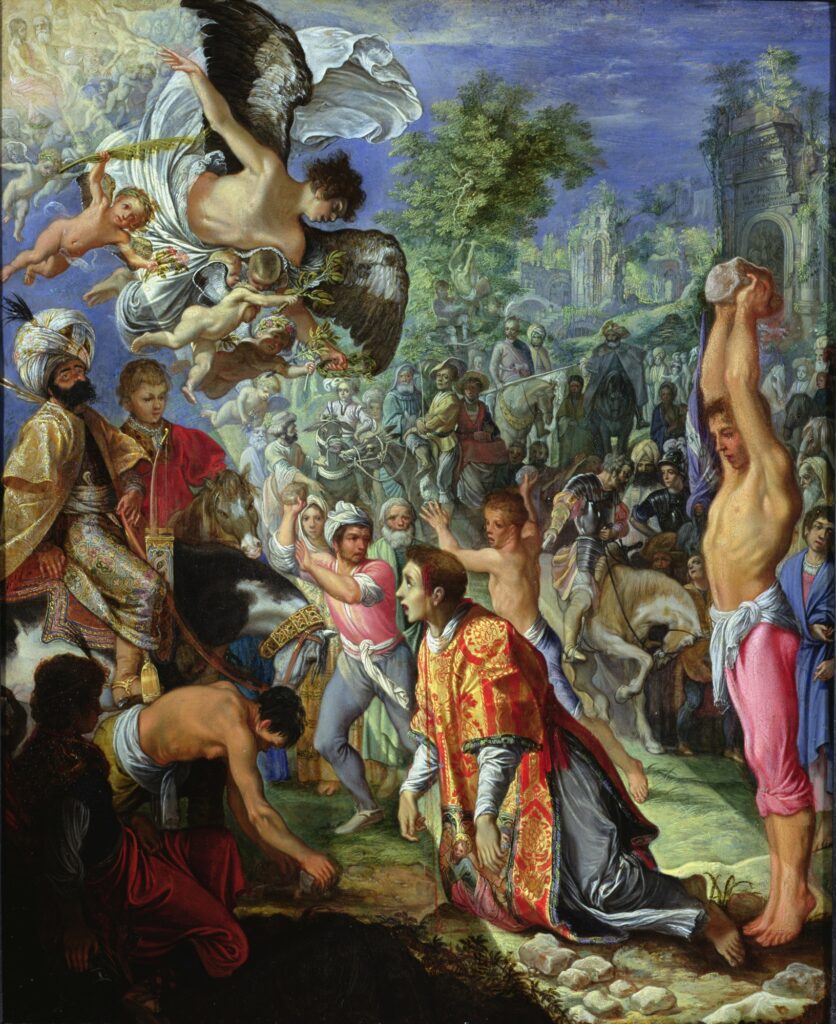
Adam Elsheimer – The Stoning of St Stephen, 1603 (detail)

So anyway; when, in Purcell’s 1688 opera Dido and Aeneas, the dying Queen of Carthage sings Nahum Tate’s beautiful words, “Remember me, but forget my fate”, she is articulating something that was then becoming, and to some extent remains a kind of ideal as humanity tried, perhaps pointlessly, to distance itself from death. Caught in a pincer movement between the Reformation, which had eliminated much of the rich mythology of religion in its determination to reduce the clutter and distance between human beings and their God, and the dawning of what would become the age of reason, which sought to cast off the shadow of crude medieval brutality and superstition, death, once an unavoidable and largely accepted part of daily life, had become something akin to what it is today. That is, entirely acceptable – even celebrated, in fiction and entertainment, in real life it’s preferably kept out of sight and out of mind as far as is possible. But although the impulse to distance oneself from the more viscerally negative aspects of life is understandable, it’s almost the opposite of the way that people, for a couple of centuries at least, related to saints.

Saints have remained celebrated through the years to some extent, but still, since their medieval heyday they have found themselves playing a gradually diminishing role in Western European society. Interestingly though, while Christianity lost much of its cast of characters and stories through the ages, what it never lost in the Reformation – quite the opposite in fact – is that key idea which saints’ lives so often embodied: misery now, rewards later. And it was this, despite the apparent opposition of the two ideologies, which made Christianity and all of the Abrahamic religions such successful facilitators, or carriers (in the pharmaceutical sense) of capitalism. But, while saints faded from the vital figures of the middle ages into their current, more modest position, they remained venerated, if not worshipped, even in the Protestant faith, and still played a vital role in Catholic countries. That being so, plenty of the somewhat harrowing and graphic art generated in their names in earlier years survives; and rightly so.

Take for example Adam Elseheimer’s 1603 Stoning of St Stephen. As a German artist working in Catholic Rome, Elseheimer’s position may have been anomalous, but no faith of any kind is required to understand and empathise with the young saint’s fate. We may not (or we may) share his implied, rather than shown, exultation at the parting of the clouds and the glimpse of heaven beyond, but we can recognise his pain, fear and loneliness. We’ve seen it many times, not only in cinema and in literature, but even more in news reports and photographs or, if we are unlucky, as eyewitnesses to (or victims of) real events. This painting make me think of the harrowing footage, a few years back, of prisoners being beheaded by Islamic State fighters, but they have echoes too, in those everyday acts of violence in which there are, thankfully, usually no deaths – but rarely any obvious sign of divine intervention either.

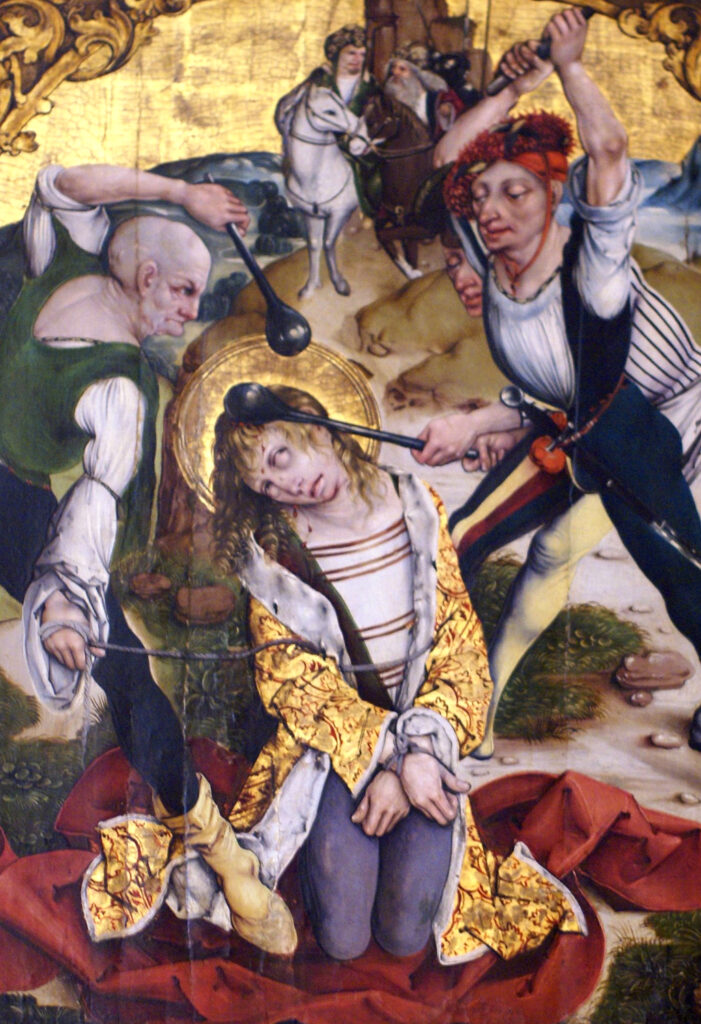
detail of St Sebastian being clubbed to death by Master WB (probably Wolfgang Beurer, c.1500)

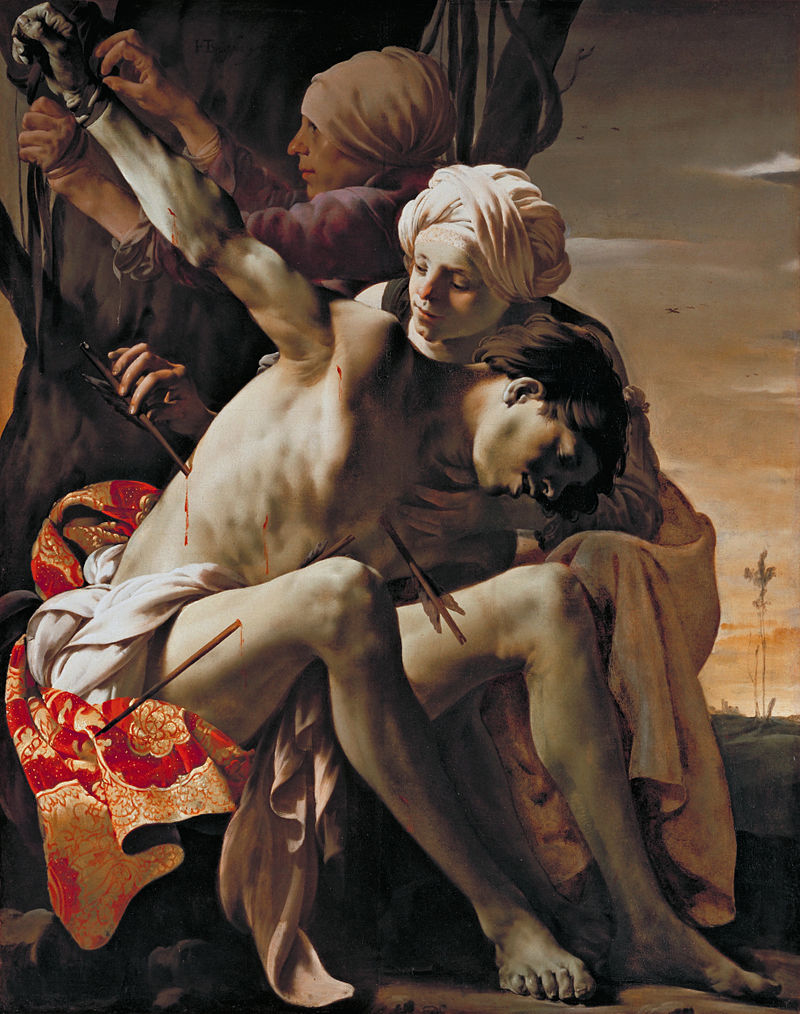
One of the most strikingly contemporary-feeling examples of the art of martyrdom is the series of Scenes from the life of St Sebastian in the Cathedral Museum, Mainz, painted by Master WB (probably the Middle Rhenish painter and engraver Wolfgang Beurer). St Sebastian is one of the most often-painted of saints, usually shown as a kind of surrogate Jesus, young and beautiful, but pierced by (sometimes a lot of) arrows. But the whole point of that part of his legend, is that the arrows didn’t kill him. Tended by St Irene of Rome (in the baroque era the healing of St Sebastian was painted quite often; there are some very beautiful and moving pictures, like the famous Georges de la Tour painting from 1650, and my favourite, by Hendrick Ter Brugghen, from a little earlier) he recovered, and went about his saintly business.

Unusually though, Beurer’s cycle of paintings takes the story past the Christ-like recovery of Sebastian and through to his eventual death, after he journeyed to see the Emperor Diocletian and scold him about his sinful life. This time, the young saint was clubbed to death and didn’t recover. This is a very different death from the ceremonial, iconic execution by arrows. There’s a sense of solemnity, of procedural, if dubious, legality that affords the victim of a firing squad a kind of Christ-like dignity – in paintings at least. There’s no way to make a clubbing to death look dignified though, and Beurer/Master WB doesn’t try. Instead he shows the by now pitifully uncomposed figure of the saint being beset by three cheerfully brutish soldiers with beautifully painted lead clubs.

Hendrik Ter Brugghen -St Sebastian tended by St Irene, 1625
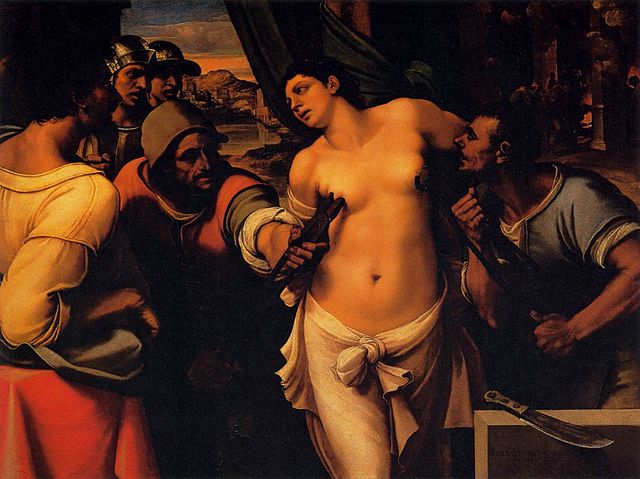
Sebastiano del Piombo’s Martyrdom of St Agatha 1520 (technically doesn’t feature her martyrdom)

St Agatha, like Sebastian, is unusual in that her actual martyrdom – technically, she died in prison at some unspecified time later, after being healed by St Peter – is never pictured. Instead what is shown, essentially for titillating reasons, as horrendous as that is, is not even her torture, where her body was torn with hooks, but only the specific detail of her breasts being cut or torn off.
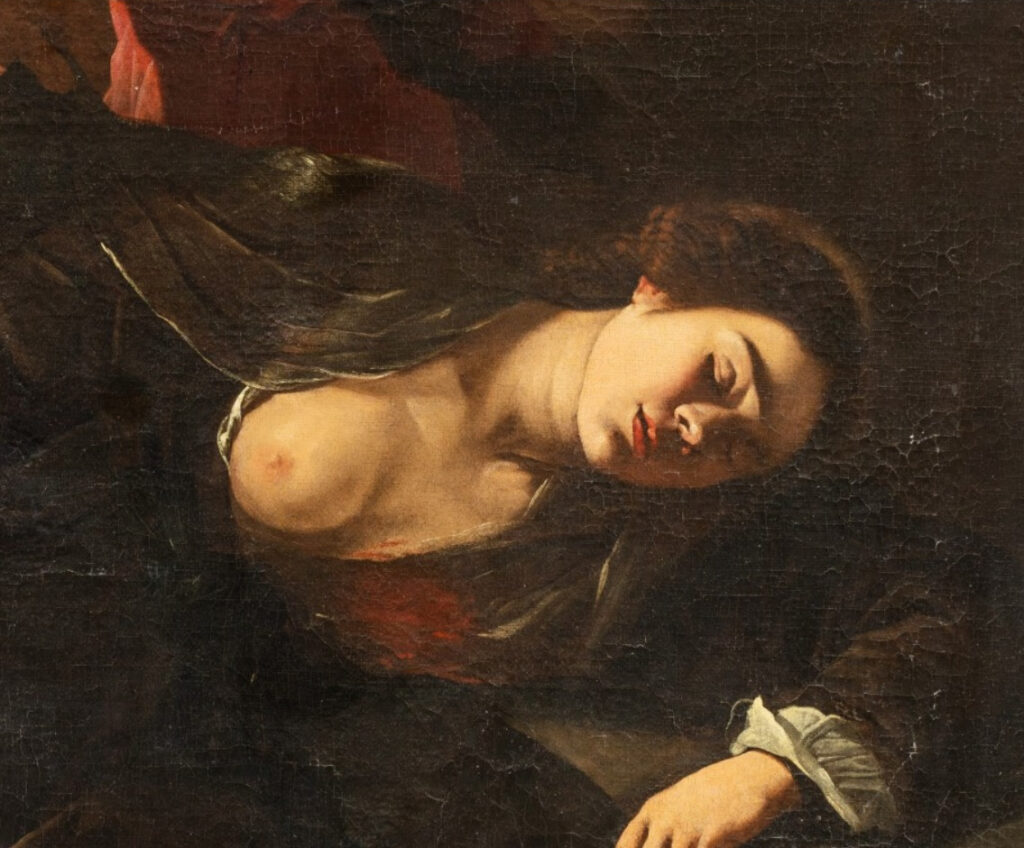
But although her death seems rarely to have been depicted, there are paintings of the healing of St Agatha in prison by St Peter. Partly this might be because of the two-saints-for-the-price-of-one nature of the image, but perhaps more importantly it afforded the artist another opportunity to show female nudity without fearing religious censure.

detail of St Agatha healed by St Peter in prison by an unknown Neapolitan painter of the early 17th century

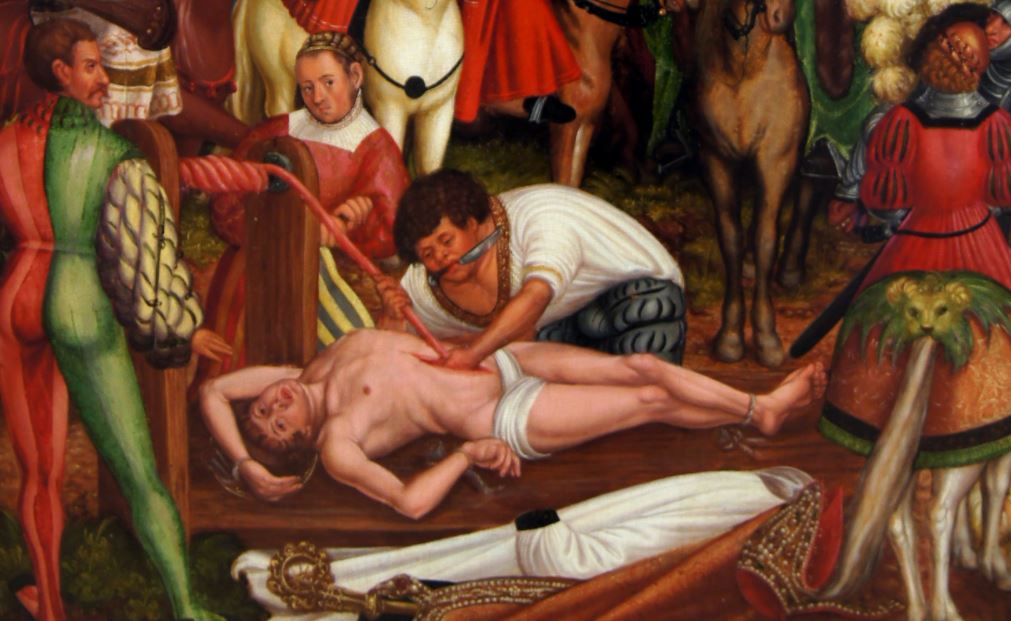
Although these paintings – Heinrich Vogtherr’s Martyrdom of St Erasmus (1516) is another great example – are full of religious feeling, it’s far easier as a secular person (or as this secular person) to respond emotionally to a painting of a martyrdom than it is to the ultimate martyrdom of the crucifixion of Christ. Jesus is of course something more than a human being, and though we are supposed to respond to his suffering in a human way, he’s still god after all; he presumably planned it and he can take it. Saints though, are different. The point may be the same – suffering holy people, relating to Christ as their father, in the same way that Christ related to god/himself as his – but these are just human beings. They may be idealised by artists, as they were in their official hagiographies, but they are supposed to be relatable for ordinary, unsaintly people.

Heinrich Vogtherr – the Martyrdom of St Erasmus, 1516 (detail)

Many artists captured the loneliness of Christ on the cross, but the loneliness of Christ, even alone in the dark, is qualitatively different from that of the martyr saints. In their last moments, the saints are usually closely surrounded by their enemies, who are of course also their fellow, imperfect human beings. The pain of Christ, too, tends, for the most part, to be a remote and rarefied thing; it’s familiar to everyone, in an almost neutralised way, from living the cultural landscape of western society. But the pain of the saints is something we recognise in a more direct way. It’s unlikely, I hope, that many people reading this, have first-hand experience of fatal stonings, mutilations, disembowelings or bludgeonings, but these saints, with their looks of glazed shock and their vividly painted blood, are a figures we have become used to in other, secular contexts.

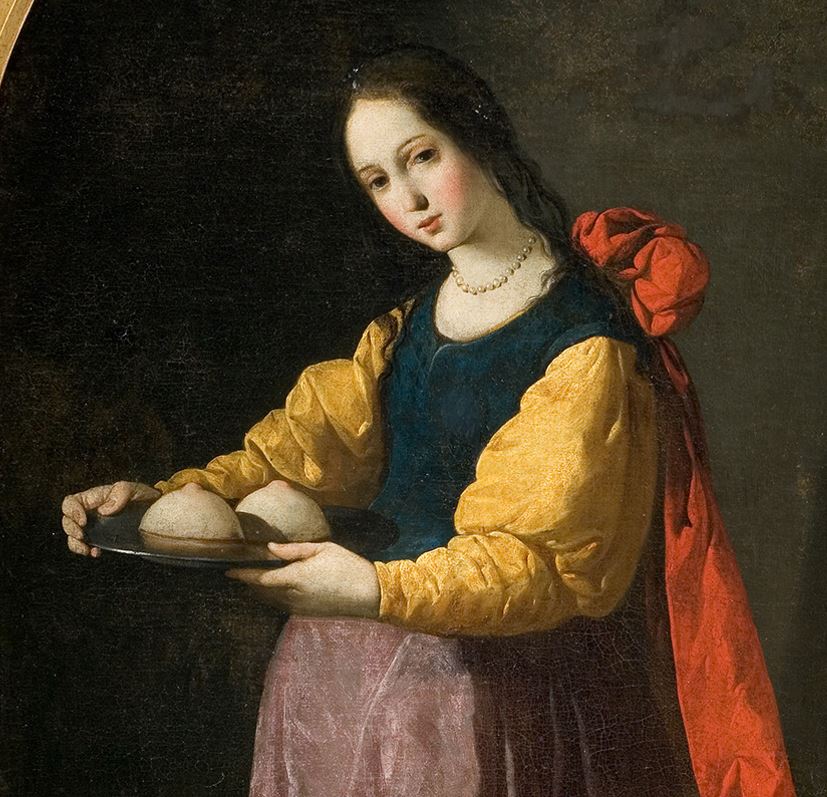
Francisco de Zurbarán St Agatha, c.1630-33 (detail)

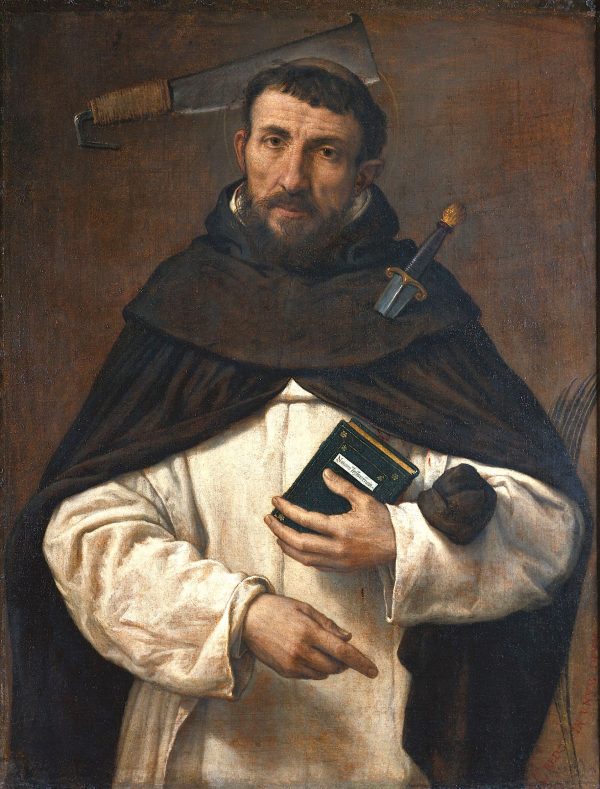
It’s fair to assume that these saints wanted to be remembered. But would they – and there are many, many more of them in addition to the few I’ve shown; from the big names like St Matthew and St John the Baptist (beheaded), to St Peter and St Andrew (crucified) to the more obscure, like Saints Cosmas and Damian (beheaded by pagans) and St Ursula (shot with an arrow by the Huns) to the theatrically horrific, like St Bartholomew (flayed and beheaded) and St Erasmus (intestines pulled out with a spindle) –  have wanted to be remembered for the nature of their deaths? Even divorced from these kind of narrative paintings, the saints were rarely depicted without their sometimes bizarre attributes, the strangest ones that spring to mind being the aforementioned Agatha, in a more serene setting, bearing her severed breasts on a plate, or Saint Peter of Verona, normally depicted with the cleaver still embedded in his skull.

After the Age of Enlightenment, these explicit, visceral images more or less disappeared from western art for a couple of centuries, despite the occasional politically-motivated flashback like Jaques-Louis David’s Death of Marat (1793). Unexpectedly, they returned in a slightly altered and ideologically almost opposite, and certainly far more secular form in interwar Germany, made vivid by the horrors of World War One. But although a comparison with the Lustmord (sex murder) paintings of the Weimar Republic seems like, and possibly is, a flippant and/or blasphemous one, it feels valid, especially in relation to the paintings of St Agatha with their uncomfortably conflicting motives and coolly horrific imagery.

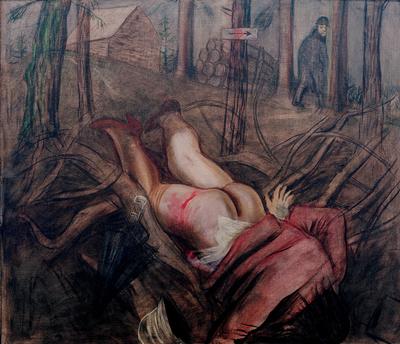
Paintings like George Grosz’s John the Sex Murderer (1918) and Otto Dix’s horrific Lustmord (especially the lost 1922 painting that exists only in black and white photos) have parallels with St Agatha, the painting I want to briefly talk about is less blatantly sensationalist and to my eyes at least has something of the heartbreaking empathy of Wolfgang Beurer’s St Stephen. Like Dix’s but less confrontational, Lustmord (1930) by the great Neue Sachlichkeit painter and photographer Karl Hubbuch, shows only the aftermath of the murder, rather than the act itself. But rather than losing force because of its relative restraint, Hubbuch’s image is imbued with all of the loneliness, fear, isolation and fragility seen in the face of Elseheimer’s St Stephen and the pitiful battered corpse of Beurer’s.

Karl Hubbuch – The Sex Murder (1930)

In the end, whatever the means or motivation for these pictures, what we are left with is the pictures themselves; and if they should survive beyond their meanings and attributions, people will, perhaps sadly, always be able to see what they represent. This is the opposite of art for art’s sake; but then, to appreciate the form of – for example – Wilfred Owen’s war poetry and study that form and its mechanics without taking into account what that apparatus is for is to miss the point. Likewise, the skill of a painter like Beurer, whose intention was to make the holy real and relatable, or of Elseheimer, or Sebastiano del Piombo, or even Karl Hubbuch, wasn’t there solely in an effort to amaze the viewer with the painter’s skill or advertise their technical ability.

Lorenzo Lotto – St Peter of Verona (1549)

It may be that these sex workers and saints would have preferred, like Purcell and Tate’s Dido of Carthage, to be remembered, but to have their fates forgotten – but instead forget that you know the titles and subjects of these pictures. These people were, as many people still are, tortured, killed and disposed of without sympathy or ceremony. It would be nice if they were all remembered.