instead of a story

Alas, I am not a young writer; I have been writing for many years. But recently I came across Ray Bradbury’s advice for young writers, put in the simplified form of a challenge: read one poem, one short story and one essay per day, preferably from different eras and different fields and write one short story per week. I first saw a version of it as a 30-day challenge, but then saw something else that said Bradbury’s bigger theory was that if continued over the course of a year, nobody could write 52 bad stories in a row, which I dispute. But still, it’s a fun idea.

I already read every day, I already write every day; but it’s nice to get better at something and the discipline of it is (I think) oddly appealing.
In fact, what Bradbury said (at least in 2001 at The Sixth Annual Writer’s Symposium by the Sea) –  is considerably more elaborate and quite a lot less appealing – but probably even better as advice:

“I’ll give you a program to follow every night, a very simple program…one poem a night, one short story a night, one essay a night, for the next 1,000 nights. From various fields: archaeology, zoology, biology, all the great philosophers of time, comparing them…But that means that every night then, before you go to bed, you’re stuffing your head with one poem, one short story, one essay—at the end of a thousand nights, Jesus God, you’ll be full of stuff, won’t you?”

So anyway, I started my own version of the challenge last Friday (though truth be told, I didn’t do my reading before bed in every case, just at various times during the day). So far been a very nice thing to do. A sort of caveat is that so far I’ve been relying on books I already own and that therefore one might assume I’ve already read. In most cases I had, but as everyone who accumulates books knows (especially if some have been bought for a specific purposes, such as academic studies) there are things that remain unread, or at least not fully read for decades, while remaining on your mental I will read this list.

I only chose things that, if I had read them it was so long ago that I had little or no memory of them. As it turned out, I tended to have a very different idea of what they were like from how they seem to me now; it was interesting.

What struck me most forcibly over the course of a few days was how I value different things in different media. Understanding is the main one: reading a story and feeling that I didn’t fully grasp it really bugged me and spoiled my enjoyment of it. Reading an essay and feeling that I didn’t fully understand it made me think that the writer had failed to communicate their ideas as well as they might have (for someone of my mental capacity at least; I am not, and don’t pretend to be everyone’s ideal reader). But in poetry the feeling that comes from the work is (to me) almost independent of the meaning, which had little to do with how much I did or didn’t engage with a poem. I’m not sure I felt that way when I was younger and read a lot more poetry than I do now.

The first poets I really loved as a teenager were to an extent ‘difficult’ – Sylvia Plath, early WH Auden and TS Eliot. But at some point in my 20s my favourite poet became Philip Larkin (whose work I still love) and I think to some extent I absorbed his attitudes toward obscure or modernist poetry and began to value clarity of meaning more than anything. Now, decades later I find that clarity needn’t be one thing: no poem I read this week had anything more immediately vivid and clear than the opening lines from Seamus Heaney’s Cairn-Maker. Whether I ‘understand’ the poem as a whole I don’t know, but these lines feel miraculously precise and evocative and the rest of the poem is no less impressive: I loved it

He robbed the stones’ nests, uncradled
As he orphaned and betrothed rock
To rock…

Seamus Heaney, ‘Cairn-maker’, from Wintering Out (Faber & Faber, 1972).
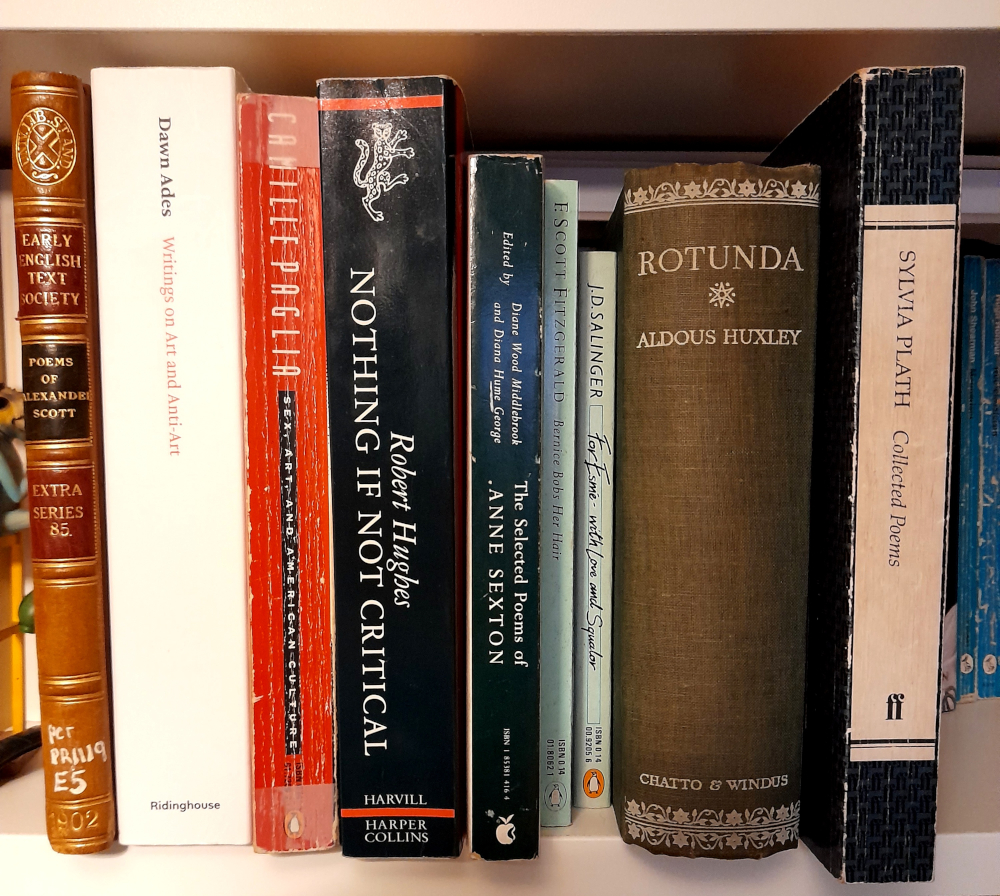
So anyway, here’s my first week, or 8 days since apparently I can’t count. Hang around at the end for my own (lack of a) story:

FRIDAY

Essay: Camille Paglia – Sexual Personae: the cancelled preface (1990) Back in the early 90s, before libertarianism became almost exclusively a right-wing preserve I loved Camille Paglia’s macho & egotistical writing: it was exciting and stimulating. Turns out it still is, but to 21st century me it’s also as infuriating as it is interesting and it seemed like every time she makes a good point (which is often) she unfailingly follows it up with some reactionary/annoying point that feels uncannily like something from the unpleasant side of the current culture war.

Poem: Wang Wei – Written at My House near the Wang River at a Time of Incessant Rain (c.750 AD). This is a very pretty and mysterious poem, more a collection of brilliantly delicate images than any kind of narrative.

Short Story: JD Salinger – Pretty Mouth and Green My Eyes (1948). I love The Catcher in the Rye, but aside from that was always a bit disappointed by Salinger’s work. Having not read this since I was probably 21 I was quite taken aback by how good it is: incredibly bitter and ironic, I loved it.

SATURDAY

Essay: Robert Hughes – Paul Gauguin (1988) I half expected to find this a little dated given the advances in Gauguin scholarship since the 80s (especially as I recently read Sue Prideaux’s phenomenal and game-changing biography Wild Thing) but in fact Hughes’ disdain for the various conflicting legends of Gauguin and his focus not on his supposed primitivism, but his actual sophistication and technical skill make this an excellently concise overview of a sometimes misunderstood artist

Poem: Anne Sexton – For John, Who Begs Me Not to Enquire Further (1960). I love Anne Sexton and this is a typically raw, intense and enigmatic poem, which may (I’m not sure) be saying ‘don’t just dismiss me as my mental illness.’ The thought that lingered with me after reading it was a very relatable one; it’s the hope that gets you.

Short Story: Story: F. Scott Fitzgerald – A Short Trip Home (1927) This was very gripping and atmospheric, more of a tough thriller type story than I’d normally associate with FSF (who I like a lot). I really enjoyed reading it, but the ending felt like a letdown and definitely not something a (much less literary) genre writer would have done. After I’d read it I kind of felt like I’d missed the point somehow; not my favourite sensation after reading a story (this was a late night one though, so might have to revisit it when wide awake in case it was just me)

MONDAY

Essay: Olivia Laing – Lamentations (2017) This was an excellent little essay about religious art which I was bound to like, partly because I like religious art, partly because Laing’s point aligns with my beliefs – basically, there’s no need for afterlife, we have life – but mostly because she is a very good writer.

Poem: Douglas Dunn – 13 steps and the 13th of March (1985) and After the War (1972) – I ended up reading two Dunn poems because I’d just heard that he died. He’s not a poet whose work I’ve ever loved (though I’ve never disliked him either), but these were good. The first, from a book of poems about the death of his wife is very sensitive and restrained and moving, but I think I preferred the second, which was about childhood and war and trauma and had a kind of oblique intensity that I thought was very effective

Story: Will Self – Between the Conceits (1994) – One of my favourite stories I read this week. Self’s surrealism was perhaps over-hyped in the early 90s but I really loved his work. At some point (not for any particular reason) I stopped keeping up with his stuff, though I still like it whenever I read it (especially his journalism). This was very funny, very straightforwardly written and deeply weird, it reminded me, very unexpectedly, of Clive Barker, another of my favourite writers in that period, though their prose styles are wildly different

MONDAY

Essay: Christopher Hitchens – The New Commandments (2010) – I love Christopher Hitchens, both before and after his transformation from being a radical left-wing writer to being am unusual right-wing one (more is made of that transformation than I think should be – almost all of his political beliefs remained the same, from reading his excellent memoir Hitch-22 it was mostly a reaction – I think an unfortunate one, it certainly didn’t bring him any happiness – to the aftermath of 9/11). But this was a fun, very sensible and amusing deconstruction/reconstruction of “the” 10 commandments (which as he points out are really only 10 of the many commandments in the Bible).

Poem: Thomas Hoccleve – On Richard II’s Burial at Westminster (1413) – This was unexpectedly one of the poems I loved reading the most. Reading medieval English can be difficult but there’s something very vivid and moving about the language. This poem is basically a religious/political one that’s filled with a sense of relief, it’s about how Henry V was putting things back on track after a period of chaos and strife (which wasn’t however over) by treating the bones of a dead king with the appropriate respect.

Story: Aldous Huxley – Half-Holiday (1926) – again I loved this – Monday was a good reading day! My favourite Huxley isn’t the Brave New World/Doors of Perception/Heaven & Hell Huxley, but the one that wrote uncomfortable and sometimes bitter social comedies like Antic Hay and Point Counter Point. This was a typically sad little story about a poor, awkward young man with a bad stutter who fantasises about picking up fashionable, posh girls and tries to do so, with painful results.

TUESDAY

Essay: George Orwell – World Affairs, 1945 (1945) This was a depressing but extremely accurate prediction of what was about to happen (the Cold War), that was written after VE day but before the atom bombs dropped.

Poem: Seamus Heaney – Cairn-Maker (1972) I first read Heaney at school and therefore had a slight aversion to his work, but at some point in my 20s I ended up getting all of the books he’d written to date, which got harder to understand as they went along. This is a superbly-written poem, the imagery is so immediate that it took me by surprise. In the end I couldn’t decide if it’s a purely a descriptive poem or not – I think it probably isn’t but it worked for me on that level. I think it has the most precisely chosen words I read for this ‘challenge’- loved it.

Story: Charles Bukowski – Swastika (the title is actually a swastika, not the word) (1969-72?) – God this was lame. Very enjoyable but completely silly story about an unnamed US president (Nixon, presumably) being kidnapped and having his body taken over by Hitler while he is put in Hitler’s body. Okay, Charles. I do like Bukowski but his quality control was non-existent.

WEDNESDAY.

Essay: Karl Marx – Investigation of Tortures in India (1857) I like Marx the journalist a lot; this was a good, clear (oddly Orwell-like, or the other way around, logically) examination of the scandal then coming to light of torture being used by the British administrators in India, for the purpose of extorting money. Typically there was an official inquest, but it blamed the Indian enforcers and so on and cleared the higher up white people of blame. Marx cuts through their bullshit nicely.

Poem: Sylvia Plath – Private Ground (written 1960/1, published 1971) – Sylvia Plath was my favourite poet for years, but the poems I remember are mostly famous ones from Ariel (1965). This one, about cleaning up a (family I assume) garden and draining the pond before winter, has superb word choices, especially for the dead baby fish (like orange peel). The overall mood is full of a chilly melancholy rather than Plath’s more dramatic horror etc.

Story: JG Ballard – The Reptile Enclosure (1963) – I’ve read so many Ballard stories over the years and I know I’d read this but I couldn’t remember what happened in it. It’s an excellent and very ‘Ballardian’ surreal little story that begins in a kind of mundane way being about a married couple who are unromantically putting up with each other, but typically ends in catastrophe.

THURSDAY

Essay: Charles Baudelaire – The Modern Public & Photography (1859) – This was an excellent & extremely prescient article about how the virtues of art and photography are different & how photography was being weaponised by the talentless in a war against art: seemed a bit over the top in a way but there was one paragraph which could have been written today about AI and would be just as true.

Poem: Andrew Motion – Leaving Belfast (1978) – this was a very nice, straightforwardly written but ambivalent poem about leaving Belfast and with it ‘the troubles’ – very effectively evoking the strain of living with an implicit but rarely openly stated threat.

Story: Thomas Burke – Tai Fu and Pansy Greers (1916) – I bought Thomas Burke’s sensational (and often pretty racist) short story collection Limehouse Nights when I was very interested in silent cinema (several of his stories were made into highly successful films like Broken Blossoms). The stories are all concerned with street life in what was then London’s Chinatown and the characters are down-and-outs, drug users, prostitutes etc: it’s shockingly un-genteel for English writing of the era. This was a sleazy, melodramatic but very readable and in some ways quite modern story. It felt quite Americanised in a Damon Runyan way, but I think that’s because it’s so rare to read the street slang etc of pre-war Britain, which was far more modern than the acceptable fictionalised speech of the era.

FRIDAY

Essay: Dawn Ades – Paolozzi, Surrealism, Ethnography (1985) – Dawn Ades is one of my favourite writers on art and this was interesting piece about the relationship between surrealism & ‘the primitive’ which was quite different from the usual modernist primitvism of Picasso or the German Expressionists. The strong anti-colonial aspect of Surrealism (which people often overlook) made their use of ‘foreign’ art quite different and in this case Ades talks about using ethnographic material as much to highlight the alien qualities of contemporary Western art and culture as to make foreign art seem alien and new

Poem: Alexander Scott – Departe, Departe, Departe (c.1550s) – I love reading medieval Scots even more than medieval English (though they are very similar; but there’s something so nice and distinctive about the way Scots has ‘Qu’ instead of W: I love ‘quhat’ instead of what, ‘quha’ instead of who etc). This is a beautiful, very conventional romantic ballad but I loved the way that reading (quietly but aloud to myself) it makes it comprehensible where at first it looks opaque. It’s full of odd words like ‘spreit’ which, from context you quickly realise is ‘spirit’.

Story: Milan Kundera – The Hitchhiking Game (1969) – This was interesting because it was the first Kundera story I ever read, back when I was a teenager. At the time I found him very grown up and kind of cool, but now he seems like the kind of unreconstructed 60s man who would call women ‘chicks’. It’s a good, horrible little story and (a distinction I’m not sure is worth making) sexist without I think being actually misogynistic: Kundera likes women, he just thinks of them as a species apart from men. But really, it’s a gripping little story about the illusion/delusion of romance, that’s looked at in such a ‘manly’ way that it’s kind of funny. When I was younger I would never have thought of Milan Kundera as a simple-minded, macho Hemingway kind of writer (no offense to either of them) but that’s how he seems in this story.

***

So, I did the reading – but although I have written a lot in the past week (my favourite thing was writing up an interview I did with the Faroese singer Eivør, who was great) I didn’t write a story. I do write fiction occasionally (as a teenager I kind of assumed I’d be a novelist one day; so far, I’m not) and over the years have written quite a lot of stories of one kind or another, mostly horror.

I’m sure at some point during my – to put it in tedious online speak – ‘Bradbury journey’ I will write a story. I did have the germ (or seeds: which is smaller?) of an idea which could be a story but which I don’t feel inclined to develop at present, so here’s that:

The idea comes from the possible relationship between two sources: there’s a famous passage in the Bible (Mark 5:9, the internet says) in which Jesus meets a possessed man. Even for an atheist, the Bible is an endless source of fascinating ideas, but why this particular passage popped into my head I don’t know – maybe because it’s nearly Halloween? Jesus talks to the possessor(s) of the man – although I see online that people who don’t understand the meanings of words are following the tradition of referring to ‘a demon named Legion.’ FFS; it’s hardly unclear: the voice even says “we are many.” Look up what legion means! I don’t think it’s intended as the ‘Royal we’. Maybe if the translators responsible for the King James version, instead of writing “My name is Legion”  had used the just as accurate “We have many names,” people would get it. But it would be a sad loss; it’s a powerfully sinister and resonant phrase.

Anyway; I was also thinking about something I’d read where a newspaper (can’t remember which, I think the Times, but wouldn’t like to state it with authority) cited in a story either ChatGPT or Claude as a source, like they would any interviewee. The journalist did not take into account that the ‘Claude’ who a teenager is asking about their acne, the ‘Claude’ that someone is asking to sift through a lengthy legal document to point out its salient points and the ‘Claude’ who is being used to select military targets aren’t one person called Claude; Claude the agony aunt is not aware of the information that Claude the legal aid and Claude the missile-aimer are giving to different users, although if asked it could probably find out. Claude’s name, in other words is Legion: how that is developed into the narrative of a short story I don’t know, but I do know that it could be. So that’ll do for now. Onwards!
shooting the messenger; moral panics, the 1980s, American Psycho turns 30


Marshall Arisman’s superb artwork used on the Picador first edition of American Psycho

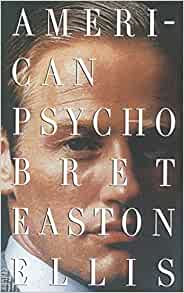
Happy New Year! I’ve written before about the way that new decades seem to bring their own distinct identities with them (probably too often; here was I think the most recent time) and as we ascend/descend/just go into 2021 an auspicious anniversary approaches; 30 years since the publication of Bret Easton Ellis’s classic novel American Psycho, a book which seemed to set the seal on certain aspects of the 1980s, preserving them in a concentrated form for future… hmm, enjoyment seems the wrong word (but it’s not).

Moral panics (“an instance of public anxiety or alarm in response to a problem regarded as threatening the moral standards of society” is how the internet defines the term) don’t occur very often, though something tells me that in the next few years they may be one of the few areas of growth in the UK, and moral panics about books are even more rare. But American Psycho caused one, and until it was to some extent defused by Mary Harron’s excellent (though necessarily less graphic) 2000 film adaptation* the novel remained (appropriately I guess) a kind of bogeyman, in some countries (still?) only being displayed in shrinkwrap lest an unwary child catch a glimpse of the dangerous words it contains.

*the film managed to avoid great controversy partly I think because it confirmed what many of the book’s defenders had always maintained; that it was (among other things) a satirical black comedy

At the heart of any moral panic there is generally one catalyst, but it usually overlays a more or less complex set of issues. These tend to be fundamental things like; should there be limits to free speech? Should human beings have control over their own bodies whatever the consequences to their health? How much control should parents exercise over their children? Is it important to be able to clearly define individuals within specific traditional pigeonholes and if so, why? Interestingly though, the point of the panic (generally sparked by a newspaper, politician or an interested pressure group) is usually, perhaps always to avoid the discussion of these issues, and instead to simply wish whatever it is – ‘video nasties’, drugs, loud music, raves, books, certain kinds of people – out of existence entirely. The unstated aim is the reiteration of a prevailing – often obsolete – orthodoxy; films that aren’t explicit, children that are ‘seen and not heard’, Christian ideas of morality). And coincidentally or not, whatever the panic happens to be about, it’s usually the same orthodoxy that is being reinforced and promoted.

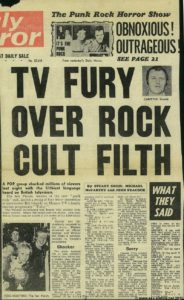
one of the UK’s classic moral panics; punk

Literature and cinema have a special place in the moral panic spectrum, because, unlike, say drugs, prostitution, hoodies or (more ridiculously) ‘happy slapping,’ those defending them (to be fair I don’t think anyone really defended happy slapping) almost always have to use, or at least generally do use, arguments that are unrelated to the charges the accusers make. DH Lawrence’s Lady Chatterley’s Lover is probably the most famously banned book in Britain, but when it was finally un-banned it was because of arguments about the quality of the book. Lady Chatterley’s Lover is indeed an important book, written by an important writer, it is ‘literature’. But, typically, the people who wanted it banned didn’t care about that, didn’t even necessarily dispute it, or disapprove of the acts that were considered so outrageous when described in print. After all, even most Festival of Light type people don’t believe that no-one should ever have sex. Mostly, what they cared about was the actual words used in the book; and, strangely, the words that were considered most offensive in the 1920s (when it was written) and the 1960s (when it was printed legally) are mostly still the same ones that are considered offensive – which is handy for the arbiters of public morality. If your tactic is simply to be outraged, you can count the number of bad words in Lady Chatterley, just as, 30-odd years after that was printed in an unexpurgated edition, critics could count the swearwords in a novel by James Kelman or Irvine Welsh, preventing them from having to address whatever uncomfortable things the books might actually be saying.*

* although swearwords are routinely still censored in print in newspapers (f**k and whatnot), the irony is that this kind of censoring only works for people who already know the words. If you know a word and are offended or horrified by it, but read it with some letters missing, does it become less offensive? Recently I’ve noticed people self-censoring non-swearwords that (I presume) might cause discomfort, such as writing ‘r*pe’, rather than ‘rape’. But a) does the use of the word ‘rape’ itself cause trauma? and b) if it does, does reading it in context as ‘r*pe’ cause less trauma? Because although it’s possible that the word I am assuming is ‘rape’ might be be warning me about ‘rope’ or ‘ripe’ – but rape is the only word that makes logical sense. And seeing that the sentence will only make sense if you understand that “r*pe” is “rape,” is the letter ‘a’ really the problem there? Are the letters “uc” the problem with the word “f**k”? This seems different to me from something like self-censoring a word associated with, say, racial abuse, where the censoree is avoiding an offensive term while also showing that they recognise its offensiveness and are distancing themselves from its casual use. But I am no authority!

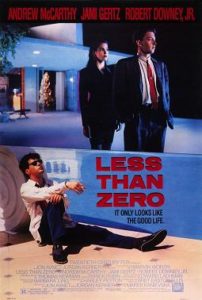
the much maligned 1987 film of Less Than Zero is surprisingly faithful, perhaps because it was a product of the milieu that it depicts.

What was often lost in the furore surrounding American Psycho is that Ellis’s first two novels, Less Than Zero (1985) and The Rules of Attraction (1987) had also been controversial; it’s just that they were controversial in a way that was more comfortable for literary critics and especially for publishers. After all, you don’t get to be an enfant terrible without being young (Ellis was 20 years old when Less Than Zero was published), or in some way terrible. With Less Than Zero, it was as much the described world itself – decadent, affluent, mid-80s consumerist LA with its drugs and excess and callousness – as the behaviour of the protagonists which shocked reviewers. And (which is also true of his second novel The Rules Of Attraction but definitely not American Psycho) the positive reviews selected for quotation for the book’s cover were largely admiring of that excess, in the classic, coolly jaded ‘yes-it’s-all-very-shocking-if-you’re-old-and-shockable’ vein:

This is the novel your mother warned you about. Jim Morrison would be proud (Eve Babitz)

Bret Easton Ellis is undoubtedly the new master of youthful alienation … makes Jack Kerouac and his Beat Generation seem like pussies (Emily Prager).

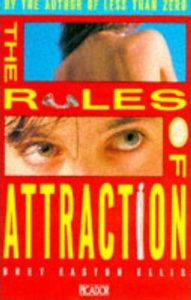
the Picador Rules of Attraction paperback is a definitively 80s artefact

For whatever reason, nobody said that American Psycho made Charles Bukowski or Norman Mailer or even Stephen King seem like “pussies,” even though, in the sense that Prager means it, it certainly does. With The Rules Of Attraction, set in more or less the same social milieu as Less Than Zero, only on a New England College campus, the controversy was again more moral than literary; promiscuous sex! Drugs! These young people are amoral, unpleasant and cynical, why would anybody want to read, let alone write about them? But again, this is the kind of controversy that critics and especially publishers are comfortable with; low level outrage that is shocking enough to attract new readers but not shocking enough to require justification for publishing. This time, the approving review used by the publisher (at least of the UK Picador edition I have) is less gloating and perhaps slightly more defensive – yes he’s young and outrageous but please note that he’s a good writer too – appealing frankly (and I think accurately) to the literary precedent for books like Ellis’s:

Compelling … and sympathetic to his “lost generation” the way only Fitzgerald was about his (nameless Vanity Fair reviewer).

Interestingly, although Simon & Schuster in the USA sparked and fuelled the controversy of American Psycho by declining to publish it, Ellis’s UK publisher Picador didn’t follow suit, and the blurb and reviews chosen for the first UK paperback edition are instructional; they knew exactly what they had on their hands tabloid-wise, and it’s interesting to look at what the publisher says they are selling:

a bleak, bitter and aversive novel about a world we all recognise but do not wish to face, but also an explosive novel which brilliantly exposes American culture today and finally a black comedy, a disturbing portrait of a madman [strangely archaic phrase that], a subtle send-up of the blatant behaviour of the ‘80s – and a grotesque nightmare of murder and insanity.

It may be all of these things, but the word that, having just re-read the novel, feels at first oddly out of place there is ‘subtle’. American Psycho does not feel subtle. It’s a maximalist (is that a thing?) novel, roughly twice the length of the author’s first two, and perhaps half of that length is made up, in effect, of lists; what – in detail – every major and minor character is wearing when Patrick Bateman (the psycho of the title) encounters them, what kind of hygiene or beauty products characters are using, what food is being eaten and where, detailed analyses of the careers of the narrator’s favourite musical artists.* As mentioned before, until the film adaptation of American Psycho was released, the blackly comic aspect of the book – although explicitly mentioned in the blurb – was mostly overlooked (or outright denied), but one of the things that makes the nasty parts of the book so effective (and they are still bracingly explicit and intense 30 years on) is that they don’t happen until half way through the novel, at which point – if not for the title – the book is to all intents and purposes an immersive dip into the more absurd aspects of New York/Wall Street consumer yuppie culture.

* interestingly and humorously, outside of those few psycho-approved artists (Huey Lewis, Whitney Houston, Phil Collins) and current 80s hits (Madonna, INXS), every musical reference Bateman makes – to what is playing on the radio, or in a cab – he gets the artist wrong; when asked towards the end of the novel for the saddest song he knows he names You Can’t Always Get What You Want by The Beatles (sic)

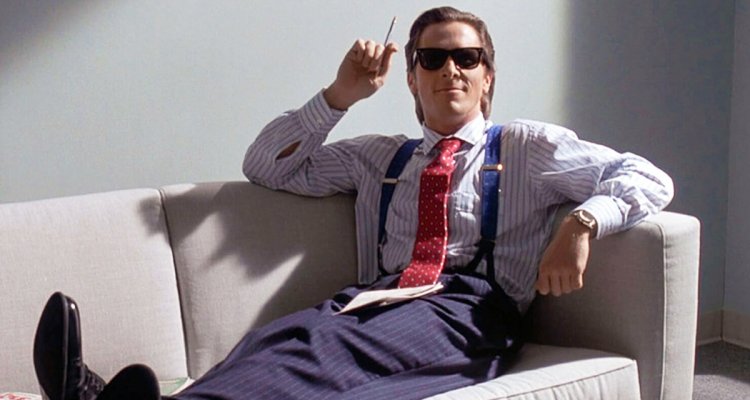
Christian Bale, iconic as Patrick Bateman in Mary Harron’s 2000 adaptation of American Psycho

What Ellis does – and significantly, it’s what made Less Than Zero such a formidable debut – is to adopt a strangely blank and hypnotic voice (a bit like the famously ‘glazed’ tone used by JG Ballard – about whom more later – in his classic Atrocity Exhibition/High Rise/Crash period), which somehow (I guess this is the subtle part) ends up being the opposite of cold or uninvolving. In The Rules Of Attraction, one of the novel’s protagonists, Sean Bateman (as it turns out, the brother of American Psycho’s  Patrick), is a generally unpleasant, amoral, cynical opportunistic drug dealer, but the reader realises (though Sean himself seems not to) that this attitude is at least in part a defence mechanism to protect the more sensitive and romantic aspects of his nature that he would rather not acknowledge. In American Psycho, the reader has direct access to Patrick Bateman’s thoughts and feelings; not just what he really thinks and feels, but also, in some of the book’s stranger moments, what he seems to think he should think and feel. There’s a very odd page-and-a-half long monologue where Bateman lectures a group of friends and acquaintances on a kind of socially responsible, enlightened conservatism that is comically at odds with the reactionary nihilism we usually read in his thoughts:

Well, we have to end apartheid for one. And slow down the nuclear arms race, stop terrorism and world hunger… Better and more affordable long-term care for the elderly, control and find a cure for the AIDS epidemic, clean up environmental damage from toxic waste and pollution, improve the quality of primary and secondary education… (American Psycho, Picador, 1991, p.15)

It’s never entirely clear if this is Bateman being funny – he does have a sense of humour, but usually he tells us if he’s making a joke (his jokes are however – importantly – not the funny parts of the novel). Or if it’s his way of making his friends uncomfortable while trying to impress people who aren’t from his social circle, in this case a bohemian couple, which seems quite likely. Or if it’s just anomalous parts of his submerged and fragmenting personality coming through; throughout the book there are moments when we realise that this is, more or less, how he’s perceived by the other characters; the ‘boy next door’, an unusually sensitive and perhaps even shy member of their set, which reaches a comic climax when he leaves a confession of his hideous crimes on the voicemail of another of his interchangeable set of yuppie acquaintances. It’s treated as a not-very-successful joke by the recipient, who like everyone in the book, has trouble differentiating between the people he knows and thinks that Patrick is someone else:

‘come on man, you had one fatal flaw: Bateman’s such a bloody ass-kisser, such a brown-nosing goody-goody, that I couldn’t fully appreciate it…. He could barely pick up an escort girl, let alone…  Oh yes, ‘chop her up’’ (American Psycho, Picador, 1991, p.387)

the still-pretty-cool US first edition

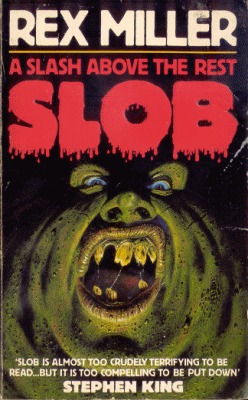
The fact that Bateman is on the surface a normal member of his peer group, and by their standards even a fairly laudable example of the 80s yuppie is of course one of the things that made the book uncomfortable in 1991. A couple of years before American Psycho was published I had read and enjoyed Slob (1987) by Rex Miller. It’s a novel about a grotesque (and unlike Patrick Bateman) grotesque-looking, remorseless, obese sadistic outsider maniac who, having previously been utilised, hopefully improbably, by the government as an assassin in the Vietnam war, returns home and continues his ‘work’. It’s more or less relentless graphic violence and sex (in that order), not really a searing indictment of anything, (although obviously not pro-serial killer either) but as far as I know the publisher had no qualms about publishing it and, far from feeling the need to defend it in the blurb or quotes, took pride in its extremeness; Slob is almost too crudely terrifying to be read… (said Stephen King, quoted on the front cover) But it is too compelling to be put down. 

a powerful indictment of overweight people wielding chains

Well yes; Slob is genre fiction after all, and therefore weirdly immune – on an individual level at least* – to the vagaries of the moral panic. It’s a fact that questions like ‘would American Psycho be published today?’ still pop up in newspapers from time to time, while the excesses of gory 80s horror are, if they are still in print, (rightly) still there in bookshops to be read by anyone who wants to do so. And some of those books really are mindlessly violent or repellently misogynistic, without the publisher feeling any particular need to defend them. No shrinkwrap is required, no literary reviewer was disappointed to find that their faith in a promising young writer had been repaid by Slob and nobody (or at least nobody powerful or influential) made to feel uncomfortable by the things it was saying about the country. If it had been written by, say, Jay McInerney and called American Slob perhaps there would have been some concern about teenagers buying it and circulating it among their friends; possibly it would also have sold more copies (though I think it did pretty well); because of course the ultimate irony of any moral panic is that it creates an interest in and appetite for what it condemns. Notoriety is good publicity.

*while it’s rare – though not unheard of – for a single genre book or film to be targeted by a moral panic there is always the chance that the ‘powers that want to be’ will try to remove a whole genre or sub-genre at once as with the UK’s notorious ‘video nasties’ furore. In a way the horror genre is always stuck in a kind of self-perpetuating, positive/negative loop – horror can ‘get away with’ pretty much any kind of extreme and transgressive material it wants to, because that is part of its raison d’etre. On the other hand, it’s very hard for that transgression to have much of a wider impact beyond the horror genre because it’s ‘just’ horror.

The reviews used by Picador on the back cover of American Psycho are as interesting at its blurb. Retraité terrible* Norman Mailer is quoted;

He has forced us to look at intolerable material, and so few novels try for that much anymore.

Clearly, Mailer had not been ‘forced to look at’ Slob. Or anything by Skipp and Spector, or Clive Barker, or Shaun Hutson (whose Spawn made me feel physically sick on first reading, which American Psycho, presumably because of the influence of Spawn, and lots of other books like Spawn, did not. More about that kind of thing here). That ‘forced’ is fun too; forced how? Because he was paid to review it?

* Vieil homme terrible? if I could speak any French at all I could have made this joke more confidently; in English I’d say something like ‘OAP terrible Norman Mailer’. Which is as good a point as any to mention a particular paternalistic and I think class-based kind of censorship that used to exist in the UK. Several times I’ve come across older books (most recently a book about the historical figure Erzsébet Báthory (the real Hungarian ‘Countess Dracula’) by Valentine Penrose, the wife of surrealist Roland Penrose, that was written in French and translated into English by the wayward Scottish writer Alexander Trocchi. Translated apart, that is, from any especially salacious parts, which were left in French, presumably so that only well educated British people could be traumatised by them. 

(American Psycho is) a very disturbing book, quoth Joe McGinnis, but the author is writing from the deepest, purest motives. Which may be true, but is it relevant? Pan books did not feel the need to reassure readers about Rex Miller’s motives. In fact, Picador, when selling Less Than Zero, chose quotes which actively encouraged the idea that Ellis’s motive with that book was to shock people. But surely if shocking readers is a valid motive (it is) then American Psycho was far more successful even than Less Than Zero? If Bret Easton Ellis’s motives had been to provide the reader with some kind of complicated entertainment, to amuse and entertain and make them think, or if he wanted  to lecture them on morality or to disgust and repel them, or even if, as his detractors said, he just got off on writing about violence, sex and Phil Collins, does that change the book itself? These are questions, I’m not sure about the answers.

Although the book contains horrifying scenes, said Nora Rawlinson, they must be read in the context of the book as a whole; the horror does not lie in the novel itself, but in the society it reflects. This book is not pleasure reading, but neither is it pornography. It is a serious novel that comments on a society that has become inured to suffering.

This seems fair enough, but it also contains some odd statements; that ‘but neither’ is strange, isn’t it? Being neither ‘pleasure reading’ (whatever that means) nor pornography suggests firstly, that pornography isn’t pleasure reading; maybe not, but what is it then? People seemed to be reading the Fifty Shades… books for some kind of pleasure, which is, believe it or not, not a judgement of the books. And secondly, it suggests that a novel can be read for something other than pleasure – which it obviously can, but a novel, even a polemical novel (and American Psycho isn’t that) still isn’t a lecture. JG Ballard – him again – was less squeamish about what his books were or weren’t, and wrote, for a 1995 edition of his most controversial novel Crash;
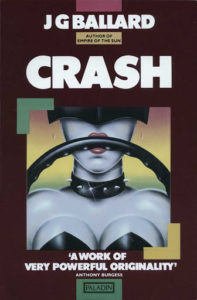
I would still like to think that Crash is the first pornographic novel based on technology. In a sense, pornography is the most political form of fiction, dealing with how we use and exploit each other, in the most urgent and ruthless way. (Crash, Vintage books, 1995, p.6).

This – although he later slightly recanted and said that Crash was purely a ‘psychopathic hymn with a point’ – seems to me a more valuable observation than any of those printed on the back cover of my edition of American Psycho. (Interesting but value-free information; Vintage, the publisher of that edition of Crash, was also the publisher that picked up American Psycho in the US after Simon & Schuster refused to print it. And James Spader, who plays a slimy drug dealer in the movie version of Less Than Zero is also in David Cronenberg’s Crash. Connections! But what of them?)

transgressive 80s classic

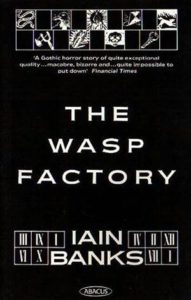
There is more than one way of dealing with a controversial novel; and the fact that Picador was squeamish or at least cautious about the book they were publishing comes through clearly in that careful choice of quotes from positive, but very sober reviews. That several of those quotes are from women is also probably no coincidence; the book was attacked (most visibly by Gloria Steinem) as being misogynistic. And indeed it is, insofar as the narrator and his milieu, and the 1980s, and consumerist capitalist culture are and were. But the book is called American Psycho; not What Bret Easton Ellis Thinks About Women and it seems surprising that, coming just as Gordon Gekko and his ilk seemed like historical figures and the 90s had established its own distinct identity, a very personal satire of the 1980s, written by an author whose earlier work was both a thoughtful product of and also an embodiment of that era (and also not misogynistic), should be taken at something less than face value. Too soon, and too extreme perhaps? But if it had come later it would suggest an absolving clarity that can only come with hindsight, and if it had been less extreme an absolving kind of a shrug; but it is what it is because the 80s were what they were; a kind of wild, extravagant, decadent but above all exclusive party; exhilarating, on the surface, for a while; if you were invited and could afford to attend. In a way, Picador missed a trick; given the book’s pre-publication notoriety, they might have been better to quote from both positive and negative reviews, as Abacus did with Iain Banks’s 1984 debut The Wasp Factory. In both editions that I have owned (a mid 80s paperback and a 2005 reprint), the book has several pages dedicated to reviews which say things like Perhaps it is all a joke, meant to fool literary London into respect for rubbish (The Times). Of course, these kinds of reviews are really a selling point, just as, in the 90s, an author being sneered at by Tom Paulin and Allison Pearson on The Late Show was usually a promising sign.

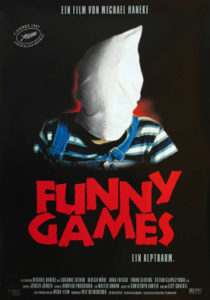
Funny Games; it’s not very nice though this poster reminds me of the one for Howard the Duck somehow

But if, as the positive reviews said, American Psycho isn’t to be read for pleasure then what is it to be read for? Education? Certainly it has – especially over time – gained a kind of educational value as a time capsule or artefact of some aspects of – and the texture of – 80s American culture. But is that what it is for? Or should it be seen as – which Rawlinson’s quote seems to be suggesting – a kind of literary analogue to a something like Michael Haneke’s film Funny Games, where the director is saying ‘so you like to watch horror films? You like violence and torture do you? Well here you go. Not very nice is it?’ But that isn’t how American Psycho feels exactly, despite being published at the height of the early 90s serial killer boom (there’s a phrase), a time when Jonathan Demme’s straightforward and well made horror thriller The Silence of the Lambs was somehow elevated to Oscar-worthy, cultural event status; clearly something, like the stench emanating from Dennis Nilsen’s drains, was in the air.

If JG Ballard’s aforementioned 1973 novel Crash was, as Ballard sometimes stated, cautionary as well as pornographic; a novel to be read for (peculiar sexual) pleasure, but also a vision of the future concerning how humanity might be shaped by the very environment it had built to suit its needs and whims; a warning against that brutal, erotic and overlit realm that beckons more and more persuasively to us from the margins of the technological landscape is how he put it in that introduction (Crash, Vintage Books, 1995, p.6), then in American Psycho, it was already too late for caution. This is a historical novel; this, says Ellis, or at least says Patrick Bateman, is what we became in the 80s. In the chapter End of the 1980s, Patrick himself gives us an extremely Ballardian kind of collage:

The dreams are an endless reel of car wrecks and disaster footage, electric chairs and grisly suicides, syringes and mutilated pinup girls, flying saucers, marble Jacuzzis, pink peppercorns(…) A month ago was the anniversary of Elvis Presley’s death… Football games flash by, the sound turned off… All summer long Madonna cries out to us “life is a mystery, everyone must stand alone…” (American Psycho, Picador, 1991, p.371)

This is still recognisably the author of Less Than Zero, but where Ellis seemed before to coolly comment on the state of the society he was talking about, here he is immersed in it. As before, the author shows us a group of people who are numb, alienated from the world and from each other, possibly looking for some kind of connection with humanity while also (inadvertently? deliberately?) distancing themselves from the possibility of it. But while outwardly, Bateman prides himself on just this kind of cool detachment, from our position inside his head we can see that however unreliable he is as a narrator (it’s never clear what really does or doesn’t happen, partly because, like everyone else in the book, he can’t really tell one person from another, outside of his closest friends), he is anything but emotionless, but instead a mass of obsessive, raw neuroses, circling endlessly around status, wealth, sex and (increasingly) age; turning 30 is something that would probably fill him with nameless dread, as many things do. Whether or not he really murders anyone (a source of frequent debate, though the publisher’s blurb takes for granted that he does), the title still stands. And it’s an important title too; after all, Robert Bloch’s Psycho was also American, but only because Robert Bloch was. American Psycho is deliberately specific.

I’ve mentioned JG Ballard’s Crash a few times, because for all its differences, it met with a similar response to American Psycho (not least from Ballard’s publisher – had Ballard been a mainstream and not genre author, it would have been an ideal contender for moral panic status. Something similar happened with the movie, where the fact that it was made by director David Cronenberg, maker of legendarily peculiar horror films, to some extent defused the more controversial aspects of the film although the Daily Mail etc tried, bless them). Like American Psycho, Crash‘s mixture of extreme violence and sex remains potent and shocking decades after its original publication. Like American Psycho too, it’s often a funny book, although the humour was not really translated to Cronenberg’s good but oddly restrained film version. Partly the film is less comical because toning down the mayhem (a film that really looked like the book reads would have been banned everywhere in the world) makes it less funny*, but also because robbing the story of its very specific object of obsessive desire, Elizabeth Taylor (presumably because she was still alive at the time; the stuff about Jayne Mansfield is still in the film) makes it less absurdly funny. The film version of American Psycho is still humorous (especially regarding the swapping of business cards), but the novel’s funniest scene, which is also one of its most strangely moving, is not included for – I presume – similarly practical reasons.

*see also Paul Verhoeven’s classic RoboCop, where the cuts administered by the BBFC to some of the more ludicrously violent scenes made what was brutal and blackly funny into something that was just brutal; do these people not want extreme violence to be funny??

Throughout American Psycho, we see Bateman revelling in, and/or boasting about his alienation from the human race, his merciless coldness and basic inhumanity etc etc, but there are several scenes where, against his will, he is forced into some kind of intimacy with another character. Usually it’s Luis Carruthers, a friendly acquaintance who mistakenly believes that Bateman is in love with him and unfortunately reciprocates, or Jean, his secretary who Bateman assumes is in love with him, but whose feelings, we learn, are more complex than Patrick realises. But strangely we see Patrick at his most naked and human and afraid at a U2 concert where, to his alarm, he shares a rare and intense moment of connection with Bono, of all people; the horror. This is not the kind of relationship that Bateman has with the artists he really likes. There is though, an almost equally funny moment in the late chapter Huey Lewis and the News (the last of Patrick’s disarmingly straightforward, cheerful and perceptive rundowns of his favourite artists’ careers) when his veneer of normality starts to crack – as well it might – and he says The album [Small World, 1988] ends with “Slammin’,” which has no words and it’s just a lot of horns that quite frankly, if you turn it up really loud, can give you a fucking big headache and maybe even make you feel a little sick.

What I have perhaps not stressed enough here is the general sincerity of the book. Some critics felt that Ellis was being sneeringly cold and cynical about the people and lifestyle he portrays, but (to me at least) it doesn’t feel that way, especially compared to his first two novels. Obviously American Psycho isn’t, thankfully, autobiographical in a narrow sense, but Bret Easton Ellis was still – more than ever – concerned with the fate of his ‘lost generation.’  These were successful young American people for whom a whole culture had been built to fulfil their every whim and enrich – albeit at a price – every element of their lives, but which instead seemed only to emphasise its own emptiness. You might think that it’s hard to feel sorry for people who have (in material terms) everything, and you might be right; but these are his people. That the worship of visible success makes anything that isn’t visible success look like abject failure seems like a glib kind of lesson, but it’s only one element of a richly textured, (sometimes literally) tortured and yet funny and readable book. Thirty years on, what’s funnier (in more than one sense) now than it was in 1991 is Patrick Bateman’s Donald Trump obsession – also less of a feature in the film – which, from the perspective of 2021 seems quite surreal but also strangely fitting. American Psycho is, after all, largely Patrick Bateman telling us, based on his experience, how the world works, and sometimes he’s right.