instead of a story

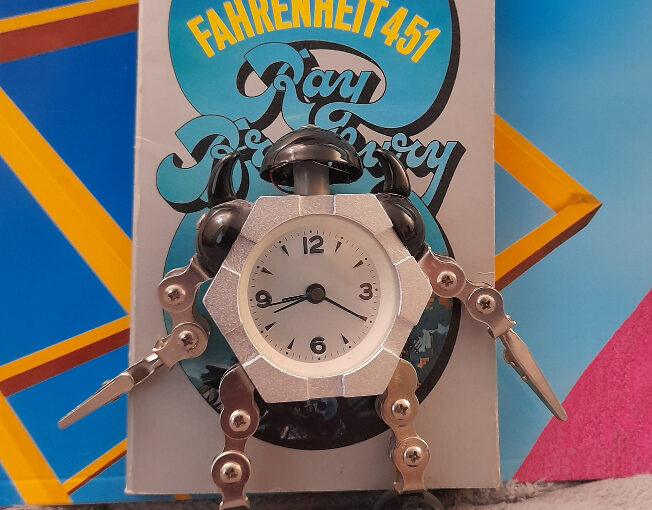
Alas, I am not a young writer; I have been writing for many years. But recently I came across Ray Bradbury’s advice for young writers, put in the simplified form of a challenge: read one poem, one short story and one essay per day, preferably from different eras and different fields and write one short story per week. I first saw a version of it as a 30-day challenge, but then saw something else that said Bradbury’s bigger theory was that if continued over the course of a year, nobody could write 52 bad stories in a row, which I dispute. But still, it’s a fun idea.

I already read every day, I already write every day; but it’s nice to get better at something and the discipline of it is (I think) oddly appealing.
In fact, what Bradbury said (at least in 2001 at The Sixth Annual Writer’s Symposium by the Sea) –  is considerably more elaborate and quite a lot less appealing – but probably even better as advice:

“I’ll give you a program to follow every night, a very simple program…one poem a night, one short story a night, one essay a night, for the next 1,000 nights. From various fields: archaeology, zoology, biology, all the great philosophers of time, comparing them…But that means that every night then, before you go to bed, you’re stuffing your head with one poem, one short story, one essay—at the end of a thousand nights, Jesus God, you’ll be full of stuff, won’t you?”

So anyway, I started my own version of the challenge last Friday (though truth be told, I didn’t do my reading before bed in every case, just at various times during the day). So far been a very nice thing to do. A sort of caveat is that so far I’ve been relying on books I already own and that therefore one might assume I’ve already read. In most cases I had, but as everyone who accumulates books knows (especially if some have been bought for a specific purposes, such as academic studies) there are things that remain unread, or at least not fully read for decades, while remaining on your mental I will read this list.

I only chose things that, if I had read them it was so long ago that I had little or no memory of them. As it turned out, I tended to have a very different idea of what they were like from how they seem to me now; it was interesting.

What struck me most forcibly over the course of a few days was how I value different things in different media. Understanding is the main one: reading a story and feeling that I didn’t fully grasp it really bugged me and spoiled my enjoyment of it. Reading an essay and feeling that I didn’t fully understand it made me think that the writer had failed to communicate their ideas as well as they might have (for someone of my mental capacity at least; I am not, and don’t pretend to be everyone’s ideal reader). But in poetry the feeling that comes from the work is (to me) almost independent of the meaning, which had little to do with how much I did or didn’t engage with a poem. I’m not sure I felt that way when I was younger and read a lot more poetry than I do now.

The first poets I really loved as a teenager were to an extent ‘difficult’ – Sylvia Plath, early WH Auden and TS Eliot. But at some point in my 20s my favourite poet became Philip Larkin (whose work I still love) and I think to some extent I absorbed his attitudes toward obscure or modernist poetry and began to value clarity of meaning more than anything. Now, decades later I find that clarity needn’t be one thing: no poem I read this week had anything more immediately vivid and clear than the opening lines from Seamus Heaney’s Cairn-Maker. Whether I ‘understand’ the poem as a whole I don’t know, but these lines feel miraculously precise and evocative and the rest of the poem is no less impressive: I loved it

He robbed the stones’ nests, uncradled
As he orphaned and betrothed rock
To rock…

Seamus Heaney, ‘Cairn-maker’, from Wintering Out (Faber & Faber, 1972).
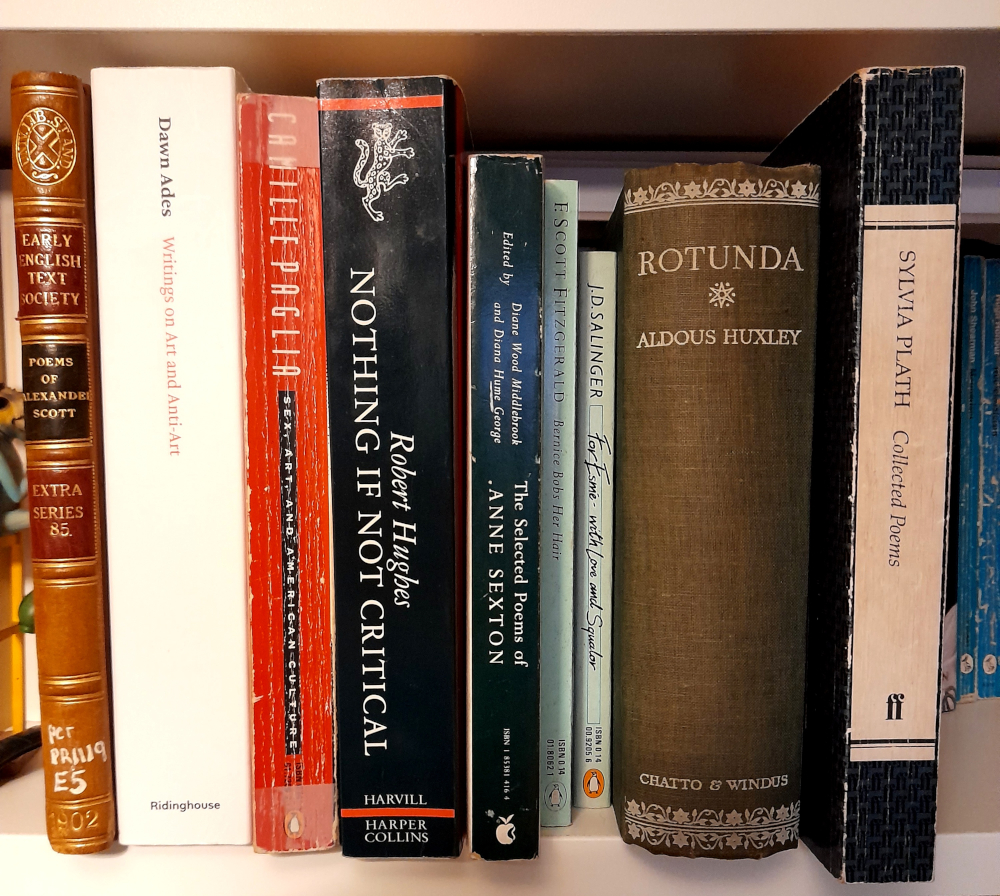
So anyway, here’s my first week, or 8 days since apparently I can’t count. Hang around at the end for my own (lack of a) story:

FRIDAY

Essay: Camille Paglia – Sexual Personae: the cancelled preface (1990) Back in the early 90s, before libertarianism became almost exclusively a right-wing preserve I loved Camille Paglia’s macho & egotistical writing: it was exciting and stimulating. Turns out it still is, but to 21st century me it’s also as infuriating as it is interesting and it seemed like every time she makes a good point (which is often) she unfailingly follows it up with some reactionary/annoying point that feels uncannily like something from the unpleasant side of the current culture war.

Poem: Wang Wei – Written at My House near the Wang River at a Time of Incessant Rain (c.750 AD). This is a very pretty and mysterious poem, more a collection of brilliantly delicate images than any kind of narrative.

Short Story: JD Salinger – Pretty Mouth and Green My Eyes (1948). I love The Catcher in the Rye, but aside from that was always a bit disappointed by Salinger’s work. Having not read this since I was probably 21 I was quite taken aback by how good it is: incredibly bitter and ironic, I loved it.

SATURDAY

Essay: Robert Hughes – Paul Gauguin (1988) I half expected to find this a little dated given the advances in Gauguin scholarship since the 80s (especially as I recently read Sue Prideaux’s phenomenal and game-changing biography Wild Thing) but in fact Hughes’ disdain for the various conflicting legends of Gauguin and his focus not on his supposed primitivism, but his actual sophistication and technical skill make this an excellently concise overview of a sometimes misunderstood artist

Poem: Anne Sexton – For John, Who Begs Me Not to Enquire Further (1960). I love Anne Sexton and this is a typically raw, intense and enigmatic poem, which may (I’m not sure) be saying ‘don’t just dismiss me as my mental illness.’ The thought that lingered with me after reading it was a very relatable one; it’s the hope that gets you.

Short Story: Story: F. Scott Fitzgerald – A Short Trip Home (1927) This was very gripping and atmospheric, more of a tough thriller type story than I’d normally associate with FSF (who I like a lot). I really enjoyed reading it, but the ending felt like a letdown and definitely not something a (much less literary) genre writer would have done. After I’d read it I kind of felt like I’d missed the point somehow; not my favourite sensation after reading a story (this was a late night one though, so might have to revisit it when wide awake in case it was just me)

MONDAY

Essay: Olivia Laing – Lamentations (2017) This was an excellent little essay about religious art which I was bound to like, partly because I like religious art, partly because Laing’s point aligns with my beliefs – basically, there’s no need for afterlife, we have life – but mostly because she is a very good writer.

Poem: Douglas Dunn – 13 steps and the 13th of March (1985) and After the War (1972) – I ended up reading two Dunn poems because I’d just heard that he died. He’s not a poet whose work I’ve ever loved (though I’ve never disliked him either), but these were good. The first, from a book of poems about the death of his wife is very sensitive and restrained and moving, but I think I preferred the second, which was about childhood and war and trauma and had a kind of oblique intensity that I thought was very effective

Story: Will Self – Between the Conceits (1994) – One of my favourite stories I read this week. Self’s surrealism was perhaps over-hyped in the early 90s but I really loved his work. At some point (not for any particular reason) I stopped keeping up with his stuff, though I still like it whenever I read it (especially his journalism). This was very funny, very straightforwardly written and deeply weird, it reminded me, very unexpectedly, of Clive Barker, another of my favourite writers in that period, though their prose styles are wildly different

MONDAY

Essay: Christopher Hitchens – The New Commandments (2010) – I love Christopher Hitchens, both before and after his transformation from being a radical left-wing writer to being am unusual right-wing one (more is made of that transformation than I think should be – almost all of his political beliefs remained the same, from reading his excellent memoir Hitch-22 it was mostly a reaction – I think an unfortunate one, it certainly didn’t bring him any happiness – to the aftermath of 9/11). But this was a fun, very sensible and amusing deconstruction/reconstruction of “the” 10 commandments (which as he points out are really only 10 of the many commandments in the Bible).

Poem: Thomas Hoccleve – On Richard II’s Burial at Westminster (1413) – This was unexpectedly one of the poems I loved reading the most. Reading medieval English can be difficult but there’s something very vivid and moving about the language. This poem is basically a religious/political one that’s filled with a sense of relief, it’s about how Henry V was putting things back on track after a period of chaos and strife (which wasn’t however over) by treating the bones of a dead king with the appropriate respect.

Story: Aldous Huxley – Half-Holiday (1926) – again I loved this – Monday was a good reading day! My favourite Huxley isn’t the Brave New World/Doors of Perception/Heaven & Hell Huxley, but the one that wrote uncomfortable and sometimes bitter social comedies like Antic Hay and Point Counter Point. This was a typically sad little story about a poor, awkward young man with a bad stutter who fantasises about picking up fashionable, posh girls and tries to do so, with painful results.

TUESDAY

Essay: George Orwell – World Affairs, 1945 (1945) This was a depressing but extremely accurate prediction of what was about to happen (the Cold War), that was written after VE day but before the atom bombs dropped.

Poem: Seamus Heaney – Cairn-Maker (1972) I first read Heaney at school and therefore had a slight aversion to his work, but at some point in my 20s I ended up getting all of the books he’d written to date, which got harder to understand as they went along. This is a superbly-written poem, the imagery is so immediate that it took me by surprise. In the end I couldn’t decide if it’s a purely a descriptive poem or not – I think it probably isn’t but it worked for me on that level. I think it has the most precisely chosen words I read for this ‘challenge’- loved it.

Story: Charles Bukowski – Swastika (the title is actually a swastika, not the word) (1969-72?) – God this was lame. Very enjoyable but completely silly story about an unnamed US president (Nixon, presumably) being kidnapped and having his body taken over by Hitler while he is put in Hitler’s body. Okay, Charles. I do like Bukowski but his quality control was non-existent.

WEDNESDAY.

Essay: Karl Marx – Investigation of Tortures in India (1857) I like Marx the journalist a lot; this was a good, clear (oddly Orwell-like, or the other way around, logically) examination of the scandal then coming to light of torture being used by the British administrators in India, for the purpose of extorting money. Typically there was an official inquest, but it blamed the Indian enforcers and so on and cleared the higher up white people of blame. Marx cuts through their bullshit nicely.

Poem: Sylvia Plath – Private Ground (written 1960/1, published 1971) – Sylvia Plath was my favourite poet for years, but the poems I remember are mostly famous ones from Ariel (1965). This one, about cleaning up a (family I assume) garden and draining the pond before winter, has superb word choices, especially for the dead baby fish (like orange peel). The overall mood is full of a chilly melancholy rather than Plath’s more dramatic horror etc.

Story: JG Ballard – The Reptile Enclosure (1963) – I’ve read so many Ballard stories over the years and I know I’d read this but I couldn’t remember what happened in it. It’s an excellent and very ‘Ballardian’ surreal little story that begins in a kind of mundane way being about a married couple who are unromantically putting up with each other, but typically ends in catastrophe.

THURSDAY

Essay: Charles Baudelaire – The Modern Public & Photography (1859) – This was an excellent & extremely prescient article about how the virtues of art and photography are different & how photography was being weaponised by the talentless in a war against art: seemed a bit over the top in a way but there was one paragraph which could have been written today about AI and would be just as true.

Poem: Andrew Motion – Leaving Belfast (1978) – this was a very nice, straightforwardly written but ambivalent poem about leaving Belfast and with it ‘the troubles’ – very effectively evoking the strain of living with an implicit but rarely openly stated threat.

Story: Thomas Burke – Tai Fu and Pansy Greers (1916) – I bought Thomas Burke’s sensational (and often pretty racist) short story collection Limehouse Nights when I was very interested in silent cinema (several of his stories were made into highly successful films like Broken Blossoms). The stories are all concerned with street life in what was then London’s Chinatown and the characters are down-and-outs, drug users, prostitutes etc: it’s shockingly un-genteel for English writing of the era. This was a sleazy, melodramatic but very readable and in some ways quite modern story. It felt quite Americanised in a Damon Runyan way, but I think that’s because it’s so rare to read the street slang etc of pre-war Britain, which was far more modern than the acceptable fictionalised speech of the era.

FRIDAY

Essay: Dawn Ades – Paolozzi, Surrealism, Ethnography (1985) – Dawn Ades is one of my favourite writers on art and this was interesting piece about the relationship between surrealism & ‘the primitive’ which was quite different from the usual modernist primitvism of Picasso or the German Expressionists. The strong anti-colonial aspect of Surrealism (which people often overlook) made their use of ‘foreign’ art quite different and in this case Ades talks about using ethnographic material as much to highlight the alien qualities of contemporary Western art and culture as to make foreign art seem alien and new

Poem: Alexander Scott – Departe, Departe, Departe (c.1550s) – I love reading medieval Scots even more than medieval English (though they are very similar; but there’s something so nice and distinctive about the way Scots has ‘Qu’ instead of W: I love ‘quhat’ instead of what, ‘quha’ instead of who etc). This is a beautiful, very conventional romantic ballad but I loved the way that reading (quietly but aloud to myself) it makes it comprehensible where at first it looks opaque. It’s full of odd words like ‘spreit’ which, from context you quickly realise is ‘spirit’.

Story: Milan Kundera – The Hitchhiking Game (1969) – This was interesting because it was the first Kundera story I ever read, back when I was a teenager. At the time I found him very grown up and kind of cool, but now he seems like the kind of unreconstructed 60s man who would call women ‘chicks’. It’s a good, horrible little story and (a distinction I’m not sure is worth making) sexist without I think being actually misogynistic: Kundera likes women, he just thinks of them as a species apart from men. But really, it’s a gripping little story about the illusion/delusion of romance, that’s looked at in such a ‘manly’ way that it’s kind of funny. When I was younger I would never have thought of Milan Kundera as a simple-minded, macho Hemingway kind of writer (no offense to either of them) but that’s how he seems in this story.

***

So, I did the reading – but although I have written a lot in the past week (my favourite thing was writing up an interview I did with the Faroese singer Eivør, who was great) I didn’t write a story. I do write fiction occasionally (as a teenager I kind of assumed I’d be a novelist one day; so far, I’m not) and over the years have written quite a lot of stories of one kind or another, mostly horror.

I’m sure at some point during my – to put it in tedious online speak – ‘Bradbury journey’ I will write a story. I did have the germ (or seeds: which is smaller?) of an idea which could be a story but which I don’t feel inclined to develop at present, so here’s that:

The idea comes from the possible relationship between two sources: there’s a famous passage in the Bible (Mark 5:9, the internet says) in which Jesus meets a possessed man. Even for an atheist, the Bible is an endless source of fascinating ideas, but why this particular passage popped into my head I don’t know – maybe because it’s nearly Halloween? Jesus talks to the possessor(s) of the man – although I see online that people who don’t understand the meanings of words are following the tradition of referring to ‘a demon named Legion.’ FFS; it’s hardly unclear: the voice even says “we are many.” Look up what legion means! I don’t think it’s intended as the ‘Royal we’. Maybe if the translators responsible for the King James version, instead of writing “My name is Legion”  had used the just as accurate “We have many names,” people would get it. But it would be a sad loss; it’s a powerfully sinister and resonant phrase.

Anyway; I was also thinking about something I’d read where a newspaper (can’t remember which, I think the Times, but wouldn’t like to state it with authority) cited in a story either ChatGPT or Claude as a source, like they would any interviewee. The journalist did not take into account that the ‘Claude’ who a teenager is asking about their acne, the ‘Claude’ that someone is asking to sift through a lengthy legal document to point out its salient points and the ‘Claude’ who is being used to select military targets aren’t one person called Claude; Claude the agony aunt is not aware of the information that Claude the legal aid and Claude the missile-aimer are giving to different users, although if asked it could probably find out. Claude’s name, in other words is Legion: how that is developed into the narrative of a short story I don’t know, but I do know that it could be. So that’ll do for now. Onwards!
a portrait of the author as a young arse

early attempts at writing (and drawing)

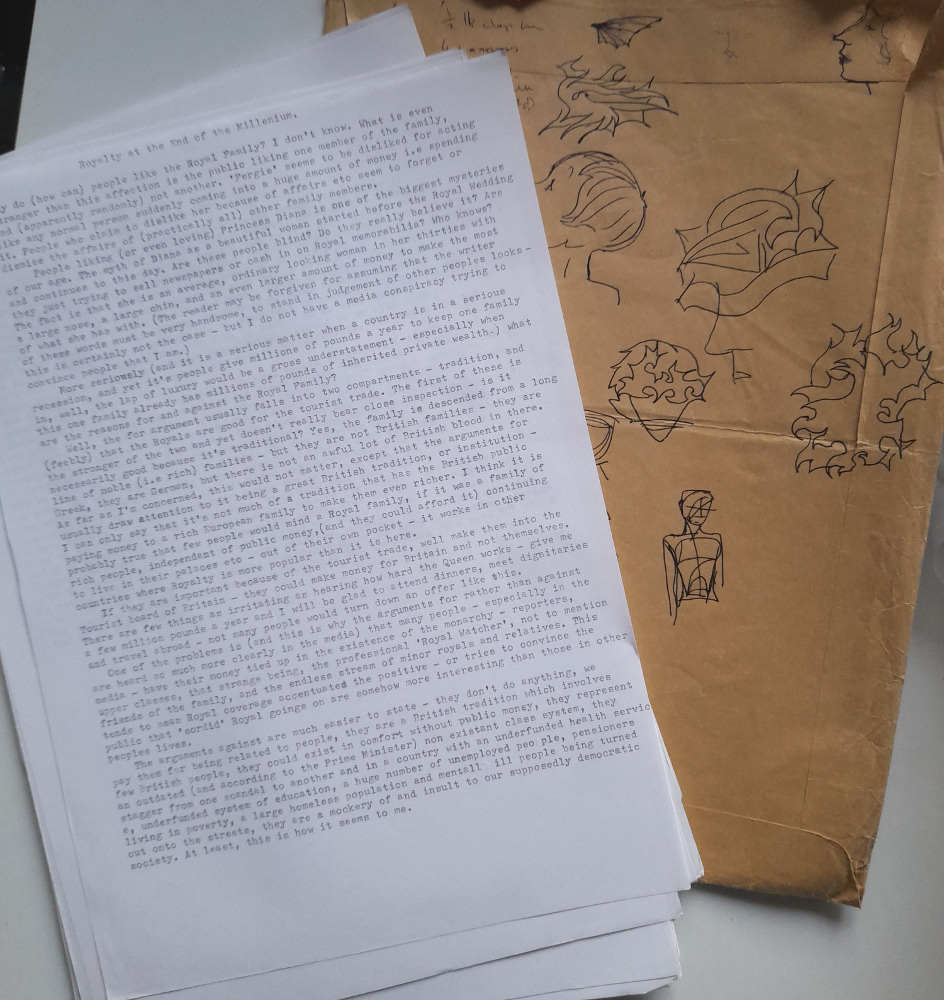
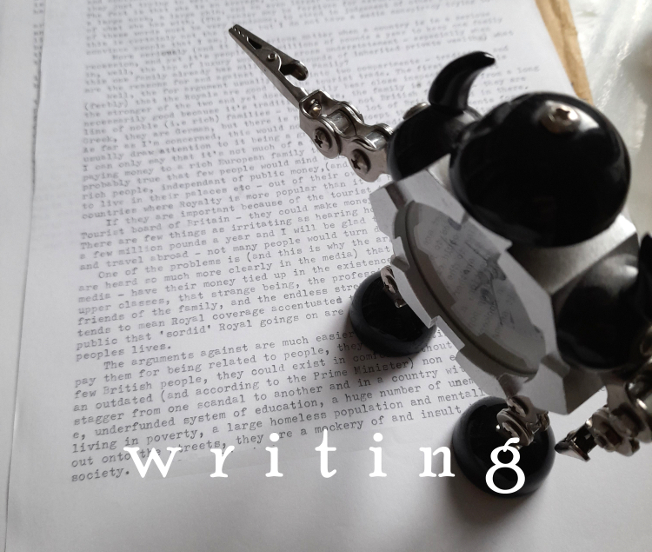
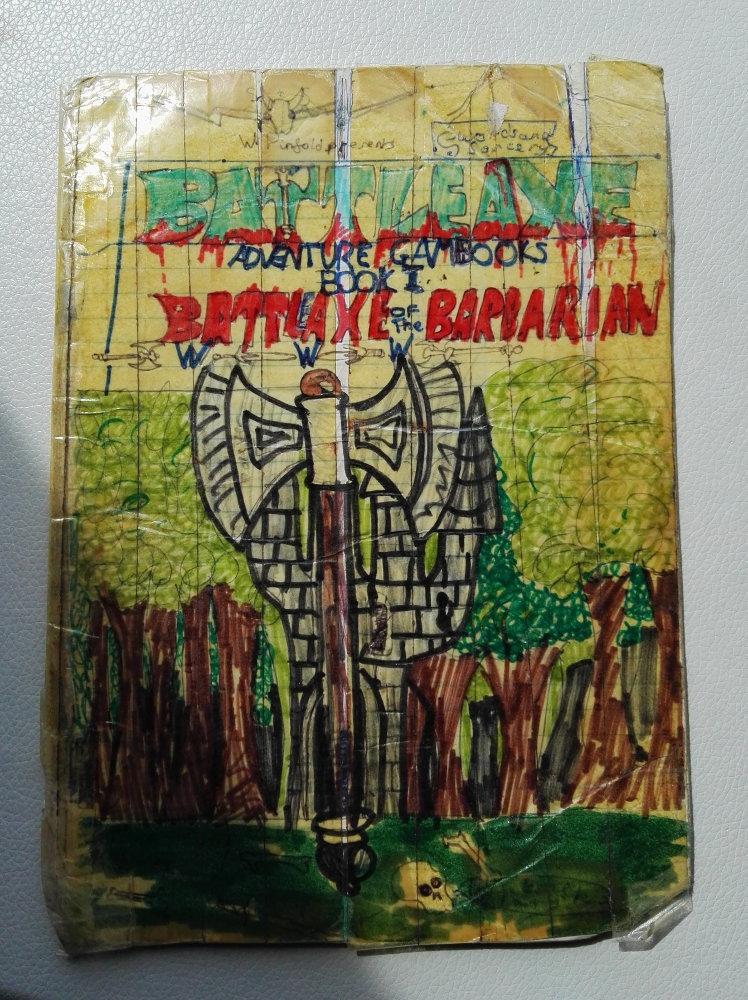
Between the ages of 19 and 21, I wrote a series of notes (the longest is about a page, so somewhere between a sketch and a mini-essay I guess) that made up a kind of summary of my worldview at the time. At this point I don’t remember why I wrote them, but I’m sure it wasn’t for its own sake; they were probably things that were to be “boiled down” and processed and incorporated somehow into poetry, strange though that sounds. From an early age, I always wanted to write. The first things I remember voluntarily writing apart from some comic strips are simplified versions of the kind of fantasy gamebooks that were then hugely popular with kids. The Swords & Sorcery series (more about that by one of the other authors of the series here) emulated Steve Jackson and Ian Livingstone’s hugely popular Fighting Fantasy single-player role-playing gamebooks pretty shamelessly but were lots of (complicated) fun to write, though few of them were actually finished. These were followed by (and/or written parallel to) various short horror stories, but in the long adolescence that seems to have lasted in my case from 15 until 25 or so, I mostly wrote poetry. It’s fair to say that it was not good. The notes though, are fun.

They cover a range of topics – politics, religion, aesthetics, social issues, ecology, the monarchy – and are exceptionally embarrassing to read. But interesting too, because although I do of course remember being 19-21, I otherwise only have the distorting mirror of my own memory to go by, and my own taste in music, books etc, which give a kind of connection to ur-me. But these notes must be pretty much what I thought, expressed to the best of my ability (or thereabouts). They reveal some interesting things I had not realised about my younger self. Although I generally did fairly well in English at school, I now see that my spelling was quite erratic (especially on words ending in -itely, which I always wanted to make -ately, like ‘definately’) and that I must not have learned the it’s/its rule until later. The pieces were typed on an actual typewriter as I didn’t own a computer at the time, which was not actually all that strange back then. More to the point though, by that age my always-terrible handwriting had deteriorated to the point where I found it hard to read things I had written after any length of time had lapsed.

The socio-political/geographical background to the notes was the bitter, tail end of the UK’s thousand year Tory Reich that I grew up in. Thatcher had by then gone, but the evolution/mutation into the Major era had made very little difference, except insofar as John Major himself was vastly inferior as a hate figure than Thatcher had been.

It’s funny; the arrogance and certainty of youth is well-known, but I’m still very surprised to find it in myself. I have rarely met anyone less sure of themselves or more reticent than my late-teens/early-20s self, but that doesn’t come across at all, except in a few deliberately self-deprecating caveats, and there’s an infuriating cockiness to some of the writing that I not only don’t identify with, but really hate; what’s mortifying is that I was genuinely trying to think deeply about the issues I covered so shallowly. Oh well, I hope I wasn’t actually that obnoxious in everyday life, but who knows? (anyone who knew me). On the other hand, my actual views don’t seem to have changed as much as I would have expected. I was more of a libertarian, albeit a left-wing one then, perhaps a bit more pessimistic, but on the whole I would still find myself on the same side of most of the arguments I am making, which is reassuring.
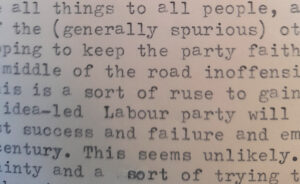
I don’t intend to transcribe very much of the writing here because I can’t bear to, mostly, but here’s a synopsis of the contents of the documents and there will be a couple of more extended examples below that illustrate how much/little/comically times have changed since then (the mid-1990s)

I don’t know if these were ever in any order, but here’s what I have:

“Classic Myths” – examining, in very little depth or detail, how things become “classics.” It ends with the question (re. literature) “how many great works have disappeared into the mists of time due to personal taste or political, religeous [sic] or moral qualms on the part of the academics of the past?” At this point I was reading the long out-of-fashion (and out of print) poetry of Robert Southey which was, to be honest mostly pretty hard going – but I was determined to like his early, pro-revolutionary work from his ‘Pantisocracy’ days with Coleridge, and I did, when I could find it anywhere.

“The Eye of the Beholder – One” This was me complaining about how Hollywood/popular culture/fashion were making standards of beauty ever more bland in a diminishing returns/vicious circle kind of way. Its exceptionally snooty tone was coloured by the fact that I was discovering the movies of the silent and pre-Hays code era and my own personal objects of desire were people like Louise Brooks, Joan Blondell and Marlene Dietrich. Sample of tone: “Sadly this means that when a certain actor or actress is in a hit film, similar actors and actresses will appear in similar films and so on and on, to ever-diminishing effect, until a new trend (snowboarding and dark hair, perhaps) transforms the screen for a few months or weeks(…) this ever-growing supply and demand for something familiar makes it hard for original voices to be heard, or any kind of innovation or talent to gain an audience.” 😬


“Religion Crazy” – This is pretty much what you’d expect from an atheist teenager, full of such blinding revelations as “Religion has often looked to me like a cunning scheme invented by some ancient tyrant to keep the peasants in their place” and, even better, “intolerance of religion and the religious is a vice I magnanimously allow myself to indulge in.” My own lack of belief hasn’t changed in the slightest since the days when I used to look around the room during the morning recitation of the Lord’s Prayer at Primary School, to see who else had their eyes open. But I though I don’t necessarily disagree with him (and actually am him), I don’t really feel much kinship with the writer of these lines, or especially his tone, now: “Am I to believe in a petty, small-minded god who creates something only to punish and destroy it? Maybe in a bored or indifferent god, as is suggested by its (had to correct it, sorry) conspicuous absence in the last few centuries. Perhaps it is more interested in ants than people, and appears to them all the the time.”

“Sexuality and Children” Luckily I was aware even then that this was an alarming and “rather dodgy” title, but essentially it was about the debate then ongoing about gay parents adopting children. My attitude (as with many of my then-attitudes) was essentially a slightly shaky but very teenage libertarian one: who is entitled to tell other adults how to live their lives? “Aside from (fairly ridiculous) superstitious quibbles which can be disregarded at once, (by me anyway) there is no reason on Earth why it is the business of any but those directly involved.” I still think the same thing, more or less but again the tone is, to be kind, insufferably annoying.


“Not Winning isn’t Losing” – politics, kind of. Contains nuggets like “My ideal political situation is unworkable (…) (it) amounts to well behaved anarchy.” But again, I still believe parts of it, despite painfully naive bits, like “The impossibility of a left-wing political ideal does not mean it is hopeless – indeed the opposite is true. Because it can never be attained, there would always be a working towards it – the lack of destination would improve the journey. The effect of a constant working towards a state of freedom and equality would inevitably lead to and ever-improving state of more freedom and more equality – which can not be bad.”

“Books” – this is funny, so I’ll write about it in more depth later


“Power Crazed”  This is one single line, which I hope isn’t true: “There can never be a good Prime Minister, because Prime Ministers are people whose ambition is to rule the country.”

“Limits” – an excruciating piece about nationalism/patriotism and so forth, in which our author pompously concludes “As far as I’m concerned, I find it absolutely impossible to feel either proud or ashamed of anything that occurred completely beyond my control – race, sex (I guess I meant as in gender), sexuality – or where I was born.”

“Money” – a blindingly obvious revelation that the idea of money is, when you look at it, kind of silly. “Why is gold a valuable metal? Presumably because it looks nicer than other metals, and there is less of it.” etc, etc


“Tripping on the Catwalk” In which I make my ignorance about the fashion industry obvious, and which includes the bizarre statement that “its nearest relative is perhaps the academic world of the university. It is completely self supporting, untouched by recession, mainly due to the fact that it is run by bored rich people for bored rich people.” I am now fairly sure that this isn’t 100% true. I also predicted “an eighties-style big shoulders revival (though with a nineties twist of course) before the turn of the millennium.” I don’t remember if that happened or not, but it’s happened since then.

“Royalty at the End of the Millennium” – Oddly, this is one of the longer pieces. As it’s as topical in the new reign of Charles III as it was then (?) I’ll deal with it later

“Part(l)y Politics One” Despite the parenthetical ‘l’ this is pretty much about party politics. In short; the Conservative Party is contemptible (“I have to assume some right-wingers are intelligent, though I have seen little evidence of this”). But I also seem to be saying that because conservatism is based on the fear of change and the desire for stability, plus an array of standard human failings; ignorance, fear, confusion, greed etc, it will always appeal to a large part of the population.

I theorise, not entirely inaccurately, about a pattern that I hadn’t then seen in action and which I later saw parts of in action – because Conservative governments appeal to the worst in people, they REALLY have to mess up before they get voted out. So therefore, any prospective left-wing government will spend a good deal of time un-wrecking the country, with consequent hardships. The public and opposition will naturally blame those in charge for those hardships, the problem then becomes that a progressive party gets voted out, but the incumbent right wing party inherits a country on the mend, which they take credit for, before ruining everything again. That’s not exactly how Tories – Labour – Tories played out in our time but it still feels plausible and at least not untrue.

“interlude” – between the two “Part(l)y Politics” pieces there’s a short kind of non sequitur in which I claim that the politics of the left, taken to their furthest extreme (i.e. ideologically, rather than in real life) is “a nice, if unworkable idea based on equality and human rights” while the politics of the right taken to their furthest extreme is ”at best an extremely nasty and distressingly workable idea based on hatred, repression and manipulation.” Not sure I agree with either of those statements now, though I think my heart was in the right place.

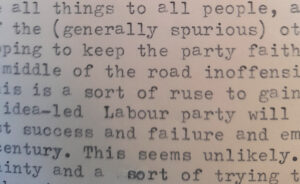
“Part(l)y Politics Two” – in which I complain that the Labour Party (and by extension any party of “the workers” is hopelessly compromised by a system in which becoming an MP is an ordinary middle class career choice, rather than being a kind of glorified shop steward. This was the Neil Kinnock/John Smith/Margaret Beckett era and I complain about the same thing that every Labour-voter-by-default has complained about ever since: that Labour in opposition try too hard to be all things to all people, appeal to Tory voters, are middle-of-the-road and inoffensive rather than truly progressive etc. It’s all very pessimistic: “We can only hope that this [middle-of-the-road inoffensiveness] is a sort of ruse to gain power, whereupon the new and hopefully forceful, idea-led Labour Party will throw off its current greyness, the spectre of past success and failure and emerge as a strong socialist party for the twenty-first century (…) The conservatives ‘accuse’ the Labour Party of being the same old socialist party underneath. This seems sadly unlikely – we understand socialism to be a system based on fairer distribution of wealth and of equality etc etc – the Labour Party does not seem to be offering this. We will vote for them, because there is no one else to vote for.”

“Opposites Attract” – this is a self-pitying whine about how “the plain or ugly are naturally attracted to the good looking, the handsome, the beautiful. The good looking, the handsome and the beautiful are naturally attracted to the good looking, the handsome, the beautiful. Beauty is in the eye of the beholder, but few beholders’ eyes will want to linger very long on the truly unattractive person.” I actually wrote this stuff down.

“Inhumanity” Here it is: “’Man’s inhumanity to man’ is a phrase used to describe acts which are definingly human. What other species would (or could) have had the atomic bomb, or the holocaust? It is a deceptive and cowardly phrase.” Well alright then.

“Food Philistine” – A strange and very silly short piece in which I discover that my attitude to food (though I had “no aversion to it”) was “the same as my attitude to sleep – if I could do without it, I would.” I don’t feel that way about either food or sleep now, really and until now I didn’t realise I had ever felt that way.

“Money, money, money” In short, class = wealth. The problem with Britain is (I seem to be saying) that the upper class control the wealth of the working class while the complacent middle class are indifferent as long as they are comfortable & therefore provide the upper class with a comfortable mattress to insulate them from the should-be-revolutionary consequences of their greed. It may be true?

“The Eye of the Beholder Two” – this time it’s all about how I prefer brutalist architecture to old churches etc and prefer the “drab emptiness” of municipal parks, deserted backstreets etc to epic, panoramic landscapes. Nowadays I like all of those things.

“Responsibility” A “pro choice” rant that, I’m glad but surprised to say, reads exactly like the social media posts of ‘pro choice’ people in the last few years – it begins “The anti-abortion lobby, for all their rhetoric about the sanctity of human life, seem to disregard entirely (and with great relish) the quality of human life. Indeed, they seem to enjoy inflicting misery wherever they go.” And it ends with the even more 2020s-ish: “To the anti-abortionist, the human being is only a human being until it is born. After that it is not their problem.” I was right then and still am now: yay me.

“Censored” In which I get on my high horse about the right to watch violent horror movies: “When I hear that a member of the British Board of Film Classification has embarked on an orgy of violence and mayhem using a chainsaw, I will begin to believe that film violence has an effect on the viewer (if it happens twice.)” I DO think it has an effect on the viewer – actually, I hope it does, or why even bother? Disturbing things should be disturbing. But my views on censorship (if no harm is done in the making of it then who has the right to say an adult shouldn’t watch it) are pretty much the same. I probably believe in ‘classification’ and parental responsibility more now than I did then though.

“A Fair Day’s Pay…” Manual workers should be at the top of the pay pyramid as their work is harder and more necessary, but pen pushers are in charge of wages etc so it’ll never happen, he seems to be saying.

“Animals” A very dubious piece in which I query the relative value of human beings and other animals, slightly in favour of other animals, or at least not in favour of us humans.

“Power Corrupts – Small time” “Power corrupts – this is an indisputable fact,” I say – but is it? Anyway, my premise is that dictators are bad and all, but for really corrupt power you have to look at school teachers and small-town police officers.

“Grown Men and Women” – Me, moaning about sport

“How to Spoke Proper” – In short,“speaking properly” (in the UK sense) is a classist fantasy based on the random fact that the BBC happened to be founded in the south of England. This may or may not be true.

“Rules of Attraction” – “Sexuality has nothing to do with morality,” he says, “I am attracted to members of the opposite sex because I was born this way – so if I saw a member of my own sex who looked like a member of the opposite sex in a way that I found attractive, I would naturally be attracted to them, for as long as they looked like an attractive female. I do not see how there can be anything wrong with this, or any variation of it.” This sounds like an argument with some lurking real-life subtext, but to the best of my knowledge now, it wasn’t.

“The Sea” – it’s about the sea, which I apparently felt very strongly about. I still love the sea but can’t imagine writing very emotionally about it.

“Philosophy” – As an atheist is there any more logical philosophy than to live a life of pure hedonism? I seem to conclude not, but for me at the time this was a purely hypothetical question

“Against Nature” –  Here it is in full: “Humankind is natural, as much a part of nature as anything else on the planet. Everything humankind does is natural. The worst it can do (selfishly speaking) is to kill itself off, which in a universal sense, would be no big loss.” I was in some ways a very standard teenager I guess. Joy Division was probably my favourite band at that point

So, here are the more extended bits.

>Firstly, I’ve chosen “Books” because it is the one that most amusingly makes the 1990s seem like it was a million years ago. My main argument is that though people were (as they always seem to have been) predicting the death of the printed word, books are unlikely to be replaced by anything else. But let young Will explain it, as his Nostradamus-like powers of prediction don’t seem to have anticipated the Kindle. More strangely, he does not seem to be aware of laptops, didn’t they already exist in the mid-90s? Surely! To be fair to him though, “we” still prefer a book to a kindle or tablet which I can’t stand using unless it’s the only way to read something.

Anyway, the death of books will not happen, he says, because…
“They are convenient, we [he often calls himself ‘we’] cannot imagine taking even a small computer on a train or plane, or to the beach or on holiday in our suitcase – though this may be possible in the future. We like to go back a page and reread something, whilst[!] keeping our place on the page we have reached. We like the thought, whether we actually do it or not, of being able to read Wordsworth in the mountains of the Lake District – we feel that a keyboard and a screen would take away a rather large part of the romance of this.”

“Royalty at the End of the Millennium” is fun because it’s surprisingly still topical (up to a point) and begins by saying things, far more grumpily, that I probably still think. I’ll transcribe as much of it as I can bear, with the faulty punctuation and repetition intact because the tediousness is part of the fun. Still, it’s odd and a bit alarming to find a UKIP-ish tone intruding re. the funding of the Royal family, even if I thought I was playing Devil’s avocado (as I might have said) at the time.

“Why do (how can) people like the Royal Family? I don’t know. What is even stranger than this affection is the public liking one member of the family, and (apparently randomly) not another. ‘Fergie’ seems to be disliked for acting like any normal person suddenly coming into a huge amount of money i.e. spending it. People who claim to dislike her because of affairs etc seem to forget or dismiss the affairs of (practically all) other family members.
People liking (or even loving) Princess Diana is one of the biggest mysteries of our age. The myth of Diana as a beautiful woman started before the Royal Wedding and continue to this day. Are these people blind? Do they really believe it? Are they just trying to sell newspapers or cash in on Royal memorabilia? Who knows? The fact is that she is an average, ordinary-looking woman in her thirties with a large nose, large chin, and even larger amount of money to make the most of what she has with.*  (The reader may be forgiven for assuming that the writer of these words must be very handsome, to stand in judgement of other peoples looks – this is certainly not the case – but I do not have a media conspiracy trying to convince people that I am).
More seriously (and it is a serious matter when a country is in a serious[!] recession, and yet it’s people give millions of pounds a year to keep one family in, well, the lap of luxury would be a gross understatement – especially when this one family already has millions of pounds of inherited private wealth). What are the reasons for and against the Royal Family?

Well, the for argument usually falls into two compartments[?] – tradition, and (feebly) that the Royals are good for the economy via the tourist trade. The first of these is the stronger of the two and yet doesn’t really bear close inspection – is it necessarily good because it’s traditional? Yes, the family is descended from a long line of noble (i.e. rich) families – but they are not necessarily British families. They are Greek, they are German, but there is not an awful lot of British blood in there. As far as I am concerned, this would not matter, except that the arguments for usually draw attention to it being a great British tradition, or institution. I can only say that it’s not much of a native tradition that has the British public paying money to a European family to make them even richer.”

Some more highlights – this is just too tedious to write out in full:
“There are few things as irritating as hearing how hard the Queen works – give me a few million pounds a year and I will be glad to attend dinners, meet dignitaries and travel abroad – not many people would turn down an offer like this.”
“The arguments against are much easier to state – they don’t do anything, we pay for them for being related to people, they are a British tradition which involves few British people, they could exist in comfort without public money, they represent an outdated (and according to the Prime Minister) non-existant class system, they stagger from one scandal to another and in a country with an underfunded health service, underfunded system of education, a large homeless population and mentally ill people being turned out onto the streets** they are a mockery of and insult to our supposedly democratic society.”

So there we have it, an unexpected meeting with my apparently slightly intense, smart-assed but ridiculous younger self. Nice to catch up but I’m not sure I’d want to hang out with him!

*Yes, I genuinely wrote “to make the most of what she has with”

**I assume this has something to do with the “care in the community” scandal that seemed to be unfolding during the last few years of the Thatcher/Major era