instead of a story

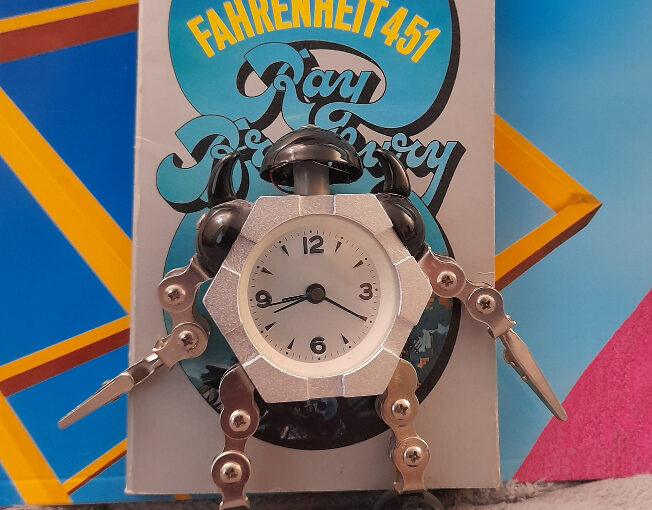
Alas, I am not a young writer; I have been writing for many years. But recently I came across Ray Bradbury’s advice for young writers, put in the simplified form of a challenge: read one poem, one short story and one essay per day, preferably from different eras and different fields and write one short story per week. I first saw a version of it as a 30-day challenge, but then saw something else that said Bradbury’s bigger theory was that if continued over the course of a year, nobody could write 52 bad stories in a row, which I dispute. But still, it’s a fun idea.

I already read every day, I already write every day; but it’s nice to get better at something and the discipline of it is (I think) oddly appealing.
In fact, what Bradbury said (at least in 2001 at The Sixth Annual Writer’s Symposium by the Sea) –  is considerably more elaborate and quite a lot less appealing – but probably even better as advice:

“I’ll give you a program to follow every night, a very simple program…one poem a night, one short story a night, one essay a night, for the next 1,000 nights. From various fields: archaeology, zoology, biology, all the great philosophers of time, comparing them…But that means that every night then, before you go to bed, you’re stuffing your head with one poem, one short story, one essay—at the end of a thousand nights, Jesus God, you’ll be full of stuff, won’t you?”

So anyway, I started my own version of the challenge last Friday (though truth be told, I didn’t do my reading before bed in every case, just at various times during the day). So far been a very nice thing to do. A sort of caveat is that so far I’ve been relying on books I already own and that therefore one might assume I’ve already read. In most cases I had, but as everyone who accumulates books knows (especially if some have been bought for a specific purposes, such as academic studies) there are things that remain unread, or at least not fully read for decades, while remaining on your mental I will read this list.

I only chose things that, if I had read them it was so long ago that I had little or no memory of them. As it turned out, I tended to have a very different idea of what they were like from how they seem to me now; it was interesting.

What struck me most forcibly over the course of a few days was how I value different things in different media. Understanding is the main one: reading a story and feeling that I didn’t fully grasp it really bugged me and spoiled my enjoyment of it. Reading an essay and feeling that I didn’t fully understand it made me think that the writer had failed to communicate their ideas as well as they might have (for someone of my mental capacity at least; I am not, and don’t pretend to be everyone’s ideal reader). But in poetry the feeling that comes from the work is (to me) almost independent of the meaning, which had little to do with how much I did or didn’t engage with a poem. I’m not sure I felt that way when I was younger and read a lot more poetry than I do now.

The first poets I really loved as a teenager were to an extent ‘difficult’ – Sylvia Plath, early WH Auden and TS Eliot. But at some point in my 20s my favourite poet became Philip Larkin (whose work I still love) and I think to some extent I absorbed his attitudes toward obscure or modernist poetry and began to value clarity of meaning more than anything. Now, decades later I find that clarity needn’t be one thing: no poem I read this week had anything more immediately vivid and clear than the opening lines from Seamus Heaney’s Cairn-Maker. Whether I ‘understand’ the poem as a whole I don’t know, but these lines feel miraculously precise and evocative and the rest of the poem is no less impressive: I loved it

He robbed the stones’ nests, uncradled
As he orphaned and betrothed rock
To rock…

Seamus Heaney, ‘Cairn-maker’, from Wintering Out (Faber & Faber, 1972).
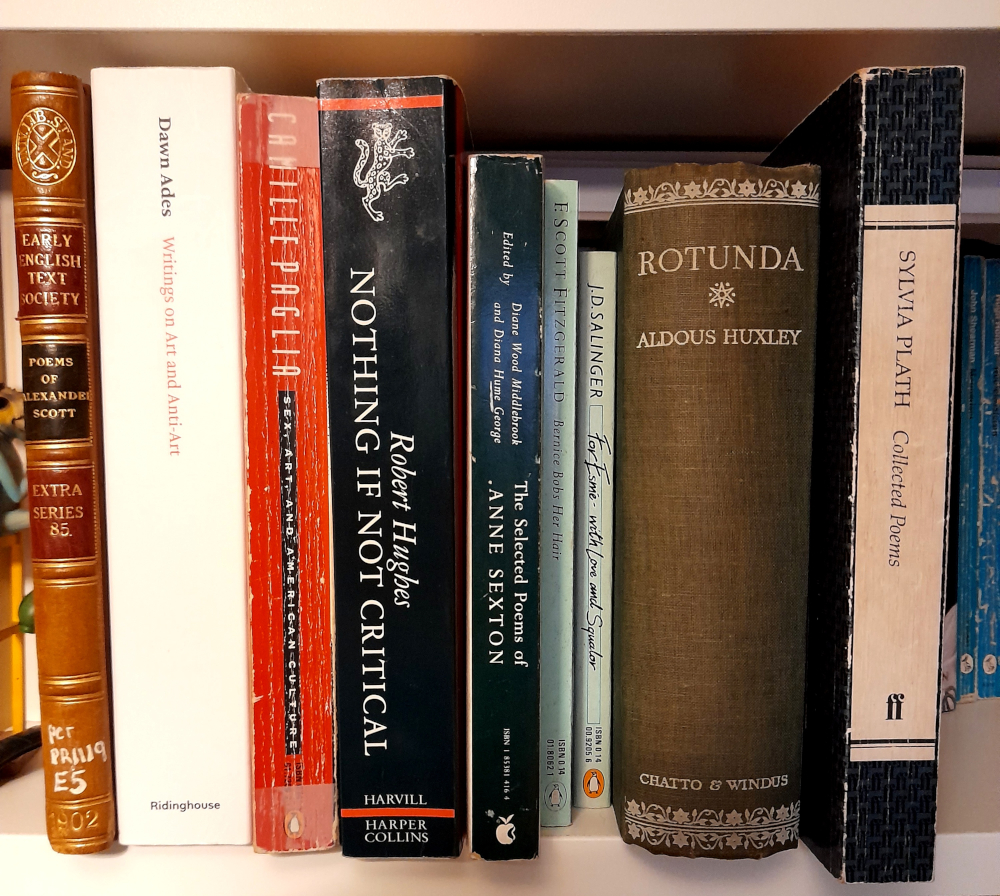
So anyway, here’s my first week, or 8 days since apparently I can’t count. Hang around at the end for my own (lack of a) story:

FRIDAY

Essay: Camille Paglia – Sexual Personae: the cancelled preface (1990) Back in the early 90s, before libertarianism became almost exclusively a right-wing preserve I loved Camille Paglia’s macho & egotistical writing: it was exciting and stimulating. Turns out it still is, but to 21st century me it’s also as infuriating as it is interesting and it seemed like every time she makes a good point (which is often) she unfailingly follows it up with some reactionary/annoying point that feels uncannily like something from the unpleasant side of the current culture war.

Poem: Wang Wei – Written at My House near the Wang River at a Time of Incessant Rain (c.750 AD). This is a very pretty and mysterious poem, more a collection of brilliantly delicate images than any kind of narrative.

Short Story: JD Salinger – Pretty Mouth and Green My Eyes (1948). I love The Catcher in the Rye, but aside from that was always a bit disappointed by Salinger’s work. Having not read this since I was probably 21 I was quite taken aback by how good it is: incredibly bitter and ironic, I loved it.

SATURDAY

Essay: Robert Hughes – Paul Gauguin (1988) I half expected to find this a little dated given the advances in Gauguin scholarship since the 80s (especially as I recently read Sue Prideaux’s phenomenal and game-changing biography Wild Thing) but in fact Hughes’ disdain for the various conflicting legends of Gauguin and his focus not on his supposed primitivism, but his actual sophistication and technical skill make this an excellently concise overview of a sometimes misunderstood artist

Poem: Anne Sexton – For John, Who Begs Me Not to Enquire Further (1960). I love Anne Sexton and this is a typically raw, intense and enigmatic poem, which may (I’m not sure) be saying ‘don’t just dismiss me as my mental illness.’ The thought that lingered with me after reading it was a very relatable one; it’s the hope that gets you.

Short Story: Story: F. Scott Fitzgerald – A Short Trip Home (1927) This was very gripping and atmospheric, more of a tough thriller type story than I’d normally associate with FSF (who I like a lot). I really enjoyed reading it, but the ending felt like a letdown and definitely not something a (much less literary) genre writer would have done. After I’d read it I kind of felt like I’d missed the point somehow; not my favourite sensation after reading a story (this was a late night one though, so might have to revisit it when wide awake in case it was just me)

MONDAY

Essay: Olivia Laing – Lamentations (2017) This was an excellent little essay about religious art which I was bound to like, partly because I like religious art, partly because Laing’s point aligns with my beliefs – basically, there’s no need for afterlife, we have life – but mostly because she is a very good writer.

Poem: Douglas Dunn – 13 steps and the 13th of March (1985) and After the War (1972) – I ended up reading two Dunn poems because I’d just heard that he died. He’s not a poet whose work I’ve ever loved (though I’ve never disliked him either), but these were good. The first, from a book of poems about the death of his wife is very sensitive and restrained and moving, but I think I preferred the second, which was about childhood and war and trauma and had a kind of oblique intensity that I thought was very effective

Story: Will Self – Between the Conceits (1994) – One of my favourite stories I read this week. Self’s surrealism was perhaps over-hyped in the early 90s but I really loved his work. At some point (not for any particular reason) I stopped keeping up with his stuff, though I still like it whenever I read it (especially his journalism). This was very funny, very straightforwardly written and deeply weird, it reminded me, very unexpectedly, of Clive Barker, another of my favourite writers in that period, though their prose styles are wildly different

MONDAY

Essay: Christopher Hitchens – The New Commandments (2010) – I love Christopher Hitchens, both before and after his transformation from being a radical left-wing writer to being am unusual right-wing one (more is made of that transformation than I think should be – almost all of his political beliefs remained the same, from reading his excellent memoir Hitch-22 it was mostly a reaction – I think an unfortunate one, it certainly didn’t bring him any happiness – to the aftermath of 9/11). But this was a fun, very sensible and amusing deconstruction/reconstruction of “the” 10 commandments (which as he points out are really only 10 of the many commandments in the Bible).

Poem: Thomas Hoccleve – On Richard II’s Burial at Westminster (1413) – This was unexpectedly one of the poems I loved reading the most. Reading medieval English can be difficult but there’s something very vivid and moving about the language. This poem is basically a religious/political one that’s filled with a sense of relief, it’s about how Henry V was putting things back on track after a period of chaos and strife (which wasn’t however over) by treating the bones of a dead king with the appropriate respect.

Story: Aldous Huxley – Half-Holiday (1926) – again I loved this – Monday was a good reading day! My favourite Huxley isn’t the Brave New World/Doors of Perception/Heaven & Hell Huxley, but the one that wrote uncomfortable and sometimes bitter social comedies like Antic Hay and Point Counter Point. This was a typically sad little story about a poor, awkward young man with a bad stutter who fantasises about picking up fashionable, posh girls and tries to do so, with painful results.

TUESDAY

Essay: George Orwell – World Affairs, 1945 (1945) This was a depressing but extremely accurate prediction of what was about to happen (the Cold War), that was written after VE day but before the atom bombs dropped.

Poem: Seamus Heaney – Cairn-Maker (1972) I first read Heaney at school and therefore had a slight aversion to his work, but at some point in my 20s I ended up getting all of the books he’d written to date, which got harder to understand as they went along. This is a superbly-written poem, the imagery is so immediate that it took me by surprise. In the end I couldn’t decide if it’s a purely a descriptive poem or not – I think it probably isn’t but it worked for me on that level. I think it has the most precisely chosen words I read for this ‘challenge’- loved it.

Story: Charles Bukowski – Swastika (the title is actually a swastika, not the word) (1969-72?) – God this was lame. Very enjoyable but completely silly story about an unnamed US president (Nixon, presumably) being kidnapped and having his body taken over by Hitler while he is put in Hitler’s body. Okay, Charles. I do like Bukowski but his quality control was non-existent.

WEDNESDAY.

Essay: Karl Marx – Investigation of Tortures in India (1857) I like Marx the journalist a lot; this was a good, clear (oddly Orwell-like, or the other way around, logically) examination of the scandal then coming to light of torture being used by the British administrators in India, for the purpose of extorting money. Typically there was an official inquest, but it blamed the Indian enforcers and so on and cleared the higher up white people of blame. Marx cuts through their bullshit nicely.

Poem: Sylvia Plath – Private Ground (written 1960/1, published 1971) – Sylvia Plath was my favourite poet for years, but the poems I remember are mostly famous ones from Ariel (1965). This one, about cleaning up a (family I assume) garden and draining the pond before winter, has superb word choices, especially for the dead baby fish (like orange peel). The overall mood is full of a chilly melancholy rather than Plath’s more dramatic horror etc.

Story: JG Ballard – The Reptile Enclosure (1963) – I’ve read so many Ballard stories over the years and I know I’d read this but I couldn’t remember what happened in it. It’s an excellent and very ‘Ballardian’ surreal little story that begins in a kind of mundane way being about a married couple who are unromantically putting up with each other, but typically ends in catastrophe.

THURSDAY

Essay: Charles Baudelaire – The Modern Public & Photography (1859) – This was an excellent & extremely prescient article about how the virtues of art and photography are different & how photography was being weaponised by the talentless in a war against art: seemed a bit over the top in a way but there was one paragraph which could have been written today about AI and would be just as true.

Poem: Andrew Motion – Leaving Belfast (1978) – this was a very nice, straightforwardly written but ambivalent poem about leaving Belfast and with it ‘the troubles’ – very effectively evoking the strain of living with an implicit but rarely openly stated threat.

Story: Thomas Burke – Tai Fu and Pansy Greers (1916) – I bought Thomas Burke’s sensational (and often pretty racist) short story collection Limehouse Nights when I was very interested in silent cinema (several of his stories were made into highly successful films like Broken Blossoms). The stories are all concerned with street life in what was then London’s Chinatown and the characters are down-and-outs, drug users, prostitutes etc: it’s shockingly un-genteel for English writing of the era. This was a sleazy, melodramatic but very readable and in some ways quite modern story. It felt quite Americanised in a Damon Runyan way, but I think that’s because it’s so rare to read the street slang etc of pre-war Britain, which was far more modern than the acceptable fictionalised speech of the era.

FRIDAY

Essay: Dawn Ades – Paolozzi, Surrealism, Ethnography (1985) – Dawn Ades is one of my favourite writers on art and this was interesting piece about the relationship between surrealism & ‘the primitive’ which was quite different from the usual modernist primitvism of Picasso or the German Expressionists. The strong anti-colonial aspect of Surrealism (which people often overlook) made their use of ‘foreign’ art quite different and in this case Ades talks about using ethnographic material as much to highlight the alien qualities of contemporary Western art and culture as to make foreign art seem alien and new

Poem: Alexander Scott – Departe, Departe, Departe (c.1550s) – I love reading medieval Scots even more than medieval English (though they are very similar; but there’s something so nice and distinctive about the way Scots has ‘Qu’ instead of W: I love ‘quhat’ instead of what, ‘quha’ instead of who etc). This is a beautiful, very conventional romantic ballad but I loved the way that reading (quietly but aloud to myself) it makes it comprehensible where at first it looks opaque. It’s full of odd words like ‘spreit’ which, from context you quickly realise is ‘spirit’.

Story: Milan Kundera – The Hitchhiking Game (1969) – This was interesting because it was the first Kundera story I ever read, back when I was a teenager. At the time I found him very grown up and kind of cool, but now he seems like the kind of unreconstructed 60s man who would call women ‘chicks’. It’s a good, horrible little story and (a distinction I’m not sure is worth making) sexist without I think being actually misogynistic: Kundera likes women, he just thinks of them as a species apart from men. But really, it’s a gripping little story about the illusion/delusion of romance, that’s looked at in such a ‘manly’ way that it’s kind of funny. When I was younger I would never have thought of Milan Kundera as a simple-minded, macho Hemingway kind of writer (no offense to either of them) but that’s how he seems in this story.

***

So, I did the reading – but although I have written a lot in the past week (my favourite thing was writing up an interview I did with the Faroese singer Eivør, who was great) I didn’t write a story. I do write fiction occasionally (as a teenager I kind of assumed I’d be a novelist one day; so far, I’m not) and over the years have written quite a lot of stories of one kind or another, mostly horror.

I’m sure at some point during my – to put it in tedious online speak – ‘Bradbury journey’ I will write a story. I did have the germ (or seeds: which is smaller?) of an idea which could be a story but which I don’t feel inclined to develop at present, so here’s that:

The idea comes from the possible relationship between two sources: there’s a famous passage in the Bible (Mark 5:9, the internet says) in which Jesus meets a possessed man. Even for an atheist, the Bible is an endless source of fascinating ideas, but why this particular passage popped into my head I don’t know – maybe because it’s nearly Halloween? Jesus talks to the possessor(s) of the man – although I see online that people who don’t understand the meanings of words are following the tradition of referring to ‘a demon named Legion.’ FFS; it’s hardly unclear: the voice even says “we are many.” Look up what legion means! I don’t think it’s intended as the ‘Royal we’. Maybe if the translators responsible for the King James version, instead of writing “My name is Legion”  had used the just as accurate “We have many names,” people would get it. But it would be a sad loss; it’s a powerfully sinister and resonant phrase.

Anyway; I was also thinking about something I’d read where a newspaper (can’t remember which, I think the Times, but wouldn’t like to state it with authority) cited in a story either ChatGPT or Claude as a source, like they would any interviewee. The journalist did not take into account that the ‘Claude’ who a teenager is asking about their acne, the ‘Claude’ that someone is asking to sift through a lengthy legal document to point out its salient points and the ‘Claude’ who is being used to select military targets aren’t one person called Claude; Claude the agony aunt is not aware of the information that Claude the legal aid and Claude the missile-aimer are giving to different users, although if asked it could probably find out. Claude’s name, in other words is Legion: how that is developed into the narrative of a short story I don’t know, but I do know that it could be. So that’ll do for now. Onwards!
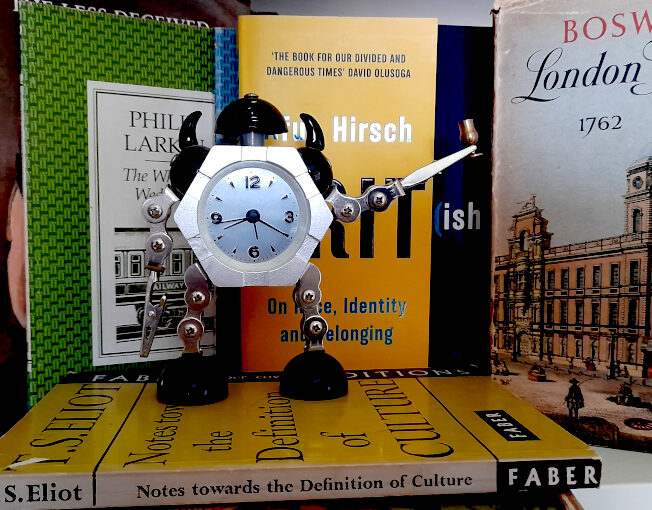
I went back to rockville

Between me thinking about writing something about what home and belonging means and actually starting to do it, it’s become a far more topical subject than I expected, which seems to be how these things go these days.

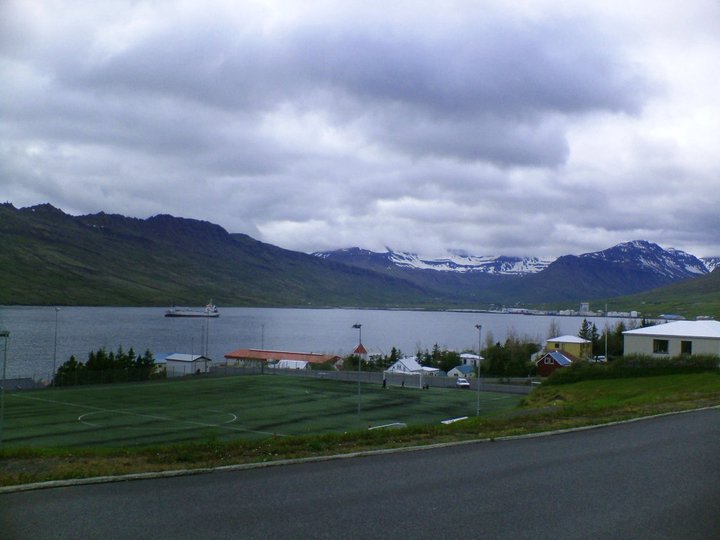
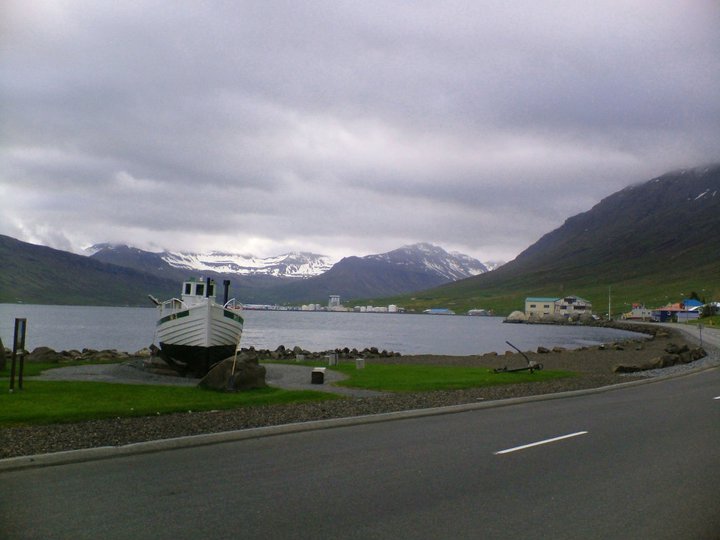
the outskirts of Neskaupstaður, Iceland

The initial impulse to write it came from several unconnected things; some photos I took in Iceland over a decade ago; the lyrics to the R.E.M. song “(Don’t Go Back to) Rockville;” a beautifully evocative description of a rundown railway station in a dusty, remote part of Austria-Hungary in the 1900s. That description felt especially poignant because Austria-Hungary is a country (and the Habsburg Empire an Empire) that no longer exists, but which must have felt permanent in its day and which people in the 1900s felt just as patriotic and loyal towards or just as ambivalent about as people now do towards the constituent parts of the United Kingdom or/and the UK itself. But all of that has retreated into the distance a little because as I write this, up and down the country – even in this little corner of rural Scotland – people are engaged in a protest of sorts. Unusually for a protest, it takes the form of doing something which has always been entirely acceptable to do and which no one has ever tried to discourage the protesters from doing; hanging up flags.

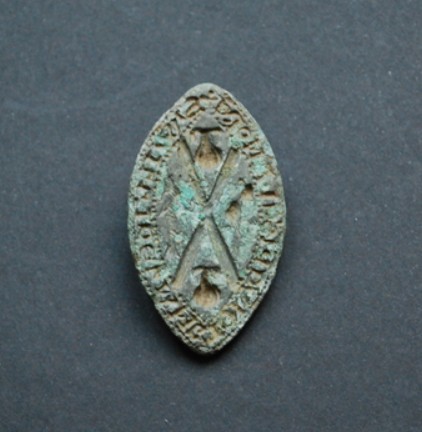
The seal matrix of Bishop William de Lamberton from the 1290s, the oldest extant physical use of the Saltire in Scotland

The flags that have made it onto the news – especially from the recent, ironically-named “Unite the Kingdom” right-wing rally in London, are mostly St George’s cross (the flag of England), interspersed with Union flags. In this village the flag fliers tend, naturally to instead display the Saltire/St Andrew’s cross (the flag of Scotland, reputedly the oldest national flag in Europe – which if its semi-mythical origins are correct actually predates the Kingdom of Scotland itself by a couple of centuries) and the Union flag.

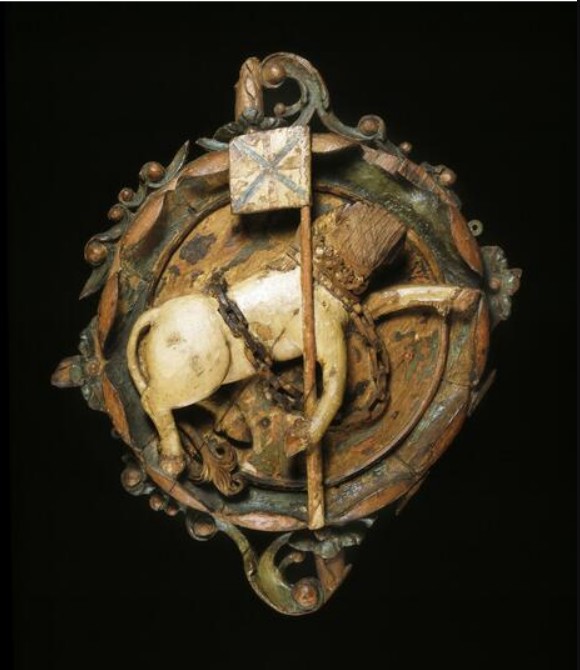
Flags are, by design, simple and very easy to identify, but they are also kind of a blunt instrument when it comes to signalling. Other people in this area have been displaying the Saltire and the medieval Scottish flag (the Royal Banner; a rampant red lion on a yellow ground) with no Union flag. I presume this is some kind of anti-unionist/nationalist counter-protest but I may be wrong; to be sure I’d have to ask the flag fliers, and who wants to do that? Whatever else they are, national flags tend not to be especially inviting, particularly when displayed in their country of origin. Nearby I’ve also seen – in a more obvious counter-protest – people displaying Palestinian and Pride flags.

carved wooden ceiling boss of a unicorn carrying the Saltire from Linlithgow Palace, c.1617

It’s a regularly remarked-on (and ultimately meaningless) irony that the historical St George was a Turkish man of Palestinian descent, but less remarked on (though similarly meaningless in this context) that St Andrew, who the saltire represents, was born in what is modern day (Israel-occupied) Syria. Lions (though not red ones) are native to sub-Saharan Africa and India. And yet, for the people waving, wearing, hanging, painting or generally displaying the flags, these symbols of Syrian and Turkish-Palestinian saints and these African/Indian mammals (1 for Scotland, 3 for England, though confusingly the English ones were historically referred to as leopards, which scans less well for a football song lyric) are symbols, I presume, of home. And therefore the people displaying them for patriotic, political or intimidating purposes mostly don’t care what their origins are, which is fair enough. It’s my home too, but although I have no special feelings about the flags of Scotland or the UK, seeing them all over the place, rather than just on official buildings or big hotels is oddly alienating, just like seeing the stars and stripes on every other street on a trip to the USA was.

The flags of your nation, displayed in that nation, tell you two things; firstly, where you are – which you already know – and secondly, that somebody wants you to be very aware of where you are, which you still already know. Theoretically, people display flags for themselves and not for anybody else, but a flag by its nature is a signal and for most of the time, the person who flies it outside their home or paints it on the street or on some historical landmark, or puts a sticker on a bus shelter can’t see it, but anyone passing by can.

Because so many of the people involved in the current protests are xenophobic (not really derogatory; many of them are explicitly saying they are protesting against “migrants”. “I belong here,” is not a protest; and anyway nobody is disputing it. “You don’t belong here” is mostly what the protest is about) there’s been a lot of discussion about what kind of symbols our flags are and what, beside dead saints, they represent. Obviously, flags themselves aren’t racist, or at least are only as racist as the people displaying them. There are possibly a few exceptions; most obviously, I feel like any Jewish or Romany person has the right to feel victimised if someone is displaying a black swastika in white circle on red ground; I wouldn’t think it was outlandishly sensitive if an African-American person felt offended by someone waving a Confederate flag at them. Still, it’s strange the extent to which seeing the flag of your country everywhere makes that country feel like a different place from the one you grew up in.

But home is a strange thing anyway and ‘feeling at home’ in the comfortable sense of being where you are supposed to be, in the place that it feels natural to be, isn’t universal; clearly the protesters don’t feel it or they wouldn’t be protesting.

Philip Larkin in 1943 by Bruce Montgomery, looking like he should be on a Smiths album cover

The poet Philip Larkin – often seen as a definitively (I refuse to use the word ‘quintessentially’) English figure and sometimes derided as a ‘Little Englander,’ made some interesting observations about home that demonstrate how one-dimensional that (otherwise not unfair) assessment of him is. In The Importance of Elsewhere (1955), he argues (well, it’s a poem, not an argument; anyway, he says) that feeling lonely and out of place is a normal, appropriate and even a comforting response to being in alien surroundings (specifically Belfast) – “Strangeness made sense. The salt rebuff of speech,/Insisting so on difference, made me welcome.” The strangeness of the place itself “went/ To prove me separate, not unworkable.” On the other hand, feeling lonely and out of place in the place you come from and where you theoretically do belong does the opposite; and it possibly says unpleasant things about the place itself, too.

Larkin was right; for himself at least and therefore it’s not surprising to find that a slightly earlier poem (Places, Loved Ones, 1954) begins “No, I have never found / The place where I could say / This is my proper ground / Here I shall stay…..” A few years later, he obliquely questioned whether the idea of home is even desirable at all, since ‘belonging’ to anything can only ever be transitory – “Home is so sad. It stays as it was left, / Shaped to the comfort of the last to go” (Home is so Sad, 1958). Eventually and unexpectedly, he did find that place where he could say this is, etc, etc – which turned out to be Hull. He celebrated the city in a 1961 poem called Here – the title is surely a self-referential one, looking back to that fourth line of Places, Loved Ones, quoted above, Here is one of Larkin’s very few poems of belonging, but inevitably he celebrates the town for what would normally be considered its negative traits; inaccessibility, neglect and, if not actual unfriendliness, then at least a distant kind of reserve; “Here is unfenced existence: / Facing the sun, untalkative, out of reach.” He really was the Morrissey of 20th century English poetry.

Coventry was where Larkin came from, but though he wrote about it several times, it was never in the sense of feeling at home there. But if “feeling at home” means some kind of existential peace and contentment, there’s no real reason why that you should have any particular connection with the place you’re originally from, unless you happened to have an idyllic childhood. Equally, there’s no special reason why where you currently live should be where you feel at home, unless you are contented there like, presumably, the angry people with their flags and paint. But if they really love their country they certainly hide it well, not just because of their anger, but also how they treat the place and the mess they leave behind; they really do protest too much.

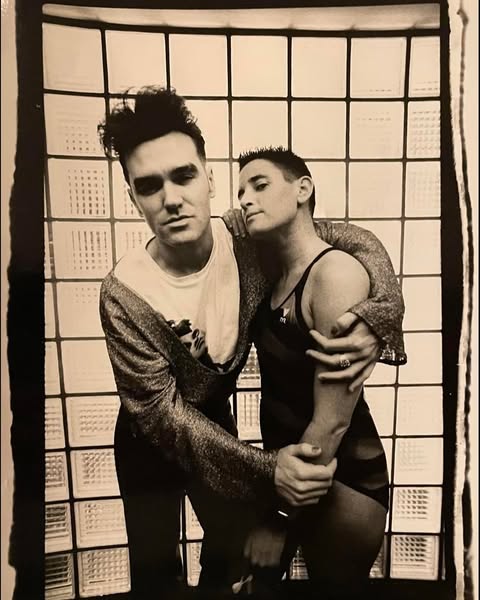
Morrissey with the American singer Phranc in 1992 by the great Kevin Cummins. Moz really is an unlikely right-winger

I’m loath to mention Morrissey again but a short side note seems relevant. For all his apparently xenophobic Englishness, Morrissey doesn’t (in common with many xenophobic, wealthy ‘patriots’) love England enough to actually live there. But to be fair, he rarely claims to love it at all; Morrissey is, thankfully, far more Larkin than Farage. The question of his (unusually complex but now undeniable) right-leaning politics goes back a long way, but when in 1992 he released the album Your Arsenal and alarm bells rang in the NME offices at the title of the song “The National Front Disco“, those NME scribes did him a disservice. He’s not foolish or racist enough to write a song actually glorifying the NF, though the song is definitely and maybe deliberately an uncomfortable one. In the lyrics he puts his finger (sympathetically or otherwise; it’s impossible to say) on the mentality of the kind of people currently waving placards telling foreigners to get out of “are country” (wish I was making that up). “There’s a country, you don’t live there / But one day you would like to / And if you show them what you’re made of / Then you might do.” That is really the essence of the march that happened last week in London and the smaller versions of it across the UK, including, dismayingly, one in Falkirk (one likes to think Scotland is above that kind of thing but realistically nowhere is, people being what they are).

‘Home’ is only on the most mundane level the place where you live, and the less mundane ideas of home are far more mysterious and often very personal. Without wishing to delve much into etymology, ‘home’ is a concept which even in its basic form as a noun (The place where a person or animal dwells, as the OED slightly creepily puts it) includes meanings that I don’t think I was aware of; “figurative. With reference to the grave or one’s state after death. Frequently with preceding adjective; ‘long home‘.” Apparently ‘long home’ was a common usage in Old English – and if you don’t belong in your grave then where do you belong? The long home is where the heart is; which makes me think of the last line of Wuthering Heights – surely one of the most beautiful endings to any deeply unpleasant novel:

I lingered round them, under that benign sky: watched the moths fluttering among the heath and harebells, listened to the soft wind breathing through the grass, and wondered how anyone could ever imagine unquiet slumbers for the sleepers in that quiet earth. Emily Bronte, Wuthering Heights, 1847

And then there’s home as in ‘too close to home,’ ‘coming home to roost,’ ‘the Home Office’, a point being ‘driven home,’ ‘home truths,’ ‘Home Rule,’ ‘make yourself at home’ (I have vague memories of a comedian or comedy character introducing their act by saying something like ‘Make yourself at home. Unless you’re in a hotel in which case make yourself in a hotel.‘ Vic Reeves? Alan Partridge? No idea).

Relatedly, belonging is a strange, unpredictable and entirely personal sensation. Larkin seems not to have felt he belonged anywhere until he found somewhere suitably impersonal and forbidding. Morrissey seems to thrive as an eternal outsider in Los Angeles, though it’s hard to think of anyone who seems more like an embodiment of Manchester. Belonging (I don’t say this self-pityingly, I’m comfortable with it) isn’t a feeling I’ve felt especially often and when I have it’s been at random times and sometimes in unexpected and unlikely places. Just recently, out walking in the area where I live and where I mostly grew up, I had one aspect of belonging; the exact kind of weather I obscurely feel most at home in; mild, grey, windless, with a low, quilted-looking heavy sky that didn’t quite threaten rain and let no ray of sunshine through. I like muggy weather and have never yet met anyone else who does. It’s kind of the other side of Larkin’s The Importance of Elsewhere – if not feeling at home ‘at home’ makes you unworkable (as he puts it), maybe the conditions that you feel the most at home in equally say something, possibly something unflattering, about you? Enjoying blue skies and sunshine (which I do too, although less so) just seems more positive somehow.

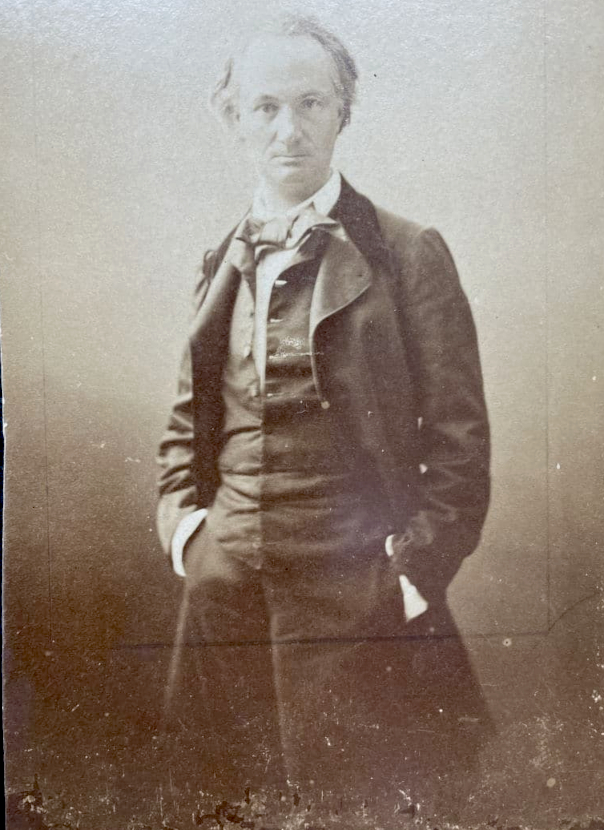
Baudelaire looking effortlessly cool & French in 1862 by Félix Nadar

Clearly for the protesters, ‘belonging’ is as much about people – a homogenous group of people – as it is about place. That’s the opposite of the vague kind of belonging that I sometimes identify with, the kind of thing expressed (very romantically) by Charles Baudelaire when he writes about ‘the flâneur’ in The Painter of Modern Life (1863). “To be absent from home and yet feel oneself everywhere at home; to view the world, to be at the heart of the world, and yet hidden from the world […] The spectator is a prince who rejoices everywhere in his incognito. … The lover of universal life enters into the crowd as into an immense reservoir of electrical energy. One might compare him, also, to a mirror, immense as that crowd; to a kaleidoscope endowed with consciousness which, with its every movement, conveys the multiplicity of life, and the grace in motion of every element of that life.” Well, I rarely feel as enthusiastic as that, and I generally don’t like being in a crowd with a specific purpose, even a benign one like the audience at a concert. But on the other hand, though I rarely feel at home anywhere, I never feel like my home has been stolen or invaded, and I don’t feel threatened because I see or hear people who are different from me. So that’s nice.

Xenophobia is kind of stranger than misanthropy, which is at least understandable, because human beings can be destructive and unpleasant like no other species. But although humanity has apparently infinite variety on the personal level, that variety, though it seems to terrify some people, is on every other level, extremely limited. However many names we choose to give this geographical (rather than political) area; the British Isles, the United Kingdom, Scotland, Wales, England, Ireland, Northern Europe – the population is, -whichever newcomers may arrive, and wherever they arrive from – pretty homogenous, because the human race is pretty homogenous. I was interested to hear my vague gut feeling given scientific validity by the archaeologist Dr Helen Geake (on the Time Team podcast of 9th September this year.) In response to a question about the diversity of the population of Anglo-Saxon England (following the discovery of a skeleton with African ancestry in an Anglo-Saxon cemetery) she said, “I’m not wanting to say ethnically diverse, partly because […] there’s so little genetic variability between humans that I don’t think we have anything like ethnicities or races or whatever. I just don’t think that makes any sense when you look at the science. I think it’s more of a diversity of appearance and origin.” When you consider the inter-species variation between, say a lion (since I mentioned them before) and a housecat, or a chihuahua and a Saint Bernard, it’s clear that the gradations between human beings are far more subtle. And when it comes to people you feel an affinity with, you’re as likely to feel at home (that expression seems stranger the more you consider it) with someone you met by chance recently (or even met virtually online), as with someone you’ve known since you were a child. Interestingly (there’s a euphemism!) I read just this morning that a “Race Science Institute – ie debunked Nazi bullshit – funded by one of the world’s richest men is currently trying to be influential in UK politics.

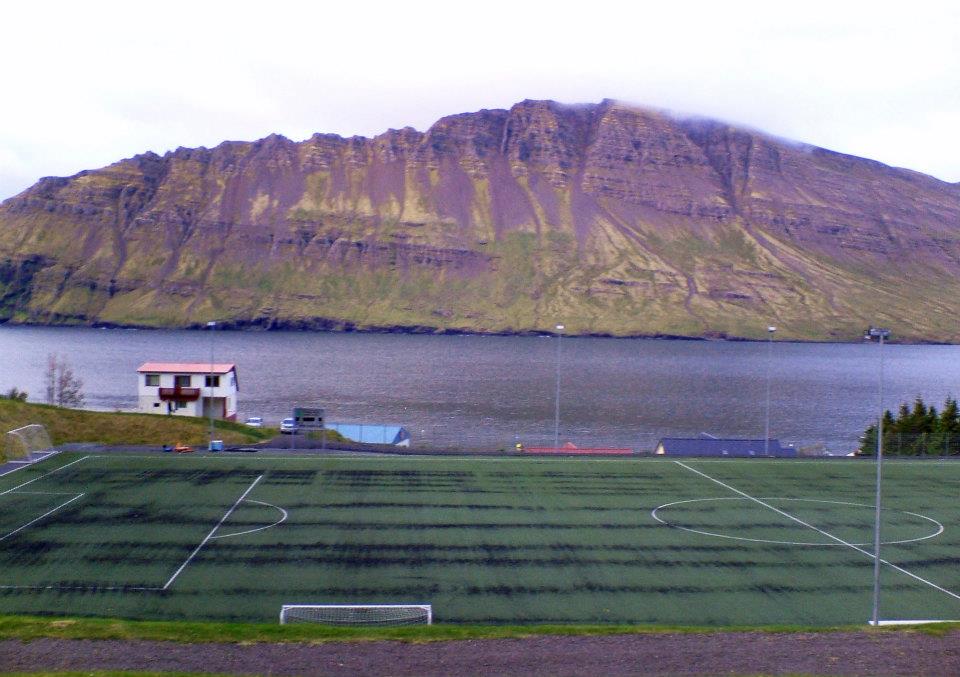
mouldy football pitch by the fjord, Neskaupstaður, eastern Iceland, around 4.30 am

Randomly – although it’s the thing that made me think about writing all this in the first place – I don’t think I’ve ever had that ‘at home’ feeling more strongly than I did when walking in the outskirts of a small town in Iceland at 4.30 am one July, during a night where the ‘midnight sun’ felt more like perpetual dusk. Why should that be? I have no idea. The conditions were right I suppose – not unlike the flat grey day mentioned earlier. Iceland is very beautiful but although this stretch of road ran alongside a fjord at some points, it mostly wasn’t something so picturesque that you’d put it on a postcard. It featured details as apparently uninspiring (but weirdly loveable to me) as a mouldering football pitch and a school or some kind of municipal building. At one point there was a boat on a platform, which did give more of that sense of ‘elsewhere’. What did ‘at home’ feel like? You know it when you feel it I suppose – a kind of vaguely melancholy contentment that may partly have come from having had a few drinks plus 24 hours or so without sleep; it was comfortable and it didn’t feel like exhaustion.

that mildewed football pitch in more detail

If I tried to express that feeling to some of the protesters, quite possibly they’d say something like “If you like it so much why don’t you go and live there” (British people have a long history of telling people if they don’t like the country they can just leave, and yet they rarely feel like they themselves should leave if they don’t like the country). It occurs to me now that when racists, xenophobes or (popular current euphemism) “concerned citizens” scream at people to go back where they came from, when they wrap themselves in the flags of their own country and wield their national identity at people, what they are doing may partly be asserting how they feel about their home, but what they really want is for everyone they oppose to not feel at home. And when, at the best of times, ‘feeling at home’ is a fleeting and precarious emotion, that’s kind of a shitty thing to do.