a pressing necessity: International Women’s Day 2026

Firstly, the title comes from this short essay by one of my favourite historical figures, Rosa Luxemburg; it’s worth a read.

one of my favourite works of art by anyone ever; Monika Geilsdorf’s 1976 self-portrait

If anything demonstrates that half of the human race is in need of a special day to celebrate their achievements and raise awareness of the challenges they face, it’s the ongoing existence and high profile of International Women’s Day. I’m not here just to criticise it, so bear with me.

In a way it seems deeply patronising (not an accidental use of the word) that it even exists, since the celebration of IWD is in itself a sign that the patriarchy is in obnoxiously good health. Seems paradoxical, but look at the contrast between not just the profile of, but the nature of IWD, compared to International Men’s Day, which contrary to the belief of the frothing-at-the-mouth men on the misogynist fringe does exist (19 November), highlights the background that it exists against.

International Women’s Day commemorates the (ongoing) fight for Women’s rights, raises awareness of issues surrounding gender inequality and is a celebration of the achievements of women throughout the ages. International Men’s Day raises awareness of issues like suicide, self-harm, violence, homelessness etc; it’s a good thing, but it’s a much smaller and very different thing. Both international days are – necessarily – framed in the same way. The bad things that women have faced and continue to face – violent death, mutilation, violence, political, religious and social disenfranchisement – are the product of societies where women have been and in many ways continue to be second class citizens; the power structures they struggle with and against are overwhelmingly male and male-dominated. The problems that Men’s day raises, likewise come from men’s struggles to exist within that same socio-political/religious framework. The fact that I’ve spent half a paragraph about Women’s Day writing about Men’s Day is ironic but it’s also systemic.

Does that mean that IWD is a bad thing? Clearly not. There are women who, for a variety of reasons choose to denounce or simply opt out of the whole idea of it – as is their right – but the position of women has not improved so much over the past quarter century that the inequalities are merely historical, as seemed possible to envision around the end of the 1980s. And while the achievements of women in almost every field are acknowledged more now than ever, they are, depending on which sphere they take place in, often still seen as special cases; ‘women artists,’ ‘female plumbers’ etc, whereas terms from my childhood like ‘male nurse’ seem comically inappropriate (which isn’t to say that some people don’t still use them; but usually men, and for reactionary reasons).

There’s also a valid argument that celebrating womens/mens days simply reinforces a binary that is merely a symptom of the old-fashioned, patriarchal system. It’s kind of undeniable; the name alone, International Women’s Day supposes “women” as a monolith. One of my favourite artists is the Surrealist Claude Cahun (born Lucie Schwob), whose work is often (by me, too) promoted as part of IWD celebrations of female artists, despite the artist’s unambiguous statement from Disavowals (1928) that “Neuter is the only gender that always suits me.” To ignore someone’s own personal identity in order to celebrate something about themselves that they specifically denied feels like a strange kind of tribute.
Nonetheless, nobody, not even Claude Cahun, denied that women do exist and that they have been and are (okay some people do loudly deny this bit) oppressed and subject to systemic inequalities.

the great Hungarian artist Mihály Biró’s 1925 poster for International Women’s Day

What’s often overlooked now too is that International Women’s Day was historically – though not consistently – a socialist celebration. See here for an excellent exploration of its radical origins. Working Women’s Day – the date 8th March was chosen by Lenin, fact fans – was originally tied to issues of Workers’ Rights and the fight for equality more widely, but even in the Soviet Union the image softened over the years until eventually it –  ironically – came to celebrate women in traditional roles (mothers, wives) rather than revolutionary ones. Which is lame; but it’s easy to see why that link has eroded. The struggle for Women’s liberation was initially, and throughout its radical period in the 60s and 70s seen as analogous to the working class struggle – where women occupied a kind of working class, that is subordinate, position even within the working class. The gradual (but of course never total) amelioration of the rights of workers made aspects of the radicalism of the past feel dated and possibly unnecessary, though that is less true than it sometimes seems. Also, not all women were or are working class anyway, and class distinctions of that kind are not universal in every society in the world, but women’s marginalisation almost is.

Madonna: “Erotica” (1992) dir Fabien Baron: not my mother’s feminism

Plus, people and perceptions change. My mother was a working class ‘Women’s Lib,’ Spare Rib-reading feminist of the 60s/70s, but although her views on Women’s liberation never really changed, from the 80s onwards she became puritanical in a way that now seems, to her children’s generation, a bit sexist, oddly. For example, she couldn’t see someone like Madonna (the popular entertainer, not the mother of Christ) and her ilk, however apparently empowered, as anything other than a manifestation of the retrograde desires of men, and she would probably have agreed with Morrissey that make-up is a lie, or even gone further to suggest that it’s a lie established by the patriarchy to keep women in their place. It’s a point of view, I suppose; but it’s also one that polices the image that women choose to project for themselves and so seems fundamentally anti-progressive, though I understand the logic of it.

Similarly, there are people who bemoan the loss of the ‘Class War’ aspect IWD, which I again understand, because I do think capitalism & patriarchy are bad and harmful to humanity in general and women in particular. But as a ‘working class’ male I also kind of reject it. Identifying with the system that labels you seems fundamentally unhelpful to me. I am ‘working class’ because that is the caste system established by a capitalist power structure, just as I would have been ‘peasant class’ centuries ago in a feudal society. Embracing that class identity seems far less attractive than altering society until its labels have no meaning anymore.

A fairer version of capitalism may not be the ultimate aim, but it would at least be a good thing. Marx’s ideal – I have a lot of time and affection for Marx, but I think he was often wrong, or at least that 21st century problems do not call for 19th century solutions – that inequality reaches crisis point so that revolution becomes a necessity feels to me very much like the apocalyptic thinking of those who want to immerse the world in war to bring about the second coming of Christ. The problem is – as we see, now, with war – that people, perhaps even generations of people, have to actually live their whole lives during that ‘crisis point’ which can continue, depending on the strength of the overarching system, almost indefinitely. Misery now, reward later is the self-serving bullshit the Christian church8 has been selling for 2000 years, I don’t think society is improved by adopting a well-meaning socialist version of it. Surely the life of even a single person is more important than the fulfilment of an ideology? Agree to disagree perhaps.

Which again has taken this away from International Women’s Day. When one is talking about half of the human race any kind of generalisation is bound to be wrong, but solidarity with people who are forced to struggle for equality as human beings within systems designed to keep them in a subordinate role never is.

It may be – especially in the social media age – that celebrations like International Women’s Day come under the banner of Bread and Circuses that the satirist Juvenal noted Imperial Rome offered to the people in lieu of the political power they held in the days of the old Republic. So should we get rid of them? No, would be my answer – quite the opposite, we should expand on them, turn them into actual holidays, raise awareness of every grievance that people have under a grossly unequal political system. If the ruling class of the Capitalist/Tech Oligarchy are offering circuses (where is the bread though?) to placate the people and keep them docile, then the very least their subjects can do to exert their will is to take over the circuses and to remake them in their own image, loud and unignorable.

Ah well, never mind, maybe soon there will be an International Humans Day where the (male) technocratic overlords agree to turn off AI for a day or something to show false solidarity with the rest of us. I won’t hold my breath though.

To end on something more positive, I’ve evangelised elsewhere about art history as a subject (here’s my one-line reason why everyone should study it; Art History is not just about the past, it encompasses everything that’s important about the present; politics, religion, gender, philosophy, personal, national and local identity – and studying the subject and freeing it from its historical assumptions and biases only makes it deeper and richer; plus you get to study fascinating, powerful and beautiful products of the human mind and body, too). Over the past decade or so the place of female artists within that history – and the profiles of individual women artists – has been explored more than ever before so that, although we are not yet at a point where women artists and male artists (and neither) just become ‘artists’ it’s no longer as unthinkable as that would have been when I studied art history 20 years ago.

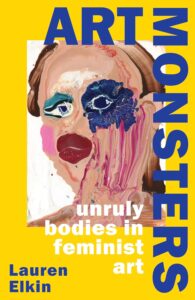
On a less exulted note, when I first started posting things on Instagram around a decade ago, books like Jennifer Higgie’s The Mirror and the Palette, Katie Hessel’s The Story of Art Without Men (2022), Eiderdown Books’ superb Modern Women Artists series, Phaidon’s Great Women Artists (2019) and (my favourite) Lauren Elkin’s Art Monsters (2023) didn’t yet exist.

Some of my favourite artists – Jenny Saville, Hannah Höch, Gabriele Münter– were women and, like most female artists they made works that on one level transcend gender, as I think all great art does, but were also formed from an unmistakably female point of view (just as I would say Picasso’s art is unmistakably male). Female artists were, in short, making art that only female artists could make, (I’d actually go further and say that all great artists regardless of gender make art that only that individual can make, but that doesn’t change the basic point).

I found, and it’s still true, about art in general and not only – though especially – by women, that the more you look, the more you find and so when I started regularly posting art by female artists, most of whom were new to me, I began keeping a kind of database of artists and their birthdays. So here it is, in simplified form. There are many, many omissions (especially of sculptors – not so much my thing – and contemporary artists, whose birthdays are often not so easy to find) and it will always be a work in progress, but I think it’s worth sharing here anyway (and in birthday order, so you can see if you share your birthday with a fantastic artist; why not?) Happy International Women’s Day!.

JANUARY

Children with Burning Torches (1920s) by Tina Bauer-Pezellen, an artist I love but can never find much information about

Selma Gubin born 01-Jan 1905
Rita Kernn-Larsen born 01-Jan 1904
Lynette Yiadom-Boakye born 01-Jan 1977
Selma Plawneek-des Coudres born 02-Jan 1883
Slava Raskaj born 02-Jan 1877
Sylvi Kunnas born 03-Jan 1903
Maruja Mallo born 05-Jan 1902
Margaret Modlin born 05-Jan 1927
Madame Yevonde born 05-Jan 1893
Ruth Gikow born 06-Jan 1915
Sanja Ivekovic born 06-Jan 1949
Franciska Clausen born 07-Jan 1899
Fahrelnissa Zeid born 07-Jan 1901
Wanda von Debschitz-Kunowski born 08-Jan 1870
Alida Jantina Pott born 08-Jan 1888
Julie Wolfthorn born 08-Jan 1864
Tina Bauer-Pezellen born 09-Jan 1897
Annemarie Heinrich born 09-Jan 1912
Maxa Nordau born 10-Jan 1897
Nora Heysen born 11-Jan 1911
Marcia Marcus born 11-Jan 1928
Rosalba Carriera born 12-Jan 1673
Hannah Hirsch-Pauli born 13-Jan 1864
Lilla Cabot Perry born 13-Jan 1848
Alice Pike Barney born 14-Jan 1857
Berthe Morisot born 14-Jan 1841
Eve Sonneman born 14-Jan 1946
Louise Blair Daura born 15-Jan 1905
Sabine Lepsius born 15-Jan 1864
Gerta Overbeck born 16-Jan 1898
Teddy Røwde born 16-Jan 1911
Alexandra Ekster born 18-Jan 1882
Cindy Sherman born 19-Jan 1954
Marianne Stokes born 19-Jan 1855
Sophie Tauber-Arp born 19-Jan 1889
Leyly Matine-Daftary born 19-Jan 1937
Maxine Albro born 20-Jan 1893
Hertha Spielberg born 21-Jan 1890
Annemarie Jacob born 22-Jan 1891
Kiki Kogelnik born 22-Jan 1935
Maria Luiko born 25-Jan 1904
Emilie von Hallavanya born 26-Jan 1874
Katarzyna Kobro born 26-Jan 1898
Yva (Else Ernestine Neulander-Simon) born 26-Jan 1900
Jeanne Selmersheim-Desgrange born 27-Jan 1877
Maria Tlusty born 27-Jan 1901
Bertha Muller born 28-Jan 1848
Alice Neel born 28-Jan 1900
Elisabeth Büchsel born 29-Jan 1867
Anna Susanna Fries born 30-Jan 1827
Teresa Feoderovna Ries born 30-Jan 1874
Amrita Sher-Gil born 30-Jan 1913
Masa Feszty born 31-Jan 1894
Elena Liessner-Blomberg born 31-Jan 1897
Cornelia Macintyre Foley born 31-Jan 1909

FEBRUARY

Anita Rée – self portrait (1930)

Doris Lee born 01-Feb 1905
Kris Torne born 01-Feb 1867
Sybil Atteck born 03-Feb 1911
Helen Forbes born 03-Feb 1891
Henriette Petit born 03-Feb 1894
Katherine Read born 03-Feb 1723
Georgina de Albuquerque born 04-Feb 1885
Marthe Hirt born 04-Feb 1890
Minna Köhler-Roeber born 04-Feb 1883
Ksenia Boguslavskaya born 05-Feb 1892
Jeanne Bieruma Oosting born 05-Feb 1898
Dorothea Maetzel-Johannsen born 06-Feb 1886
Arte Topalian born 06-Feb 1906
Kaete Lassen born 07-Feb 1880
Paula Modersohn-Becker born 08-Feb 1876
Anita Ree born 09-Feb 1885
Celia Calderon born 10-Feb 1921
Eva Frankfurther born 10-Feb 1930
Dorte Clara Wolff (Dodo) born 10-Feb 1907
Annelise Kretschmer born 11-Feb 1903
Léa Lafugie born 11-Feb 1890
Kate Diehn-Bitt born 12-Feb 1900
Marie Vassilieff born 12-Feb 1884
Marta Hegemann born 14-Feb 1894
Marie Vorobieff (Marevna) born 14-Feb 1892
Dora de la Torre born 14-Feb 1924
Mary Adshead born 15-Feb 1904
Grethe Jurgens born 15-Feb 1899
Gertrude Abercrombie born 17-Feb 1909
Greta Hällfors-Sipilä born 19-Feb 1899
Hazel Janicki born 19-Feb 1918
Gabriele Munter born 19-Feb 1877
Else Berg born 19-Feb 1877
Maria von Heider-Schweinitz born 20-Feb 1894
Lía Correa Morales born 20-Feb 1893
Grace Carpenter Hudson born 21-Feb 1865
Delhy Tejero born 22-Feb 1904
Gundula Schulze Eldowy born 23-Feb 1954
Martha Cunz born 24-Feb 1876
Alice Bailly born 25-Feb 1872
Broncia Koller-Pinnell born 25-Feb 1863
Hilde Hamann born 26-Feb 1898
Alexandra Povorina born 26-Feb 1885
Annie Swynnerton born 26-Feb 1844
Teresa Condeminas i Soler born 27-Feb 1905
Eva-Maria Bergmann born 28-Feb 1941
Julia Thecla born 28-Feb 1896

MARCH

Maria Slavona – Houses in Montmarte (1898)

Marcelle Cahn born 01-Mar 1895
Erika Streit born 01-Mar 1910
Lola Cueto born 02-Mar 1897
Agda Holst born 02-Mar 1886
Judith Alpi born 03-Mar 1893
Gussy Hippold-Ahnert born 03-Mar 1910
Anne Ratkowski born 03-Mar 1903
Ellen Emmet Rand born 04-Mar 1875
Charmion Von Wiegand born 04-Mar 1896
Gertrude Fehr born 05-Mar 1895
Clara Ledesma Terrazas born 05-Mar 1924
Maria Blanchard born 06-Mar 1881
Pauline Boty born 06-Mar 1938
Maria Uhden born 06-Mar 1892
Marisa Roesset Velasco born 06-Mar 1904
Aenne Biermann born 08-Mar 1898
Constance Mayer born 09-Mar 1774
Annalize Pilasik born 10-Mar 1903
Rita Angus born 12-Mar 1908
Zofia Atteslander born 12-Mar 1874
Elaine De Kooning born 12-Mar 1918
Marie Eberhard born 12-Mar 1897
Idelle Weber born 12-Mar 1932
Lizzy Ansingh born 13-Mar 1875
Andree Bosquet born 13-Mar 1900
Diane Arbus born 14-Mar 1923
Annemarie von Jakimow-Kruse born 14-Mar 1889
Maria Slavona born 14-Mar 1865
Mary Pratt born 15-Mar 1935
Gerda Wegener born 15-Mar 1886
Maria Austria born 19-Mar 1915
Marie Ellenrieder born 20-Mar 1791
Renee Sintenis born 20-Mar 1888
Alix Ayme born 21-Mar 1894
Greta Kempton born 22-Mar 1901
Lea Grundig born 23-Mar 1906
Marie Howet born 24-Mar 1897
Charley Toorop born 24-Mar 1891
Petrona Viera born 24-Mar 1895
Therese Debains born 25-Mar 1897
Johanna Kampmann-Freund born 25-Mar 1888
Käthe Loewenthal born 27-Mar 1878
Elga Sesemann born 28-Mar 1922
Dora Carrington born 29-Mar 1893
Cecile Walton born 29-Mar 1891
Helene Riedel born 30-Mar 1901

APRIL

Karin Luts – The Artist (1937)

Gertrude Bohnert born 02-Apr 1908
Emilie Charmy born 02-Apr 1878
Stella Snead born 02-Apr 1910
Hermine Aichenegg born 03-Apr 1915
Francesca woodman born 03-Apr 1958
Constance Marie Charpentier born 04-Apr 1767
Ruth Smith born 05-Apr 1913
Leonora Carrington born 06-Apr 1917
Jeanne Hebuterne born 06-Apr 1898
Kata Kalivoda born 06-Apr 1877
Hilde Rubinstein born 07-Apr 1904
Lilly Steiner born 07-Apr 1884
Annemirl Bauer born 10-Apr 1939
Gunvor Gronvik born 10-Apr 1912
Frances Foy born 11-Apr 1890
Adélaïde Labille-Guiard born 11-Apr 1749
Maggie Laubser born 14-Apr 1886
Olga Boznanska born 15-Apr 1865
Elizabeth Catlett born 15-Apr 1915
Princess Elisabeth Vilma Lwoff-Parlaghy born 15-Apr 1863
Laura Alma-Tadema born 16-Apr 1852
Inji Efflatoun born 16-Apr 1924
Charlotte Salomon born 16-Apr 1917
Hermine David born 19-Apr 1886
Eva Gonzales born 19-Apr 1849
Dod Procter born 21-Apr 1890
Raquel Forner born 22-Apr 1902
Ottilie Roederstein born 22-Apr 1859
Lee Miller born 23-Apr 1907
Christine Bacheler Nisbet born 24-Apr 1902
Lyubov Popova born 24-Apr 1889
Bridget Riley born 24-Apr 1931
Mary Brandt (Perez) born 25-Apr 1917
Mela Muter born 26-Apr 1876
Doro Ording born 26-Apr 1901
Nathalie Kraemer born 28-Apr 1891
Else Fischer-Hansen born 29-Apr 1905
Mainie Jellett born 29-Apr 1897
Karin Luts born 29-Apr 1904
Ruth Meier born 29-Apr 1888
Juana Romani born 30-Apr 1867
Thea Schleusner born 30-Apr 1879
Joronn Sitje born 30-Apr 1897

MAY

June Beer – Woman in Red (self portrait), 1984

Cecilia Beaux born 01-May 1855
Romaine Brooks born 01-May 1874
Elsa Thoresen born 01-May 1906
Eva Aeppli born 02-May 1925
Peggy Bacon born 02-May 1895
Chinwe Chukwuogo-Roy born 02-May 1952
Brigitte Fugmann born 03-May 1948
Stina Forssell born 03-May 1906
Geta Bratescu born 04-May 1926
Sylvia Pankhurst born 05-May 1882
Celeste Woss y Gil born 05-May 1891
Lucie Citti Ferreira born 06-May 1911
Suzy Freylinghuysen born 07-May 1911
Marion Gilmore born 07-May 1909
Dore Meyer-Vax born 08-May 1908
Felicita Pauluka born 08-May 1925
Paula Gans born 09-May 1883
Stanislawa de Karlowska born 09-May 1876
Hanna Klose-Greger born 09-May 1892
Grete Stern born 09-May 1904
Frida Konstantin born 10-May 1884
Helene von Taussig born 10-May 1879
Eva Schulze Knabe born 11-May 1907
Ilske Schwimmer born 11-May 1915
Monika Brachmann born 12-May 1944
Paula Lauenstein born 12-May 1898
Charlotte Wankel born 12-May 1888
Sara Afonso/Affonso born 13-May 1899
Louise Seidler born 15-May 1786
Stella Bowen born 16-May 1893
Tamara de Lempicka born 16-May 1898
Laura Wheeler Waring born 16-May 1887
Bele Bachem born 17-May 1916
June Beer born 17-May 1935
Martha Bernstein born 17-May 1874
Kati Horna born 19-May 1912
Clara von Rappard born 19-May 1857
Ellen Auerbach born 20-May 1906
Lily Furedi born 20-May 1896
Margret Hofheinz-Döring born 20-May 1910
Maria Hiller-Foell born 21-May 1880
Marisol Escobar born 22-May 1930
Erszebet Korb born 22-May 1889
Julia Diaz born 23-May 1917
Charlotte Berend-Corinth born 25-May 1880
Anita Magsaysay-Ho born 25-May 1914
Vally Wieselthier born 25-May 1895
Fanny Harlfinger-Zakucka born 26-May 1873
Amelie Lundahl born -May 1850
Heidi Vogel born 27-May 1951
Anna De Weert born 27-May 1867
Anna-Eva Bergman born 29-May 1909
Marlow Moss born 29-May 1889
Vanessa Bell born 30-May 1879
Audrey Flack born 30-May 1931
Magdalena Mira Mena born 30-May 1859
Carmen Herrera born 31-May 1915
Mireya Lafuente born 31-May 1905
Hilla von Rebay born 31-May 1890

JUNE

Biruta Baumane – Group Portrait (1969)

Vera Nilsson born 01-Jun 1888
Lotte B Prechner born 01-Jun 1877
Greta Gerell born 02-Jun 1898
Louise Amans born 05-Jun 1850
Winifred Knights born 05-Jun 1899
Biruta Baumane born 06-Jun 1922
Ricarda Jacobi born 07-Jun 1923
Laura Rodig born 07-Jun 1901
Alice Rahon born 08-Jun 1904
Montserrat Gudiol born 09-Jun 1933
Oda Krohg born 11-Jun 1860
Priscilla Warren Roberts born 13-Jun 1916
Pan Yuliang born 14-Jun 1895
Agnes Tait born 14-Jun 1894
Erna Lincke born 15-Jun 1899
Edith Meyer von Kamptz born 15-Jun 1884
Fritzi Brod born 16-Jun 1900
Henriette Browne born 16-Jun 1829
Irma Lang-Scheer born 17-Jun 1901
Margarete Kubicka born 20-Jun 1891
Emilia Bertole born 21-Jun 1896
Gwen John born 22-Jun 1876
Wangechi Mutu born 22-Jun 1972
Hilde Rakebrand born 22-Jun 1901
Olga Rozanowa born 22-Jun 1886
Madge Tennent born 22-Jun 1889
Lilo Raymond born 23-Jun 1922
Elena Shegal born 23-Jun 1924
Meraud Guinness born 24-Jun 1904
Helen Lundeberg born 24-Jun 1908
Alice Frey born 25-Jun 1895
Kay Sage born 25-Jun 1898
Vilma Eckl born 26-Jun 1892
Coba Ritsema born 26-Jun 1876
Helene Perdriat born 27-Jun 1889
Catherine Yarrow born 27-Jun 1904
Ali Goubitz born 28-Jun 1904
Florence Henri born 28-Jun 1893
Nan Youngman born 28-Jun 1906
Hannelore Neumann-Tachilzik born 29-Jun 1939

JULY

Prudence Heward – Portrait of an unknown Woman c.1920s

Herminia Arrate born 01-Jul 1896
Elizabeth Lochrie born 01-Jul 1890
Prudence Heward born 02-Jul 1896
Lydia Mei born 02-Jul 1896
Rahel Szalit-Marcus born 02-Jul 1894
Georgina Klitgaard born 03-Jul 1893
Petra Flemming born 06-Jul 1944
Frida Kahlo born 06-Jul 1907
Unica Zurn born 06-Jul 1916
Artemisia Gentileschi born 08-Jul 1593
Kathe Kollwitz born 08-Jul 1867
Carmen Mondragon (Nahui Olin) born 08-Jul 1894
Maria Tupper Hunneus born 09-Jul 1893
Helene Schjerfbeck born 10-Jul 1862
Luise Kornsand born 11-Jul 1876
Bertina Lopes born 11-Jul 1924
Ruth Starr Rose born 12-Jul 1887
Honore Desmond Sharrer born 12-Jul 1920
Helene Arnau born 13-Jul 1870
Alice Brasse-Forstmann born 13-Jul 1903
Elena Huerta Muzquiz born 15-Jul 1908
Giselle Kuster born 15-Jul 1911
Berenice Abbott born 17-Jul 1898
Marie Petiet born 20-Jul 1854
Marta Astfalck-Vietz born 21-Jul 1901
Greta Freist born 21-Jul 1904
Maral Rahmanzadeh born 23-Jul 1916
Anna Dorothea Therbusch born 23-Jul 1721
Wanda Wulz born 25-Jul 1903
Alba Calderon (de Gil) born 27-Jul 1908
Nelly van Doesburg born 27-Jul 1899
Sofia Bassi born 28-Jul 1913
Mathilda Rotkirch born 28-Jul 1813
Anna Stainer-Knittel born 28-Jul 1841
Grace Pailthorpe born 29-Jul 1883
Bettina Shaw-Lawrence born 29-Jul 1921
Friedl Dicker-Brandeis born 30-Jul 1898
Maria Szantho born 31-Jul 1897
Doris Zinkeisen born 31-Jul 1897

AUGUST

Macena Barton – Salome (1930s?)

Rachel Baes born 01-Aug 1912
Ida Gerhardi born 02-Aug 1862
Gretel Haas-Gerber born 02-Aug 1903
Maria Wiik born 03-Aug 1853
Laura Knight born 04-Aug 1877
Hedda Sterne born 04-Aug 1910
Edith Dettmann born 04-Aug 1898
Margit Graber born 05-Aug 1895
Irene Rice Pereira born 05-Aug 1902
Macena Barton born 07-Aug 1901
Maria Caspar-Filser born 07-Aug 1878
Lili Orszag born 08-Aug 1926
Tove Jansson born 09-Aug 1914
Eliane de Meuse born 09-Aug 1899
Cornelia Paczka-Wagner born 09-Aug 1864
Rogi Andre born 10-Aug 1900
Margret Bilger born 12-Aug 1904
Marianne Fieglhuber-Gutscher born 12-Aug 1889
Nola Hatterman born 12-Aug 1899
Ernestine von Kirchsberg born 12-Aug 1857
Helene Roth born 12-Aug 1887
Gluck (Hannah Gluckstein) born 13-Aug 1895
Xenia Cage born 15-Aug 1913
Marie Goth born 15-Aug 1887
Zsuzsi Robos born 15-Aug 1929
Tamara Natalie Madden born 16-Aug 1975
Käthe Ephraim Marcus born 16-Aug 1892
Gunnvor Advocaat born 17-Aug 1912
Gudrun Petersdorff born 17-Aug 1955
Anna Ancher born 18-Aug 1859
Kyra Markham born 18-Aug 1891
Florine Stettheimer born 19-Aug 1871
Lette Valeska born 20-Aug 1885
Hedwig Holtz-Sommer born 22-Aug 1901
Agnes Lawrence Pelton born 22-Aug 1881
Ebba Carstensen born 23-Aug 1885
Agnes Cleve born 23-Aug 1876
Hannah Frank born 23-Aug 1908
Mariette Lydis born 24-Aug 1887
Henriette Paula Häberlin born 25-Aug 1882
Dorothea Tanning born 25-Aug 1910
Fanny Rabel born 27-Aug 1922
Olga Costa born 28-Aug 1913
Else Lohmann born 29-Aug 1897
Sughra Rababi born 29-Aug 1922
Martha Schrag born 29-Aug 1870
Anna Zinkeisen born 29-Aug 1901
Siri Deckert born 30-Aug 1888
Leonor Fini born 30-Aug 1907
Amy Sherald born 30-Aug 1973
Ida Kerkovius born 31-Aug 1879

SEPTEMBER

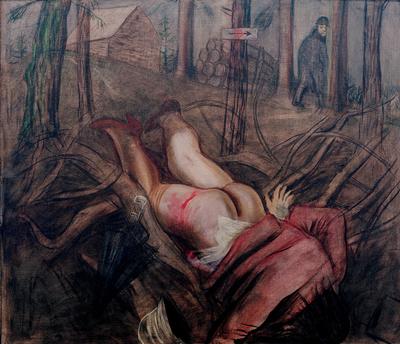
Toyen – The Message of the Forest (1936)

Adriana Bisi Fabbri born 01-Sep 1881
Mario Miguel Mollari 01-Sep 1930
Hilda Rix Nicholas born 01-Sep 1884
Augusta Roszmann born 01-Sep 1859
Mina Carlson-Bredberg born 02-Sep 1857
Else Meidner born 02-Sep 1901
Elin Danielson-Gambogi born 03-Sep 1861
Helene Funke born 03-Sep 1869
Lis Bertram-Ehmsen born 05-Sep 1897
Piti (Francis) Bartolozzi born 06-Sep 1908
Marie-Gabrielle Capet born 06-Sep 1761
Rosa Rolanda born 06-Sep 1896
Hanna Bekker vom Rath born 07-Sep 1893
Maria Lassnig born 08-Sep 1919
Mimi Parent born 08-Sep 1924
Anna Walinska born 08-Sep 1906
Aurora Reyes Flores born 09-Sep 1908
Consuelo Remedios González del Bianco born 10-Sep 1911
Marianne von Werefkin born 10-Sep 1860
Bona di Mandiargues born 12-Sep 1926
Nan Goldin born 12-Sep 1953
Lili Pancu born 13-Sep 1908
Eva Cederström born 15-Sep 1909
Hope Gangloff born 15-Sep 1974
Rosalie Gwathmey born 15-Sep 1908
Cordelia Urueta Sierra born 16-Sep 1908
Alla Horska born 18-Sep 1929
Maud Sulter born 19-Sep 1960
Hilda Belcher born 20-Sep 1881
Denise Bellon born 20-Sep 1902
Genevieve Springston Lynch born 20-Sep 1891
Else Hagen born 21-Sep 1914
Toyen born 21-Sep 1902
Anne Winterer born 21-Sep 1894
Hansl Bock born 22-Sep 1893
Irena Rüther-Rabinowicz born 22-Sep 1900
Esphyr Slobodkina born 22-Sep 1908
Suzanne Van Damme born 22-Sep 1901
Suzanne Valadon born 23-Sep 1865
Maina-Miriam Munsky born 24-Sep 1943
Tilsa Tsuchiya 24-Sep 1928
Marguerite Zorach born 25-Sep 1887
Suzi Gablik born 26-Sep 1934
Arcangela Paladini born 29-Sep 1596

OCTOBER

Penny Slinger – I Hear What You Say (1973)

Marianne Brandt born 01-Oct 1893
Alice Prin (Kiki de Montparnasse) born 02-Oct 1901
Elisabeth Sophie Cheron born 03-Oct 1648
Kathleen Walne born 03-Oct 1915
Ester Ellqvist born 04-Oct 1880
Ellen Thesleff born 05-Oct 1869
Graciela Aranis born 06-Oct 1908
Meret Oppenheim born 06-Oct 1913
Nina Arbore born 08-Oct 1889
Elise Ransonnet-Villez born 08-Oct 1843
Faith Ringgold born 08-Oct 1930
Louise Rösler born -Oct 1907
Ithell Colquhoun born 09-Oct 1906
Zelia Salgado born 10-Oct 1904
Linda Kogel born 11-Oct 1861
Grete Csaki-Copony born 12-Oct 1893
Paula Deppe born 12-Oct 1886
Nadezhda Petrovic born 12-Oct 1873
Ruth Bernhard born 14-Oct 1905
Vilma Vrbova born 14-Oct 1905
Minna Citron born 15-Oct 1896
Lilly Hildebrandt born 16-Oct 1887
Elisabeth Chaplin born 17-Oct 1890
Cata Dujšin-Ribar born 17-Oct 1897
Agnes van den Brandeler born 18-Oct 1918
Jeanne Mandello born 18-Oct 1907
Bettina von Arnim born 19-Oct 1940
Jacqueline Marval born 19-Oct 1866
Ottilie Reylaender born 19-Oct 1882
Else-Christie Kielland born 20-Oct 1903
Gustava Engels von Veith born 20-Oct 1879
Penny Slinger born 21-Oct 1947
Lygia Clark born 23-Oct 1920
Rina Lazo (Wasem) born 23-Oct 1923
Marie-Louise von Motesiczky born 24-Oct 1906
Claude Cahun born 25-Oct 1894
Katalin Ladik born 25-Oct 1942
Ruth Light Braun born 26-Oct 1906 2003 oa
Marthe Donas born 26-Oct 1885 1967 oa
Bep Rietveld born 26-Oct 1913 1999 oa
Blanche-Augustine Camus born 27-Oct 1884
Julie Hagen-Schwarz born 27-Oct 1824
Sigrid Hjerten born 27-Oct 1885
Mary Moser born 27-Oct 1744
Paraskeva Clark born 28-Oct 1898
Bertha Müller born 28-Oct 1848
Alice Lex-Nerlinger born 29-Oct 1893
Louise Abbema born 30-Oct 1853
Maria Izquierdo born 30-Oct 1902
Angelika Kauffmann born 30-Oct 1741
Erna Schmidt-Carroll born 30-Oct 1896
Marie-Laure de Noailles born 31-Oct 1902
Marie Laurencin born 31-Oct 1883
Jóhanna Kristín Yngvadóttir born 31-Oct 1953

NOVEMBER

Débora Arango – Justice (c.1944)

Hannah Hoch born 01-Nov 1889
Hedwig Woermann born 01-Nov 1879
Venny Soldan-Brofeldt born 02-Nov 1863
Lois Mailou Jones born 03-Nov 1905
Lilias Torrance Newton born 03-Nov 1896
Charlotte Buresova born 04-Nov 1904
Elena Luksch-Makowsky born 04-Nov 1878
Milena Pavlovic-Barili born 05-Nov 1909
Ann Brockman born 06-Nov 1899
Elsa Haensgen-Dingkuhn born 07-Nov 1898
Sonja Kovačić – Tajčević born 07-Nov 1894
Angeles Santos Torroella born 07-Nov 1911
Elizabeth Sparhawk-Jones born 08-Nov 1885
Emmy Bridgwater born 10-Nov 1906 1999 oa
Lisette Model born 10-Nov 1901
Debora Arango born 11-Nov 1907
Carry Hess born 11-Nov 1889
Magda Langenstraß-Uhlig born 11-Nov 1888
Mary Kessell born 13-Nov 1914
Ekaterina Savova-Nenova born 13-Nov 1901
Sonia Delaunay born 14-Nov 1885
Julie Manet born 14-Nov 1878
Tina Blau born 15-Nov 1845
Miriam Schapiro born 15-Nov 1923
Elisa Counis born 16-Nov 1812
Katharina Sieverding born 16-Nov 1944
Louise Dahl-Wolfe born 19-Nov 1895
Lily Harmon born 19-Nov 1912
Marianne Breslauer born 20-Nov 1909
Angelika Hoerle born 20-Nov 1899
Germaine Krull born 20-Nov 1897
Elisabeth Jerichau-Baumann born 21-Nov 1819
Jeanne Mammen born 21-Nov 1890
Dora Maar born 22-Nov 1907
Bridget Bate Tichenor born 22-Nov 1917
Else Hertzer born 24-Nov 1884
Mary Foote born 25-Nov 1872
Sara Shamma born 26-Nov 1975
Audrey Buller born 27-Nov 1902
Gretchen Wohlwill born 27-Nov 1878
Mabel Alvarez born 28-Nov 1891
Hedwig Marquardt born 28-Nov 1884
Else Wex-Cleemann born 29-Nov 1890
Fridel Dethleffs-Edelmann born 30-Nov 1899

DECEMBER

Alison Watt – Alabaster (1998)

Eileen Agar born 01-Dec 1899
Jenny Mucchi-Wiegemann born 01-Dec 1895
Emilie Mediz-Pelikan born 02-Dec 1861
Marion Adnams born 03-Dec 1898
Dorte Helm born 03-Dec 1898
Grace English born 04-Dec 1891
Elfriede Lohse-Wächtler born 04-Dec 1899
Louise Catherine Breslau born 06-Dec 1856
Margaret Brundage born 09-Dec 1900
Louise de Hem born 10-Dec 1866
Zinaida Serebriakova born 10-Dec 1884
Olga Terri born 10-Dec 1916
Irène Zurkinden born 11-Dec 1909
Alison Watt born 11-Dec 1965 alive
Ragnhild Keyser born 12-Dec 1889
Emily Carr born 13-Dec 1871
Alice Sommer born 13-Dec 1898
Aino Bach born 14-Dec 1901
Remedios Varo born 16-Dec 1908
Bertha Wegmann born 16-Dec 1846
Suze Robertson born 17-Dec 1855
Jane Graverol born 18-Dec 1905
Ewa Kierska born 18-Dec 1923
Lucie Cousturier born 19-Dec 1876
Therese Schwartze born 20-Dec 1851
Trude Fleischmann born 22-Dec 1895
Margit Anna born 23-Dec 1913
Luvena Buchanan Vysekal born 23-Dec 1873
Alma del Banco born 24-Dec 1862
Sigrid Maria Schauman born 24-Dec 1877
Dorothy Johnstone born 25-Dec 1892
Ragnhild Kaarbo born 26-Dec 1889
Stella Steyne born 26-Dec 1907
Augusta von Zitzewitz born 26-Dec 1880
Annott (Jacobi) born 27-Dec 1894
Aisha Galimbaeva born 29-Dec 1917
Adela ber Vukić born 30-Dec 1888
Lucile Blanch born 31-Dec 1895
Beatrice Mandelman born 31-Dec 1912

Self-Portrait in the Studio (1579), by Lavinia Fontana, generally considered to be the first professional female artist

to the victor…

Everyone knows that history is written by the victors, but I’m not sure it’s always realised – or I should say that I hadn’t considered – how much of a privilege that is. Of course there are the obvious material, societal privileges that come with winning, but I’m thinking specifically about history and the way it’s transmitted.

This little epiphany came while watching the now ten-year-old show, Tony Robinson’s Wild West. It’s not a piece of history that generally interests me, but Robinson belongs to the last generation for whom ‘cowboys and Indians’ occupied a major place in popular culture – and he is also a presenter who tends to look at history from a point of view that conservative critics would call postmodern; i.e. he tends to think that history is complicated and acknowledges injustices, calls exploitation exploitation and that kind of thing, and so it piqued my interest. But one of the unexpected consequences of making an enlightened history show is the focus it places on experts and the way that they come across.
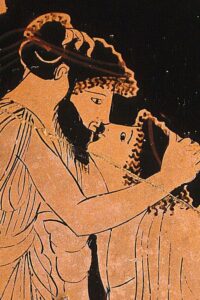
Ancient Greek red-figure pottery c.480 BC

I don’t mean to condemn the historians I’m talking about here; most historians are in some ways at least, enthusiasts for their subject. The best ones (in my experience) have a special, and sometimes quite a nerdy, bond with the period and people that they have chosen to study. When I studied ancient history, one of the best lecturers I had was a specialist on ancient Greece who had seemingly based his physical appearance on the look of Greek men on ancient red-figure pottery; curly hair, big beard and all. And there was a historian of Rome in my Classical Studies course with a ‘Julius Caesar’ haircut. It feels natural that someone would want to immerse themselves in the civilisation which fascinates them enough to make it their life’s work.
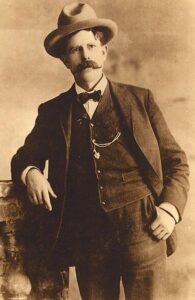
Joe LeFors – lawman & fashion role model

And so it makes sense that some of the historians in Tony Robinson’s Wild West, with their (to British eyes) Edwardian moustaches and waistcoats should look as though they are tending the bar in a saloon in Calamity Jane, or are speaking to the camera from the frontier, while wearing their fringed buckskin jackets. It’s kind of comical, but also isn’t, in the context of that history. The clothes seem like a concession to the romanticism of the Old West, but these are modern historians, and despite being occasionally slightly squeamish about the history they are recounting, and tending to overstate the balance of power in the ‘Indian wars’ they make no serious attempt to whitewash it.

But it feels significant that the Lakota historian talking about the massacre at Wounded Knee in 1890 wasn’t wearing historical fancy dress, and it would seem strange if he was. And it’s the discussion of atrocities like Wounded Knee that remind you that the victor writes the history. To paraphrase the Lakota historian, Wounded Knee is framed as a war crime, because that feels historically, appropriate – but in fact there was no war – it was just a crime, albeit one committed by a government. And nakedly genocidal attitudes at the time, encapsulated by a quotes from L. Frank Baum, author of – of all things – the Wizard of Oz and its sequels, make the buckskins, waistcoats and archaic facial hair and fashions of the Western historians seem somewhat incongruous.
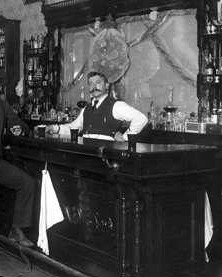
Bartender at the Toll Gate Saloon in Black Hawk, Colorado c.1897

Hearing of the death of Sitting Bull in the aftermath of Wounded Knee, Baum wrote in his popular newspaper:

The proud spirit of the original owners of these vast prairies inherited through centuries of fierce and bloody wars for their possession, lingered last in the bosom of Sitting Bull. With his fall the nobility of the Redskin is extinguished, and what few are left are a pack of whining curs who lick the hand that smites them. The Whites, by law of conquest, by justice of civilization, are masters of the American continent, and the best safety of the frontier settlements will be secured by the total annihilation of the few remaining Indians. Why not annihilation? Their glory has fled, their spirit broken, their manhood effaced; better that they die than live the miserable wretches that they are.

Though thankfully not, or not quite, enacted, this wasn’t a controversial view at the time. But with even with a little knowledge of the historical context (there had been a government policy explicitly called the Indian Removal Act only 50 years earlier), its knowing blatancy is shocking. It’s one thing to talk or read about massacres of Greeks or Spartans or Persians thousands of years ago; it’s quite another to think of it happening in the time of your own great-grandparents, or to think of it happening elsewhere literally as I write these words.

It’s an obvious, problematic and quite cheesy comparison to make, but I’ll make it. Had things worked out differently, a situation where a historian could sit in a black shirt and swastika armband, talking about World War Two – acknowledging quite reasonably the terrible things that were done on both sides, but talking, in an essentially neutral way about the formation of modern Europe, while a far more sombre Jewish historian shows us the Auschwitz museum, is almost unimaginable. And yet – judging by the way these things actually work – it’s not an especially outlandish alternate present.

the Emperor Augustus, statue from the 1st century AD with eternally modern hair

Not only is history written by the victors, but the world we live in is forged by them, and generations on from winning an overwhelming victory they are no longer ‘they,’ they are just us. But that takes time.

The historian who loves ancient Greece can afford to love it, wherever they come from. Greece was barbaric as well as enlightened, Greece had slaves and was misogynistic – but Greece is only what we call it now for convenience; the collection of independent city states and relatively heterogynous cultures we now call ‘ancient Greece’ is not the same as the country Greece. “Rome” is not Italy. The world – especially but not exclusively the western world – has benefitted from ancient Greek and Roman culture and though it’s easy to argue for its negative influence too, that’s less the fault of those ancient people than it is our more recent ancestors who understood those cultures in the way they could and wanted to understand them.

Regarding America, and Britain and everywhere else, all of that may come, in a thousand years or so, when the state of the world will probably be as unimaginable to us now as the internet would be to Herodotus. But. There are photographs of the mass graves being dug at Wounded Knee and while the winners of the ‘Indian wars’ were able to impress their culture on the country and to define that recent history in terms of expansion, exploration and consolidation, the other side of the story is still living history too. And the losers get to just live with it and tell their stories to whoever will listen.

It’s fair to say that the nature of the conquest of America – not just the 1800s and the Old West, but everything from the founding of the first colonies to the establishment and erosion of the reservations – has never been forgotten, but it’s only relatively recently that it’s been publicly acknowledged. Tony Robinson’s television show came about precisely because he belongs to a generation – my father’s generation – where young boys were entertained by stories of heroic cowboys fighting savage Indians in a way that now looks – despite the inevitable messiness of history as opposed to fiction – like an almost perfect inversion of the facts. And I belong to one of the first generations where it hasn’t been popularly presented that way.

It’s never too soon to be passionate about history or to tell the truth about it, but even though it’s always nice to find yourself on the winning team, when that happens it’s probably worth considering what it really means and how you got there. And if the dressing up still feels appropriate, then by all means go for it.

of comfort no man speak

Everybody has their comforts, but after trying to analyse some of my own to see why they should be comforting I’ve pretty much come up with nothing, or at least nothing really to add to what I wrote a few years ago; “comforting because it can be a relief to have one’s brain stimulated by something other than worrying about external events.” But that has nothing to do with what it is that makes the specific things comforting. Like many people, I have a small group of books and films and TV shows and so on that I can read or watch or listen to at almost any time, without having to be in the mood for them, and which I would classify as ‘comforting.’ They aren’t necessarily my favourite things, and they definitely weren’t all designed to give comfort, but obscurely they do. But what does that mean or signify? I’ve already said I don’t know, so it’s not exactly a cliffhanger of a question, but let’s see how I got here at least.

I’ve rewritten this part so many times: but in a way that’s apposite. I started writing it at the beginning of a new year, while wars continued to rage in Sudan and Ukraine and something even less noble than a war continued to unfold in Gaza, and as the world prepared for an only partly precedented new, oligarchical (I think at this point that’s the least I can call it) US government. Writing this now, just a few months later, events have unfolded somewhat worse than might have been expected. Those wars still continue and despite signs to the contrary, the situation in Gaza seems if anything bleaker than before. That US administration began the year by talking about taking territory from what had been allies, supporting neo-Nazi and similar political groups across the world, celebrating high profile sex offenders and violent criminals while pretending to care about the victims of sex offenders and violent criminals, and has gone downhill from there.

In the original draft of this article I predicted that this Presidential term would be an even more farcical horrorshow (not in the Clockwork Orange/Nadsat sense, although Alex and his Droogs might well enjoy this bit of the 2020s; I suppose what I mean is ‘horror show’) than the same president’s previous one, and since it already feels like the longest presidency of my lifetime I guess I was right. So, between the news and the way it never stops coming (hard to remember, but pre-internet ‘the news’ genuinely wasn’t so relentless or inescapable, although events presumably happened at the same rate) it’s important to find comfort somewhere. The obvious, big caveat is that one has to be in a somewhat privileged position to be able to find comfort in the first place. There are people all over the world – including here in the UK – who can only find it, if at all, in things like prayer or philosophy; but regardless, not being so dragged down by current events that you can’t function is kind of important however privileged you are, and even those who find the whole idea of ‘self-love’ inimical have to find comfort somewhere.

But where? And anyway, what does comfort even mean? Well, everyone knows what it means, but though as a word it seems fluffy and soft (Comfort fabric softener, the American word “comforter” referring to a quilt), it actually comes from the Latin “com-fortis” meaning something like “forceful strength” – but let’s not get bogged down in etymology again.

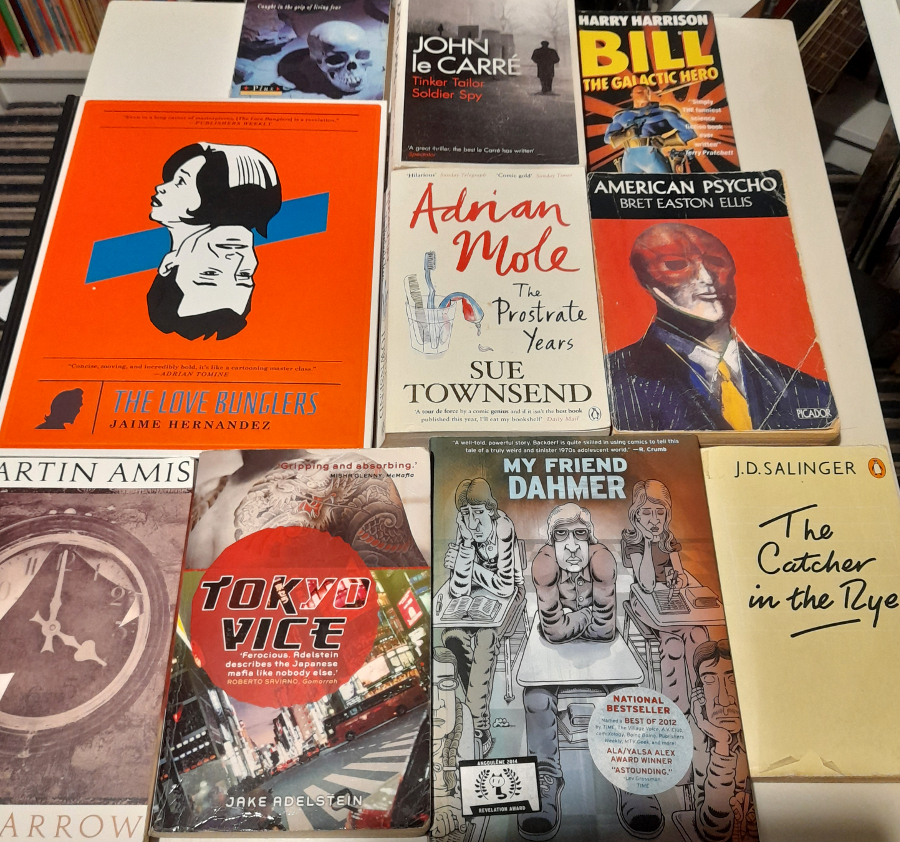
But wherever you find it, the effect of comfort has a mysterious relationship to the things that actually offer us support or soothe our grief and mental distress. Which is not obvious; normally if you desire a specific reaction (laughter, fear, excitement) you turn to a particular source. If you want to laugh, you turn to something funny, which is obviously subjective but never mind. Sticking to books, because I can – for me lots of things would work, if I want to be amused, Afternoon Men by Anthony Powell, Sue Townsend’s Adrian Mole books and, less obviously, The Psychopath Test by Jon Ronson always raise a smile or a laugh. Conversely, if you want to be scared or disgusted (in itself a strange and obscure desire, but a common one), you’d probably turn to horror, let’s say HP Lovecraft, Stephen King’s IT or, less generic but not so different, Bret Easton Ellis’s American Psycho. But as you might have guessed if you’ve read anything else on this website, I’d probably list all of those books among my ‘comfort reads.’

not my comfort reads

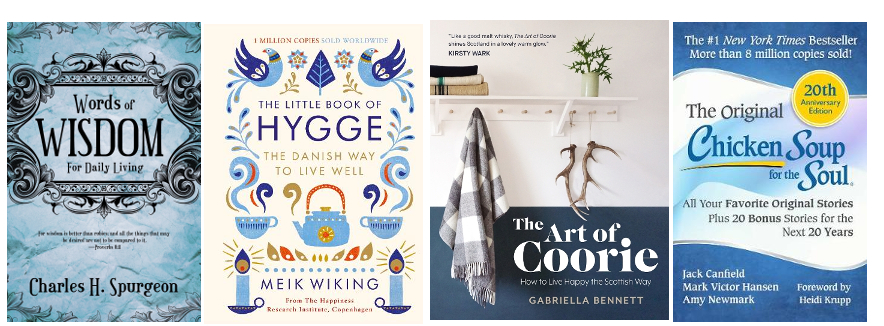
But whatever I am reading, I’m not alone; people want ‘comfort reads’ and indeed there is a kind of comfort industry these days. Over the years it’s developed from poetry anthologies and books of inspirational quotes to more twee versions of the same thing. I think of books of the Chicken Soup for the Soul kind (I don’t think I made that up; if I recall my mother owned a little book of that title, full of ‘words of wisdom’ and comforting quotes) as a 90s phenomenon, but that might be wrong. But at some point that evolved into the more widespread ‘mindfulness’ industry (colouring books, crochet, apps, etc). Marketing-wise there have been phenomena like hygge (as far as I’ve seen books of the Chicken Soup type, but with more crossover into other areas, as with mindfulness) and, in Scotland at least, hygge rebranded, aggravatingly, as ‘coorie.’ In this context ‘coorie’ is a similar concept to ‘hygge’ but that’s not really how I’ve been used to hearing the word used through my life, so something like ‘A Little Book of Coorie‘ just doesn’t sound right. But maybe a book of hygge doesn’t either, if you grew up with that word?

People take comfort in pretty much anything that distracts them, so often the best kind of comfort is being active; walking, running, working or eating, and I understand that; nothing keeps you in the moment or prevents brooding like focusing on what you’re doing. But, unless you’re in a warzone or something, it’s when you aren’t busy that the world seems the most oppressive, and while running may keep you occupied, which can be comforting, it isn’t ‘comfortable’ (for me) in the usual sense of the word. Personally, the things I do for comfort are most likely to be the same things I write about most often, because I like them; reading, listening to music, watching films or TV.

Comfort reading, comfort viewing, comfort listening are all familiar ideas, and at first I assumed that the core of what makes them comforting must be their familiarity. And familiarity presumably does have a role to play – I probably wouldn’t turn to a book I knew nothing about for comfort, though I might read something new by an author I already like. Familiarity, though it might be – thinking of my own comfort reads – the only essential ingredient for something to qualify as comforting, is in itself a neutral quality at best and definitely not automatically comforting. But even when things are comforting, does that mean they have anything in common with each other, other that the circular fact of their comforting quality? Okay, it’s getting very annoying writing (and reading) the word comforting now.

Many of the books that I’d call my all-time favourites don’t pass the comfort test; that is, I have to be in the mood for them. I love how diverse and stimulating books like Dawn Ades’ Writings on Art and Anti-Art and Harold Rosenberg’s The Anxious Object are, but although I can dip into them at almost any time, reading an article isn’t the same as reading a book. There are not many novels I like better than The Revenge for Love or The Apes of God by Wyndham Lewis. They are funny and clever and mean-spirited in a way that I love and I’ve read them several times and will probably read them again; but I never turn to Lewis for comfort. He would probably be glad not to be a ‘comfort read,’ that has nothing (as far as I can tell) to do with the content of his books. Some of my ‘comfort reads’ are obvious, and in analysing them I can come up with a list of plausible points that make them comforting, but others less so.

random selection of comfort reads

In that obvious category are books I read when I was young, but that I can still happily read as an adult. There is an element of nostalgia in that I’m sure, and nostalgia is a complicated kind of comfort. I first read The Lord of the Rings in my early teens but, as I’ve written elsewhere, I had previously had it read to me as a child, so I feel like I’ve always known it. Obviously that is comforting in itself, but there’s also the fact that it is an escapist fantasy; magical and ultimately uplifting, albeit in a bittersweet way. The same goes for my favourites of Michael Moorcock’s heroic fantasy series. I read the CorumHawkmoon and Elric series’ (and various other bits of the Eternal Champion cycle) in my teens and though Moorcock is almost entirely different from Tolkien, the same factors (escapist fantasy, heroic, magical etc) apply.

Even the Robert Westall books I read and loved as a kid, though they (The Watch House, The Scarecrows, The Devil on the Road, The Wind Eye, the Machine Gunners, Fathom Five) are often horrific, have the comforting quality that anything has if you loved it when you were 11. Not that the books stay the same; as an adult they are, surprisingly, just as creepy as I remembered, but I also notice things I didn’t notice then. Something too mild to be called misogyny, but a little uncomfortable nonetheless and, more impressively, characters that I loved and identified with now seem like horrible little brats, which I think is actually quite clever. But that sense of identification, even with a horrible little brat, has a kind of comfort in it, possibly.

The same thing happens with (mentioned in too many other things on this site) IT. A genuinely nasty horror novel about a shapeshifting alien that pretends to be a clown and kills and eats children doesn’t at first glance seem like it should be comforting. But if you read it when you were thirteen and identified with the kids rather than the monster, why wouldn’t it be? Having all kinds of horrible adventures with your friends is quite appealing as a child and having them vicariously via a book is the next best thing, or actually a better or at least less perilous one.

But those are books I read during or before adolescence and so the comforting quality comes to them naturally, or so it seems. The same might be true of my favourite Shakespeare plays, which I first read during probably the most intensely unhappy part of my adolescence – but in a weird, counterintuitive way, that adds to the sense of nostalgia.

Sue Townsend’s Adrian Mole books are kind of in a category of their own. When I read the first one, Adrian was 13 and I would have been 11. And then, I read the second a year or so later, but the others just randomly through the years. I’m not sure I was even aware of them when they were first published, but the ones where Adrian is an adult are just as funny but also significantly more painful. It’s a strange thing to read about the adult life of a character you “knew” when you were both unhappy children. Although she had a huge amount of acclaim and success during her life, I’m still not sure Townsend gets quite the credit she’s due for making Adrian Mole a real person. Laughing at a nerdy teenager’s difficult adolescence and his cancer treatment as a still-unhappy middle-aged adult is a real imaginative and empathic achievement. Still; the comfort there could be in the familiar, not just the character but the world he inhabits. Adrian is, reading him as an adult (and as he becomes an adult) surprisingly nuanced; even though he’s uptight and conservative and in a way a little Englander and terminally unreliable as a teenager and loses none of those traits as an adult, you somehow know that you can count on him not to be a Nazi or misogynist, no small thing in this day and age.

But if Frodo and Elric and Adrian Mole are characters who I knew from childhood or adolescence, what about A Clockwork Orange, which I first read and immediately loved in my early 20s and which, despite the (complicatedly) happy ending could hardly be called uplifting? Or The Catcher in the Rye, which again I didn’t read until my 20s and have been glad ever since that I didn’t “do” it at school as so many people did. Those books have a lot in common with Adrian Mole, in the sense that they are first-person narratives by troubled teenagers. Not that Alex is “troubled” in the Adrian/Holden Caulfield sense. But maybe it’s that sense of a ‘voice’ that’s comforting? If so, what does that say about the fact that Crash by JG Ballard or worse, American Psycho is also a comfort read for me?

I read both of those novels in my 20s too, and immediately liked them, though not in the same way as The Catcher in the Rye. To this day, when I read that book, part of me responds to it in the identifying sense; that part of me will probably always feel like Holden Caulfield, even though I didn’t do the things he did or worry about ‘phonies’ as a teenager. I loved Crash from the first time I read the opening paragraphs but although there must be some sense of identification (it immediately felt like one of ‘my’ books) and although I have a lot of affection for Ballard as he comes across in interviews, I don’t find myself reflected in the text, thankfully. Same (even more thankfully) with American Psycho – Patrick Bateman is an engaging, very annoying narrator (more Holden than Alex, interestingly) and I find that as with Alex in A Clockwork Orange his voice feels oddly effortless for me to read. Patrick isn’t as nice(!) or as funny or clever as Alex, but still, there’s something about his neurotic observations and hilariously tedious lists that’s – I don’t know, not soothing to read, exactly, but easy to read. Or something. Hmm.

But if Alex, Adrian, Holden and Patrick feel real, what about actual real people? I didn’t read Jake Adelstein’s Tokyo Vice until I was in my early 30s, but it quickly became a book that I can pick up and enjoy it at any time. And yet, though there is a kind of overall narrative arc and even a sort of happy ending, that isn’t really the main appeal; and in this case it isn’t familiarity either. It’s episodic and easy to dip into (Jon Ronson’s books have that too and so do George Orwell’s Essays and Journalism and Philip Larkin’s Selected Letters, which is another comfort read from my 20s) The culture of Japan that Adelstein documents as a young reporter has an alien kind of melancholy that is somehow hugely appealing even when it’s tragic. Another true (or at least fact-based) comfort read, Truman Capote’s In Cold Blood, which I only read in my 40s after meaning to read it ever since high school, has no business whatsoever being comforting. So why is it? I’m not getting any closer to an answer.

Predictability presumably has a role to play; as mentioned above, I wouldn’t read a book for the first time as ‘a comfort read’ and even though I said I might read a familiar author that way, it suddenly occurs to me that that is only half true. I would read Stephen King for comfort, but I can think of at least two of his books where the comfort has been undone because the story went off in a direction that I didn’t want it to. That should be a positive thing; predictability, even in genre fiction which is by definition generic to some extent, is the enemy of readability and the last thing you want is to lose interest in a thriller. I’ve never been able to enjoy whodunnit type thrillers for some reason; my mother loved them and they – Agatha Christie, Ngaio Marsh, Sue Grafton, even Dick Francis, were her comfort reads. Maybe they are too close to puzzles for my taste? Not sure.

So to summarise; well-loved stories? Sometimes comforting. Identifiable-with characters? Sometimes comforting. Authorial voices? This may be the only unifying factor in all the books I’ve listed and yet it still seems a nebulous kind of trait and Robert Westall has little in common with Sue Townsend or Bret Easton Ellis, or (etc, etc). So instead of an actual conclusion, I’ll end with a funny, sad and comforting quote from a very silly, funny but in some ways comforting book; Harry Harrison’s 1965 satirical farce Bill, the Galactic Hero. The book is in lots of ways horrific; Bill, an innocent farm boy, finds himself swept up into the space corps and a series of ridiculous and perilous adventures. The ending of the book is both funny and very bitter, but rewinding to an earlier scene where Bill has lost his left arm in combat but had a new one – a right arm, which belonged to his best friend, grafted on:

He wished he could talk to some of his old buddies, then remembered that they were all dead and his spirits dropped further. He tried to cheer himself up but could think of nothing to be cheery about until he discovered that he could shake hands with himself. This made him feel a little better. He lay back on the pillows and shook hands with himself until he fell asleep.

Harry Harrison, Bill the Galactic Hero, p.62 (Victor Gollancz, 1965)

a dream itself is but a shadow

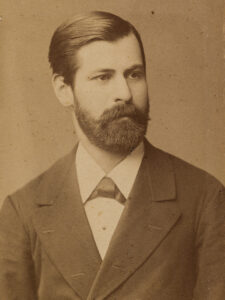
Sigmund Freud c.1885, with Freudian facial hair

Whether you agree with Sigmund Freud that “the dream proves to be the first of a series of abnormal psychic formations” or that “one who cannot explain the origin of the dream pictures will strive in vain to understand [the] phobias, the obsessive and delusional ideas and likewise their therapeutic importance,” (The Interpretation of Dreams, 1913 translated by A.A. Brill) or not, dreams are a regular feature of human life regardless of culture, language, age etc, and so can’t be entirely without significance. I could go on about dreams at length like I did about honey in this previous post but I won’t – they are too pervasive in popular culture – just everywhere in both ‘high’ and ‘low’ culture; in books, and plays and art and films and songs (Dreams they complicate/complement my life, as Michael Stipe wrote). Dreams are everywhere, so that’s enough of that.

But what about daydreams? If dreams arrive uninvited from the unconscious or subconscious mind, then surely the things we think about, or dwell on, more-or-less deliberately are even more important? “Dwell on” is an interesting phrase – to dwell is “to live in a place or in a particular way” BUT the word ‘dwell’ also has a fascinating history that makes it seem like exactly the right word in this situation. From the Old English dwellan “to lead into error, deceive, mislead,” from Proto-Germanic dwaljana “to delay, hesitate” and related to dwelian “to be led into error, go wrong in belief or judgment” etc, etc, according to etymonline.com : I’ll put the whole of this in a footnote* because I think it’s fascinating. But the key point is that at some time in the medieval period its largely negative connotations disappeared and to “delay” become modified to mean “to stay.” But I like to think the old meaning of the word lingers in the subtext like dreams in the subconscious.

I could say something similar about my own use of the word “deliberately” above (“Things we dwell on … deliberately”) and even more so the phrase I nearly used instead, which was “on purpose” – but then this would become a ridiculously long and convoluted piece of writing, so that’s enough etymology for now.

The human mind is a powerful thing, even for those of us who don’t believe in telekinesis or remote viewing or ‘psychic powers’ in the explicitly paranormal sense. After all, your mind controls everything you think and nearly everything you do, to the point where separating the mind from the body, as western culture tends to do, becomes almost untenable. The euphemism “unresponsive wakefulness syndrome” has gained some traction in recent years because the dysphemism (had to look that word up, thought there must be an opposite) “persistent vegetative state” is something we fear and because of that fear, the loss of self, or as we perceive it, of humanity offends us. As fiction frequently demonstrates, despite the evidence it’s preferable for most of us to believe that even in that “vegetative” state, dreams of some kind must continue; because as human beings we are fully our mind in a way that we are only occasionally fully our body. One of the fears connected to the loss of self is that we lose the ability to choose what to think about, which is intriguing because that takes us again into the (might as well use the pompous word) realm of dreams.

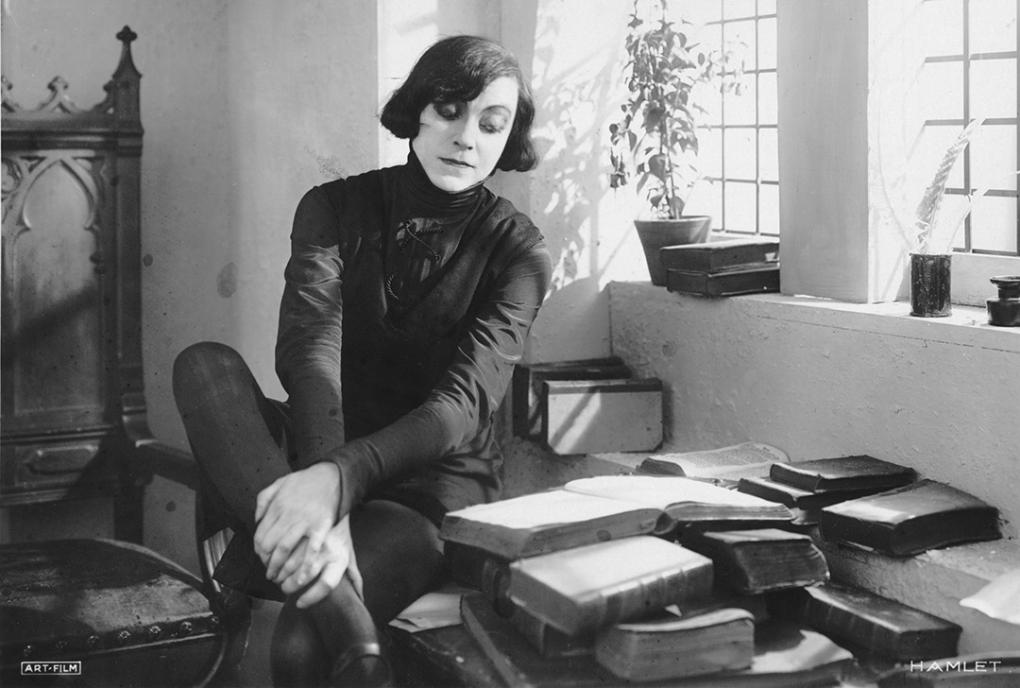
The Danish actress Asta Nielsen as Hamlet in 1921

My favourite Shakespeare quote is the last line from this scene in Hamlet (Act 2 Scene 2)

Hamlet: Denmark’s a prison.
Rosencrantz: Then is the world one.
Hamlet: A goodly one, in which there are many confines, wards, and
dungeons, Denmark being one o’ th’ worst.
Rosencrantz: We think not so, my lord.
Hamlet: Why then ’tis none to you; for there is nothing either good or
bad, but thinking makes it so. To me it is a prison.

There is nothing either good or bad, but thinking makes it so” seems to deny any possibility of objective morality, but its logic is undeniable. After all, you or I may think that [insert one of thousands of examples from current politics and world events] is ‘wrong’, but if [individual in position of power] doesn’t think so, and does the wrong thing, even if all of the worst possible outcomes stem from it, the most you can say is that you, and people who agree with you, think it was wrong. Hitler almost certainly believed as he went to the grave that he was a martyr who had failed in his grand plan only because of the betrayal and duplicity of others. I think that’s wrong, you hopefully think that’s wrong, even “history” (currently) thinks that’s wrong, but none of that matters to Hitler in his bunker in 1945, any more than Rosencrantz & Guildenstern finding Denmark to be a nice place if only their old friend Hamlet could regain his usual good humour makes any difference to Hamlet.

Anyway, onto daydreams or reveries (the latter is a nice word that feels a bit pretentious to say). The dictionary definitions of these words are mostly positive – a series of pleasant thoughts about something you would prefer to be doing or something you would like to achieve in the future. A state of abstracted musing. A loose or irregular train of thought occurring in musing or mediation; deep musing. There’s a school of thought that has been around for a long time but seems even more prevalent today, which values daydreams as not just ‘idle thoughts’, but as affirmations. Anyone who has tried to change their life through hypnosis or various kinds of therapy will find that daydreaming and visualising are supposed to be important aspects of your journey to a better you. In a way all of these self-help gurus, lifestyle coaches and therapists are saying the same thing; as Oscar Hammerstein put it, “You got to have a dream, If you don’t have a dream, How you gonna have a dream come true?” But is making your dreams, even your daydreams, come true necessarily a good thing?

patriotic vapour trails spotted this winter

I seem to remember once reading that if you can focus all of your attention on something for 15 seconds you’ll remember it forever. Whether or not that’s true, every time I see a vapour trail in an otherwise blue sky, I have the same combination of thought and image* which must date from the age of 9 or 10 or so. I realise that people telling you their dreams is boring (or so people say, I never find it to be so), but you don’t have to keep reading.

I can see the fluffy, white trail against the hot, pale blue sky (it’s summer, the sun is incandescent and there are no clouds) and as my eye follows it from its fraying, fading tail to its source, I can see the nose cone of the ‘plane’ glinting in the sun, black or red and metallic. It looks slow, leisurely even, but the object is travelling at hundreds of miles an hour. I know there’s no pilot inside that warm, clean shell (I can imagine feeling its heat, like putting your hand on the bonnet or roof of a car parked in direct sunshine; only there are rivets studding the surface of this machine). I’m shading my eyes with my hand, watching its somehow benign-looking progress, but I know that it’s on its way to the nearby airforce base and that other missiles are simultaneously flying towards other bases and major cities and soon, everything I can see and feel will be vapourised and cease to exist.

I had this daydream many times as a child, I have no idea how long it lasted but I can remember the clarity of it and its metallic taste incredibly clearly. Did I want it to happen? Definitely not. Was I scared? No, although I remember an almost physical sense of shaking it off afterwards. Did I think it would happen? It’s hard to remember; maybe – but I wouldn’t have been alone in that if so. But anyway, the interesting point to me is that this wasn’t a dream that required sleep or the surrender of the conscious mind to the unconscious – I was presumably doing it “on purpose”, although what that purpose was I have no idea; nothing very nice anyway.

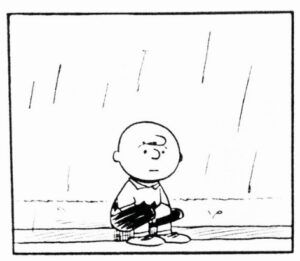
Childhood hero: Charles M Schulz’s Charlie Brown

Probably most of us carry around a few daydreams with us, most I’m sure far more pleasant than that one. I can remember a few from my adolescence that were almost tangible then and still feel that way now (I would swear that I can remember what a particular person’s cheek felt like against my fingertips though I definitely didn’t ever touch it. As my childhood role model, Charlie Brown would say, “Augh!” Charles M. Schulz clearly knew about these things and still felt them vividly as an adult (as, more problematically, did Egon Schiele, subject of my previous article; but let’s not go into that).

Most of the daydreams we keep with us into adulthood (or create in adulthood) are probably nicer baggage to carry around than the vapour trail one, unless you’re one of those people who fantasises about smashing people’s heads in with an iron bar. Iron feels right, but why? Who has such a thing as an iron bar? Wouldn’t brass do the job just as well and lead even better? Violent daydreams are almost inevitable during the teenage/school years, but they are hopefully fleeting.

But thinking about your daydreams is odd. They are, like your thoughts and dreams, yours and nobody else’s, but where they come from in their detail seems almost as obscure as night-dreams. Perhaps Freud would know. I have a couple of daydreams that have been lurking around for decades, but while I don’t believe in telekinesis or even the current obsession with affirmations and ‘manifesting,’ apparently I must be a bit superstitious; because if I wrote them down they might not come true innit?


*Old English dwellan “to lead into error, deceive, mislead,” related to dwelian “to be led into error, go wrong in belief or judgment,” from Proto-Germanic *dwaljana “to delay, hesitate,” *dwelana “go astray” (source also of Old Norse dvelja “to retard, delay,” Danish dvæle “to linger, dwell,” Swedish dväljas “to dwell, reside;” Middle Dutch dwellen “to stun, perplex;” Old High German twellen “to hinder, delay”) from PIE *dhwel-, extended form of root *dheu- (1) “dust, cloud, vapor, smoke” (also forming words with the related notions of “defective perception or wits”).

The apparent sense evolution in Middle English was through “to procrastinate, delay, be tardy in coming” (late 12c.), to “linger, remain, stay, sojourn,” to “make a home, abide as a permanent resident” (mid-14c.). From late 14c. as “remain (in a certain condition or status),” as in phrase dwell upon “keep the attention fixed on.” Related: Dwelled; dwelt (for which see went); dwells.

It had a noun form in Old English, gedweola “error, heresy, madness.” Also compare Middle English dwale “deception, trickery,” from Old English dwala or from a Scandinavian cognate (such as Danish dvale “trance, stupor, stupefaction”); dwale survived into late Middle English as “a sleeping potion, narcotic drink, deadly nightshade.”

* there is another thought: “first you look so strong/then you fade away” but it’s a line from a song and came later and failed to replace the earlier thought

what do you look like?

A few years ago a friend sent me a photograph of the ten-year-old us in our Primary School football team. I was able, without too much thought, to put names to all eleven of the boys, but the biggest surprise was that my initial reaction – for maybe a second but more like two seconds – was not to recognise myself. In my defence, I don’t have any other pictures of me at that age, and even more unusually, in that picture I’m genuinely smiling. Usually I froze whenever a camera was pointed at me (and I still do, if it takes too long), but I must have felt safer than usual in a group shot, because it is a real smile and not the standard grimace that normally happened when I was asked to smile for photographs.

I could possibly also be forgiven for my confusion, because in contrast with my present self, ten year old me had no eyebrows, a hot-pink-to-puce complexion and unmanageably thick, wavy, fair hair; but even so, that was the face I looked at in the mirror every day for years and, more to the point, that gangly child with comically giant hands actually is me; but what would I know?

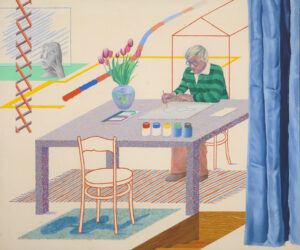
My favourite of David Hockney’s self portraits – Self Portrait with Blue Guitar (1977)

In a recent documentary, the great artist David Hockney made a remark (paraphrased because I don’t have it to refer to) that resonated with me; your face isn’t for you, it’s for other people. As you’d expect of someone who has spent a significant part of his long career closely scrutinizing people and painting portraits of them, he has a point. Everyone around you has a more accurate and certainly more objective idea of what you look like than you do. Even when you see someone ‘in real life’ who you are used to seeing in photographs or films, there’s a moment of mental recalibration; they may look like their image, but the human being before you in three dimensions is on a whole different scale and proportion from the thing you are used to seeing.

I remember reading in some kids’ novel that the young footballer me from that photograph liked (I’m guessing it was by Willard Price but can’t swear to it) that when being shown photographs of themselves, the indigenous people of (I think) New Guinea, not only weren’t impressed, but didn’t recognise them as anything in particular other than little squares of paper. Like Hockney, they had a point; if the Victorian people who invented photography hadn’t grown up with a tradition of ‘realistic,’ representational art would they have seen any relationship between themselves as living, breathing, colourful, space-filling three-dimensional organisms and the monochromatic marks on little flat pieces of paper? The response of the fictional New Guinea tribespeople is far more logical than the expected response (surprise, wonder, awe) in the novel.

Hockney went on further to say that portrait painting (if the sitter is present with the artist) gives a better idea of a person than photography does. At first this is a harder argument to buy into, but it has its own logic too. A photograph, as he pointed out, is a two-dimensional record of one second in time, whereas the portrait painter creates their similarly two-dimensional image from spending time in the company of the sitter and focusing on them – a different, deeper kind of focus, since it engages the brain as well as the senses, than the technical one that happens with a lens, light and film or digital imaging software. A camera doesn’t care what you are like, it just sees how you look, from that angle, for that second. Maybe my big 10-year-old smile really is representative of how I was, but from memory it doesn’t represent that period for me at all.

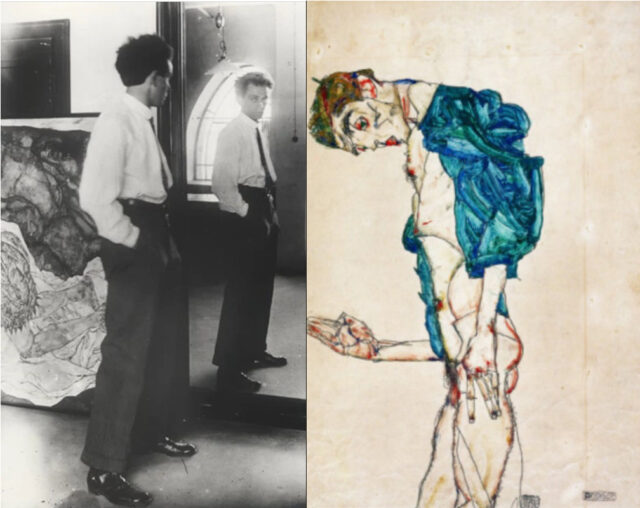
Egon Schiele in his studio c.1915 (left) vs his 1913 self-portrait (right)

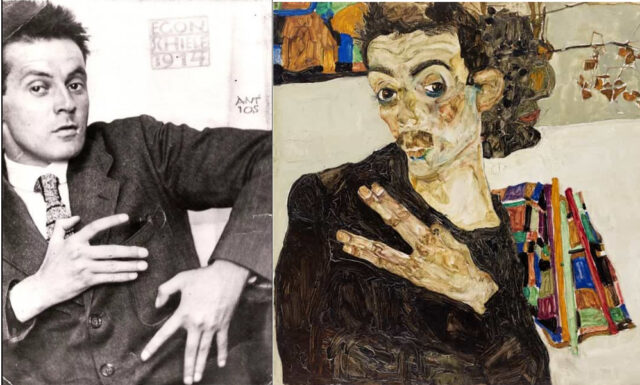
I might never have written this had I not been reading Frank Whitford’s excellent monograph on the Austrian expressionist painter Egon Schiele (Thames & Hudson, 1981). Schiele is famous for (among other things) his twisted, emaciated and fanatically awkward self-portraits. The man he depicts is scrawny, elongated, intense, sometimes almost feline and utterly modern. Schiele in photographs, on the other hand, is quite a different presence. Sometimes he has the expected haunted look and often he has the familiar shock of hair. He sometimes poses almost as awkwardly too, but otherwise he looks surprisingly dapper, civilised, diminutive, square faced and elfin. But if we think – and it seems logical that we do – that the photographs show us the ‘real’ Schiele, then the descriptions of those who actually knew him suggest otherwise.

a slim young man of more than average height… Pale but not sickly, thin in the face, large dark eyes and full longish dark brown hair which stood out in all directions. His manner was a little shy, a little timid and a little self-confident. He did not say much, but when spoken to his face always lit up with the glimmer of a quiet smile.” (Heinrich Benesch, quoted in Whitford, p.66) This description doesn’t exactly clash with the Schiele of the photographs (though he never appears especially tall), but it’s somehow far easier to identify with the dark-eyed, paradoxically shy and confident Schiele of the self portraits. In his own writings, Schiele seems as tortured and intense as in his paintings, but in photographs he appears confident, knowing and slightly arch.  His face, as Hockney says, may not have been for him, but he seems to have captured it in his art in ways that his friends and acquaintances recognised, and which the camera apparently didn’t.

Schiele in 1914 by Josef Anton Trčka (left) vs his 1911 self portrait (right)

So does that prove Hockney both right (portraiture is superior to photography) and wrong (Schiele did know his own face)? And anyway, what does that have to do with the 10-year old me? Nothing really, except that the camera, objective and disinterested, captured an aspect of me in that second which may or may not have been “true.” Objectivity and disinterestedness are positive qualities for evaluating facts, but when it comes to human beings, facts and truth have a complicated relationship. Photography, through its “realness,” has issues capturing complexities, unless the photographer is aware of them and – Diane Arbus and Nan Goldin spring to mind – has the ability to imbue their work with more than just the obvious surface information that is the camera’s speciality. But (hu)manually-created art, with its human heart and brain directing, naturally takes the relationship between truth and facts in its stride.

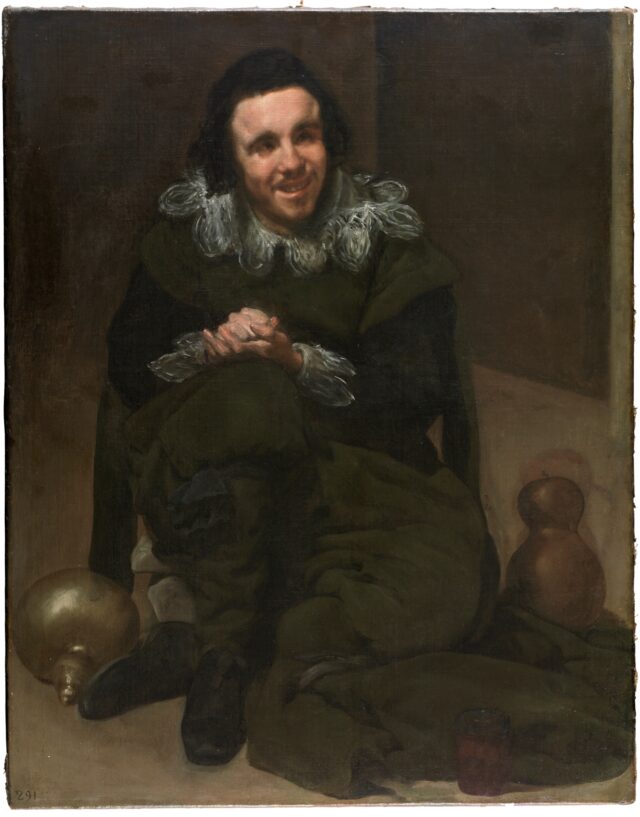
One final example that proves nothing really, except to my satisfaction. Around the year 1635, the Spanish painter Diego Velázquez was tasked with painting portraits of the assorted fools, jesters, dwarfs and buffoons whose lives were spent entertaining the Spanish court. Most of these people suffered from mental or physical disabilities (or both) and were prized (I think that’s a more accurate word than ‘valued’ in this context) for their difference from ‘normal’ people; treated in and viewed as the same way as carnival “freaks” up to the early 20th century in fact.

These people were comparatively privileged – that is, compared to what their lives as someone with a disability would have been like had they not been adopted by the Royal court. But their position in the household was more akin to pets than friends or even servants. Juan de Calabazas (“John of Gourds; a gourd was a traditional jester’s attribute) suffered from unknown mental illnesses and physical tics. In a time and place where formality and manners were rigidly maintained, especially around the monarch – where a misstep in etiquette could have serious or even fatal consequences, buffoons like Juan entertained the court with unfettered, sometimes nonsensical or outrageous speech, impulsive laughter and strange, free behaviour.

In normal 16th-17th century society these people would be lucky even to survive, but in the Court their behaviour was celebrated and encouraged. Velázquez is rightly famous for the empathy and humanity with which he painted portraits of these marginalised figures, but although, as Wikipedia (why not?) puts it; “Velázquez painted [Juan] in a relatively calm state, further showing Velazquez’s equal show of dignity to all, whether king or jester” that seems an unusual response to the portrait below, It’s not untrue, but for me at least, Velázquez’s process of humanisation is painful too. The knowledge that this man lived his life as a plaything of the rich and powerful, alive only because they found him funny is troubling enough. But that pathos seems to be embodied in the picture and you know, or it feels like you know, that Velázquez didn’t find him funny, or at least not only funny. It’s something like watching David Lynch’s The Elephant Man compared to looking at the Victorian photographs of the real Joseph Merrick. Seeing the photographs is troubling, seeing Lynch’s cinematic portrait is too, but it’s deeply moving as well.

Juan de Calabazas (c.1635-9) by Diego Velázquez

All of which may just be a way of saying that a camera is a machine and does what it does – recording the exterior of what it’s pointed at – perfectly, while a human being does, and feels, many things simultaneously, probably not perfectly. Well I’m sure we all knew that anyway. I eventually got eyebrows, by the way.


2024 – welcome to the/a future(s)


Another year – and the actual name of the year itself gets ever stranger and more unlikely and exotically futuristic, if you grew up in the era when the film 2001: A Space Odyssey was still set in the future. And here’s the annual attempt to get something onto this site at the beginning of the year – just made it in the first week this time – and hopefully, to post more often. The goal is a minimum of once a month but I think goals are better than resolutions so that’s as far as I will go.

2023 was the usual mixed bag of things; I didn’t see any of the big movies of the year yet. I have watched half of Saltburn, which so far makes me think of the early books of Martin Amis, especially Dead Babies (1975) and Success (1978) – partly because I read them again after he died last year. They are both still good/nasty/funny, especially Success, but whereas I find that having no likeable characters in a book is one thing, and doesn’t stop the book from being entertaining, watching unlikeable characters in a film is different – more like spending time with actual unlikeable people, perhaps because – especially in a film like Saltburn – you can only guess at their motivations and inner life. So, the second half of Saltburn remains unwatched – but I liked it enough that I will watch it.
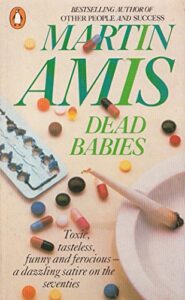
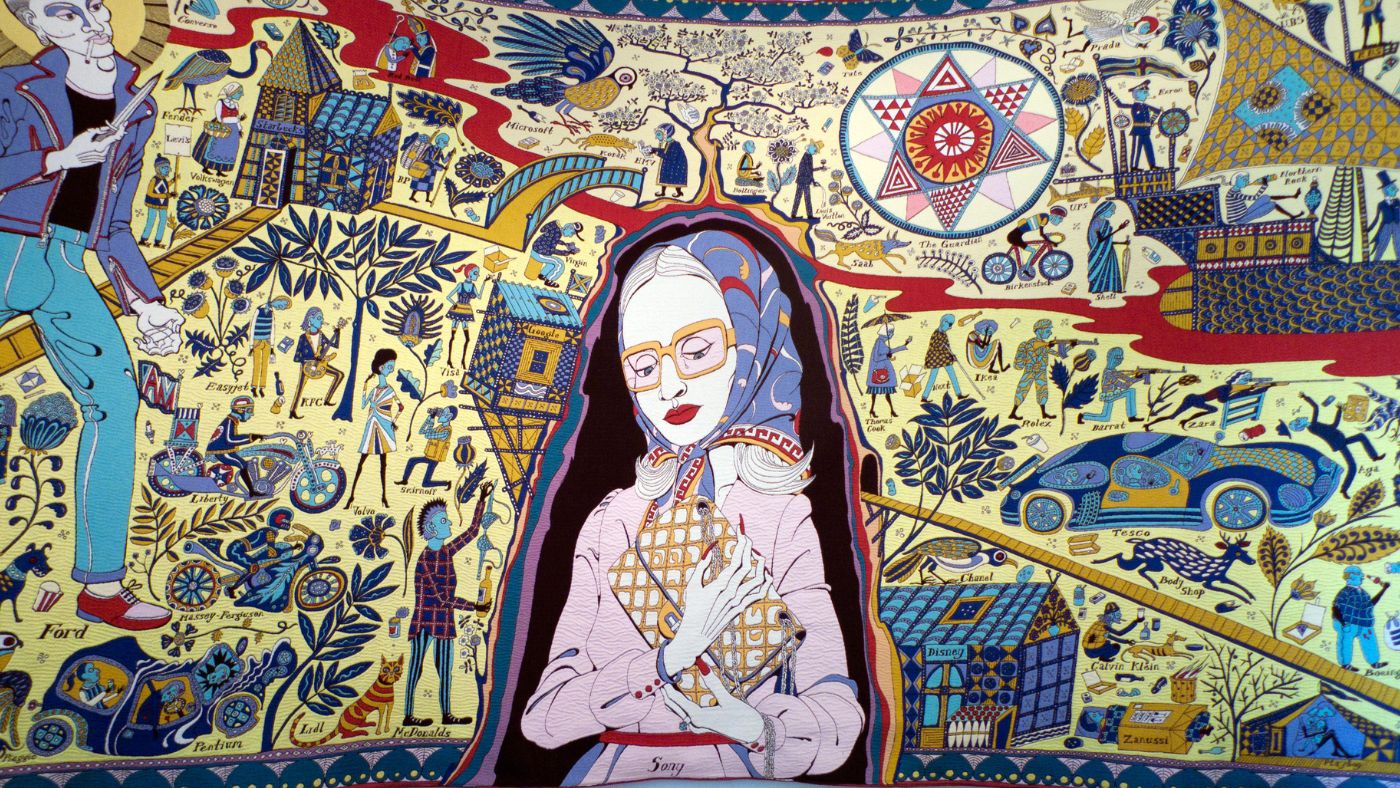

Grayson Perry – The Walthamstow Tapestry (detail)

I didn’t see many exhibitions last year but am very glad that I caught Grayson Perry’s Smash Hits in Edinburgh. I didn’t really plan to see it as assumed in advance I wouldn’t like it, but in fact I loved it and ended up having a new respect for GP that only partly evaporates whenever I see him on TV.

Kristin Hersh by Peter Mellekas

I can’t be bothered going in depth about my favourite music of the year because the year is over and I’ve written about most it elsewhere. Old teenage favourites came back strongly: Kristin Hersh’s superb run of albums continued with Clear Pond Road. I hadn’t thought a lot about Slowdive in years but I really liked Everything is Alive and was very pleased to see them get the kind of acclaim that mostly eluded them when I was buying their first album a million years ago. Teenage Fanclub’s Nothing Lasts Forever and Drop Nineteens’ Hard Light were good too, and The Girl is Crying in her Latte by Sparks was probably my favourite of theirs outside of their early 70s classics. There were some excellent black metal (or black metal-related) albums too; much as I don’t like to think of Immortal without Abbath, Demonaz did himself proud with War Against All. Niklas Kvarforth returned to form with the brilliant Shining and Skálmöld’s Ýdalir is as good as anything they’ve recorded. In less guitar-oriented genres, I loved Kid Koala’s Creatures of the Late Afternoon and the latest Czarface record but my favourite album of the year if I had to choose one was the loveably lo-fi and enigmatic compilation Gespensterland.

I read lots of good books in 2023 – I started keeping a list but forgot about it at some point – but the two that stand out in my memory as my favourites are both non-fiction. Lauren Elkin’s Art Monsters: Unruly Bodies in Feminist Art  is completely engrossing and full of exciting ways of really looking at pictures. I wrote at length about Elena Kostyuchenko’s I Love Russia here. Kostyuchenko introduced me to a country that I only knew via history and stereotypes and her book is an exercise in what good journalism should be – informative, interesting, compassionate and readable. Both of these books cut across a wide range of subjects and examine unfamiliar things but also analyse the familiar from unfamiliar points of view; you should read them, if you haven’t already.
 

It’s no great surprise to me that my favourite books of the year would be – like much of my favourite art – by women. Though I think the individual voice is crucial in all of the arts, individuals don’t grow in a vacuum and because female (and, more widely, non-male) voices and viewpoints have always been overlooked, excluded, marginalised and/or patronised, women and those outside of the standard, traditional male authority figures more generally, tend to have more interesting and insightful perspectives than the ‘industry standard’ artist or commentator does. The first time that thought really struck me was when I was a student, reading about Berlin Dada and finding that Hannah Höch was obviously a much more interesting and articulate artist than (though I love his work too) her partner Raoul Hausmann, but that Hausmann had always occupied a position of authority and a reputation as an innovator, where she had little-to-none. And the more you look the more you see examples of the same thing. In fact, because women occupied – and in many ways still occupy – more culturally precarious positions than men, that position informs their work – thinking for example of artists like Leonora Carrington, Kay Sage or – a bigger name now – Frida Kahlo – giving it layers of meaning inaccessible to – because unexperienced by – their male peers.
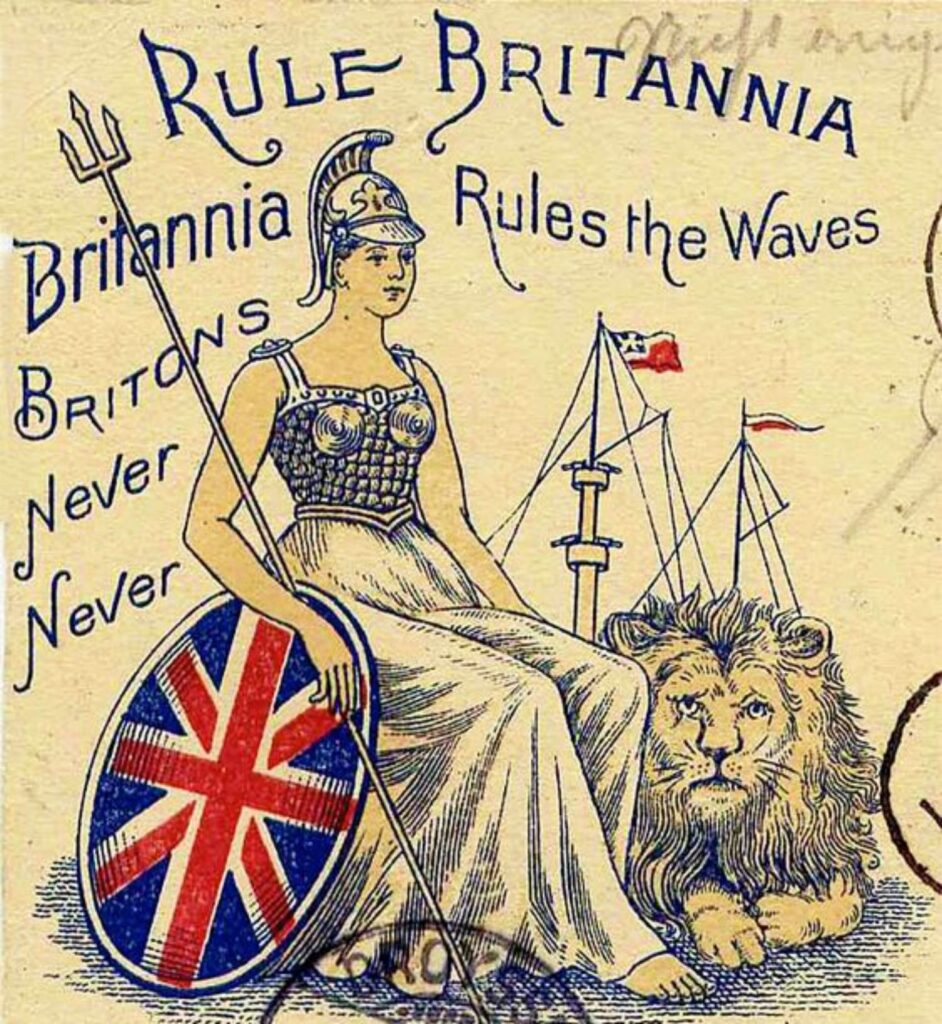
The fact that women know more about themselves but also more about men than men do – because they have always had to – gives their work an emotional and intellectual charge often missing from those who belong comfortably within a tradition. This is a pretty well-worn idea – it’s why outsiders like Van Gogh or dropouts like Gauguin’s work speaks to us more clearly than the academic, tradition-bound art that they grew up with. Anybody on the margins, in whatever sense, of “mainstream society” has to have a working knowledge of that society, just to exist. Society has far less need to understand or even notice those people. – therefore their points of view are likely to not only be more individual, but more acute when it comes to observing the world in which they live. Class, race, gender; all of these things are always fascinatingly central to art and art history and the gradual recognition of that fact is making art history ever more exciting and vibrant. For now at least; we live in a time of conservative backlashes which attempt to restore order to those with a comfortable position within yesterday’s world – there will probably be an art historical backlash at some point, and the reputations of the mainstream stars of art in Van Gogh and Gauguin’s day, like William-Adolphe Bouguereau will find their reputations restored.

If that backlash comes, it will be from the academic equivalent of those figures who, in 2023 continued to dominate the cultural landscape. These are conservative (even if theoretically radical) people who pride themselves on their superior rational, unsentimental and “common sense” outlook, but whose views tend to have a surprising amount in common with some of the more wayward religious cults. Subscribing to shallowly Darwinist ideas, but only insofar as they reinforce one’s own prejudices and somehow never feeling the need to follow them to their logical conclusions is not new, but it’s very now. Underlying  ideas like the ‘survival of the fittest’, which then leads to the more malevolent idea of discouraging the “weak” in society by abolishing any kind of social structure that might support them is classic conservatism in an almost 19th century way, but somehow it’s not surprising to see these views gaining traction in the discourse of the apparently futuristic world of technology. In more that one way, these kinds of traditionalist, rigidly binary political and social philosophies work exactly like religious cults, with their apparently arbitrary cut off points for when it was that progress peaked/halted and civilisation turned bad. That point varies; but to believe things were once good but are now bad must always be problematic, because when, by any objective standards, was everything good, or were even most things good? For a certain class of British politician that point seems to have been World War Two, which kind of requires one to ignore actual World War Two. But the whole of history is infected by this kind of thinking – hence strange, disingenuous debates about how bad/how normal Empite, colonialism or slavery were; incidentially, you don’t even need to read the words of abolitionists or slaves themselves (though both would be good to read) to gain a perspective of whether or not slavery was  considered ‘normal’ or bad by the standards of the time. Just look at the lyrics to Britain’s most celebratory, triumphalist song of the 18th century, Rule Britannia. James Thomson didn’t write “Britons never, never, never shall be slaves; though there’s nothing inherently wrong with slavery.” They knew it was something shameful, something to be dreaded, even while celebrating it.
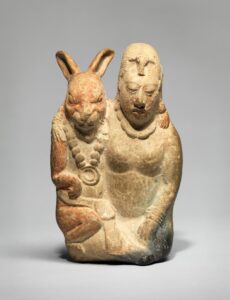
But anyways, the kind of avowedly forward-looking people we that are saddled with now, with their apparent concern for the future of the human species – especially the wellbeing of thus far non-existent future humans, as opposed to actual real living humans are, unlike the Amish, okay with progress, in the material sense of cars, computers, aircraft, spacecraft. But that only makes their core concern with traditional values and what is natural/unnatural even more nonsensical. If the defining thing about human beings is nature – men are like this, but not like that, women are like that, but not this; that nature dictates that compassion and medical science ate wasted on the weak and inferior, etc, then why draw the line at controlling gender and reproduction? Why get excited about the use of vaccines, or whether or not people “should” eat meat? If nature/”natural” really is the be all end all of human existence, why wear clothes, drive cars, cook food, use computers, build houses?  At what point does nature dictate what we do or can or should do? Isn’t everything humans do inherently natural because we have the capacity to do it and actually do do it?

Again, despite the supposed rationalism that fuels the superiority complexes of so many powerful people in whatever sector, their bullshit traditional ideas are dictated against – and always have been – by the lived experience of almost everyone in the world. If ‘real men’ are strong, rational and above all heterosexual, how come most of us will have met, throughout our lives, emotional, irrational men who can’t cope with pressure, who aren’t in control of themselves or their environment? How come homosexuality has existed since the beginning of recorded time and does not go away no matter how traditional or repressive society becomes or how much generation after generation insists that it is unnatural? If ‘real women’ are weak, gentle, sentimental, maternal, submissive and above all heterosexual, how come (etc, etc, etc, etc) Because of decadent western society? Well Western society is partly founded on the ideas of Ancient Greece, which though pretty misogynistic, famously did not have quite the same views on sexuality. And how come these people equally exist in every other society too? Could it be that traditional ideas of ‘human nature’ have nothing to do with actual nature but have always existed in western patriarchal societies simply to reinforce the status quo in the interests of those at the top of the hierarchical tree? From monarchies to oligarchies to modern democracies and communist states – all of which have their own ruling class, even when it is explicitly labelled otherwise – it’s been in the interest of those in charge to prevent anything which fundamentally changes the way things work.

For similar reasons, people in western society (perhaps elsewhere; I am no expert) who live unremarkable and mediocre lives within essentially complacent, and often apolitical circles are increasingly drawn to right rather than left wing extremism to gain prominence and (importantly) material success. Extremist views across the spectrum are entertainingly “edgy” and titillating to people who like to be entertained by controversy and/or shocked by outrageous behaviour, but right-wing views are far more acceptable within the media – and therefore are far more lucrative and rewarding – because they don’t threaten the financial basis that underpins the media and political structure.

So in short – only joking, this will be a long sentence (deep breath). If comedian or podcaster A) gains millions of followers who are excited about disruptive ideas that undermine the state by questioning the validity of the (sigh) mainstream media, by interrogating ideas of media ownership and the accumulation of wealth and power and so on, that represents a genuine threat to Rupert Murdoch, Viscount Rothermere, Meta and Elon Musk in a way that comedian or podcaster B), gaining millions of followers who lean towards ideas that disrupt society by attacking progressive, egalitarian or (sigh) “woke” culture does not. Regardless of the actual or avowed political beliefs of these media magnates, is comedian/podcaster A or comedian/podcaster B going to be the one they champion in order to tap into the zeitgeist (which media magnates have to do to survive)?

BUT ANYWAY, it would be nice to think that these things would be less central or at least more ignorable in 2024. It would also be nice if people in power could not enable the worst elements in society (where the two things are separable). It would be more than nice if the governments of the world would listen to people and end the butchering of helpless civilians. It’s important to remember that it is in the interests of governments – even relatively benign ones – that people in general feel powerless. But we’re not. If making resolutions works for you then make them, if not then don’t, if you have goals then aim for those and you may achieve something even if not everything you want to achieve. But if something is unacceptable to you, don’t accept it. You may have money, power, time or you may have little more than your own body and/or your own mind, but those are 100% yours and the most important things of all. Happy New Year and good luck!
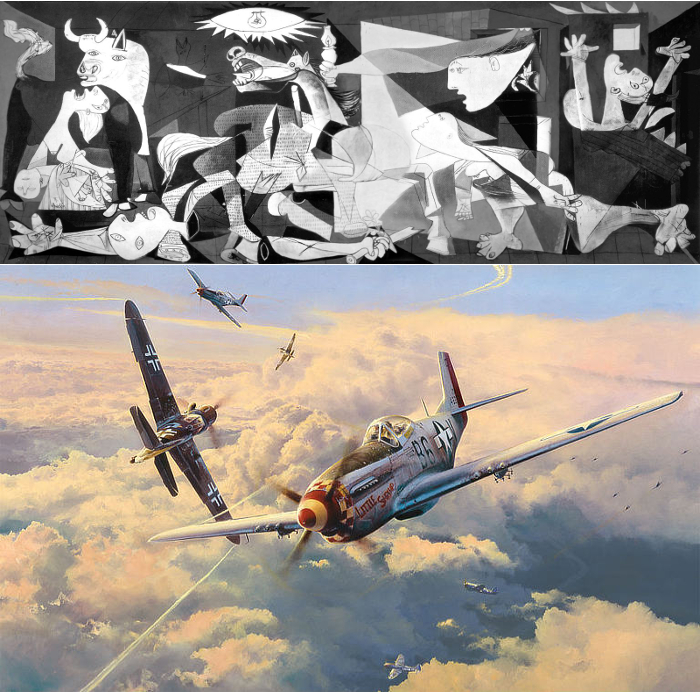
chocolate eggs & bunnies & pregnancy & blood: happy Easter!

ceramic sculpture of a Moon Goddess and her rabbit or hare partner, Mexico, c.700 AD

Imagine a culture so centred on wealth, property and power that it becomes scared of something as fundamental to human existence as sex, and frets endlessly about what it sees as the misuses of sex. A culture that identifies breeding so closely with with money, wealth and status, and women so closely with breeding and therefore with sex that, when looking to replace the traditional symbols of birth and regeneration it rejects sex and even nature and, in the end makes the embodiment of motherhood a virgin and the embodiment of rebirth a dead man. Unhealthy, you might think; misanthropic even – and yet here we are.

But when that misanthropic culture loses the religious imperative that fuelled it for centuries, what should be waiting but those ancient symbols of fertility; rabbits and eggs. But whereas Christianity in its pure, puritanical form found it hard to assimilate these symbols, preferring instead to just impose its own festival of rebirth on top of the pagan one, capitalism, despite being in so many ways compatible with the Judeo-Christian tradition, is essentially uninterested in spiritual matters. So even though capitalism is mostly pretty okay with Christianity, which creates its own consumer-friendly occasions, it proves to be equally okay with paganism, as long as it can sell us the pagan symbols in a lucrative way.

In Christianity the idea of the life cycle is almost surreally reproduced in the (male) Trinity; God the Father, God the Son and God the Holy Spirit – defined by the Lateran Council of 1213 – 15 as “the Father who begets, the Son who is begotten, and the Holy Spirit who proceeds” – there’s no room for anything as earthly or earthy as motherhood. The Virgin Mary is essentially a token female presence, and one with her biological female attributes erased. And yet in every society that has worshipped under the Christian banner, child-bearing has historically only been done by women and child-raising has almost entirely been ‘women’s work’ too. Which makes you think that really, patriarchy is one of the great mysteries of humanity and the fact that it’s seen by many as the natural order of human society is even stranger.

But anyway; Easter. Easter is a mess, even to begin with; its name is pagan (Ēostre or Ôstara, Goddess of the spring) and its Christian traditions, even when embodied in the tragic idea of a man being murdered/sacrificed by being nailed to a cross, were never entrenched enough to suppress the celebratory, even frivolous feeling that spring traditionally brings. Okay, so Christ ascending to heaven is pretty celebratory without being frivolous; but as, in the UK at least, represented by a hot cross bun, with the cross on the top to represent the crucifix and even – to play up the morbid factor that is so central to Christianity – its spices that are supposed allude to the embalming of Christ’s dead body, it’s hardly solemn: it’s a bun.

On the other hand, birth, since the dawn of time and to the present day, is not just a simple cause for rejoicing and in that, the Christian tradition – although it tries to remove the aspects that seem most central to birth to us: women, labour (the word presumably wasn’t chosen accidentally) and procreation – probably tells us more about the seriousness and jeopardy of childbirth than the Easter bunny does.

St Margaret, “reborn” after being eaten by a dragon

Childbirth is the central and most fundamental human experience and, until the 20th century it was one of the most perilous ones, so naturally the church had to address it. And so there’s a ‘patron’ (interesting choice of word) saint of childbirth; clearly the Virgin Mary is too specialist to be identified with (and perhaps it would even be blasphemous to do so?) so instead there’s St Margaret. Not much help; firstly, St Margaret should surely be a ‘matron saint’ but that’s not a thing, and secondly, in herself she has nothing to do with birth, although she was presumably born. Instead she becomes the saint of childbirth through the symbolic act of bursting out of the dragon who ate her – a strange analogy but one that reflects the hazardous nature of childbirth in medieval times, when mortality rates were high, not just for babies but for their mothers. And what mother couldn’t relate to bursting out of a dragon? But Christianity’s real issue with the whole topic of birth has less to do with birth itself than how humans reproduce in the first place. Rabbits and hares may represent – in ancient cultures across the world, from Europe to Mexico and beyond – fecundity, but it’s an animal idea of fertility for its own sake that has nothing to do with the practical or emotional aspects of producing new human beings, or the legal, dynastic and financial ones that the Old Testament and the ancient world generally saw as the purpose of reproduction.
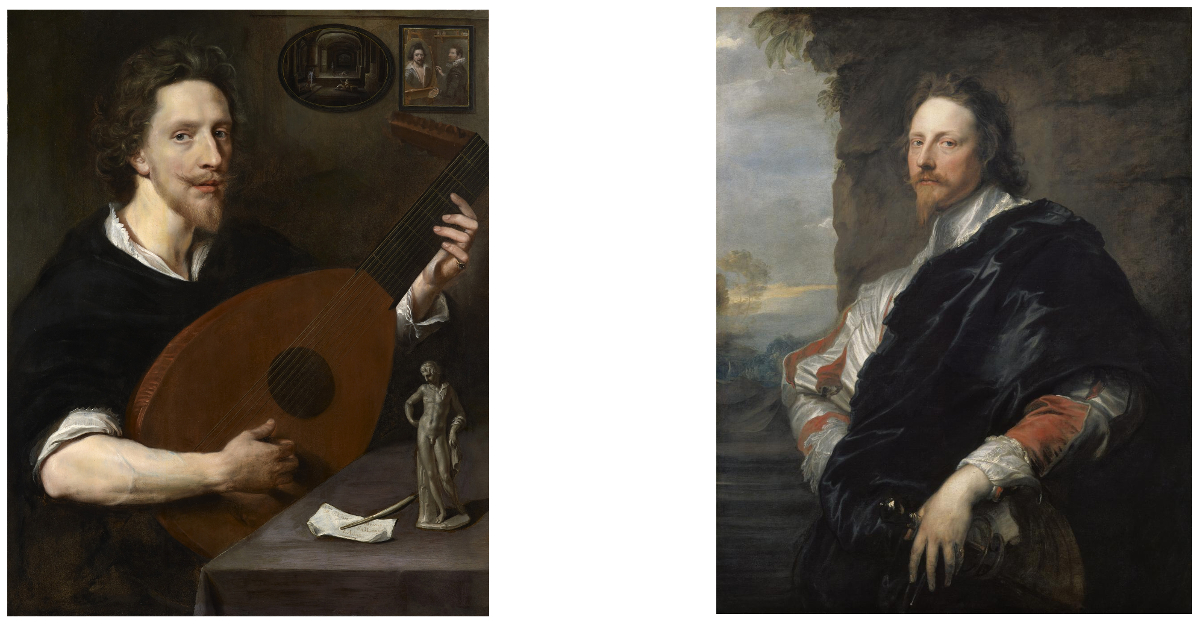
Jan & Hubert Van Eyck’s Eve from the Ghent Altarpiece (completed c 1432)

Pregnancy in Western art was a rarity until fairly recently and the puritanical ideas inherited by Victorian Christianity shaped art historical studies, to the point that people (until quite recently) tended to deny the evidence of their own eyes. Surely to believe that Jan and Hubert van Eyck’s hyper-realistic Eve – the mother of the human race – from Ghent Altarpiece (completed in 1432) just has the preferred medieval figure, rather than being pregnant, is perverse, isn’t it? Or that Mrs Arnolfini (Costanza Trenta) in the Arnolfini Portrait of 1434, who is touching her swollen stomach and who had died, presumably in childbirth – the year before this painting was completed, is just an example of that same fashionable shape, seems ridiculously far-fetched. (My favourite among the many theories about the Arnolfini portrait is Margaret Koster’s – which is explored in Waldemar Januszczak’s excellent short film about the painting.)

To go back to Eve; the idea of the first woman pregnant with the first child makes more sense for the 15th century, which was neither squeamish about or embarrassed by the realities of life in the same way that the 19th and early 20th century gentlemen who codified the canon of Western art history were. It’s not impossible that she is just the medieval/gothic ideal of femininity as seen in illuminated manuscripts and carvings; small shoulders, small breasts, big hips and stomach – given an unusually realistic treatment, but it’s hard to believe that even in the 15th century the first reaction of viewers – especially given the realism of the picture – wouldn’t have been to assume she was pregnant. Culture and society has changed a lot in the intervening centuries, but biology hasn’t.

For subsequent generations, the status of women and the perils of childbirth and childhood gave pregnant women and babies a strange presence in secular art. While there’s no reason to assume that people were less caring or sentimental about their partners or their children, portraits were rarely about sentiments, but status. Portraits of women, with the rare exception of Queens, were generally portraits of wives or potential wives, and pregnancy was of crucial dynastic importance. But in times when childbirth was almost as likely to end in death as life for both mother and child, it was presumably a risky thing to record; there are not very many pregnant portraits. Maybe – I should probably have investigated this before writing it – the time a portrait took from commission to completion was also a factor that made it risky? A portrait wasn’t a particularly inexpensive thing, possibly commissioning a portrait of someone who would quite likely be dead within the next nine months felt like an iffy investment, or (to be less mercenary about it) courting bad luck? In the generations that followed, female artists – such as Elizabeth Vigee-Lebrun – could celebrate motherhood in self-portraits, but for the kind of reasons mentioned above – and because of contemporary ideas of ‘decency’ – they were hardly likely to portray themselves as obviously pregnant.

Gustav Klimt – Hope 1 (1903)

As time went on and connoiseurship and ‘art history’ became a thing I don’t think it’s too much of an exaggeration to say that the arbiters of high culture in the paternalistic (at best, misogynistic at worst) society of Europe were intimidated by the female power inherent in the creation of the human race. The other side of that coin is the (slightly titillating) sense of the beauty, magic and wonder of pregnancy that the pro-female (philogynist? There must be a word) Austrian Gustav Klimt brought to art with Hope I. Beautiful though that is, Klimt’s vision isn’t really so far from the pure virgin/corrupt whore binary of medieval times, especially when you see his beautiful female figure of hope and renewal glowing against a background of death and peril. It really only when women enter the art world in greater numbers that the symbolic and magical aspects of motherhood are reconciled with the more sombre, earthly spirituality that Christianity preferred to represent in a dying man and that pregnant women can just be pregnant women.

For me, Paula Modersohn-Becker – one of my favourite painters – is the artist of pregnancy and childbirth and a painting like her Reclining Mother and Child II (1907) shows all of the human aspects that were embodied in the contorted Christian images of the Virgin Mary, crucifixion and Christ’s rebirth. In her self-portraits, the magic of Klimt without the titillating overtones, the fragility and peril of the older periods and the prosaic facts of pregnancy and what it does, good and bad, to the body, are all acknowledged. For once, it doesn’t seem ironic, only tragic, that Modersohn-Becker would be one of the many thousands of women of her era to die from complications shortly after giving birth.

Paula Modersohn-Becker – Reclining Mother & Child II (1906)
Käthe Kollwitz, 1920

But once the reality had been captured, where to go from there? Anywhere, essentially; after Paula Modersohn-Becker pregnancy becomes just a subject, if a special one; art as creation representing creation. That’s a lofty way of putting it, but for the generation of German artists that followed, ‘realism’ was the whole point, some of the time at least. If Paula Modersohn-Becker represented pregnancy from the point of view of experience, capturing both its beauty and discomfort, Otto Dix the arch-realist gives us just the discomfort. His pregnant mothers are almost all exhausted working class women, heavy, swollen, weighed down by their burden. It’s a beautifully-observed point of view, and an empathetic one, but possibly a very male one too. Although Dix claimed, possibly sincerely, “I’m not that obsessed with making representations of ugliness. Everything I’ve seen is beautiful.” he nevertheless took a definite pride in shocking viewers with his art. As he also said; “All art is exorcism. I paint dreams and visions too; the dreams and visions of my time. Painting is the effort to produce order; order in yourself. There is much chaos in me, much chaos in our time.” By the time Dix painted these pictures he was a father himself, but although his paintings of his family reveal a more tender, if just as incisive, aspect to his art. When he paints these mothers-to-be, with their hard lives in the terminally unstable Weimar Republic, he paints as a pitiless observer, knowing that his work was challenging and confrontational to the generally conservative audience of his time; a time when, like ours, forces of intolerance and conservatism were closing in on the freedom embodied in art this truthful. It’s notable that, while dealing in the same harsh realities as Dix, but with a socially conscious, rather than clinical eye, the artist Käthe Kollwitz gives her women a more studiedly pitiable, though no less ‘realistic’ aura.

But the fact that Dix’s realism, though ‘objective’ was dramatically heightened is highlighted by a comparison between two paintings, one by Dix and the other by his female student Gussy Hippold-Ahnet, painted in 1931/2 and of – I think – the same model. In Dix’s painting, his most famous painting of a pregnant woman, the mother-to-be’s face is averted, hidden in darkness and it’s her almost painful roundness and heaviness that is the focus of the picture. In Hippold-Ahnet’s painting, far less dramatically, the mother sits more or less neatly, looking big but not unhappy. It’s a less dynamic and less assured piece of work – but is it any less real? In Dix’s realism, reality is generally harsh and pitiless, with no veneer of politeness or sentimentality. But although that represents a kind of underlying truth, especially about nature, people are often savage and cruel are nevertheless just as often also polite and sentimental. Gussy’s painting seems less powerful, but she is not showing us, as Dix seems to be, a faceless being representing the eternal, but rarely-remarked-on hardship involved in the joyous business of continuing the human species. Instead, sh3 shows us a woman who happens to be pregnant; both paintings are realistic, both are objective and, as with the symbolic sacrifice of Christ and the eternally recurring Easter bunny, both display different aspects of the truth.

Otto Dix – Pregnant Woman (1931) & Gussy Hippold-Ahnert – Pregnant Woman (1932)

Since the 1920s, attitudes towards pregnancy and women have fluctuated but female artists are no longer the exception within the art world and so women in art can be women in art and not women as a symbols in art. And although male artists have continued – and why not? – to paint pregnant sitters (Lucian Freud’s Pregnant Girl is a beautiful, not uncomplicated example), not surprisingly women do it better. And while I’m not sure if my favourites – Alice Neel and Paula Rego spring to mind – add anything in terms of content and meaning to Paula Modersohn-Becker’s example, what they do add is more experience, wider experience and therefore bring a truer reflection of the source and the central experience of humanity to the world. Regardless of whether or not one believes in a god, everyone believes in that creation story; which is kind of more important than an old, bearded man, a young, sacrificed man and a bird; but it doesn’t matter, there’s room in art for everything. Anyway, enjoy your chocolate eggs.

Paula Rego – The First Mass in Brazil (1993)
Bonus picture: my favourite bunny in art: detail from Piero di Cosimo’s Venus, Mars & Cupid (1505)


forget my fate: saints and sex workers; the art of violence & martyrdom

In a way, this article concerns religious art, though the person who wrote it has no religious beliefs whatsoever. But when people really, passionately, even if unconsciously, believe – in a religion, a philosophy, an idea – that belief imbues the works they create with the power of human feeling. Art, music, architecture, literature, objects; that power that is retained whether or not the observer accepts or understands the ideas that are living within those things. That’s my opinion anyway; I may not believe in the supernatural, but I do believe the ‘natural’ contains magic of its own.

Adam Elsheimer – The Stoning of St Stephen, 1603 (detail)

So anyway; when, in Purcell’s 1688 opera Dido and Aeneas, the dying Queen of Carthage sings Nahum Tate’s beautiful words, “Remember me, but forget my fate”, she is articulating something that was then becoming, and to some extent remains a kind of ideal as humanity tried, perhaps pointlessly, to distance itself from death. Caught in a pincer movement between the Reformation, which had eliminated much of the rich mythology of religion in its determination to reduce the clutter and distance between human beings and their God, and the dawning of what would become the age of reason, which sought to cast off the shadow of crude medieval brutality and superstition, death, once an unavoidable and largely accepted part of daily life, had become something akin to what it is today. That is, entirely acceptable – even celebrated, in fiction and entertainment, in real life it’s preferably kept out of sight and out of mind as far as is possible. But although the impulse to distance oneself from the more viscerally negative aspects of life is understandable, it’s almost the opposite of the way that people, for a couple of centuries at least, related to saints.

Saints have remained celebrated through the years to some extent, but still, since their medieval heyday they have found themselves playing a gradually diminishing role in Western European society. Interestingly though, while Christianity lost much of its cast of characters and stories through the ages, what it never lost in the Reformation – quite the opposite in fact – is that key idea which saints’ lives so often embodied: misery now, rewards later. And it was this, despite the apparent opposition of the two ideologies, which made Christianity and all of the Abrahamic religions such successful facilitators, or carriers (in the pharmaceutical sense) of capitalism. But, while saints faded from the vital figures of the middle ages into their current, more modest position, they remained venerated, if not worshipped, even in the Protestant faith, and still played a vital role in Catholic countries. That being so, plenty of the somewhat harrowing and graphic art generated in their names in earlier years survives; and rightly so.

Take for example Adam Elseheimer’s 1603 Stoning of St Stephen. As a German artist working in Catholic Rome, Elseheimer’s position may have been anomalous, but no faith of any kind is required to understand and empathise with the young saint’s fate. We may not (or we may) share his implied, rather than shown, exultation at the parting of the clouds and the glimpse of heaven beyond, but we can recognise his pain, fear and loneliness. We’ve seen it many times, not only in cinema and in literature, but even more in news reports and photographs or, if we are unlucky, as eyewitnesses to (or victims of) real events. This painting make me think of the harrowing footage, a few years back, of prisoners being beheaded by Islamic State fighters, but they have echoes too, in those everyday acts of violence in which there are, thankfully, usually no deaths – but rarely any obvious sign of divine intervention either.

detail of St Sebastian being clubbed to death by Master WB (probably Wolfgang Beurer, c.1500)

One of the most strikingly contemporary-feeling examples of the art of martyrdom is the series of Scenes from the life of St Sebastian in the Cathedral Museum, Mainz, painted by Master WB (probably the Middle Rhenish painter and engraver Wolfgang Beurer). St Sebastian is one of the most often-painted of saints, usually shown as a kind of surrogate Jesus, young and beautiful, but pierced by (sometimes a lot of) arrows. But the whole point of that part of his legend, is that the arrows didn’t kill him. Tended by St Irene of Rome (in the baroque era the healing of St Sebastian was painted quite often; there are some very beautiful and moving pictures, like the famous Georges de la Tour painting from 1650, and my favourite, by Hendrick Ter Brugghen, from a little earlier) he recovered, and went about his saintly business.

Unusually though, Beurer’s cycle of paintings takes the story past the Christ-like recovery of Sebastian and through to his eventual death, after he journeyed to see the Emperor Diocletian and scold him about his sinful life. This time, the young saint was clubbed to death and didn’t recover. This is a very different death from the ceremonial, iconic execution by arrows. There’s a sense of solemnity, of procedural, if dubious, legality that affords the victim of a firing squad a kind of Christ-like dignity – in paintings at least. There’s no way to make a clubbing to death look dignified though, and Beurer/Master WB doesn’t try. Instead he shows the by now pitifully uncomposed figure of the saint being beset by three cheerfully brutish soldiers with beautifully painted lead clubs.

Hendrik Ter Brugghen -St Sebastian tended by St Irene, 1625
Sebastiano del Piombo’s Martyrdom of St Agatha 1520 (technically doesn’t feature her martyrdom)

St Agatha, like Sebastian, is unusual in that her actual martyrdom – technically, she died in prison at some unspecified time later, after being healed by St Peter – is never pictured. Instead what is shown, essentially for titillating reasons, as horrendous as that is, is not even her torture, where her body was torn with hooks, but only the specific detail of her breasts being cut or torn off.
But although her death seems rarely to have been depicted, there are paintings of the healing of St Agatha in prison by St Peter. Partly this might be because of the two-saints-for-the-price-of-one nature of the image, but perhaps more importantly it afforded the artist another opportunity to show female nudity without fearing religious censure.

detail of St Agatha healed by St Peter in prison by an unknown Neapolitan painter of the early 17th century

Although these paintings – Heinrich Vogtherr’s Martyrdom of St Erasmus (1516) is another great example – are full of religious feeling, it’s far easier as a secular person (or as this secular person) to respond emotionally to a painting of a martyrdom than it is to the ultimate martyrdom of the crucifixion of Christ. Jesus is of course something more than a human being, and though we are supposed to respond to his suffering in a human way, he’s still god after all; he presumably planned it and he can take it. Saints though, are different. The point may be the same – suffering holy people, relating to Christ as their father, in the same way that Christ related to god/himself as his – but these are just human beings. They may be idealised by artists, as they were in their official hagiographies, but they are supposed to be relatable for ordinary, unsaintly people.

Heinrich Vogtherr – the Martyrdom of St Erasmus, 1516 (detail)

Many artists captured the loneliness of Christ on the cross, but the loneliness of Christ, even alone in the dark, is qualitatively different from that of the martyr saints. In their last moments, the saints are usually closely surrounded by their enemies, who are of course also their fellow, imperfect human beings. The pain of Christ, too, tends, for the most part, to be a remote and rarefied thing; it’s familiar to everyone, in an almost neutralised way, from living the cultural landscape of western society. But the pain of the saints is something we recognise in a more direct way. It’s unlikely, I hope, that many people reading this, have first-hand experience of fatal stonings, mutilations, disembowelings or bludgeonings, but these saints, with their looks of glazed shock and their vividly painted blood, are a figures we have become used to in other, secular contexts.

Francisco de Zurbarán St Agatha, c.1630-33 (detail)

It’s fair to assume that these saints wanted to be remembered. But would they – and there are many, many more of them in addition to the few I’ve shown; from the big names like St Matthew and St John the Baptist (beheaded), to St Peter and St Andrew (crucified) to the more obscure, like Saints Cosmas and Damian (beheaded by pagans) and St Ursula (shot with an arrow by the Huns) to the theatrically horrific, like St Bartholomew (flayed and beheaded) and St Erasmus (intestines pulled out with a spindle) –  have wanted to be remembered for the nature of their deaths? Even divorced from these kind of narrative paintings, the saints were rarely depicted without their sometimes bizarre attributes, the strangest ones that spring to mind being the aforementioned Agatha, in a more serene setting, bearing her severed breasts on a plate, or Saint Peter of Verona, normally depicted with the cleaver still embedded in his skull.

After the Age of Enlightenment, these explicit, visceral images more or less disappeared from western art for a couple of centuries, despite the occasional politically-motivated flashback like Jaques-Louis David’s Death of Marat (1793). Unexpectedly, they returned in a slightly altered and ideologically almost opposite, and certainly far more secular form in interwar Germany, made vivid by the horrors of World War One. But although a comparison with the Lustmord (sex murder) paintings of the Weimar Republic seems like, and possibly is, a flippant and/or blasphemous one, it feels valid, especially in relation to the paintings of St Agatha with their uncomfortably conflicting motives and coolly horrific imagery.

Paintings like George Grosz’s John the Sex Murderer (1918) and Otto Dix’s horrific Lustmord (especially the lost 1922 painting that exists only in black and white photos) have parallels with St Agatha, the painting I want to briefly talk about is less blatantly sensationalist and to my eyes at least has something of the heartbreaking empathy of Wolfgang Beurer’s St Stephen. Like Dix’s but less confrontational, Lustmord (1930) by the great Neue Sachlichkeit painter and photographer Karl Hubbuch, shows only the aftermath of the murder, rather than the act itself. But rather than losing force because of its relative restraint, Hubbuch’s image is imbued with all of the loneliness, fear, isolation and fragility seen in the face of Elseheimer’s St Stephen and the pitiful battered corpse of Beurer’s.

Karl Hubbuch – The Sex Murder (1930)

In the end, whatever the means or motivation for these pictures, what we are left with is the pictures themselves; and if they should survive beyond their meanings and attributions, people will, perhaps sadly, always be able to see what they represent. This is the opposite of art for art’s sake; but then, to appreciate the form of – for example – Wilfred Owen’s war poetry and study that form and its mechanics without taking into account what that apparatus is for is to miss the point. Likewise, the skill of a painter like Beurer, whose intention was to make the holy real and relatable, or of Elseheimer, or Sebastiano del Piombo, or even Karl Hubbuch, wasn’t there solely in an effort to amaze the viewer with the painter’s skill or advertise their technical ability.

Lorenzo Lotto – St Peter of Verona (1549)

It may be that these sex workers and saints would have preferred, like Purcell and Tate’s Dido of Carthage, to be remembered, but to have their fates forgotten – but instead forget that you know the titles and subjects of these pictures. These people were, as many people still are, tortured, killed and disposed of without sympathy or ceremony. It would be nice if they were all remembered.


the cult of maimed perfection

*firstly, may change this title as it possibly sounds like I’m saying the opposite of what I’m saying*

That western culture¹ has issues with womens’ bodies² is not a new observation. But it feels like the issues are getting stranger. Recently there have been, both on TV (where the time of showing is important) and online (where it isn’t), cancer awareness campaigns where women who have had mastectomies are shown topless (in the daytime). This is definitely progress – but it simultaneously says two different things with very different implications.
On the one hand it’s – I would say obviously – very positive; it is of course normal to have a life-changing (or life saving) operation and the scars that come with it, and it can only be helpful to minimise the fear surrounding what is a daunting and scary prospect for millions of people. Normalising in the media things that are already within the normal experience of people – especially when those things have tended to be burdened with taboos – is generally the right thing to do. These scars, after all are nothing to be ashamed of or that should be glossed over or hidden from view. I hope that not many people would argue with that. But at the same time, isn’t it also saying, ‘yes it’s completely normal and fine for a woman to be seen topless on daytime TV, or on popular social media sites, as long as she’s had her breasts³ cut off?’ That seems less positive to me.

¹ Western culture isn’t alone in this, but ‘write about what you know’ (not always good advice, but still). I’m also aware that this whole article could be seen as a plea for more nudity. I’m not sure that’s what I mean

² might as well say it, this article deals mainly with old fashioned binary distinctions, but misogyny applies equally to trans women and I think what I say about men probably applies equally to trans men. 

³ or her nipples, on social media

Raphael – The Three Graces (1505) nudity acceptable due to classical context

Essentially, this positive and enlightened development seems to be inadvertently(?) reinforcing ancient and (surely!) redundant arguments, in a completely confused way. ‘Non-sexual nudity’, whatever that means, has always been okay with the establishment(s) in some circumstances. Now, one could argue from the context (cancer awareness campaign) that the nudity is desexualised, and I think that’s why it is allowed to be aired at any time of day. In fact, the Ofcom (UK TV regulating authority) rules on nudity – which are aimed at ‘protecting the under 18s’ from nudity, a strange a concept, as it always has been*, are pretty simple:

Nudity

1.21: Nudity before the watershed [9 pm in the UK], or when content is likely to be accessed by children […] must be justified by the context.

*Interestingly, Ofcom’s rules about nudity are listed between their rules about ‘Sexual behaviour’ and their rules about ‘Exorcism, the occult and the paranormal’

So presumably, Ofcom (rightly) considers this context to be justified, because the naked body is not being presented in a sexual context. But, at the same time, one thing the cancer awareness film demonstrates – and which I think it’s partly supposed to demonstrate – is that there’s nothing undesirable about the female body post-mastectomy. I mean, possibly that’s just me, projecting the notorious male gaze onto the subject, as if that’s the determining factor in what attractiveness is or isn’t, but let’s ignore that. Of course, the people that devised and created the film are not the same people that determine what can be shown on TV or online and when, but they would surely have been aware of the rules that they are working within.

Even accepting that it’s permitted to show a topless woman on TV during the daytime because it’s ‘de-sexualised nudity’, why is that better? Two opposing sides of that argument, a puritanical, right-wing one and a feminist one might both be (rightly?) skeptical of me, as a heterosexual male writing about this. But if women have to be de-sexualised to be regarded equally, or taken seriously, to not be somehow reduced by the male gaze (or damaging to the child’s gaze, since nudity on TV tends to be fine after children’s standard bedtimes and on the internet is theoretically policed by child locks) then that seems no less problematic – and not even very different – from the traditional, paternalistic Western view which sees the Virgin Mary as the ultimate exemplar of female-kind. And if sex or desire is itself the problem then not allowing specifically female nudity is also, typically, reducing the visibility of women for what is in essence a problem of male behaviour.

Sebastiano del Piombo – The Martyrdom of St Agatha (1520)

It’s worth looking at the fact that nudity is even an issue in the first place, considering that we all privately live with it, or in it, every day of our lives. In many world cultures of course, it isn’t and never has been a problem, unless/until Westerners have interfered with and poisoned those cultures, but it’s widespread enough elsewhere too, to be a human, rather than purely western quirk. It possibly has a little to do with climate, but it definitely has a lot to do with religion.

But the fact is that, in Western culture, even before the era of the Impressionists and their selectively nude women or the (as it now looks, very selectively) permissive society of the 1960s, female nudity has been perfectly acceptable to depict for hundreds of years; as long as the nude female is either mutilated (say, a virtuous martyr like the Roman suicide Lucretia), the victim of alien (non-Christian) assailants (various saints*) or, turning the tables, if she is a heathen herself (various classical figures, plus Biblical villains like Salome; a favourite subject with the same kind of sex & violence frisson as Lucretia)

* I didn’t realise when I posted this article that today (5th February) is the Feast day of St Agatha, the patron saint of – among other things – breast cancer. I’m not a believer in the supernatural or supreme beings, but that’s nice.

Even in Reformation Germany – surely one of the least frisky periods in the history of Western civilisation – in the private chambers of the privileged male viewer, nudity – especially female nudity – was there in abundance, providing it came with various kinds of extenuating nonsense; dressed up (or rather, not dressed up) in the trappings of classical antiquity. Okay, so maybe a woman can’t be flawless like Christ, but she can be nude and beautiful too, as long as she is being murdered, or stabbing herself to preserve her virtue, or is sentenced to everlasting damnation.

Lucas Cranach the Elder – Lucretia (1528)

Men could, in art, and can on TV or anywhere else, be more or less naked (admittedly with a fig-leaf or something similar) at pretty much any time because – I assume – of Jesus. Otherwise how to explain it? The male chest is arguably less aesthetically pleasing than the female one, and certainly less utilitarian in the raising of infants, but in deciding that it is less sexual, our culture makes lots of assumptions and takes directives that come from religious, patriarchal roots.

The dissonance between the ways that female and male nudity are treated in our culture has its roots in Christianity and its iconography and although in the UK we’re technically the children of the Reformation, what’s striking is how little difference there really was between the way nudity was treated in the Catholic renaissance and the Protestant one.

In both Catholic and Protestant cultures, the art that was not solely designed for the private, adult (male) gaze was almost entirely religious. Popes and Puritans both found themselves in the same odd position; Jesus must be perfect and preferably therefore beautiful, whatever that meant at the time – but more than that, it would be blasphemous – literally criminal – not to portray Christ as beautiful. But in addition to being perfect, he must, crucially, be human. Understandably, but ironically, it seemed the obvious way to depict human beauty and perfection was without the burden of clothes. The human aspect is after all how the people of the Renaissance could (and I presume people still can) identify with Christ, in a way that they never do with God in other contexts, where that identification would be as blasphemous as a deliberately ugly Christ.

But how was one supposed to regard the nearly nude, technically beautiful body of Christ? With reverence, of course. But revering and worshipping the naked beautiful body of a perfect human being is not something that a misanthropic (or if that’s too strong, homo-skeptic5) religion can do lightly. Helpfully, the part of Christianity that puts the (nearly) naked figure at the centre of our attention is the human sacrifice ritual of the crucifixion and its aftermath.  That bloody, pain-filled ritual allows the viewer to look at Jesus with pity and empathy and tempers (one would hope; but people) the quality of desire that the naked beautiful body of a perfect human being might be expected to engender. And to that Renaissance audience, the reason for that desire was another, but far more ambiguous subject for artists; Adam and Eve.

4 There are special cases though, see below re Grunewald

5 Doesn’t Alan Partridge call himself homoskeptic at some point? What I mean is – and I’m sure many Christians would take serious issue with this – that Christianity/the Christian God is in theory all-accepting of humans and their frailties, but somehow humans just as they are never seem to be quite good enough to escape negative judgement. Not just for things like murder or adultery that are within their power to not do, but things that are in their nature like envy and greed, and which were placed in their nature by God. And then, making a human being who must be killed for the things that other human beings have done or will by their nature do seems on the one hand, not very different from a horror movie pagan blood sacrifice cult and, on the other, kind of misanthropic

Hans Baldung Grien’s slightly diabolical looking Adam & Eve (1531)

Adam and Eve were a gift to the Renaissance man seeking pervy thrills from his art collection because they are supposed to be sexy. Here are the first humans, made, like Christ, in God’s image and therefore outwardly perfect; and, to begin with, happily nude. But in (almost immediately) sullying the human body, Adam and Eve are fallible where Christ is not. But how to depict the people that brought us the concept of desire except as desirable? Because they are not only not our saviours, but the actual opposite, their nudity can afford to be alluring, as long as the lurking threat of that attraction is acknowledged.

Alongside the problems of the iconography in art came the practical problems of making it; and I think that one of the reasons that, of the four main ‘Turtles’ of the Italian Renaissance,6 Raphael was elevated to the status he enjoyed for centuries, is that his nude women suggested that he might actually have seen some nude women. For all their athletic/aesthetic beauty, figures like Michelangelo’s Night (see below) and his Sistine Chapel Sibyls are the product of someone who found that the church’s strictures on female nudity (no nude models) happened to strike a chord with his own ideas of aesthetic perfection. Likewise,  Leonardo’s odd hybrid woman, the so-called Monna Vanna (possibly posed for by one of his male assistants) seems to demonstrate an uncharacteristic lack of curiosity on the artist’s part.

6 childish

Michelangelo – Night, Basilica di San Lorenzo in Florence (1526-31) and Leonardo(?) Monna Vanna (c.1500)

One way around the problem of naked human beauty was – as it seems still to be – to mutilate the body. Paintings like Mattias Grünewald’s agonised, diseased-looking Jesus (perhaps the most moving depiction of Christ, designed to give comfort and empathy to sufferers of skin diseases) and, on (mostly) a slightly shallower level, the myriad Italian paintings of the martyrdom of St Sebastian, do much the same as those Lucretias and St Agathas; they show the ideal of the body as god intended it, while punishing its perfection so that we can look at it without guilt.

This feels, for all its beauty, like the art of sickness. What kind of response these St Sebastians are supposed to evoke can only be guessed at; and the guesses are rarely ones the original owners of the paintings would have liked. Empathy with and reverence for the martyred saint, obviously; but while Grunewald’s Christ reflects and gives back this sense of shared humanity with the weight of his tortured body and his human suffering, St Sebastian gives us, what? Hope? Various kinds of spiritual (it’s in the eyes) and earthly (relaxed pose and suggestive loincloth) desire?

Grunewald’s agonised Christ from the Isenheim Altarpiece (1515) and one of Pietro Perugino’s fairly comfortable-with-his-situation St Sebstians (1495)

There are lots of fascinating themes and sub-themes here, but for now, there you have it; Christ may have, spiritually, redeemed all of humankind, but aesthetically speaking, women remain (as they say in Narnia) ‘daughters of Eve’.

Nowadays, tired presumably of the restrictions on their lives, men have liberated themselves enough that we don’t even need St Sebastian’s spiritual gaze, or a hint of damnation, to justify our nudity. In what remains an essentially patriarchal society, just advertising a razor, or underwear, or perfume, or chocolate, or taking part in a swimming event, or even just being outside on a warm day is enough to justify our bodies, as long as they don’t veer too far from that Christlike ideal, and as long as they aren’t visibly excited. But even now, women – who can look like humanity’s mother Eve, but not our reborn father Christ – can be more or less naked too, at any time of day they like (on TV or online at least); just as long as they are mutilated.

inside the doll’s house

Thomas Braithwaite of Ambleside making his will (1607, artist unknown)

The dying man glows with sickness in his mildewy-looking bed, the light seeming to emanate from where he sits, crammed into the airless, box-like room. He signs his will while his friend looks on intently with concern and restrained grief.

The artist who painted Thomas Braithwaite of Ambleside making his will in 1607 may not have been considered important enough as an artist, (still a person of relatively low social status in northern Europe, though this was starting to change with painters like Rubens and his pupil Anthony Van Dyck) to warrant signing the picture or having their name recorded at all, except perhaps in the household accounts – but they were important as a witness, and the painting is itself a kind of legal document, although it’s more than that too. The great enemy of the Elizabethan and Jacobean ages wasn’t death, with which most adults would have been on very familiar terms,  but disorder and chaos*; and this, despite its tragic appearance, is a painting devoted to the age’s great virtue; order. Both the dying lord (an inscription records the date of his death (Thomas Braithwaite of gentry stock, died 22 December, 1607, aged 31) and his friend George Preston of Holker are identifiable to those who knew them by their likenesses and to those who didn’t, by their coats-of-arms. Biblical texts tell us that Thomas Braithwaite was a virtuous man, but so does the painting itself; this is a man who, even while he lay dying, took care of his business. His passing is tragic, but, he reassures us, it will cause only grief and not inconvenience.

*see EMW Tillyard, The Elizabethan World Picture, Pelican Books, 1972, p.24

We talk about religious faith now as a kind of choice as much as a belief system, but for all its paranoia about atheism –and all the subsequent romanticism about that era’s new spirit of humanism – the Tudor and Stewart ages had inherited a world view in which the existence, not only of God and Heaven and Hell, but the essential hierarchy of existence, was more or less taken for granted. We may differentiate arbitrarily now between religion and superstition, but for the people in these cramped and airless paintings there was no real contradiction between, say Christianity and astrology, because in accepting without exception the primacy of god the creator, it all works out in the end – everything that has ever existed and everything that will ever exist, already exists. Perhaps human beings aren’t supposed to divine the future, but God has written it and the signs – comets, unseasonal weather, the movement of the stars and the behaviour of animals – are there to be read and interpreted by anyone with the nerve to do so.


John Souch – Sir Thomas Aston at his Wife’s Deathbed (1635)

In an off-kilter, vertigo-inducing room that seems almost to unfurl outwards from the skull at its centre, an illogical space hung with black velvet, a man and his son, looking outwards, but not at us, stand by the deathbed of their wife and mother, while a glamorous young woman meets our gaze from where she sits, apparently on the floor at the foot of the bed.

There’s virtue in this painting too, but mostly this one really is about death. It’s there at the centre, where the lord’s hand sits on a skull, recalling the kind of drama which was then passing out of fashion, just as this kind of painting was. The skull, like the black-draped cradle (with its inscription that reads He who sows in flesh reaps bones), acts as a vanitas motif, focussing the viewer’s attention on the shortness of life, but also recalls the enthusiastically morbid writing of men like John Webster and Thomas Middleton. Sir Thomas and his wife had grown up in an England where plays like Middleton’s Revenger’s Tragedy often featured soliloquies over the remains of loved ones. Sir Thomas Aston is not being consumed by a desire for revenge, but his hand on the skull can’t help recalling Hamlet, or even more so, anti-heroes like Middleton’s Vindice, who opens The Revenger’s Tragedy contemplating the skull of his fiancée;

My study’s ornament, thou shell of death/once the bright face of my betrothed lady/When life and beauty naturally fill’d out/these ragged imperfections,/when two heaven-pointed diamonds were set/ in those unsightly rings – then t’was a face/so far beyond the artificial shine/of any woman’s bought complexion
The Revenger’s Tragedy, Act1 Sc 1, in Thomas Middleton, Five Plays ed. Bryan Loughrey & Neil Taylor, Penguin Books, 1988 p.73

Sir Thomas, unlike Vindice, displays the correct behaviour for a grieving man with an orphaned young son – not, the deadpan ‘stiff upper lip’ restraint of later generations of British gentlemen – though he is a dignified figure, but the kind of behaviour noted in books of etiquette like the anonymous Bachelor’s Banquet of 1603, which states that if

in the midst of this their mutual love and solace, it chanceth she dies, whereat he grieves so extremely, that he is almost beside himself with sorrow: he mourns, not only in his apparel for a show, but unfeignedly, in his very heart, and that so much, that he shuns all places of pleasure, and all company, lives solitary, and spends the time in daily complaints and moans, and bitterly bewailing the loss of so good a wife, wherein no man can justly blame him, for it is a loss worthy to be lamented.

The Bachelor’s Banquet in The Laurel Masterpieces of World Literature – Elizbethan Age, ed. Harry T. Moore, Dell Books, 1965,  p.324)

It is perhaps this behaviour we should read in Sir Thomas’s sideways glance, not the hauteur of the nobleman but the remoteness of the recently bereaved. His black sash is adorned with a death’s head brooch; he and his young son (also Thomas) are to be considered men of the world; to their left a globe sits on a tapestry decorated with elephants. But all their worldly knowledge and faith is no help here; the two Astons grasp a cross staff bearing the inscription, The seas can be defined, the earth can be measured, grief is immeasurable. Given this display of intense, but restrained grief, the smiling girl – the only person who makes eye contact with us – is a strange figure, despite her beautiful mourning clothes, and it may be that she is the lady in the bed, as she looked in happier times, there to show us, and remind father and son, of what they are missing.

David Des Granges – The Saltonstall Family c.1636-7

On what looks like a shallow stage opening onto a bed in a cupboard, a strangely-scaled set of figures pose stiffly, only the older child meeting our eye with a knowing smirk, although the strangely capsule-like baby seems aware of us too.

As in the Souch painting, the father figure dominates, just as they dominated their households; the household being a microcosm of the state, the state itself a microcosm of the universe.* Mr Saltonstall, despite being at the apex of a pyramid of hierarchy that allowed absolute power, does not look devoid of compassion or warmth – indeed, he has had himself depicted holding the hand of his son, who himself mirrors (in, it has to be said, a less benign-looking way) this gesture of casual mastery, holding his little sister’s wrist, demonstrating just how the links in this chain of family work. And the family is inside the kind of house familiar nowadays to the heritage tourist as a mirror of the world that produced it; mansions like overgrown doll’s houses, big on the outside, but strangely cramped and illogical inside, with peculiar little wood-panelled rooms and an ancient smell of damp.

Dorothea Tanning – A Family Portrait (1954)

The nakedness of the power structure here isn’t subtle; and it isn’t supposed to be, because it wasn’t there to be questioned but accepted. Virtue lies in following god’s system of organisation, any suggestion to the contrary would make it an entirely different kind of painting. And indeed when painting – and painters – achieved a higher social standing in the century that followed, the messages become more subtle, only reappearing in something like this blatant form again in western art in the post-Freudian era, with a painting like Dorothea Tanning’s 1954 A Family Portrait. But Tanning’s painting is a knowing representation of a reality she was aware of but which had the force of tradition alone. Its appearance in the mid-17th century reflects the reality of the age; the truth, if not the only truth.


*EMW Tillyard, The Elizabethan World Picture, p.98-9

Richard Dadd – The Fairy Feller’s Master Stroke (1855-64)

The first impression, looking at these kinds of paintings, is something like looking at fairyland through the distorting lens of Richard Dadd’s insanity centuries later; comical and disturbing, familiar and illogical. These painters of the Elizabethan and Jacobean tradition (their art died out at around the same time as Charles I did in the middle of the seventeeth century) – Souch, Des Granges, William Larkin and their many nameless contemporaries – were at the tail end of a dying tradition that would be replaced by something more spacious, gracious, modern and ‘realistic’; but ‘realistic’ is a loaded word and it’s entirely likely that this older tradition captures their world more accurately. We don’t need a time machine (though it would be nice) – a visit to almost any castle, palace or stately home is enough to confirm that the velvet curtains and classical paraphernalia of a Rubens or Van Dyck portrait does not tell the whole story of their era, even among the tiny demographic who their art served. It is a world that we would probably find dark and claustrophobic; witness the smallness of furniture, the lowness of the doorways and the dark paintings of dead ancestors, and this – regardless of the fact that it is partly due to what would later be seen as incompetence* – is what is preserved in this tradition of painting, as well as in the homes these people left behind.

* it’s a matter of fact that the average artist drawing a superhero comic in the 20th/21st century has a better grasp of mathematical perspective – and the idea of perspective at all – than even the more accomplished Elizabethan or Jacobean portrait painter 

William Larkin: a great painter who could have learned something from John Buscema & Stan Lee’s ‘How to Draw Comics the Marvel Way’ (1978)

This is the kind of art that the Renaissance and its aftermath is supposed to have made obsolete – but though the word ‘art’ may owe its origin to its nature as something artificial, it also tells the truth, or a truth, regardless of its creators’ intentions. But if I’m implying that it’s realistic rather than idealistic, what does ‘realistic’ mean? Often when deriding ‘modern art’ (a meaningless term, since the art it usually refers to is often post-dated by art – like Jack Vettriano for instance – that is not considered to be ‘modern’) the assumption is that modern art is kind of aberration, a straying from a realistic norm*. But when looked at as a whole (or as much of a whole as is possible from a particular cultural viewpoint) it becomes quickly apparent that art that is ‘realistic’ in the narrowly photographic sense is a tiny island in the vast ocean of art history – and what is more, relies on ideas – such as the opposition of ‘abstract’ and ‘realistic’, that may have no currency whatsoever outside of the Western tradition.

visions of war: Picasso’s Guernica (1937) and Robert Taylor’s Struggle For Supremacy (2001)

Even within Western cultures, the idea that photographic equates to experiential is debatable; despite the persistence (outside of academia) of the idea that Picasso was primarily an artist who painted noses on the wrong side of heads etc, a painting like his Guernica clearly has more in common with images of war as it was experienced in the 20th century – even vicariously through cinema and TV – than the kind of ‘war art’ that my granddad had on his walls, beautiful paintings in a tradition that lives on through artists like Robert Taylor, visions of war where the fear and panic becomes excitement and drama, an altogether easier thing to be entertained by.

*A classic example of this attitude came from Philip Larkin, who, when writing about modernism in jazz, digressed to cover all of the arts, noting

All that I am saying is that the term ‘modern’ when applied to art, has a more than chronological meaning: it denotes a quality of irresponsibility peculiar to this [ie the 20th] century… the artist has become over-concerned with his material (hence an age of technical experiment) and, in isolation, has busied himself with the two principal themes of modernism, mystification and outrage. Philip Larkin, All What Jazz, Faber & Faber, 1970, p.23

Picasso was trying to capture the feel of his century – but most of the great courtly artists of the sixteenth and seventeenth centuries – the Renaissance masters who became household names – were trying to capture something loftier, to escape the more earthy, earthly aspects of theirs, not least because they were the first generation to attain something like the status that Picasso would later attain; artists as creators and inventors, not craftsmen and recorders. And therefore that feeling of the life of the times shines through more vividly in the work of artists like John Souch and David Des Granges. The 17th century was a time when the world – even the world inhabited by the aristocracy – was far smaller than it is today in one sense, but the wider world seemed correspondingly bigger and more dangerous, but also perhaps richer or deeper, just as these people – often married by 12 or 14, learned – if they were allowed to learn – by 20, old by 40, were both smaller and bigger than we are.

This kind of painting, part portrait, part narrative, was uniquely suited to the lives it recorded, and in one late example its strengths can be contrasted with those of the baroque style that swept it away. In 1613, Nicholas Lanier was a rising star in the English court, composer of a masque for the marriage of the Earl of Somerset. Around this time he was painted by an unknown artist, in the semi-emblematic tradition of artists like John Souch. There are references – the classical statue, the pen and paper with its mysterious inscription (RE/MI/SOL/LA) that highlight that this man is more than just a lutenist, but at the same time he is most definitely that, and the artist has taken care to render realistically Lanier’s muscles as he holds the instrument; an artist yes, but a workman of sorts too. By 1632, Lanier was the Master of the King’s Music and a trusted envoy of King Charles, who even sent him on picture-buying missions. And it is this gentleman that Van Dyck captures; aloof, authoritative, not someone we can picture sweating over a difficult piece of music.

Nicholas Lanier (1613) by an unknown artist (left) and Nicholas Lanier (1632) by Anthony van Dyck (right)

With the art of Van Dyck, the courts of Britain were to discover an ideal of aristocratic indifference which would partly define the project of British imperialism and which is, unfortunately, still with us today. But the truth of Van Dyck’s age, and those which preceded him was stranger, darker and more human. And it’s there still, in those damp-smelling big-small houses, and in the art that died with King Charles.