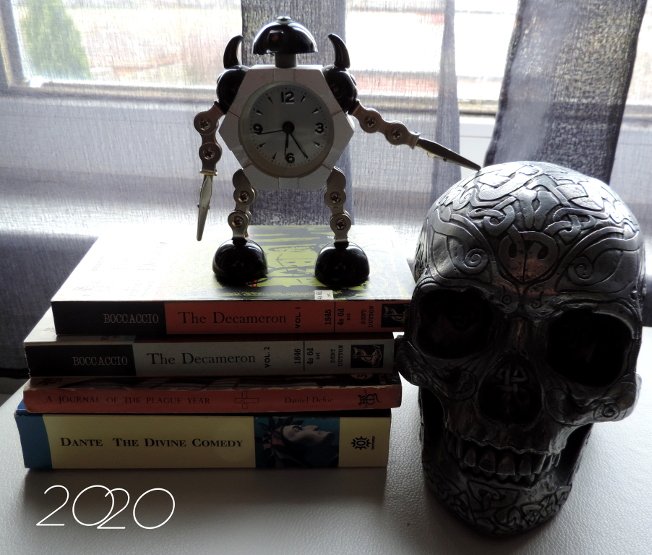
“Ane doolie sessoun” covid-19 and the art of isolation

Prelude: Getting older while time stands still
Apparently today, when I’m writing this, is five years to the day since the first (and even then, belated) UK lockdown of the Covid-19 pandemic. A strange thing to have experienced then, it almost feels like a dream now. There was much discussion, online and on TV during that unusually warm and pleasant spring and summer, about how life and the world would be changed by it. Some of that discussion was oddly hopeful, even among the shocking daily mortality figures and news reports about medical facilities in the UK running out of bodybags. I remember those reports about the canals of Venice having fish in them for the first time in decades; I remember the wildlife around here (being in a quiet rural area meant that a daily walk was permitted without being aggressively policed) becoming unusually bold and visible. And though of course business was suffering and various goods becoming ridiculously expensive or hard to find, the world didn’t come to an end.

The thinking was that, since we had proved that the roads needn’t always be choked with cars or the skies busy with air traffic, and that nature bounced back far more quickly than could have been expected, perhaps the key to ecological recovery was within our grasp. But that’s not how things worked out; the second that it was possible to do so, the roads filled up, the airports were busy again and yet somehow it worked out so that all the negativity associated with capitalism went back to normal but prices didn’t.

And now I think everyone who lived through that time is discovering why we grow up learning plenty about the First World War but not about the Flu pandemic that killed more people in its aftermath. Not I think because it was too horrible to talk about or too difficult to put into words, but because when it’s done you just get on with other stuff and before you know it those events have an undramatic sense of unreality hanging over them; too tedious to talk about. I had the feeling during that time that the only way it would have been taken genuinely seriously (lockdown was serious, but people mostly whined about it rather than cowering in their homes) would be if it had been a disease as dramatic and visible and fast-moving as the Black Death. Maybe if people were rotting before our eyes, the dead lying in the streets, there wouldn’t have been all the debate and denial and conspiracy theories; I’m glad we didn’t find out.

Oh well; the pandemic was an experience and, aside from the death and horror, I have to admit I quite enjoyed the strangeness, the empty streets, the quietness, the masks. Not so much queueing outside of shops in single file with 6-foot gaps. But anyway; this was written during that first (by the sound of it, quite relaxed) lockdown, five years ago but feels like it could have been twenty….

Ane doolie sessoun” covid-19 and the art of isolation

At some point in the late fifteenth century, the poet Robert Henryson (who lived in Dunfermline, not too far from where I’m writing this now), began his Testament of Cresseid with one of my favourite openings of any poem:

Ane doolie sessoun to ane cairfull dyte
Suld correspond and be equivalent.

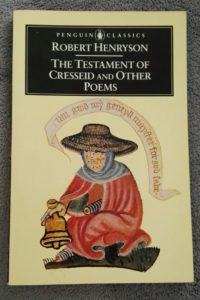
Robert Henryson – The Testament of Cresseid and Other Poems, my edition Penguin Books, 1988, p. 19
I don’t think I knew, word for word, what Henryson was saying when I first read those lines, but I did get the meaning: essentially that miserable/sad/grim times call for miserable/sad/grim poetry. I guess ‘doolie’ would be ‘doleful’ or ‘dolorous’ a few hundred years later; not sure what it would be now. ‘Cairfull’ sounds far more familiar, but in this case means literally ‘full-of-care’ as in the more woeful sense of caring about things than the casual one we would usually use. The words, with their mixture of strangeness and familiarity (people in Scotland have not talked like that for many centuries, but I think that being attuned to the accents and patterns of speech here probably still makes it easier to understand), stayed with me.

The poet goes on to talk about the weather; apparently it was an unseasonable Lent in Fife that year, when “schouris of hail can fra the north discend/that scantlie fra the cauld I micht defend.” Despite impending climate disaster, Fife weather hasn’t changed beyond all recognition it seems; It was only two weeks ago – though it seems far longer now – that I was caught in a hailstorm myself.
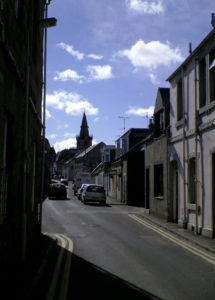
my own photograph from April 2006

The season is still doolie however; not because of the weather, but because of the pandemic sweeping the world, one unlike any that Henryson would have known, but which probably wouldn’t have surprised him too much. One of the key elements he brought to his version of the Troilus and Cressida story in The Testament of Cresseid is its heroine being struck down by leprosy and joining a leper colony. The cover of my copy of his poems (above somewhere) has a drawing from a medieval manuscript, of a figure which would have been familiar to most readers at the time; a leper with a bell begging for alms.
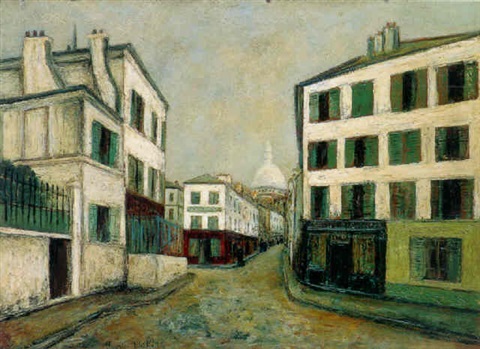
Maurice Utrillo

In fact, with dependable cosmic irony (or if you are less fatalistic, normal seasonal progress), the weather, since #stayhome has been trending online and quarantine officially recommended, has been beautiful here. The streets are fairly, but not yet eerily, quiet. So this particular dyte (the old word that Henryson used referred to his poem, but I think stems ultimately from the Latin dictum that can apply to any piece of writing) may not seem especially gloomy (and may in fact be quite sloppy), but it is certainly careful in the sense that Henryson intended. It’s quite easy – and I think reasonable – to be optimistic about the state of the world in April 2020, but not I hope possible for anybody with any sense of empathy to not be concerned about it.

There are some silver linings to the current situation (major caveat: so far). As well as – inevitably – bringing out the worst in some people, a crisis also brings out the best in many more. And a whole range of major and minor plus points, from a measure of environmental recovery to time to catch up with reading, have emerged. For me, one of the nicest things to come out of the crisis so far is – thanks to social media – the way that arts institutions, while physically almost empty, have begun to engage online with a wider range of people than those who are likely to, or physically able to visit the galleries themselves.
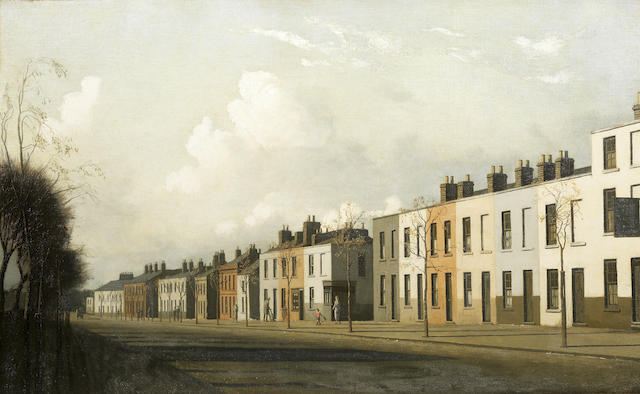
Algernon Newton – The Outskirts of Kensington

It has been said that Edward Hopper is the artist who has captured this particular moment best, and it’s true that his vision of loneliness in the metropolis particularly mirrors our own age of social media and reality TV, in that it is voyeuristic (not a criticism, visual art is by definition voyeuristic). Online, we are not looking at ourselves, or at an absence of people, we are looking at other people whose isolation mirrors our own. If there’s something about this particular pandemic that sets it apart from the Spanish flu of 1918-19 or the great plague of 1665 or the Black Death of 1348-9, or any of the devastating outbreaks of disease that sweep the earth from time to time, it’s that online we are (a ridiculous generalisation perhaps, but if you’re reading this chances are you have internet access at least) sharing the experience of isolation; surely in itself a relatively new phenomenon, at least on this kind of a scale. When Daniel Defoe wrote in his fictional memoir of the 1665 plague (and it’s worth remembering that, although he was only five when the plague swept London, he would have had the testimony of many who had survived as adults as well as whatever shadowy memories he himself had of the period) –

Passing through a Token-house Yard, in Lothbury, of a sudden a casement violently opened just over my head, and a woman gave three violent screeches, and then cried “Oh! Death, Death, Death!“in a most inimitable tone, and which struck me with horror and a chilness in my very blood. There was nobody to be seen in the whole street, neither did any other window open; for people had no curiosity now in any case; nor could any body help one another

Daniel Defoe, A Journal of the Plague Year, 1722, my copy published by Paul Elek Ltd, 1958, p. 79-80

– he was depicting a situation which many people could no doubt relate to; when they read it, long after the fact. What we have now is a sense of shared helplessness in real time; this has never existed, quite in this way before. Assuming some kind of return to normality, we (not entirely sure who I mean exactly by ‘we’) will know each other better than we ever have; which is something to have mixed feelings about no doubt.
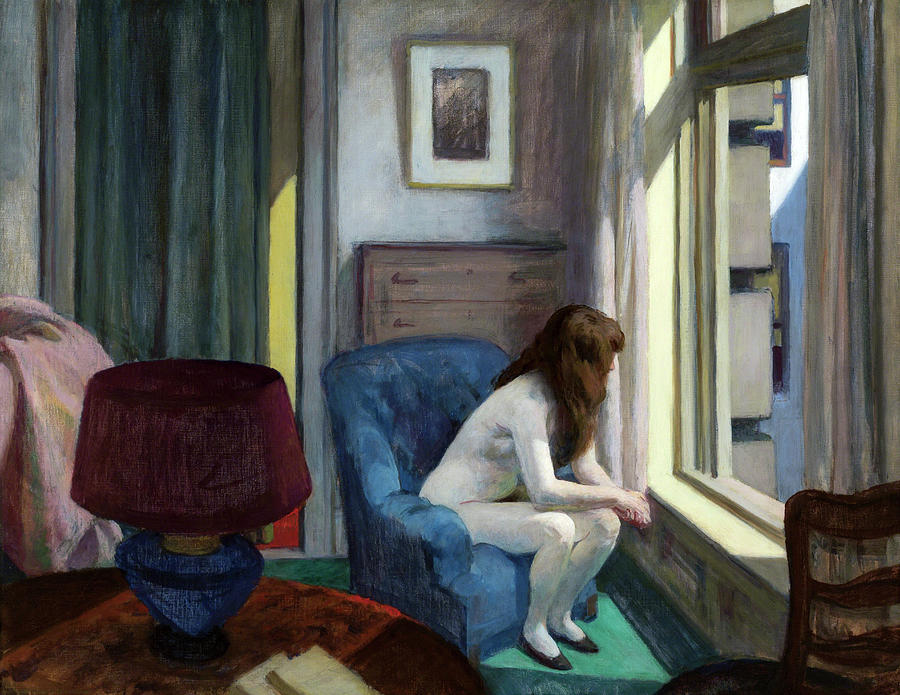
Edward Hopper capturing the 2020 zeitgeist with 11 am (1926)

The current appeal of Edward Hopper’s paintings of lonely figures is humanistic and easy to explain. His art, with its depiction of strangers quietly sitting in anonymous places, people who paradoxically we can never know and never know much about, but who we can easily relate to, is profoundly empathetic.  It belongs to a long tradition of quiet loneliness or at least alone-ness that stretches back, in Western, art to the seventeenth century and the art of Vermeer (it’s easy to forget, as the children of it, but the idea of art reflecting the individual for reasons other than wealth and status is an essentially Protestant one*) through artists like Arthur Devis (though I’m not sure he intended the quiet melancholy of his paintings though) and Vilhelm Hammershoi (he did). In fact, Hammershoi’s beautiful turn-of-the (19th-to-20th)-century paintings are if anything even more relevant to stay-at-home culture than Hopper’s diner, bar and hotel-dwelling urbanites. With Hopper, we are often watching – spying on – his characters from the outside, as if through a pair of binoculars, with Hammershoi we are shut in with them, like ghosts haunting their silent rooms.

Really, the only ‘lonely’ figures in pre-Protestant European art are Christ himself  (think of the utter solitary misery of the crucified Jesus in Grunewald’s Isenheim altarpiece) and of course Judas, or those who that, like him have separated themselves from Christianity. There is a terrifying solitary quality in some depictions of saints during martyrdom, but for their contemporary audience it was essential to bear in mind that they were not spiritually alone (note: this may be a completely false assertion)
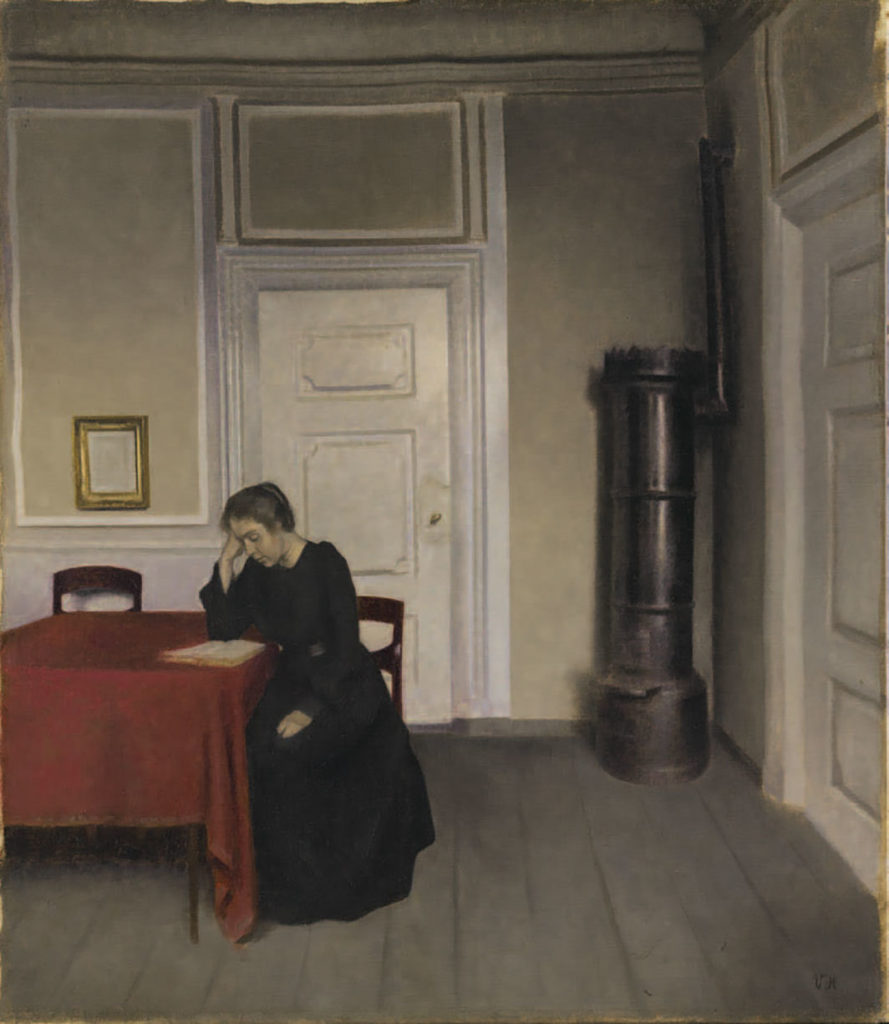
Vilhelm Hammershoi – A room at home with the artist’s wife (1902)
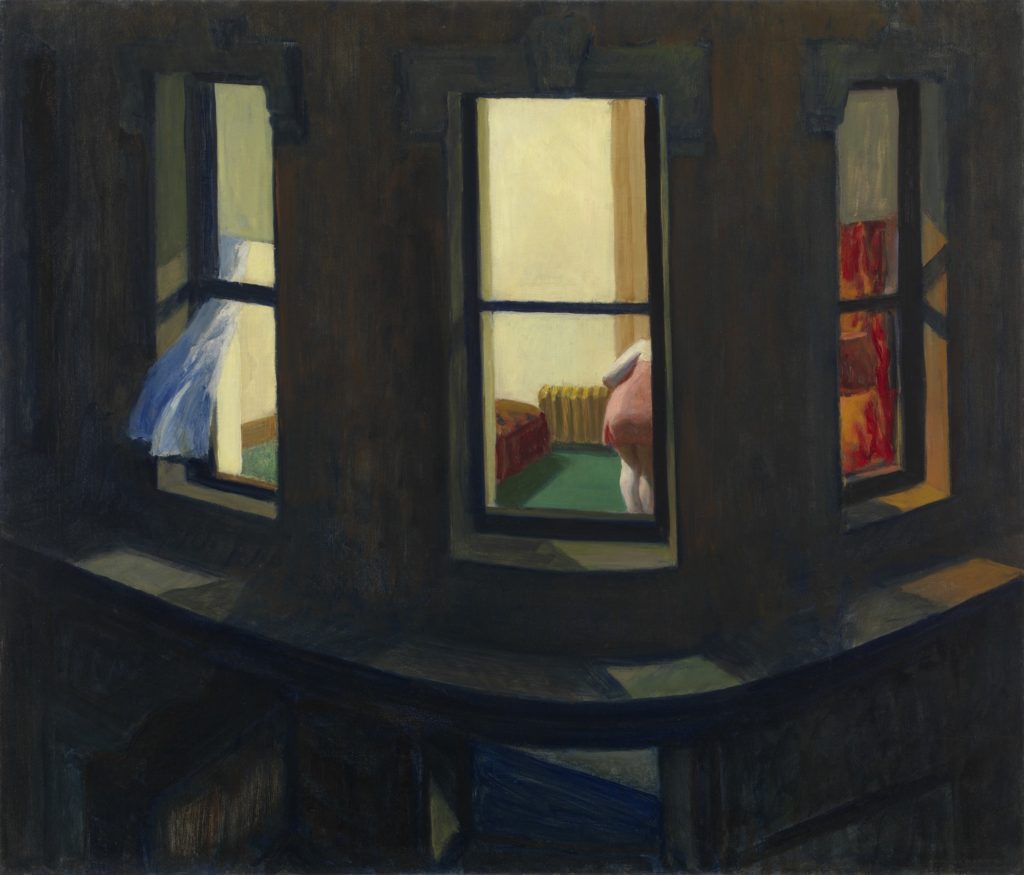
voyeuristic Hopper: Night Windows (1928)

Hopper’s most discussed and shared works now are those where we seem to catch, as we do from a train window, a momentary glimpse of a life that is utterly separate from our own. It’s a feeling I strongly associate with childhood and (very) specifically, with travelling through Edinburgh in the winter and seeing glimpses of people at windows and the high ceilings in the big Georgian townhouses in the New Town when their Christmas decorations were up. Who were all these people? What were their lives like? Why was this such a melancholy experience? Who knows.

But there are other kinds of Edward Hopper paintings too – including some of my favourites, like Early Sunday Morning (see below) – where the only human presence is the artist, or the viewer, where Hopper could claim (though I have no idea if he would have) like Christopher Isherwood, I am a camera with its shutter open, quite passive, recording not thinking.* But recording, for a human being, is thinking. And the picture of a place-without-people is rarely as simple as it seems; even in the case of an actual photograph. Someone had to be there to photograph it, and had their human reasons for doing so. The tradition of landscape painting exemplifies this; landscapes may be mythical, romantic, epic, realistic, but they have been recorded or edited or invented for a variety of complex human reasons. The landscape painting of earlier eras was often self-consciously beautiful, or psychologically charged (Caspar David Friedrich is the classic example; landscape as a personal, spiritual vision; in some ways his work, with its isolated or dwarfed human figures, is kind of like a romantic-era Hopper), but the fact that the urban landscape is itself an artificial, human-constructed environment gives it a different, poignant (if you are me) dimension.

*Christopher Isherwood, Goodbye To Berlin, in The Berlin Novels, Minerva 1992, p. 243.
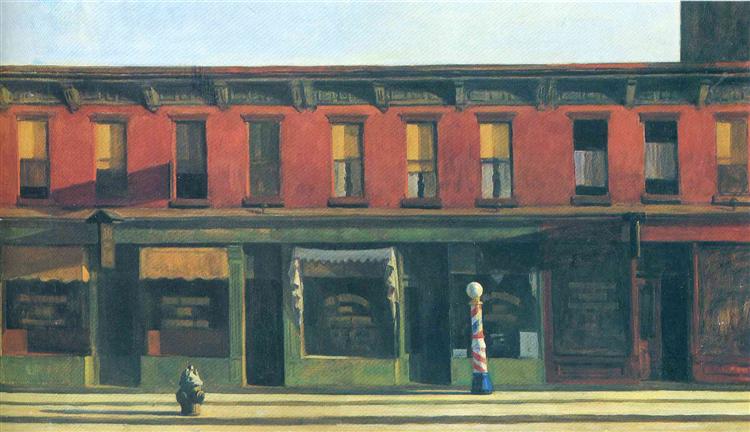
Edward Hopper – Early Sunday Morning (1930)

The appeal of the empty urban landscape in art is perhaps hard to explain to those who don’t see it, but I think it’s worth examining. There is a utopian tradition beginning with (or at least exemplified by) the ‘ideal cities’ produced in Italy in the late 15th century that is in a strange way misanthropic (or at least anthro-indifferent) in that the tranquil geometric perfection of the imaginary cities can only be made less harmonious by the introduction of human figures. But it’s also important to note that these cityscapes actually pre-date landscape painting for its own sake in western art by a few centuries. I don’t think it’s much of an exaggeration to say that in the medieval and renaissance period, the urban landscape had a far greater claim to represent paradise than the natural one. The garden of Eden was a garden after all, not a wilderness, and even the word paradise denotes a walled enclosure in its original Persian meaning. We might think now of paradise existing beyond the realms of human habitation, but in ages where the landscape was mainly something perilous to be passed through as quickly as possible on your way to safety, the controlled human landscape had a lot to be said for it.
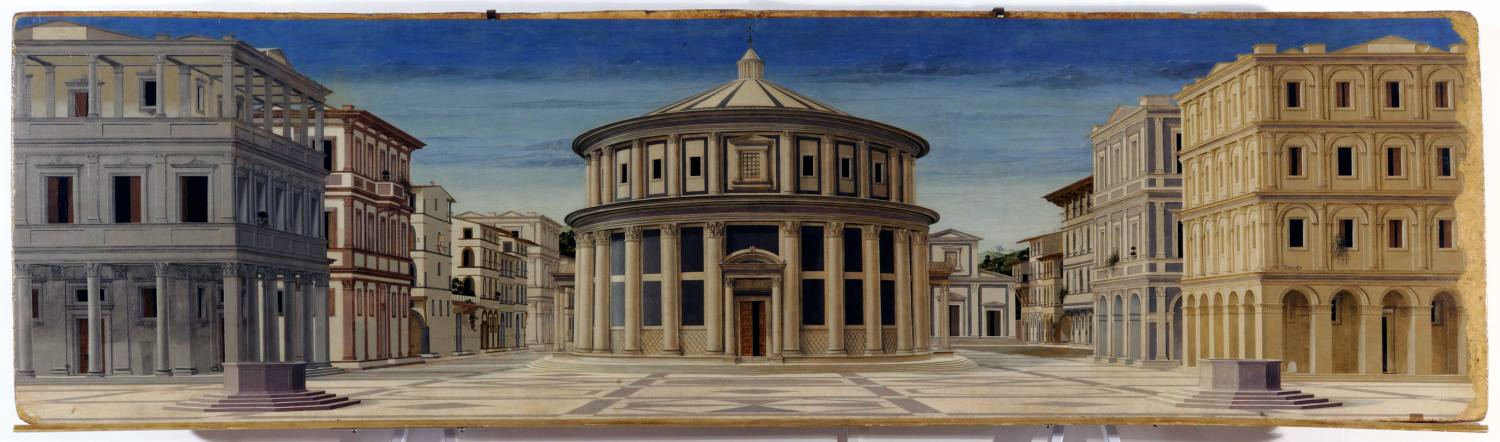
Ideal City c.1480s, previously attributed to Piero della Francesca

Like the Renaissance ‘ideal city’, the beautiful post-cubist-realist paintings of Charles Demuth have a sense of perfection, where the severe but harmonious geometry of his industrial buildings seems to preclude more organic shapes altogether.
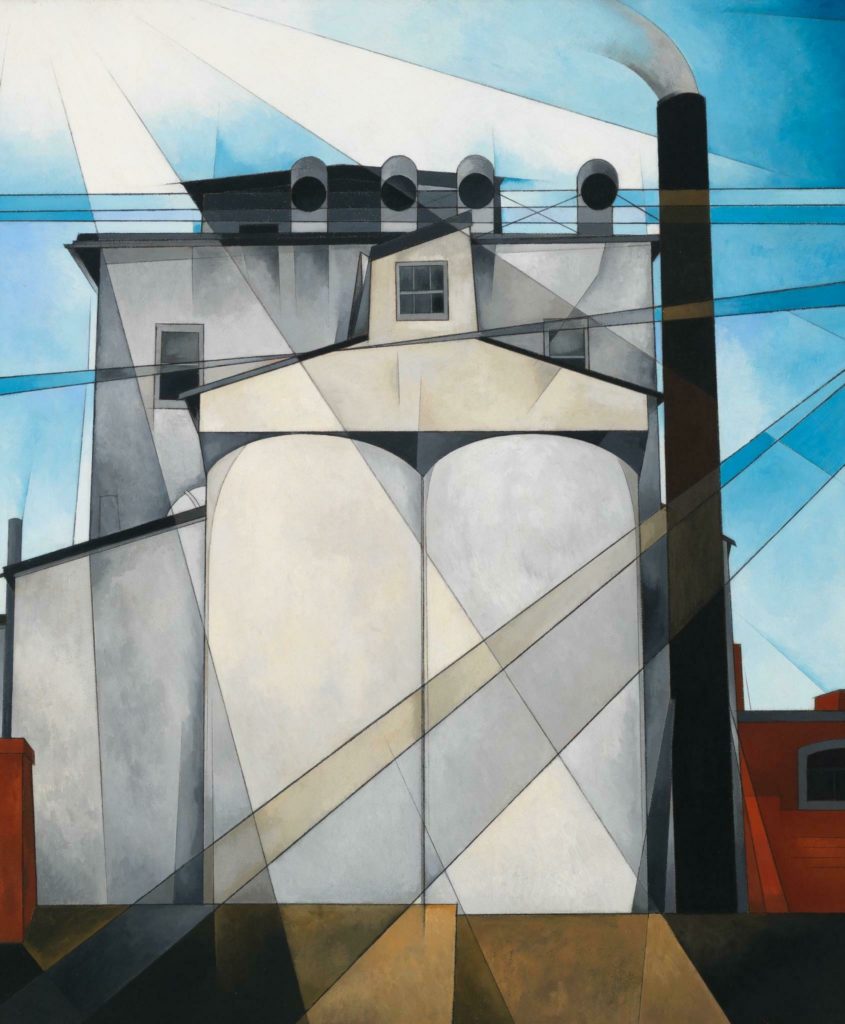
Charles Demuth – My Egypt (1927)

But if Demuth shows an ideal world where human beings seem to have designed themselves out of their own environment, the ideal cities of the Renaissance, with their impossibly perfect perspectives are something  more primal and dreamlike; prototypes in fact for the examinations of the inner landscape of the subconscious as practised by proto-surrealist Giorgio de Chirico and his actual-surrealist successors.

De Chirico’s eerie ‘metaphysical’ cityscapes are essentially those ideal Renaissance cities by twilight, and artists like Paul Delvaux used the extreme, telescoped perspectives of the early Renaissance to create their own prescient sense of urban displacement. Why the kind of linear perspective that sucks the eye into the distance should so often be, or feel like, the geometry of dreams is mysterious – one plausible possibility is that it’s the point of view that first forms our perception of the world, the low child’s eye view that renders distances longer and verticals taller; we may be the hero (or at least main protagonist) in our dreams, but that definitely doesn’t mean we dominate them.
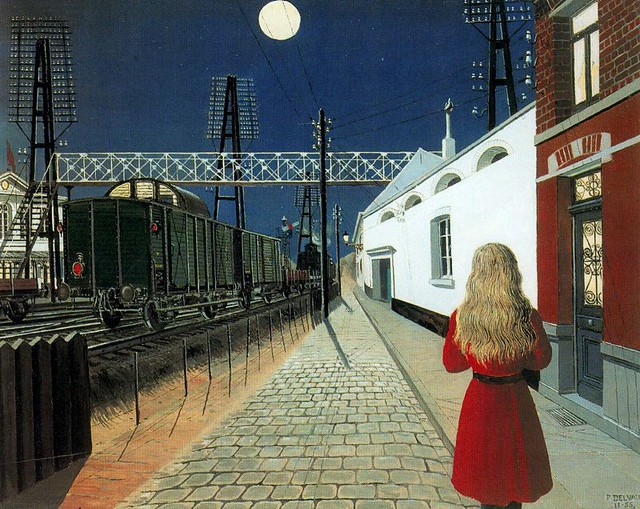
Paul Delvaux – Isolation (1955)

The use of isolated human figures, as in Delvaux and Hopper’s work, gives us a ‘way in’ to a picture, something human to either to relate or respond to (although Delvaux – like Magritte in Not To Be Reproduced (1937) – emphasises the loneliness and again the ultimate unknowable nature of human beings in Isolation by showing the figure only from behind), but the cityscape that is devoid of life, or which reduces the figures to ciphers, has a very different appeal.
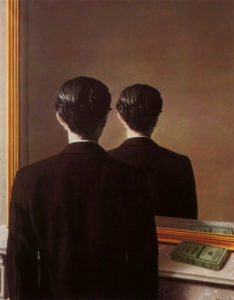
Rene Magritte – Not To Be Reproduced (1937)

Whereas the unpopulated landscape may suggest a prelapsarian, primordial or mythical past, or an entirely alien realm altogether, empty streets are just that; empty. These are utilitarian environments designed specifically for human beings and their patterns reflect our needs. A meadow or hillside or mountain with no visible sign of human life may be ‘unspoiled’; towns and cities, by this definition, come ‘pre-spoiled’, and the absence of people raises questions that a natural landscape usually doesn’t; Where are the people? What has happened?

That said, nothing about Hopper’s Early Sunday Morning, Algernon Newton’s paintings of Kensington (or Takanori Oguiss’s Paris, or indeed the beautiful photographs of the city in Masataka Nakano’s Tokyo Nobody (2000)) really suggests anything ominous or post-apocalyptic – but even so, the absence of life is the most noticeable thing about them. Whether intended or not, this gives a picture a psychological depth beyond that of a simple topographical study. In still life paintings from the Renaissance onwards, the use of objects with a purpose, for example musical instruments, was always more than just something pretty to paint. Whether the instrument in question was there to express the fleetingness of time (music fades away quickly), discord (a lute with a broken string etc) it was never just an object. And so in the urban landscape, objects with a specific purpose (roads, paths, buildings) apparently not fulfilling that purpose, creates a response as complex as – though very different from – the feeling of looking at those lonely figures in Hopper and Hammershoi’s paintings. Not so different in fact, from the feeling of leaving your home in the spring of 2020 and walking down the deserted street outside.
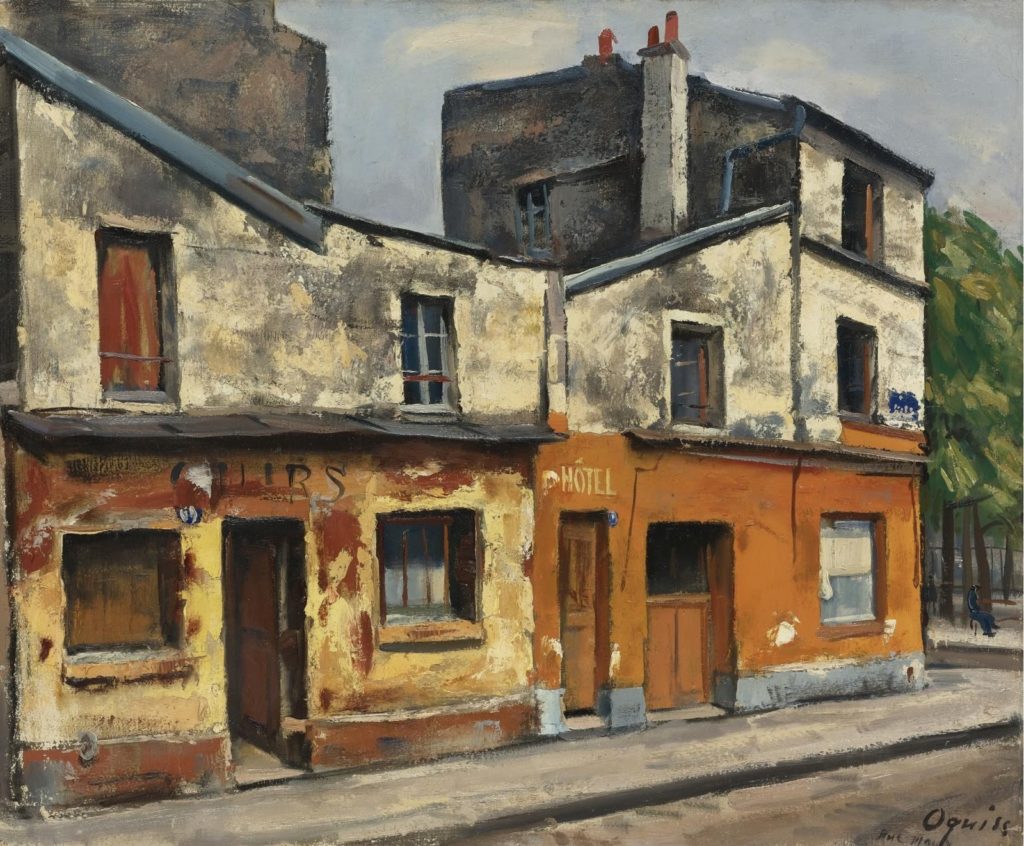
Takanori Oguiss

These paintings can have a slightly uncanny quality reminiscent of the eerie opening scenes (the best parts) of movies like The Omega Man (1971) and 28 Days Later (2002) or John Carpenter’s classic Escape From New York (1981) where, emptied of people, any sign of life in a city becomes, not a sign of hope, but threatening and full of sinister power. Things will hopefully never reach that point in the current crisis, but as it is, avoiding people in the street is for now the new norm; for the first time I can remember, my natural reserve feels like a plus.
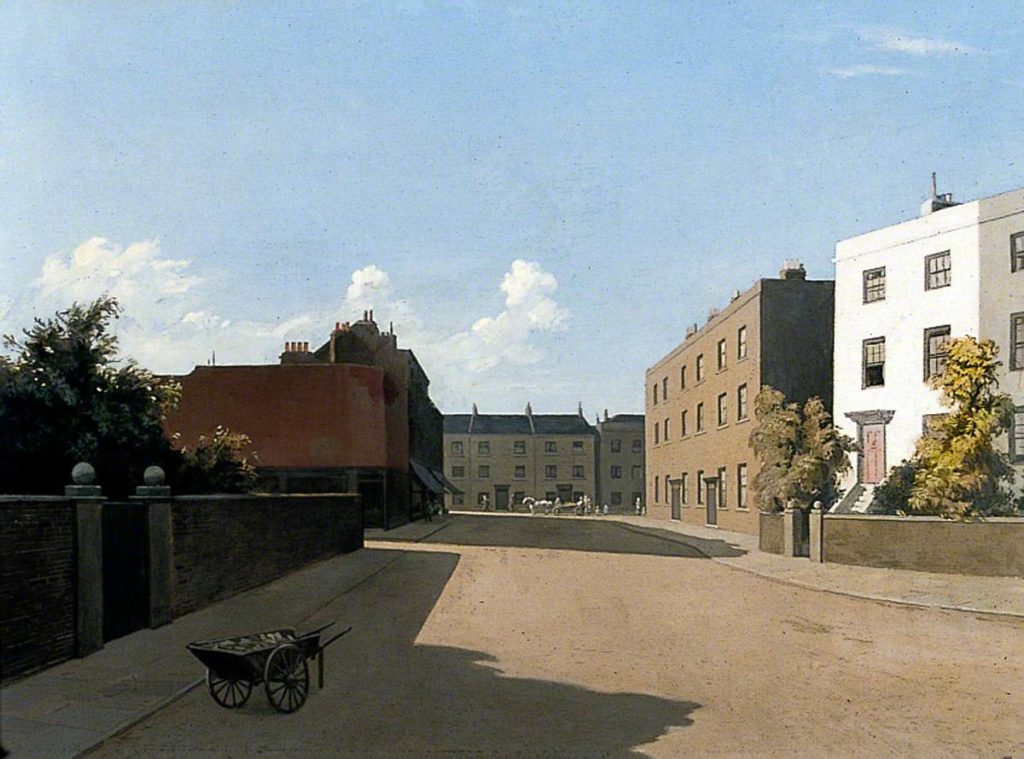
Algernon Newton – In Kensington (1922-3)

Those 15th century ‘ideal cities’ were part of the flowering of the Renaissance, and, as with every other aspect of it, they were the product of people looking backwards as much as forwards. The actual, non-ideal cities that were lived in by the artists who painted those pictures were largely organic, messy, medieval conglomerations, regularly visited by outbreaks of disease. The ideal city’s emptiness is not only harmonious and logical, it’s clean. And like the classical sculptures, bleached white by time and weather which were to prove so influential on that generation of artists, the aspiration is towards a kind of sterile perfection which never really existed until long after the culture that created the buildings and the art, had disappeared to leave just a ghostly husk of its former self.
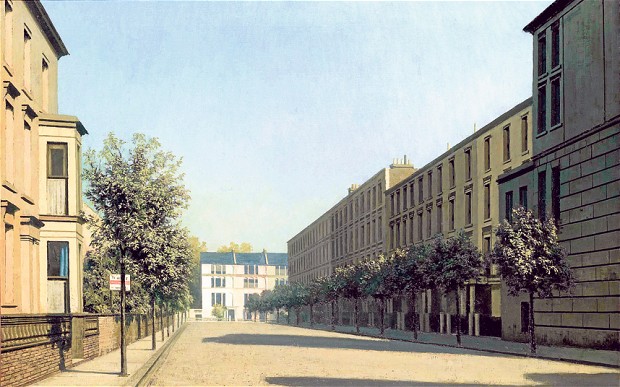
Algernon Newton – Spring Morning Camden Hill, 1940

The deserted city or townscape more or less disappears from art from the 15th century until the later years of the industrial revolution, when urban life itself became the subject for modern art. And it makes sense; the reversal in European culture which saw city life become perilous and the countryside as a means of escape was a slow one, and the solution (never more than a partial one) was in building programmes, urban renewal and harmonious town planning; Empire building and colonial expansion fuelled the growth of urbanisation and were fuelled by it; to imagine an empty city at the height of Empire was to imagine extinction. If there was any remaining collective memory of empty streets in the late 19th century, it was probably an echo of the kind of scenario that Defoe had written about*; less graced by the muses of harmony than haunted by the dead.

*or of natural disasters like drowned villages, or man made catastrophes like the Highland Clearances.

But by the late 19th century, in Europe, plague was less a current concern than it was a subject for gothic horror, the memory of a memory, and industrialisation had – for those with a measure of financial security – rendered the city (now with drains and public transport) and the country (now sans dangerous animals and medieval lawlessness) on something of an equal footing. For the generation of the impressionists, both city and country could be celebrated, and both (as has been true ever since) could mean escape. But that impressionist cliché, the ‘bustling metropolis’, defined by Baudelaire’s “fleeting, ephemeral experience of life in an urban metropolis” – the hub of modernity, the engine of culture and progress, becomes something else when the streets are empty; it can never just be a collection of buildings.
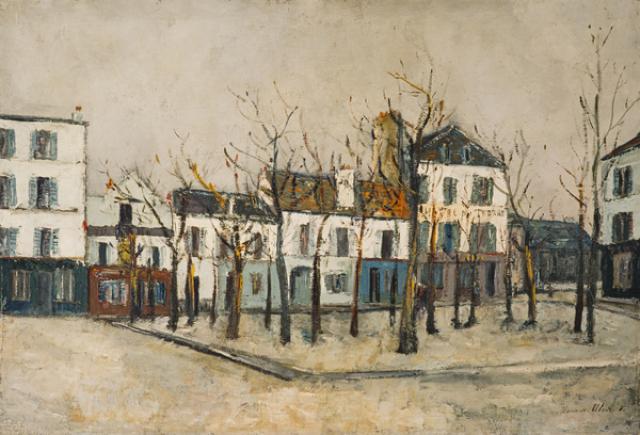
Maurice Utrillo

Not surprisingly perhaps, it seems that to some degree, the art of the deserted street is a kind of outsider art; Maurice Utrillo was an alcoholic with mental health issues, and although literally based at the centre of the Parisian art scene in Montmartre – because he was born there to an artist mother – he was nevertheless a marginal figure, and his paintings of his home town are heavy with melancholy and isolation.

Similarly, although far less gloomy, the Montmartre paintings of Maria Slavona, a foreigner – a German Impressionist painter living in Paris, are depictions of an urban landscape that, while not hostile, is enclosed and other and (to me) brings to mind the closing lines of Philip Larkin’s Here: “Facing the sun, untalkative, out of reach.” Whether that mood is inherent in the paintings, or only in the mind of the person looking at them, is not something I can answer.
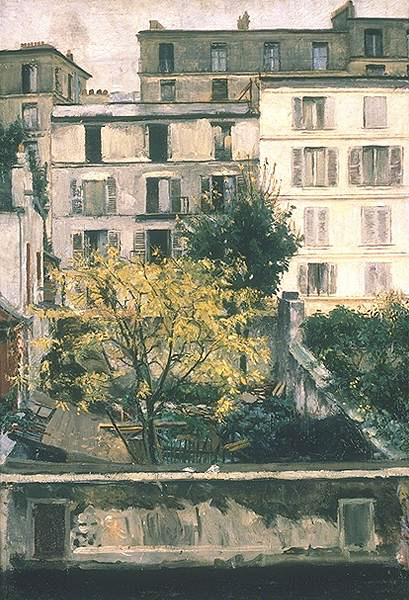
Maria Slavona – Houses in Montmartre (1898)

The German artists of a later generation found a similar sense of alienation at home. The neue sachlichkeit (‘new objectivity’) movement of the Weimar Republic may have been a rejection of the extremes of Expressionism and romanticism, but in its embracing of modernity it was a specifically urban movement too. The teeming street scenes of George Grosz and Otto Dix reflected the often-chaotic street life of Germany’s big cities in the social and economic upheaval following that followed World War One, much as Alfred Döblin’s Berlin Alexanderplatz (1929) was to do in literature, but there were other views of the city too. It was an era of political unrest, but if one thing united the political left and right it was the understanding that they were living in an essentially transitional period; that change would, and must come.

Hans Grundig was the epitome of the kind of artist hated by the Nazi party; politically a communist, he used his art to oppose the creeping rise of fascism but also to capture working class life in the city (in his case Dresden). But in Thunderstorm (Cold Night), 1928, it is the environment itself that condemns the society of the declining republic: the streets are empty and ghostly pale and the buildings, run down and near-derelict, offer little shelter and no comfort. The people whose fate looked uncertain, are nowhere to be seen, but meanwhile, a storm approached.
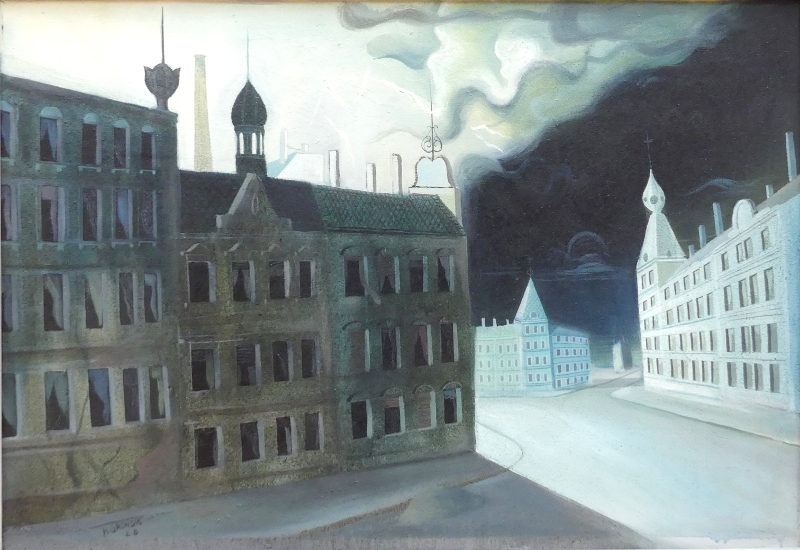
Hans Grundig Thunderstorn (Cold NIght), 1928


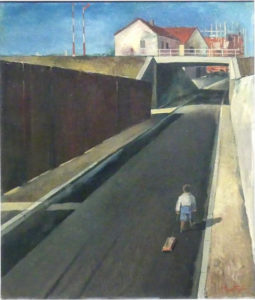
Carl Theodor Protzen – Lonely Street (1932)

Carl Theodor Protzen was, by contrast, an establishment figure; a member of the Association of Fine Artists and the German Society for Christian Art, he was to become a pillar of the Nazi art community. Urban landscapes were his speciality and his depictions of Nazi building projects were to make his name, but just prior to the NSDAP’s rise to power in 1933, he was painting pictures like Lonely Street (1932) that show those same urban landscapes, but without the excitement of progress. Less bleak and doom-laden than Grundig’s city, this is nevertheless an environment which does not embrace or protect humankind; the title reflects the child’s exclusion from the harshly geometric scene in which he finds himself and, although there is no sense of exaggeration, the perspective, as in surrealism, pushes the end of the road ever further into the distance.

This perspective is seen too, in Volker Böhringer’s the Road to Waiblingen, painted in the year that the Nazis came to power. Böhringer, an anti-fascist painter, was later to become a surrealist, and the ominous (blood-stained?) road, stormy clouds and sinister trees suggest that this is  (with apologies to Waiblingen) not a road that he saw leading anywhere very pleasant.
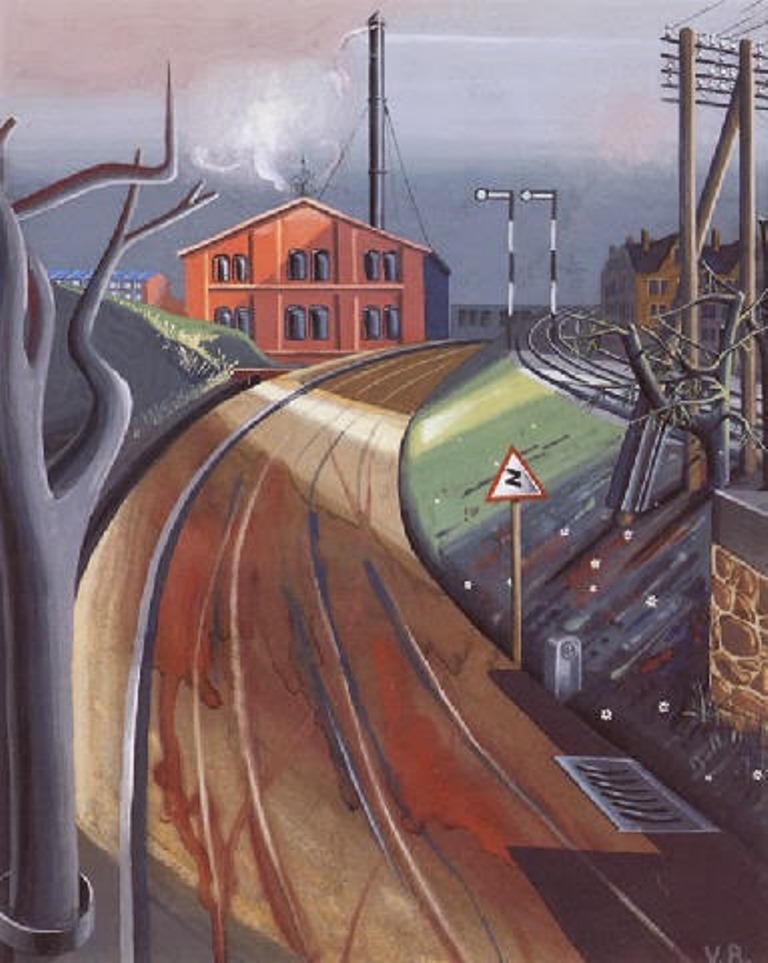
Volker Böhringer – the Road to Waiblingen (1933)

Ever since I was a child, I’ve always loved to visualise (usually at night) a real place, say a nearby hilltop or field, as it is at that moment, with nobody except animals and birds there to see or experience it. It’s a strange kind of excitement that depends on not being able to experience the thing you’re excited about. Psychology probably has a term for it, but at a time when people have never been more inescapable (not that one necessarily wants to escape them) there is something appealing about the complex landscapes we have created for our needs, but without the most complex element of all – ourselves – in them.

Whether we enjoy the empty streets or not (and hopefully we don’t have to get too used to them), we should probably take the time to have a good look at what is all around us; it’s a rare chance to see our world without us getting in the way.
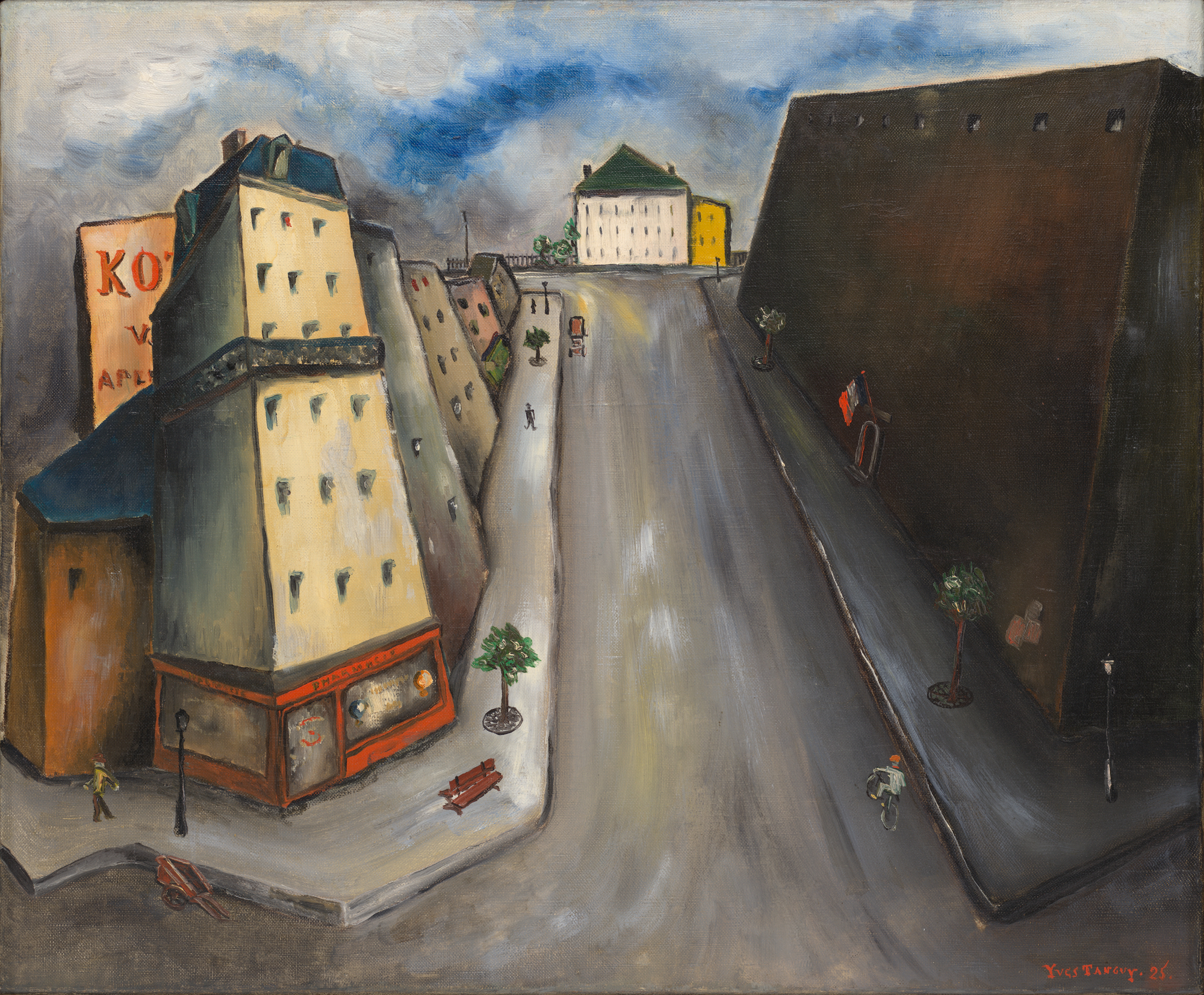
Surrealist social distancing: Rue de la sante (1925) by Yves Tanguy

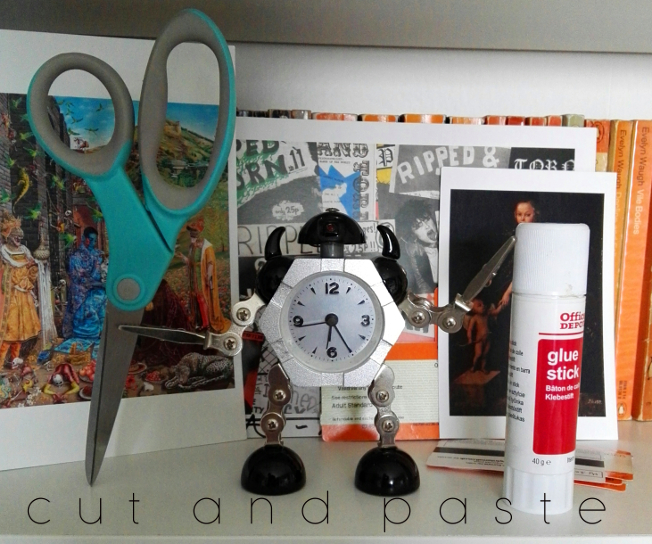
a true state – cut and paste and the art of collage (Edinburgh, summer 2019)

Francesca Woodman, Untitled (1977)

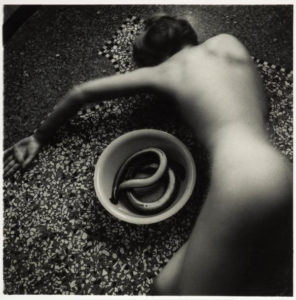
2019 has, in many ways, not been a good year so far. But this summer, the National Galleries of Scotland had (well, has; they are still on) three particularly outstanding exhibitions that brought a bit of light and intelligence to a period of more-than-usual stupidity. At the National Gallery itself, there was the excellent, eye opening and brain-frying Bridget Riley exhibition (closes 22nd September), at the National Portrait Gallery the superb Self Evidence (closes 20th October) in which Francesca Woodman’s tiny, intimate, self-enclosed photographs vibrate balefully in their little corner, overshadowing (for me) the also (but in an entirely different way) intimate and at times frankly challenging monumental works of Robert Mapplethorpe* and, to a lesser extent, the brilliant but (I guess appropriately) don’t-quite-fit-in Diane Arbus portraits of the lives of people marginalised and made invisible by mainstream culture.

*though the Mapplethorpe pictures were the ones that moved me the least, they did provide the priceless spectacle of parents hurrying their curious kids past the notorious 1978 Self Portrait With Whip. They had been warned!

But for me, the highlight of the National Galleries’ summer programme is Cut and Paste: 400 years of Collage at Modern Two (closes 27th October).

Thanks to its inclusive definition of collage (which covers photomontage, traditional collage, plus bits of decoupage, pressed plant samples and even quilting) as well as its historical scope, the exhibition manages to be both focused and wide-ranging, and also (I found) surprisingly moving. What collage does, or at least amplifies – perhaps paradoxically given its use of found/ready-made materials – is that aspect of art that disappears most quickly in reproduction; the hand of the artist. This is art not only as a reflection/projection of culture but one that includes material culture itself.* There is, sometimes regardless of the picture/object, a poignant quality that comes from the materials used, in a way that doesn’t happen with paint, unless you are the kind of conservator who can isolate pigments used to specific periods (I’m not, unfortunately).

*I don’t think this is just pretentious bullshit; but you never know

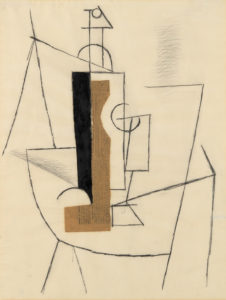
Pablo Picasso, Bottle and Glass on a Table (1912)

I’m getting ahead of myself here, but a seminal collage that makes an appearance in the exhibition, Pablo Picasso’s Bottle and Glass on a Table (1912) is a classic/typical Picasso cubist/spatial experiment, but the use of newspaper – a very specific, dateable piece of ephemera (from Le Journal, 3 December 1912) – gives the work, instantly and inherently, a dimension largely absent in conventional painting. The feeling that the collage is both artwork and artefact; literally as well as figuratively multi-layered, makes a case for collage as a distinct and special art form, a feeling echoed by the Scottish artist Eduardo Paolozzi (represented by some outstanding works in the exibition), for whom the form offered clarification, where formal art training raised problems and questions: “Unlike the world of school where the universe was systematised in a certain order, the reassembly of this disparate material reflected a true state, both autobiographic and dynamic.” (quoted in the exhibition catalogue,  p. 126)

So anyway; the exhibition is arranged chronologically, in the usual Modern Two layout; in various rooms, up the stairs, through the corridors etc, always I think a layout that makes for an engaging, surprising way of looking at art. Partly deliberately (there were too many people in the first room), I went around the exhibition in reverse chronological order and in retrospect that seems like a good decision. This meant that the exhibition opened with the Chapman Brothers’ The Disasters of Everyday Life (2017), a spectacular-looking wall-like object consisting of 80 of Goya’s horrific etchings, The Disasters of War, with of course added bits and pieces, sometimes powerful, sometimes deliberately absurd, I think (though I’d have to go through again the other way) it serves better as a kind of abstract for what is to follow than it would as a conclusion, where peering at a lot of small images might have seemed a bit anticlimactic.
I’m not going to mention every picture in the show, though I can’t think of anything that doesn’t deserve a mention. The first thing to have a major impact for me was Lucy Williams’ 2015 Crescent House, as much a piece of model making as a collage, a strange, small scale (just under a metre long) recreation of a bit of postwar architecture, but simplified and made more colourful, giving it a feeling of harmony almost like a kind of 3D Mondrian.

Lucy Williams – Crescent House (2015)
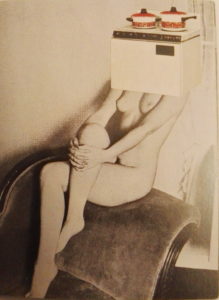
Linder – Pretty Girl (1977)

Crescent House captures something of the intended optimism of the postwar new town planning that’s most often associated now with neglect and urban decay. I don’t know if it’s a generational thing (Williams is around my age), but for me there was something powerfully bittersweet about the feeling of an abandoned, never-quite-attained future, heightened by the realness of the work as an object.

The aesthetic of Crescent House – though that is far lighter in tone – makes me think of the late 70s work of Linder (Sterling), another exhibition highlight. Although similar in its reference points to the pop art collages of Richard Hamilton a couple of decades before (sadly his iconic 1956 collage Just What Is It That Makes Today’s Homes So Different, So Appealing is not in the exhibition, though they do have a nice work by him, Desk from 1964), the feel of Linder’s work is far darker (it makes me think of the confrontational industrial work of Throbbing Gristle and COUM Transmissions around the same period) and the satire more pointed. Works like her Pretty Girl series(1977) exemplify a particular approach to collage. Using the detritus of everyday life; magazines, posters, advertising, it became a way of embodying in the art a criticism of the culture that it’s a reaction to as well as a product of. It’s a feminist criticism of the objectification of women that uses already depersonalised women (part of the problem) and merges them with actual ‘objects of desire’ from a patriarchal culture that above all else believes in commodification for its own benefit.

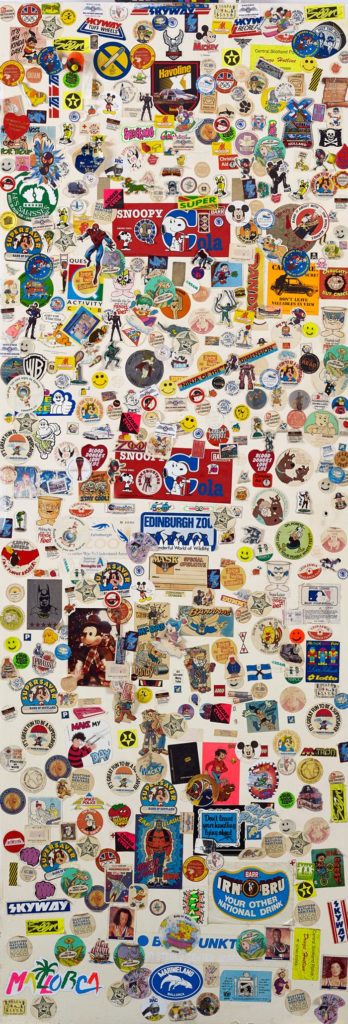
Craig W. Lowe, Bedroom Cupboard door covered with stickers, 1987-1997

Thanks to the exhibition’s open-minded and inclusive approach, there are some unexpected revelations (but aren’t all revelations unexpected? I mean, that’s obvious). While Craig W. Lowe’s bedroom cupboard door covered in stickers c. 1987-1997) may appeal most as nostalgia, the inclusion of Jamie Reid‘s original Sex Pistols Never Mind The Bollocks cover collage (1977; copyrighted image so I’d better not share) opens realms of not-previously-considered information (at least to me) about one’s record collection. Firstly, the collage is black and white, and secondly, it isn’t just a picture or a ‘file’, it’s an actual thing. Like, presumably all album cover art (and book cover art etc) before the digital age, the NMTB cover in all its yellow and pink (or pink and green) glory, taken for granted forever, is not a picture, it’s a photograph of a picture. In its final form it’s been overlaid with colours, but that object there on the wall in Edinburgh is the thing itself. A strange feeling, like looking at the inscription on a ten pound note and considering that it is a representation of something, rather than ten actual pounds.

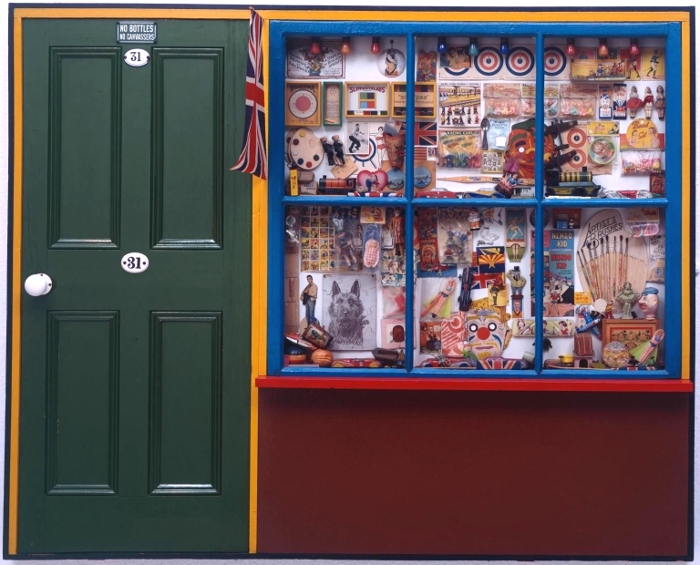
The Sex Pistols cover primes the viewer (at least the viewer going through the exhibition backwards) for the various bits of Peter Blake’s Sgt Pepper’s Lonely Hearts Club Band cover that are on show – and, great though they are (and I like Sgt Pepper quite a bit more than I like Never Mind The Bollocks), without that priming, the Beatles items wouldn’t have the same impact; perhaps because the cover itself is clearly a photograph of objects and cut-outs and seeing them is very cool but not really revelatory, the whole is too familiar and iconic to give the frisson of a moment captured. In fact, Blake’s superb, possibly slightly twee The Toy Shop (1962) is a far more vivid time capsule; clearly pointing to Sgt Pepper, its a conglomeration of bits and bobs familiar to children of the 60s – but also to children of later generations as belonging to the same family as the bits & bobs of their own youth (in my case, comics, football stickers, sweets, TV tie-in toys (He-Man et al), but also the odd antiquated throwbacks that still existed, like bows and arrows and balsa wood or polystyrene gliders which came with a weighted plastic propeller so they flew when thrown – do they still make those?). It’s hard to imagine that there will be a generation that can’t relate to The Toy Shop at all, however virtual entertainment becomes, kids will always like stickers.

Peter Blake – The Toy Shop (1962)

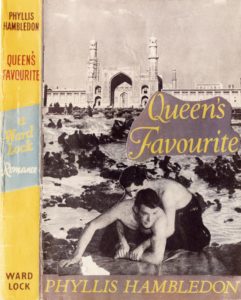
But Blake’s pop art nostalgia – powerful though that is – is one of the few purely positive and joyous post-war works in the show. More typical are the mischievous collage book covers made by Joe Orton and his partner and eventual murderer Kenneth Halliwell. These were put on library books and returned to the library – an act that eventually cost them a six month prison sentence – and they exemplify the sense of the significant, perhaps subversive and illogical accident that drew the surrealists to collage a few generations earlier.

Kenneth Halliwell & Joe Orton – collage on library book cover (c.1960-2)

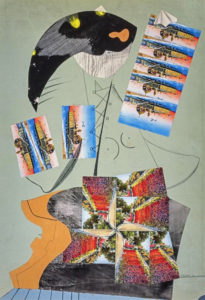
For the surrealists, collage was almost a manifestation of the galvanising quotation from Lautréamont’s Les Chants de Maldoror (1869) where a boy could be described as being “as beautiful as a chance meeting on a dissecting table of a sewing machine and an umbrella.” This aspect of surrealism is brilliantly captured in Max Ernst’s gothic ‘collage novels’ (one of the most exciting inclusions in the show is an unpublished picture from his 1934 collage novel Une semaine de bonté) as well as in beautiful works by Toyen and some of the collaborative exquisite corpse collages made by André Breton, Jacqueline Lamba and Yves Tanguy, where each artist could only see their own part of the work until it was complete. Again, what I hadn’t really anticipated was the difference it makes seeing these items in real life – for example, I had seen and liked (and own a postcard of) Roland Penrose’s untitled 1937 postcard collage, but seeing it, life size, and looking at the actual real postcards stuck to it, was a weirdly moving experience. But why? It’s something about the immediacy and associations of familiar things, the thought perhaps of Roland Penrose actually going into a newsagent and buying the postcards one day in 1937. Why that should be more moving than an artist using paint I don’t know, except that, like the scrapbooks owned by Tristan Tzara (very exciting to see) and the paper cutouts by Matisse (which until now I’ve never been a fan of) it brings the whole process of making art into an immediate, almost tangible one.

Roland Penrose – Untitled (1937)

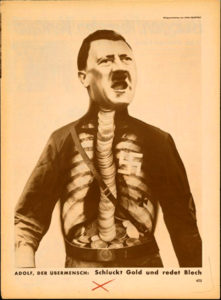
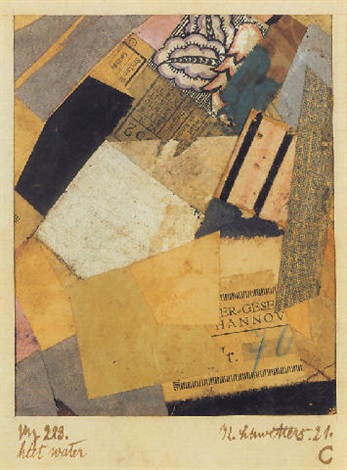
The work of the Dadaists (Hannah Höch was the main reason I wanted to see the show) is less self-consciously unconscious (well, that makes no sense) than the surrealist works, but the element of satire and sometimes bitter humour – especially in John Heartfield’s iconic anti-Nazi photomontages – make them the spiritual ancestors of the works of artists like Carolee Schneemann and Nancy Spero in the 1960s as well as Linder and even Terry Gilliam in the 70s. Highlights for me were the selection of works by Kurt Schwitters, whose own version of Dada, Merz, even had a collage-like genesis, the word itself apparently derived from a fragment of text relating to a banking firm (Kommerz und Privatbank). The fact that the word Merz also has echoes in the words schwerz (pain) and ausmerzen (to weed out or discard) adds to the sense that this was a movement (if you can call one person a movement) for which collage wasn’t an entertaining diversion, but a central idea. The cumulation of meanings and associations in works like Merz 229: Heet Water (1921) makes these small works with their train tickets, textiles, playing cards – pretty much anything that could be cut up and stuck down – powerfully evocative, as well as decorative in themselves.

John Heartfield – Adolf the Superman – swallows gold and spouts junk (1932)
Kurt Schwitters – Merz 229: Heet Water (1921)


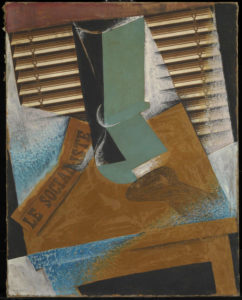
The section on the birth of modernist collage features a group of Picasso works including the the aforementioned Bottle and Glass on a Table, which form year zero of modernist collage, alongside works by peers including Braque (who may actually be the first modernist collage-maker) and Juan Gris (whose The Sunblind, 1914 is a highlight) and then the ripples spreading outwards from that explosive group of works, including the Russian constructivists and suprematists, the Italian Futurists and even the Bloomsbury group in the UK; I was very impressed to come across a painting by Vanessa Bell (Portrait of Molly MacCarthy, 1914-5) that didn’t immediately wilt into insignificance when surrounded by the big names of European modernism.

Juan Gris – The Sunblind (1914)

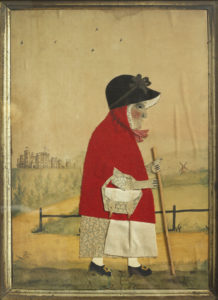
It seems obvious to say that collage is comparatively egalitarian insofar as you don’t need to be able to draw or paint to do it – and it’s true that works by generally non-visual artists like Breton and Joe Orton have a similar energy and atmosphere as those by more conventional artists, but it’s also noticeable that, pre-modernism, although the idea of collage existed and there was sometimes that same element of playfulness, the work is more notable for its skill and ingenuity – especially in the Victorian photomontages – than for any disruptive or ironic qualities. But collage being what it is, it’s here that the sense mentioned earlier of the collage as actual material culture comes into play again, sometimes – especially for me in the small character pieces by George Smart from the early 19th century – powerfully so. Somehow, these little watercolour paintings adorned with carefully cut out and arranged pieces of paper and fabric (irresistibly reminiscent to me of the ‘fuzzy felt’ sets I played with as a child) bring us closer to the artist than just paint on canvas would do.

This is perhaps art history as human interest and association rather than as aesthetics (this is especially true in the case of the Victorian scraps and scrapbooks, perhaps because the ready-made nature of the scraps themselves makes the objects feel less like the works of an artist and more like a hobby; nothing wrong with that, but as the sort of things you see in auctions and junk shops they have the aura of being ephemera, rather than using ephemera to make something else; a false distinction perhaps), but for me this exhibition brings those two aspects of art – the human/historical and the aesthetic/technical together in a deep and very satisfying way.
I have no real criticisms of the exhibition; it is thought provoking, beautiful to look at and put together with care and imagination. It might have been nice to have had something by some of the other artists most strongly associated with collage, like Romare Bearden and Wangechi Mutu; but if an exhibition leaves you wanting more that can’t be a bad thing.

***POSTSCRIPT***

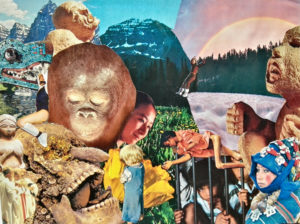
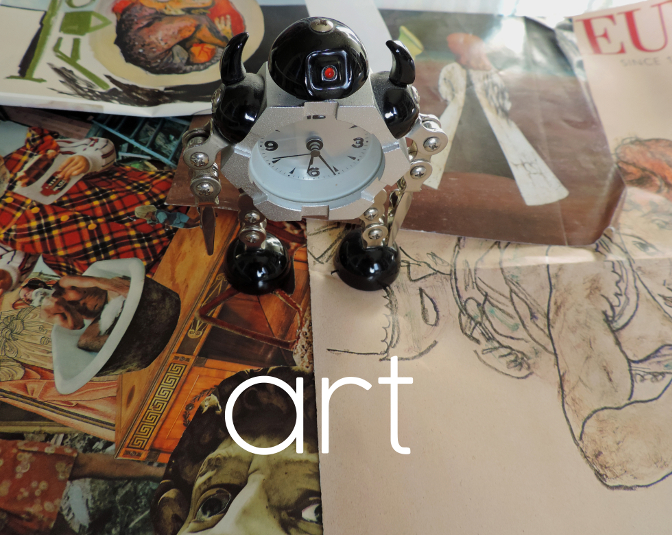
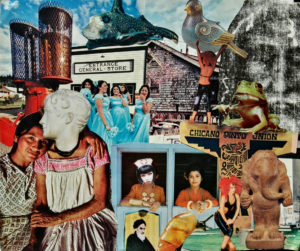
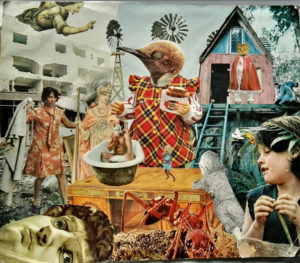
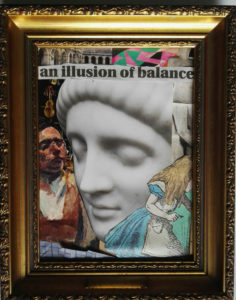
Since I mentioned the anyone-can-do-it aspect of collage, I might as well mention that I went through a phase, especially in my student days of making collages, and while they are nothing special, they do have a kind of diary-esque subtext which has only really become apparent over time. Since it’s my website and no-one can stop me, here are a couple of examples, plus a more recent one.

untitled collage, c. 1998?
untitled collage c. 1998-9


untitled collage, 2019
untitled collage, late 90s

A continuous chain of little inventions; art in Edinburgh summer 2018


Probably as much as I love any art movement, I love German Expressionism; most of all the artists of Die Brücke (I wrote at length about them here) and their (initially) optimistic quest to forge a new, forward-looking art which was distinctively German, drawing on native traditions (woodcuts, landscape etc), but also attempted to peel away the layers of staleness built up by decades, or even centuries of academicism, to reveal living art beneath. The art of Paula Modersohn-Becker, too, who was doing something similar in Worpeswede, is important to me too, but I also love the more anguished, personal kind of Expressionism that was reflected in the famous Expressionism of German silent cinema (see also Kirchner’s later works, and – not “German Expressionism” per se, but still German and expressionistic, early Dix and Grosz, Max Beckmann, Käthe Kollwitz).

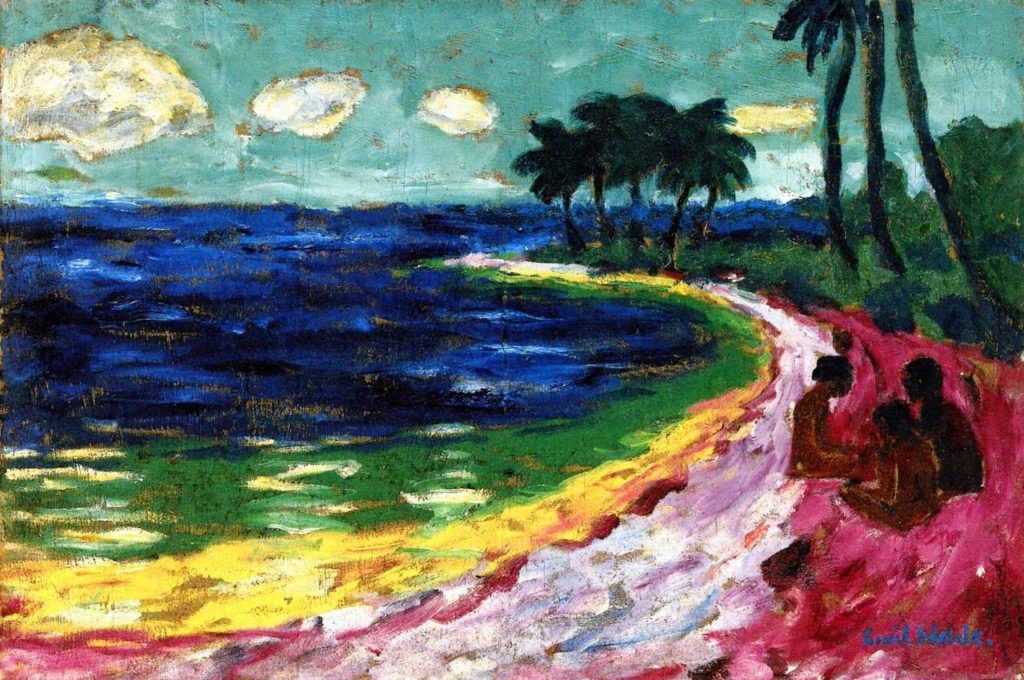
Emil Nolde – Bay (1914)

So, even though Emil Nolde (1867-1956) is perhaps my least favourite of the major German Expressionist painters, and even though I had lots of qualms about it (see here), I was excited to see the Scottish National Gallery of Modern Art’s exhibition Colour Is Life. And it really is good.


In comparison with the much younger artists of Die Brücke, which he joined for a year in 1906* Nolde’s art is just as vivid, but less vibrant (if that makes sense); his colours tend towards the bilious and acidic and his style, though ‘free’, often seems – even in landscapes – more frenzied and less harmonious than the works of the rest of the group. His deeply felt religious paintings, especially – and there is a really remarkable group of them in the exhibition – have an intense, anguished, alienated quality that is more like Munch atmospherically than it is his German contemporaries. It’s among his figurative (but not religious) works that my favourite painting of the exhibition, an enigmatic and slightly double portrait (that I can’t find online), which is smoother in surface texture than the religious pictures and imbued with an oddly menacing atmosphere.

*at which point Nolde was 39 and the group’s founders were in their early to mid twenties

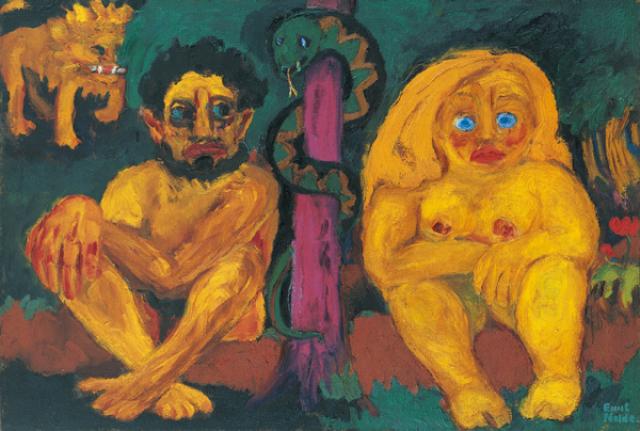
Emil Nolde – Paradise Lost (1921)

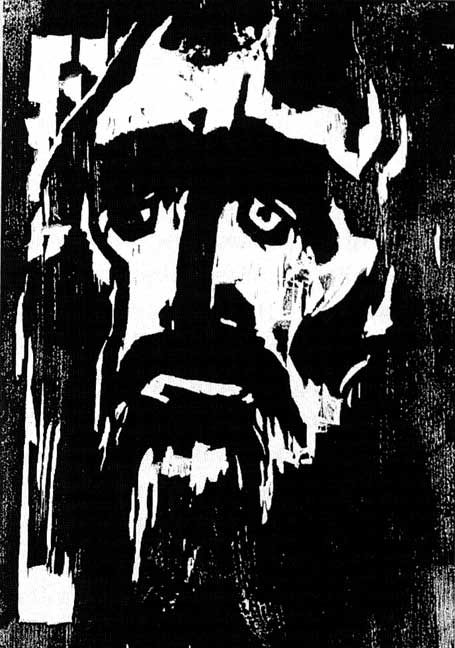
I’m glad to say that although I felt like the information at the exhibition tended to downplay his vociferous Nazism a little, it at least acknowledged it – and although it is nowhere explicit in his art, there are some uncomfortably anti-Semitic-caricature-like faces in his paintings of people, including in some of the religious works. But whether I would think that if I didn’t know he was (extremely) anti-Semitic, I can’t say. Interestingly, for an exhibition called Colour Is Life, by far the most powerful works to me were Nolde’s woodcuts (including arguably his most famous work, The Prophet of 1912), where his compositions are remarkable for their economy and stark intensity.

Emil Nolde – The Prophet (1912)

Interestingly (perhaps not coincidentally?) the majority of Nolde’s most impressive work seems to have been done by the mid-1920s, but there is also a selection of his ‘unpainted pictures’ in the exhibition. These are little watercolours, incredibly vivid in their colours, which were made in secret during the period when his work was condemned/forbidden by the Nazi government which Nolde had, however, not only welcomed, but effectively campaigned for since the early 30s. Incidentally, around the time that Nolde was signing the Aufrufs der Kulturscha (1934) which supported Hitler as Fuhrer and joining the National Socialist Association of Northern Schleswig, Ernst Ludwig Kirchner, one of the founders of Die Brücke, was writing “Here we have been hearing terrible rumours about torture of the Jews, but it’s all surely untrue…There is a war in the air. In the museums, the hard-won cultural achievements of the last 20 years are being destroyed, and yet the reason why we founded the Brücke was to encourage truly German art, made in Germany. And now it is supposed to be un-German. Dear God. It does upset me.”*

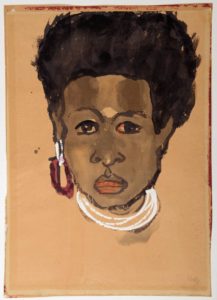
Head of a South Seas Islands woman (1914)

This was more than just the symptom of a generation gap between different artists; it’s at the heart of why Nolde’s art is, despite surface similarities, so different from that of the artists of Die Brücke; Expressionism is (obviously) about expressing; and yes, Kirchner and co expressed their anxieties, but their vision – at least at the time the group was at its most cohesive – was an optimistic one, accepting other influences as much as it rejected the status quo. To the 21st century, the way they were influenced by the art of other cultures, to simplify and brighten their own work can be uncomfortable; it has something of the ‘noble savage’ myth about it and their assumptions about the freedom and ‘naturalness’ of the tribal cultures whose work they studied in ethnographic museums were made from a viewpoint that now seems colonial and ignorant. But – the point of their own work is that it uses these forms and elements to describe something that is whole, natural and above all universal – the ‘otherness’ of the figures Nolde drew and painted on his trip to the South Seas (and even of his incredibly bold landscapes) just before WW1 is inescapable. His drawings of the people he encountered aren’t caricatures; they are brilliantly observed, but they are themselves ‘ethnographic’ in a way that Kirchner and co’s art strove not to be; Nolde is seeing and recording, not absorbing.

* Kirchner, quoted in Kirchner Museum Davos Biography Ernst Ludwig Kirchner by EW Kornfield, & CE Stauffer (1992)

Still; the Nazi government didn’t care about this distinction, and the exhibition text tells us that Nolde had more paintings shown in the condemnatory Entartete Kunst (‘degenerate art’) exhibition than any other artist, which would be a cause for some schadenfreude if not for the fact that, after petitioning the government (he was on civil if not familiar terms with charming people like Goebbels and Baldur von Schirach) he was informed in late 1941 that any work he undertook should be presented before government officials before any kind of public showing, which is of course harsh and limiting by any normal standards, but surprisingly mild compared to what they were doing to other artists. But, as Nolde must surely have realised, for all their cultural protectionism and promotion of what they considered to be artistically wholesome and correct ideas, the Nazis really weren’t interested in art as art at all.

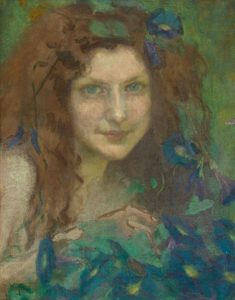
Julie Wolfthorn – Witch of the Woods (1899)

For some not very pleasant perspective, since I can; Nolde was prevented from making a living from his art for a few years, and had works confiscated (which he did eventually get back however), meanwhile his contemporary, Julie Wolfthorn (only three years older than he was), whose figurative, traditional, slightly folkloric art has at least an equal right to be seen as definitively German (or, far more right, to the anti-modernist authorities of the time), was, as a Jew, too dangerous to exist, and was murdered in 1942, at the age of 78, by the regime which Nolde did his best to be accepted by.


So yes, a beautifully curated and mounted exhibition; but one which leaves a slightly bitter taste.

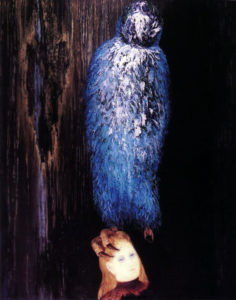
Toyen – Message of the Forest (1936)

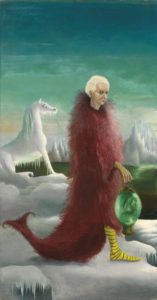
So,  that’s what I paid to see (and it is absolutely worth the price of admission), but in fact the bitterness faded quickly; aside from owning a Kirchner painting that is for me everything that Nolde’s work isn’t, the National Gallery of Modern Art (Modern Two) hosts a permanent (and free) exhibition Surrealism and the Marvellous, which was already great, but has been enhanced hugely by the acquisition of Toyen’s superbly enigmatic The Message of the Forest (1939) and Leonora Carrington’s diminutive but haunting (and at the same time kind of funny) 1939 portrait of Max Ernst, Bird Superior (1939).


Leonora Carrington – Bird Superior (Portrait of Max Ernst), 1939

I could spend (and I think have spent) hours in this room; even longer now, as the archive adjoining it is hosting Club Dada: Berlin and Beyond, a really exciting collection of books, pamphlets, photos etc (and a small Max Ernst painting) that focuses mainly on Berlin Dada but also has some great items from the original Zurich group. Much as one wants to pore over these artefacts, I don’t even mind too much that the books etc are in glass cases since my German is minimal and I can’t read French at all.


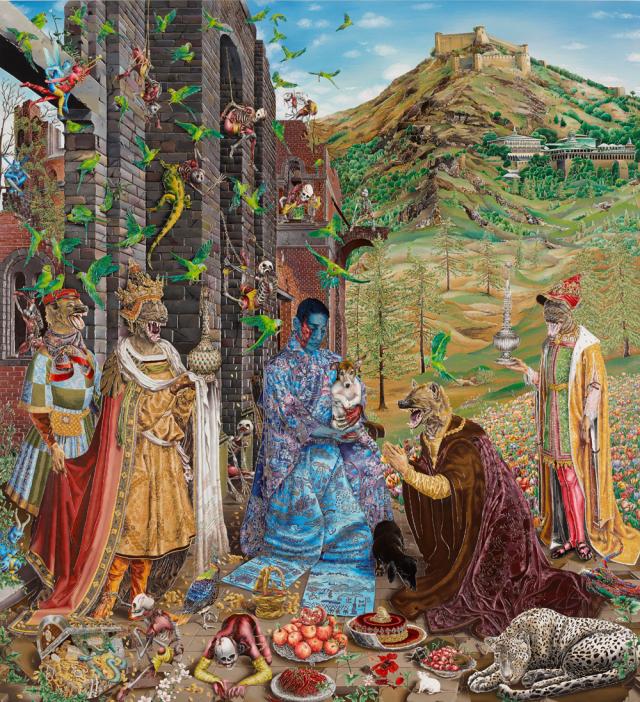
Raqib Shaw – The Adoration (after Jan Gossaert), 2015/6 © the artist

Over in Modern One, I nearly didn’t look at the (also free) exhibition Raqib Shaw: Reinventing the Old Masters, partly because part of me doesn’t really want them to be reinvented, and because I didn’t know Shaw’s work, and also because it was up the stairs and I’d been walking around for hours. But I’m glad I did; what a fantastic show! I can’t imagine anyone not being impressed by Shaw’s work, even if it’s not their cup of tea. The paintings (too simple a description; his huge panels are painted in shimmering enamels, but embellished with a kind of cloisonné effect, incorporating jewels, glitter, all kinds of things) are brilliantly drawn and dazzling in their richness and detail (and a bit over the top, which is part of the charm). Although the compositions of the pictures in this exhibition are inspired by ‘old master’ paintings (one of which is one of my all-time favourite pictures, Lucas Cranach’s enigmatic Allegory of Melancholy (1528), displayed alongside Shaw’s painting), the familiarity only makes the extravagant fantasy of Shaw’s works all the more dreamlike and affecting.

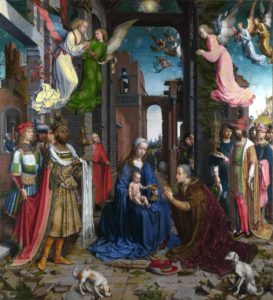
Jan Gossart – The Adoration of the Kings (1510/15)

I think we (no, I don’t know who I mean by ‘we’) are used to seeing and accepting things like Biblical scenes or Greek myths presented through the filter of the Italian (or Northern) renaissance, and this is similar but different. With the old masters we (them again) see familiar (or what were once familiar) scenes  presented in a kind of fancy dress of anachronistic costumes/settings etc which were initially intended to heighten the relatable-to realism of the works, but which now add another layer of meaning and cultural baggage. With Shaw’s work, the ghosts of both the original meaning and the original treatment are seen as if through the eyes of someone from another, much more effervescent dimension. The dislocating, hallucinatory blend of familiar (and it isn’t just the source material that’s familiar; Shaw’s use of dazzling, opulent colours and ornate textures is, despite the fantastical elements, quintessentially Indian, to my western eyes anyway) and strange is exhilarating and strangely poignant.* To take my favourite picture; neither Cranach’s or Shaw’s Allegory of Melancholy is sombre exactly; but despite the centuries and world views that separate them, the same delicately wistful atmosphere pervades both pictures. It’s an impressive exhibition.

So, the moral of this is; go to the Scottish National Gallery of Modern Art in Edinburgh if you get the chance. Oh, and the National Gallery of non-modern art too – aside from having an incredible permanent collection, they currently have a Rembrandt – who doesn’t like Rembrandt? – exhibition and have put a fantastic Jenny Saville painting (Aleppo) among the old masters in a way that works amazingly well and was gathering crowds of (especially young) people when I was there.

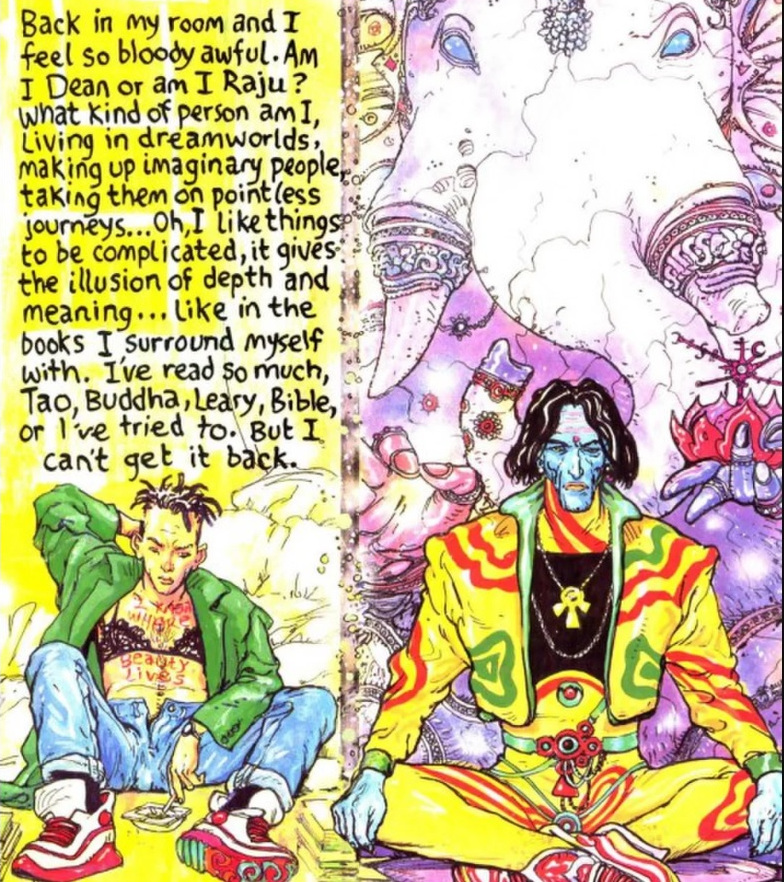
*Perhaps an obscure (and certainly a geeky) comparison; looking at Raqib Shaw’s pictures reminded me of reading Brendan McCarthy & Pete Milligan’s similarly post modern/immersive/multicultural/hallucinogenic comic strip Rogan Gosh in the 2000AD spinoff Revolver.

Brendan McCarthy & Peter Milligan, Rogan Gosh (1990)


It’s not real if you don’t feel it – but what is ‘it’ and what is ‘real’ and who’s to say anyway?


A wise woman once sang “It’s not real if you don’t feel it”* and as far as the arts are concerned it’s as good a measure of quality as anything. But what is “it” that you are feeling? Is everyone feeling the same thing? Clearly not. Even the opinions of people who do like the same song, the same book, the same film, the same painting, are likely to diverge when it comes to the detail of what they like and how it feels.

*The Goonies “R” Good Enough, (Cyndi Lauper, Stephen Broughton Lunt, Arthur Stead, 1985

Part of the mission of modernism in the early 20th century was to free art from associations; from sentimentality, from tradition, culture, religion, politics – and to define it for itself. That was necessary, in order to break the endless repetitive staleness of academicism and/or lowest-common-denominator entertainment, and also because photography and recorded sound and near-universal literacy had all become significant factors in western society. Looking at the visual arts; if all that art does is to repeat what is already popular, to record and represent and recreate the visual and the actual, then how can it compare or compete with something like the camera which captures that external reality? And if that external reality, in the form of contemporary society, is something the artist rejects or objects to, then why use its tools and its language at all?

It’s hard to imagine, a century after the modernist explosion (say 1900-1939), the extent to which the arts were in thrall to academicism. Presumably that was because, having fought first for freedom from the world of manual labour and craftsmanship back in the late middle ages and renaissance period, later artists were keen to stress their respectability, their links to nobility, aristocracy and wealth. But access to that world came – not surprisingly – with rules, manners and forms of behaviour which settled, over the course of a couple of centuries, into rigid artistic traditions. Therefore, the artists of the modernist era were, like any revolutionaries, especially concerned with making their own manifestos and statements. ‘Art for art’s sake’ is a nineteenth century, essentially romantic/bohemian idea which feels remote from the milieu of modernism, but at the same time a theory of ‘pure art’ is found more clearly in something like Kazimir Malevich’s The Non-Objective World (1926) than in anything written by Théophile Gautier or Edgar Allen Poe;

“Art no longer cares to serve the state and religion, it no longer wishes to illustrate the history of manners, it wants to have nothing further to do with the object, as such, and believes that it can exist, in and for itself, without “things”.’

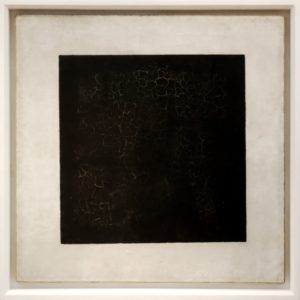
Kazimir Malevich – Black Square (1915)

Though formulated later, this is the kind of theorising that helps partially to explain works like Malevich’s Black Square (1st version 1915). Un-controversially considered a masterpiece – and one that I myself like a lot – it nevertheless seems to me a work that gains enormously from some kind of context, even if all that context is, is the knowledge that it is in fact a painting by an artist.  ‘Left to itself’, without any associations, if encountered ‘cold’, especially if it wasn’t in a gallery, it might just as easily not be ‘art’ at all. And while that isn’t a bad thing, a random black square encountered in one’s daily life doesn’t – depending of course on the individual who encounters it – have the intensity or pregnant quality that one can (repeat of previous caveat) feel standing in front of Malevich’s ‘Black Square’. But what Malevich does in his statement is to take the artist out of the art and anthropomorphise the art itself (“…it wants to have…”). This seems to me to negate – not unintentionally – what is meant by art at all. For myself, I prefer the German Expressionist Karl Schmidt-Rottluff’s statement which, while it doesn’t even slightly contradict the idea of purely abstract art, puts the artist at its centre, rather than treating art as a kind of self-creating phenomenon:

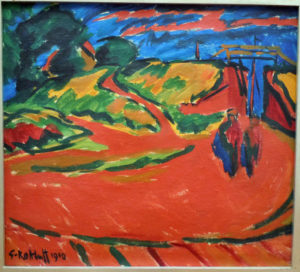
Karl Schmidt-Rottluff, Landscape (1910)

“I know of no new ‘programme’…. Only that art is forever manifesting itself in new forms, since there are forever new personalities – its essence can never alter, I believe. Perhaps I am wrong. But, speaking for myself, I know that I have no programme, only the unaccountable longing to grasp what I see and feel, and to find the purest means of expression for it.”

Karl Schmidt-Rottluff in Kunst und Kunstler (1914) quoted Wolf-Dieter Dube, The Expressionists, p.21 (T&H 1972, transl. Mary Whittall)

If a painting hangs in a forest…

The three key factors here (for me) are creator-work-recipient. If the artists (Schmidt-Rottluff’s ‘personalities’) are trying to communicate something specific to the recipient with their work, then they either succeed or they don’t. If the artist doesn’t succeed in communicating what they intended to communicate – or if they aren’t thinking of the ‘end user’ at all, and are expressing their own feelings/ideas purely for their own reasons – they may (and probably will) still transmit something of themselves; a personality, an emotion or group of emotions, a mood or idea. But although in either case the work may be imbued with that power, it only becomes power when someone else is there to experience and/or interact with it. In material terms, the great masterpieces of painting, be it the Mona Lisa (oil paint on wood), or the Black Square (oil paint on linen) have little more intrinsic ‘value’ than a few tubes of oil paint or a piece of wood or linen. After the lights go out and the visitors go home, those paintings basically cease to exist as art.  The alchemy that takes place when art finds an audience is what makes it art; at least, so it seems to me.

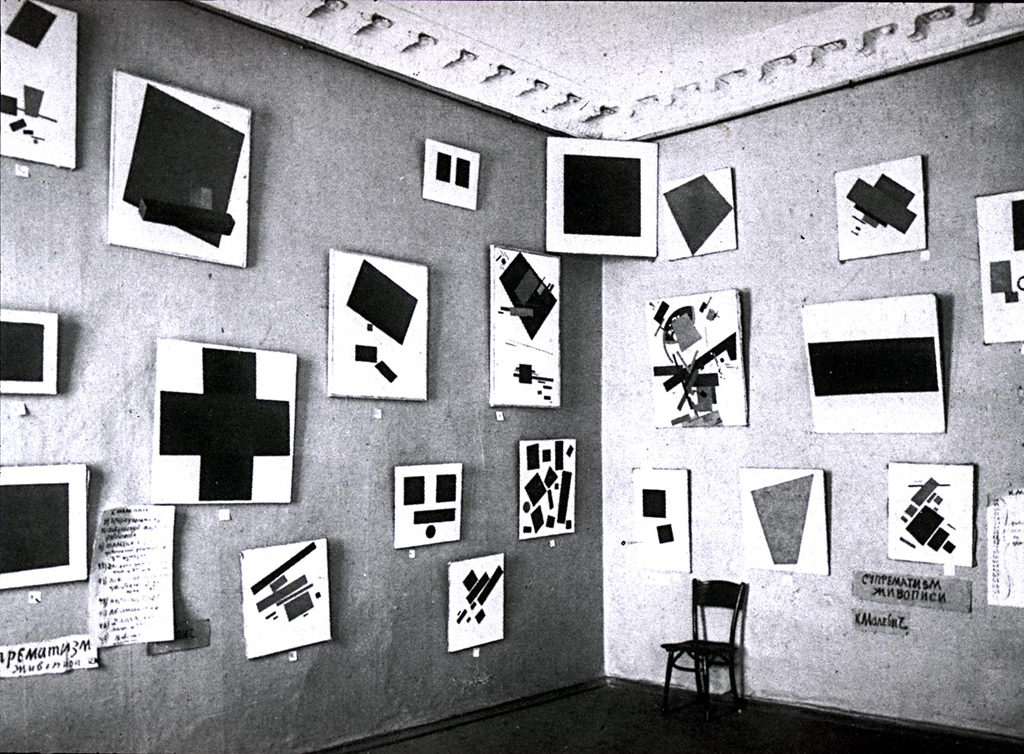
Malevich’s paintings at the 0,10 exhibition, Petrograd 1915. Black Square hangs where traditionally a religious icon would be displayed

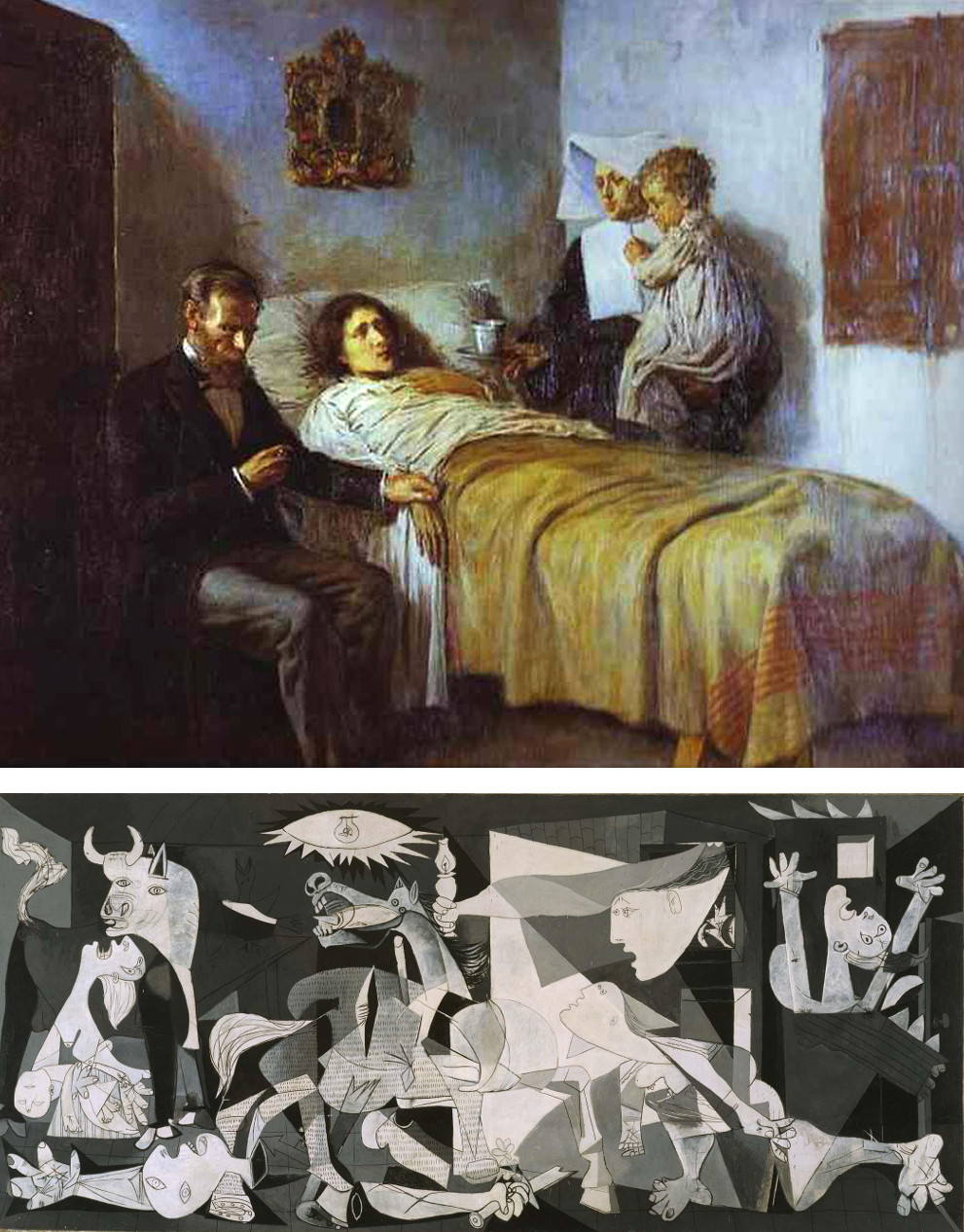
So can there be ‘good’ or ‘bad’ art? Short answer; intuition says yes, but experience says no. Alongside the disintegration of traditional academic rules, there has been the growth and persistence of the myth that, in order to break the rules of art, you must first understand and adhere to the rules. This idea has been strengthened by the fact that some of the iconic figures of modern art, like Picasso and Dali, have been immensely talented by the traditional, renaissance standards of art and could easily have made a career in academic painting; but so what? Would Guernica, looking exactly as it does, be a lesser work of art if it was the only painting Picasso had ever done, or if his immature works had been bland and unimpressive?

Top: Pablo Picasso – Science & Charity (1897)
Bottom – Pablo Picasso – Guernica (1937)

Separating personal, aesthetic judgements of good and bad from objective judgements is almost impossible, A strong argument could be made for either one of the above images being ‘better’ than the other, especially since the emotional impact is entirely subjective. And separating these kinds of aesthetic judgements from moral ones can become even more complicated – can a work of art that is an expression of something ‘bad’ be good? If for example we discovered that Picasso was celebrating rather than mourning/protesting the slaughter and destruction at Guernica, would the painting be as good? And what does ‘good’ even mean in that sentence anyway? The idea that (for instance) a painting, or a song is “bad” is essentially meaningless, despite the fact that millions of paintings and songs are clearly very bad. They can never be demonstrably bad because, as Hamlet says, (and even the relatively short history of pop music proves) “there is nothing either good or bad, but thinking makes it so.”  Even the most derivative, tuneless, unimaginative, moronic or amateurish song can and will be loved by someone, or many someones. And beyond people liking it, how can the quality of something like art truly be gauged? Yes, ‘liking’ can be a complex thing and is not the same as ‘admiring’ and yes, there are people with knowledge and expertise and highly developed critical faculties and so forth; but their opinion can no more prove a work of art is good than a restaurant critic can prove that a Michelin-starred chef’s finest creation tastes better than a Big Mac.

Despite the ‘golden ratio’ of the ancients, Hogarth’s ‘line of beauty’ and the Turner Prize, despite Grammys and Brits and Eurovision Song Contests, there is no logical ‘2 + 2 = 4’ type equation which can prove that “4” equals a good work of art. In architecture at least, a building either works as a building (ie it stands up and people can go inside) or it doesn’t, but even then, it would probably be easier to ‘prove’ that your local supermarket is logically ‘better’ as a building than Chartres Cathedral, rather than vice versa. But obviously (unless you are very lucky) it isn’t better than Chartres Cathedral. It feels too trite and easy to say ‘art is only as good or bad as an individual’s opinion of it’, but I can’t really do any better than that. You can’t make someone like something by telling them it’s good, however convincing your argument may be to you.

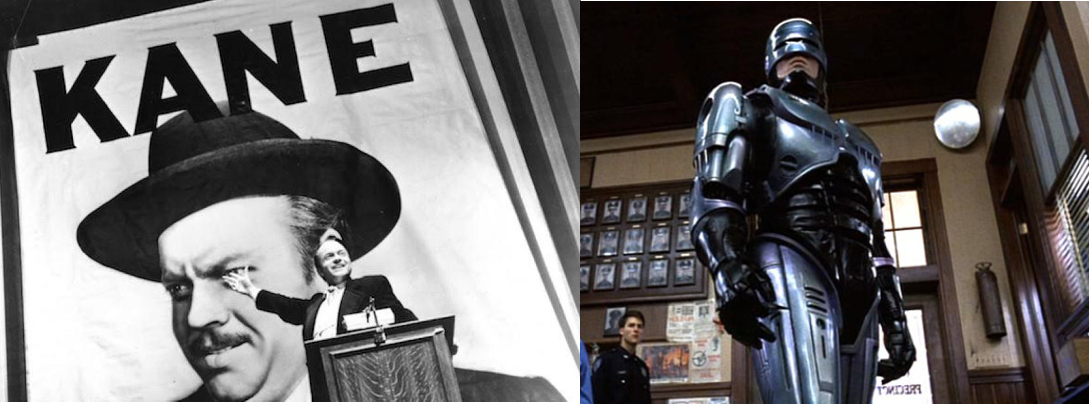
I also don’t think (though I am less convinced about this) there are good or bad reasons for liking a work of art, a song or a book, although there are certainly different levels of engagement. These are still subjective though; I like Citizen Kane but I love Robocop. Do I think Robocop is therefore the better film? Absolutely not. In the western world there is a kind of agreed pantheon of ‘great art’, codified by the way in which art history, English literature, cinema et al are taught in institutions and, at the lower end of the scale in books and websites of the corny ‘1000 albums/films you must hear/see before you die’ type, but in practice everybody constructs their own pantheon, with the ‘official’ ones being little more than a vague guide. I know that Robocop wouldn’t exist in the same form as it does without the innovations of Citizen Kane, but that doesn’t change the way I feel about either film. In reality, the only way to gauge (for example) the “greatest album ever recorded” is to have a public vote without offering a list of previously selected albums to choose from and then see who ‘wins’ – and I am sure I still wouldn’t agree with it.

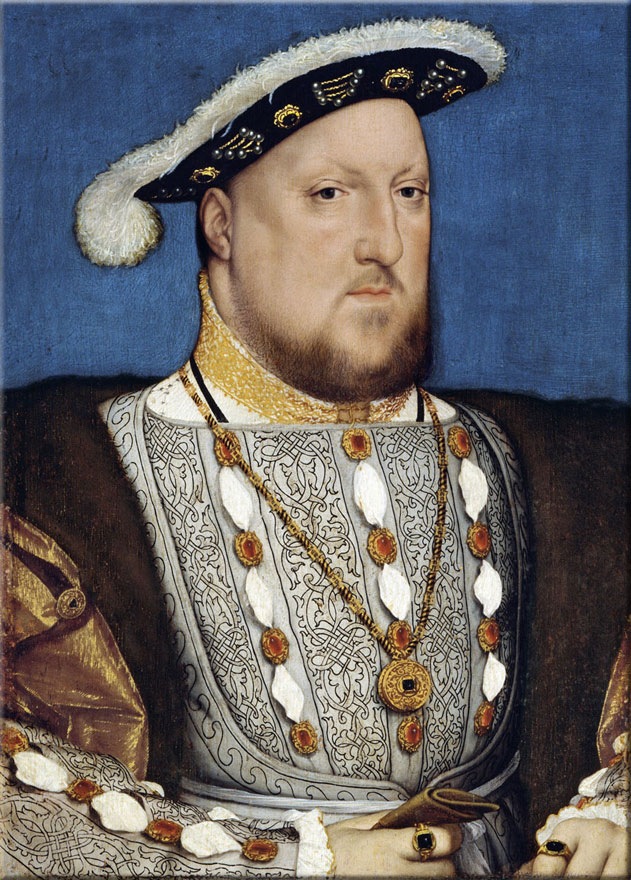
Hans Holbein the Younger; Henry VIII (c.1537)

Over the years, it has often been considered that the ‘correct’ critical attitude is to remove sentimentality from judgements on the arts. That is one way – judging pictures on their composition, harmony etc, ignoring subject altogether, evaluating music on its structure, technical skill etc – but it is sometimes almost impossible to do. And really, thinking again of both the emotional satisfaction people get from songs, films, pictures they love, and the example of Malevich’s Black Square, is it even desirable to do so? Thinking of Black Square – to judge a work which has so much context; theoretical, spiritual, cultural and emotional – by the sum of its basic physical attributes is reductive, as well as boring. Likewise, a great portrait in no way relies on the viewer knowing anything about the sitter, but even so – is Holbein’s great Henry VIII (1537) more interesting and engaging as flat masses of colour laid out in a particular, intricate design on a two-dimensional surface, or as the impression and interpretation of one human being through the eyes, mind and skill of another? The answer for me is the latter, which is really both, since the technical aspects of the first option are anyway incorporated in the second.

Pogo and the Black Square

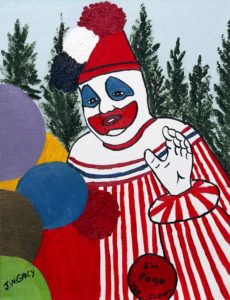
A debate that rears its head fairly often – and I guess will increasingly do so as information about everything becomes more readily available – is whether ‘bad’ people (or just bad people) can make good art. Unlike art, and despite the murkiness of morality (influenced as it is by essentially amoral and anyway changeable concepts like tradition, religion and culture) there are some people that we can probably agree are bad, or at the very least, ‘not good’. Here’s an uncontroversial opinion; John Wayne Gacy, the ‘killer clown’, rapist and murderer of around 33 young people, was – even if he was at the mercy of his own personality disorder – a bad person. He also made something that is as close to being ‘bad art’ as anything I can think of. The fact that his paintings are collected by people and have sold for serious sums of money has nothing to do with their quality as art and everything to do with their associations. You could of course say much the same about the Black Square. And if the imaginary passerby who unpreparedly encountered the Black Square also encountered one of Gacy’s paintings, how would the experience differ?

John Wayne Gacy – Pogo the Clown

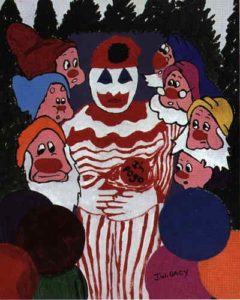
Firstly, unlike the Black Square they would know immediately that Pogo the Clown was a painting made by a human being, and, if from a western background, they would probably recognise the subject matter. Because of this, Gacy is both at an advantage and disadvantage; an advantage because, no matter how the viewer feels about clowns, they have immediate ‘access’ to the painting – ‘I know what that is’. Disadvantage, because while the black square is a black square and therefore looks like a black square, Gacy’s clowns, portraits, skulls etc are – by the standards that most people judge art by – pretty amateurish. He wasn’t accomplished enough as an artist (I don’t mean just in a technical way) to communicate anything very deliberately. He wanted his paintings to bring joy into peoples’ lives; which seems unlikely, unless said people are serial killer fetishists or love clowns indiscriminately, so what the viewer is left with are essentially just his obsessions – or at least the ones he could express to his own satisfaction through his art.

Going back to my highly dubious creator-work-recipient idea of art, the creator, Gacy was (or said he was) trying to do something specific – to create bright and happy pictures to bring joy to the recipient. Whether he succeeded in this aim, regardless of who he was, depends on how one responds to childlike but sometimes enigmatic pictures of clowns. What he definitely did do was to transmit something of himself; a clear-cut but deeply alienated/alienating vision of the world; actually, without a world. His pictures don’t as one might expect, depict a simplified Norman Rockwell America, with the sun in the sky and a clown in the garden, but essentially just the clown; mostly in fact Pogo the clown, Gacy’s own alter ego, sometimes with an extremely cursory, but telling hint of a setting. Not a circus, or the suburbia of the childrens’ parties he haunted, but a hint of a dark, fairytale forest (the seven dwarfs appear in a particularly odd picture). These are clowns in the wild. The term ‘outsider art’ could have been coined for Gacy’s paintings. The other often-used term, ‘naïve art’ seems fleetingly appropriate, until one considers pictures like his paintings of Charles Manson, or even more so, of Tim Curry’s Pennywise from the TV adaptation of Stephen King’s IT. Gacy may not have been a good painter, he may have been to all intents and purposes insane, but he was not naïve; he knew that he belonged to a pantheon of famous murderers, that he was the original killer clown, and he was flattered by the association.
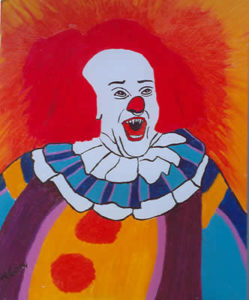
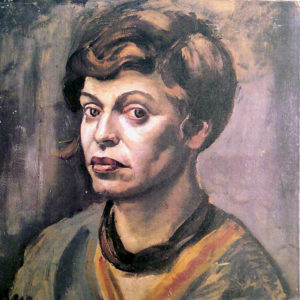
John Wayne Gacy – Pennywise the Clown (1993)

But Gacy was chosen as an deliberately extreme example; even more extreme would be Hitler. Hitler’s serviceable but bland and slightly lifeless paintings are also highly collectable, despite lacking even the visceral ‘disturbed’ quality of Gacy’s. Whereas the innocent buyer might just be attracted to Gacy’s clowns for their kitsch, weird, outsider quality, Hitler’s works are best suited for what they were meant to be – postcards, unambitious souvenirs, illustrations. The lack of frisson they have as images is an indicator that the reasons people have for buying them have little to do with the pictures themselves. For, hopefully, a variety of reasons, these people are not buying ‘art’ at all, they are buying history.

The art didn’t abuse…

 The world of actual ‘high’ art also has its fair share of murderers, rapists and so forth, and the question of whether their lives and actions invalidate their work is never really answerable. Apart from anything else, what about the legions of artists, musicians, writers whose private lives and opinions we know little or nothing about? Or artists like Andrea del Castagno, known for centuries as a murderer because of a mistake (whether malicious or not we cannot know) in Giorgio Vasari’s biography of him? At this distance of time it doesn’t really matter, even when talking about a definite murderer like Caravaggio. We don’t expect historical figures to have views, opinions and beliefs that we would find acceptable in the 21st century, although people of the 16th century certainly felt at least as strongly about murder as we do now.

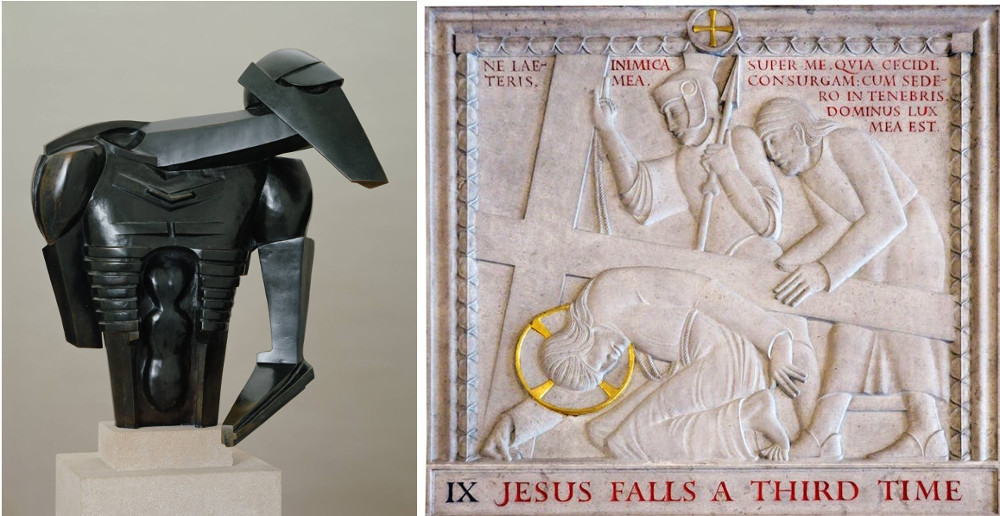
When we get closer to our own time, things become more complicated. For me, it’s easy to disregard the achievements of, say Eric Gill*, because even without the knowledge of his child (and animal) abuse, his work isn’t really my cup of tea; graceful and stylish yes, but, given that he was a contemporary of people like Jacob Epstein and Constantin Brâncuși, also a bit un-dynamic, insipidly faux-modern and backwards-looking. And then, adding the context, knowing about Gill’s religious beliefs, a bit churchy, and then, knowing about his abuse of his daughters, hypocritically pious too; it leaves a bad taste. Which doesn’t stop people from loving it, and nor should it; the art didn’t abuse anyone.  (This short article by Waldemar Januszczak is very good on Gill I think).

Left:Jacob Epstein – Rock Drill (1913)
Right: Eric Gill – Stations of the Cross (1913-18)

But one of the points about Gill is that even his apologists probably wouldn’t, these days, hold an exhibition of Gill the artist without at least acknowledging the problems with Gill the man. More my cup of tea, and more relevant to now, the Scottish National Gallery of Modern Art will be hosting an exhibition of Emil Nolde’s work this summer. German Expressionism (or in Nolde’s case, German-Danish Expressionism) is one of the areas of art I love the most and, although Nolde is not one of my favourite artists I will be excited to see his work. But. Emil Nolde was a member of the Nazi Party. That of course doesn’t change his paintings, but it makes them – and the exhibition – problematic for several reasons. The main reason for me, is that, in its pre-exhibition publicity at least, the NGS makes no mention of his Nazism whatsoever. That might still be okay, I suppose, if they didn’t include this little snippet in their bio:

“This exhibition…covers Nolde’s complete career, from his early atmospheric paintings of his homeland right through to the intensely coloured, so-called ‘unpainted paintings’, works done on small pieces of paper during the Third Reich, when Nolde was branded a ‘degenerate’ artist and forbidden to work as an artist.”

Elfriede Lohse-Wächtler – self portrait (c.1930)

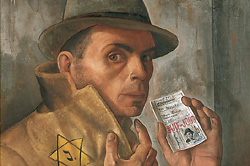
There is a certain amount of schadenfreude in this detail. But there is also the ghost of fellow Expressionist Elfriede Lohse-Wächtler, murdered at Sonnenstein castle in 1940 as part of a government programme to eliminate the mentally ill, and of German-Jewish painters like Charlotte Salomon and the surrealist Felix Nussbaum, murdered in Auschwitz in 1943 and 44 respectively. As a member of the Nazi Party (and an enthusiastic one), Nolde was to an extent complicit in their deaths. For Nolde, ‘entartete kunst’, a policy that he didn’t necessarily oppose in general,  meant he had to paint unobtrusively, in private and couldn’t exhibit his work until after the war.  For those artists it meant a death sentence, for many others it meant harassment or exile. A more wide-ranging exhibition in which Nolde’s paintings bridge the gap between the work of his fellow ‘degenerates’ including perhaps some of Nussman’s Auschwitz paintings, and the art of Nazi-approved painters like Adolf Ziegler or Conrad Hommel would be a strange and indigestible (and chronologically back to front) thing perhaps, but I think that failing that kind of an overview we, at the very least, shouldn’t be encouraged to feel sorry for Nolde that he had to work in secret because of the actions of the government he supported.

Felix Nussbaum – Self Portrait with Jewish Identity Card (1943)

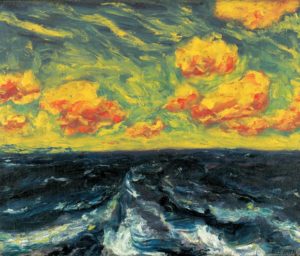
Is Nolde’s art then ‘Nazi art’? No, or at least not in the same way that state-sponsored art under Hitler was. It isn’t didactic, realist or heroic. Nolde saw expressionism and therefore his own painting as definitively German, and was deeply moved by colour, which he equated with emotion. The works of his which I like best (which, maybe coincidentally long pre-date even the idea of the Third Reich and belong to the period when he had recently been in contact with the younger artists of Die Brücke) translate that emotion into intense and visionary land- and seascapes. These pictures feel utterly free of the ideology of Nazism – but that said, even under Nazi rule, the German ideal of the nude Freikörperkultur (Free Body Culture) and ‘oneness with nature’ was respectable in a way that was unthinkable in the UK, so the apparent freedom of the painting need not be reflected in the kind

Emil Nolde – Autumn Sea (1911)

of egalitarian ideals that artists like Ernst Ludwig Kirchner expressed in their art. If expressionism can be seen as the ultimate kind of subjective painting; where the aim is ultimately to make the viewer feel what the artist feels by filtering a subject through the distorting lens of their individual perception, then Nolde’s paintings show the world as it was felt by someone who could write, in 1938;

For as long as I’ve worked as an artist I have publicly battled against the foreign infiltration of German art, against the dirty dealings on the art market and the disproportionately predominant Jewish influence everywhere in the arts. Now if that is the case, and I have been attacked and persecuted now for years by the side I championed and fought for, then there must be misunderstandings in need of clarification.” Well, isn’t that just tragic.

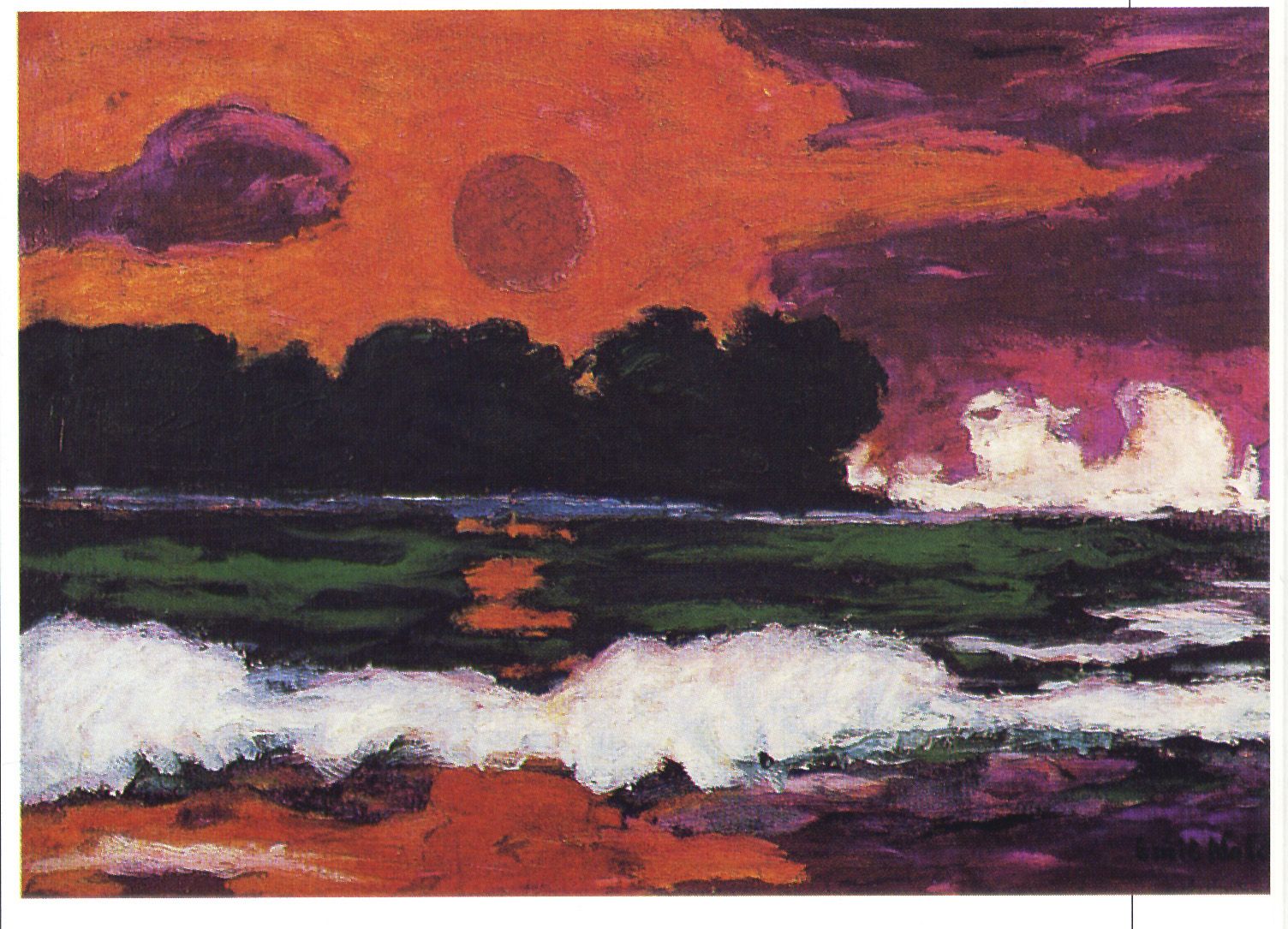
Emil Nolde – Tropical Sun (1915)

As to the question of how easy it is to like Nolde’s ‘unpainted pictures’, I’ll have to wait for the exhibition.

How do you solve a problem like Morrissey (it solves itself)

The Nolde exhibition is only one reason that these issues have been on my mind recently; the other, more personal one is Morrissey. Now, Morrissey is clearly not John Wayne Gacy, or Adolf Hitler, or even Emil Nolde. Nor is he, unlike Varg Vikernes, whose music I also like some of, a murderer or actual Nazi. But I never felt let down by any of those people; with Varg I knew about him before I ever heard his music, I have no emotional investment in it, whereas Morrissey’s recent utterances seem completely at odds with the worldview of his earlier music; which is not his problem, or his fault. I simply interpreted what I wanted to from the art he created, just as it’s possible to look at Emil Nolde’s work and see beauty and freedom there, even if that freedom and beauty is diametrically opposed to the views he professed in his non-artistic life.

I first listened to The Smiths and Morrissey when I was 17, although I was aware of them/him years before. Of all the music I loved as a teenager I think Morrissey’s was the music I identified with the most. I loved The Cure and Joy Division and The Fall probably as much, but their music was – I suppose because it’s less lyrically straightforward – less personal to me. To this day, Morrissey’s lyrics (up to the mid 90s at least) are engraved on my memory and I certainly know more of his lyrics by heart than any other band or artist’s. It’s been very clear for a while now (and murkily apparent for much, much longer) what kind of person, politically, Morrissey is.  And that’s fair enough; he is entitled to his views, even if I think he’s wrong and don’t feel inclined to fund him any further (I still think he is more complex than his worst detractors would say, but so what?)

It’s not really any use to say as some people do, that there are artists out there making great work who don’t have extreme right wing views. Obviously that’s true; but unless their art speaks to you personally, why would you care? And most of the time, one has no idea what opinions or beliefs of an artist are anyway, unless they specifically say so. To me personally, art that is explicitly political/religious or politically/religiously-motivated rarely connects on a very deep level; and to paraphrase Cyndi again, it’s not real unless I feel it. But I always felt The Smiths’ music, deeply, and much of Morrissey’s solo stuff too, though it is less critically acclaimed. His recent/latest statements in the press just don’t seem like the words of someone who could write “It’s so easy to laugh/It’s so easy to hate/It takes strength to be gentle and kind”, but that’s people for you.

Initially, several controversies ago, I decided that although I wouldn’t actively avoid Morrissey and his works, I would no longer buy them in a way which would  financially benefit him; mean and possibly unfair I know, but that’s people for you too. I am not someone who is going to burn records, CDs and books, or even throw/give them away in disgust, if they have ever meant anything to me. But then came the latest and most crass Morrissey interview (so far) and I got to the point where I’d actually be kind of embarrassed to buy anything Morrissey-related at all. It’s not so much (as one example out of many) the factual inaccuracy of statements like “Hitler was left-wing” – people have been saying moronic things like that (Hitler was a Zionist etc etc etc) for many years. It’s the fact that, as with those who claim the death toll in the holocaust has been exaggerated, people like Morrissey seem to think that this amazing revelation is in any way relevant to the things his regime did and how one should feel about it. As with (irony!) people who taunt vegetarians with ‘Hitler was a vegetarian’, it spectacularly misses the point; Hitler is not famous because he’s a vegetarian, any more than he’s famous for his ‘left-wing’ views. And you know that, so don’t be so stupid.

But anyway, in the end my fears that the unhappy soundtrack to my youth/life would be tainted only came half true. When Morrissey songs popped up in a shuffle I found that, without any feeling of revulsion, drama or anguish, I just didn’t want to hear them anymore. The connection seems to be gone, without regret and possibly with the relief that I was never – despite the fact that I even, unrepentantly,  like his autobiography – one of those Morrissey obsessives. Maybe one day my love of his music will come back, maybe not. As Cyndi says, it’s not real if you don’t feel it and, right now I just don’t, so it isn’t. Ho hum.


Weekly Update: Complicated Comforts

For a variety of reasons, it is being a slightly stressful, sleepless time, so I’ve been looking at things that are, in a variety of perhaps complicated ways, comforting or soothing (to me). I suppose comforting because it can be a relief to have one’s brain stimulated by something other than worry about external events. So, possibly comforting but at the very least distracting, hopefully. Here are a few of those things:

Listen to these:

HAV – Inver (Folkwit Records, releases 5th May 2017)

HAVI am not at all averse to folk music of various types, but I have to admit that on the whole I avoid the folk music of my own country. Partly it’s because most of the Scottish folk music I have come in contact with is dance music. I’m with Mark E. Smith on that one; I don’t want to dance (he may of course have contradicted that somewhere in the hundreds of albums he’s made since 1979). There are lots of kinds of dance music I do like, but the memory of Scottish country dancing at high school; of accordions, fiddles, ceilidhs etc; it’s just not for me. However, on their debut album, Inver, HAV make music that seamlessly combines the instrumentation and feel (and some of the tunes) of Scottish folk music with delicately atmospheric ambient electronica and field recordings and it is quite simply beautiful. Alternately bracing and embracing, it really seems to capture the feeling of the landscapes I grew up in, while also making the past (traditional songs like Loch Tay Boat SongPeggy Gordon etc) feel present and the present timeless; which is surely what folk music is all about.
Regurgitate Life – Obliteration of the Self (Truthseeker Music, out now)    


v200_Regurgitate_Life_Luke_Oram

This could hardly be more of a contrast to the HAV album; Regurgitate Life was once the technical death metal solo project of Sammy Urwin, but is now a duo (Sammy plus drummer Daryl Best) and not having to play everything really seems to have made Urwin experiment more with his guitar playing and composition. Whereas his (highly recommended) 2012 debut album The Human Complex was a brutally exuberant creation with more riffs per song than some bands manage per album, the new songs, without sacrificing their heaviness, refrain from throwing everything into every song. Instead, the riffs and melodies are put together as effectively as possible and the songs, for all their extremity, have far more depth than before. Also, I think this is the first Regurgitate Life recording where Urwin’s compositional and technical skills are used with the same kind of imagination he showed with Oblivionized. The Human Complex was intense, punishing and fun; Obliteration of the Self is more complex but also more complete and satisfying; a deeper, wider ranging and more considered but no less brutal death metal album; progressive without being boring. Oh, and Daryl Best’s drumming is superb throughout.

Dominic Lash Quartet – Extremophile (Iluso Records, out now)    

extrmDespite the title, after the squeaks and pings intro of Puddle Ripple (the first of several strangely tense Lash compositions), Extremophile as a whole isn’t especially extreme (unless you hate jazz in general I guess). It is certainly an imaginative and wide-ranging album, featuring both a peculiar and beautifully atmospheric jazz exploration of the already very peculiar 14th century French composition Fumeux Fume and an epic, incredibly effective version of Cecil Taylor’s Mixed Mixed. The quartet consists of Lash on bass, Ricardo Tejero (saxophone and clarinet), Alex Ward (surprisingly loud stabby guitar and clarinet) and Javier Carmona (drums and percussion) and across the seven tracks on the album they range from joyous exuberance to fragile melancholy to tranquil menace to chaotic tension. It’s a really good album.
Read these:

One of the reasons I love art history so much is that it encompasses so many things; art and history (duh), but also psychology, politics, religion, sociology, gender studies, sexuality… the list goes on. And when a really good writer combines all of these things in the study of art which is in itself fascinating, emotionally involving and intensely unsettling you have, essentially, a very good read; with pictures! One such book is Sue Taylor’s brilliant study of the German surrealist Hans Bellmer:


Hans Bellmer,The Anatomy of Anxiety (MIT Press, 2000)

bellmer

Whereas many of Bellmer’s admirers have sought to clear him of


Hans Bellmer 'La Poupee' (the Doll) 1934
Hans Bellmer ‘La Poupee’ (the Doll) 1934

charges of misogyny and paedophilia in his art, Taylor, who subjects the artist and his work to Freudian analysis, neither shies away from, nor seeks to simplify these elements in his art. Regardless of whether one regards Freud’s discoveries as a) not actually universal, but specific to a particular period/class, b) not right, or c) genuinely revealing the workings of the human mind, the approach works extremely well with Bellmer’s obsessive, symbol-rich work, relating the images closely to his biography and preoccupations, and uncovering layers of plausible meaning in the process. His art is disturbing, and was supposed to disturb; to deny its problematic aspects is to misunderstand it and ultimately underestimate and trivialise its power. Anyway; this is a really good book.


Also art history related, but somewhat different is:


Munch by Steffen Kverneland (SelfMadeHero, 2016)

Munch-A-Cover

A graphic biography of the great Norwegian Expressionist Edvard Munch, Kverneland’s book uses Munch’s own words and those of his contemporaries to create a vivid picture (literally) of the artist’s life, times and the genesis of his most famous works. The inclusion of Kverneland and his colleague Lars Fiske working out the artist’s complicated life through often amusing conversation makes it not just a biography, but also a book about writing (and drawing) a biography and as such it is a multilayered and hugely enjoyable read.


And why not watch this:

The Last Kingdom (series 2, BBC2)


uhtred

Okay, it’s not finished yet and could still turn bad, but after being dubious about the BBC’s adaptation of Evelyn Waugh’s Decline and Fall their adaptation of Bernard Cornwell’s Saxon Stories still makes me not grudge paying the license fee. It’s extremely well made, directed and acted, but for me what makes it is the central performance of Alexander Dreymon as Uhtred of Bebbanburg; heroic but slightly comical, even a stint as a slave couldn’t kill his basic smugness for long.