I intend to write something substantial for the site every month this year, but it’s nearly midnight on the 31st of January and nothing is finished for January, so here are some disparate notes and thoughts instead.
Despite the non-appearance of the big January post I’ve actually written quite a lot this January – 22, 546 words (not including these ones) in fact; that’s about half a novel, length-wise, but it was split between ten reviews, five articles of various types for my substack and, more unusually for me, a little bit of fiction.
In January I also enjoyed various things, so here are a few of them; I suppose you could think of them as recommendations, so the heading shall be…
Recommendations
my book of the month, why not?
I read several good books in January. One of them was Ramsey Campbell’s Scared Stiff, a collection of sex-themed short horror stories from the 80s. You may have come across some of my thoughts on Campbell before. The short version is; I want to like his work a little bit more than I generally do. He is I think the most critically acclaimed British horror author of his generation (unless you count Clive Barker, who was born just six years later but who seems to belong to a slightly younger generation. Maybe best to say that Campbell is the most acclaimed author of straightforward horror fiction of his generation, since at this point Barker’s reputation is based more on his imaginative/fantastical writing than his early horror work.) But anyway; Campbell is an acclaimed author and while I think that’s nice and I’m glad about it, more often than not I find there’s a surprisingly unremarked-on awkwardness to Campbell’s prose that mars it for me. Having said that, Scared Stiff included some of the best stories I’ve read by him and if it was a slightly mixed bag, it was a very enjoyable and genuinely chilling one, though I never really need to read the word ‘dwindled’ again.
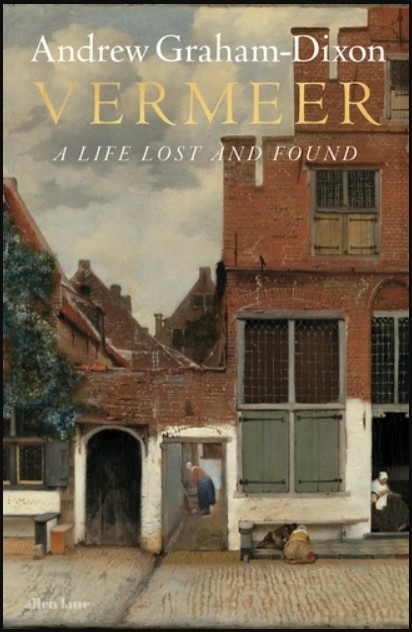
I also read and enjoyed (in translation, naturally) Monsieur Proust by Céleste Albaret, which was fascinating and enlightening and occasionally (not Madame Albaret’s fault) a little disappointing. I’m very glad to have read it even though a little part of me preferred the Marcel I had imagined from reading his work to the more mundane but also much more rounded and believable human being that came across in Monsieur Proust. Almost the exact opposite happened when I read Andrew Graham-Dixon’s revelatory biography Vermeer – a Life Lost and Found, in which the mysterious and opaque Vermeer of the imagination. As Jonathan Richman sang in No One Was Like Vermeer (2008):
Vermeer was eerie
Vermeer was strange
He had a more modern colour range
As if born in another age
Like maybe a hundred or so years ago
What’s this? A ghost in the gallery?
Great Scot! The Martians are here!
These strange little paintings next to the others
No-one was like Vermeer
Unexpectedly, to me at least, Andrew Graham-Dixon dispels much of the mystery, without undoing any of the magic; the Vermeer he describes is a man very specifically of his time and milieu, but ultimately to me that makes his particular kind of alchemy more rather than less extraordinary; maybe it’s just because I’m lacking in ‘negative capability,’ but for me knowing that the Girl With the Pearl Earring and the rest have a meaning and function that was highly specific to 17th century Delft, but which still communicate their human quality of warmth, empathy and connection down the ages is the miracle of art.
I also watched some good films this January, most recently, Jonathan Glazer’s The Zone of Interest (2023), which I had seen before, but watched two nights in a row, utterly hypnotised by it, just like the first time. By now it’s already a cliché to use the phrase ‘the banality of evil’ – but it also feels slightly wrong. In a way it’s the banality of the characters itself, especially Hedwig and Rudolf Höss, brilliantly played by Sandra Hüller and Christian Friedel – but also their children and the assorted businessmen and soldiers – that is what’s evil about them. At first it seems that to Rudolf Auschwitz is just his job, and to Hedwig it’s just her husband’s job – which is bad enough. But the genius of the film is the way that Glazer undercuts their blasé attitude by showing that they do understand not just the reality but the implications of what’s going on in the camp and that it’s not some kind of inexplicable mass hysteria; Hedwig’s own mother, though presumably just as unthinkingly loyal to her homeland and its government as her daughter is almost immediately struck by the utter wrongness of Auschwitz; Rudolf and Hedwig get it too; they just don’t mind.
The feeling of being hypnotised by a film is a rare one for me, but coincidentally(?) I watched two of the very few others that have that effect on me this January too. I watched Gus Van Sant’s Elephant (2003) several times last year and then watched it twice in January too. The first time the feeling is all about the suspense of not knowing how events will unfold, but obviously that can’t be true when rewatching it. And yet for me it remains just as appallingly gripping and sad every time, The same is true in a very different way of Oliver Hirschbiegel’s 2004 film Der Untergang. I watched that in January too, only once, but for the third or fourth time in the past few years. Key to its hypnotic quality is the great Bruno Ganz, but also the brilliant pacing, editing and performances of the whole cast. It feels like a thriller, even though it’s mostly people squabbling in a bunker.
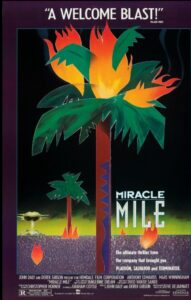
New to me though, was a film I’ve wanted to see since 1988 when I first read about it in (I’m fairly sure) FEAR magazine; a confusing memory because I clearly remember the picture of Anthony Edwards below (though in black and white), which is a still from the film. And I remember the headline was ‘Miner Miracles‘ and part of the article related to Steve Miner. But as far as I can see, Steve Miner (director of the great Warlock (1989) has nothing whatever to do with Miracle Mile, which was written and directed by Steve De Jarnatt. So maybe it was a general film roundup that mentioned both Miracle Mile and Warlock, which was definitely promoted in/by FEAR.
Anthony Edwards in Miracle Mile
Anyway, I loved Miracle Mile and found it completely gripping and kind of sweet and heartbreaking and in a weird way nostalgic for the expected nuclear holocaust of my childhood. Partly it was nostalgic because it was like a cross between two different things from the 80s, both of which I love. Firstly, the kind of teen romance movie most associated with John Hughes (Pretty in Pink, Some Kind of Wonderful etc) and secondly Jimmy Murakami’s adaptation of Raymond Briggs’ cosily apocalyptic comicbook When the Wind Blows. I loved the glossy, 80s way it was filmed (especially the opening, idyllic shots of Miracle Mile itself) and its goofy humour and especially the two leads. I knew Anthony Edwards from a few things (though not his 80s work, oddly. I never liked and barely remember Revenge of the Nerds and I’ve never seen Top Gun) but I thought he was perfect in this; likeably dorky but also sincere – and I love Mare Winningham. She’ll always be Wendy from St Elmo’s Fire (1985 – one of my favourite 80s teen movies) to me, so it was strange at first, seeing her as cool-quirky rather than nerd-quirky. Anyway, loved it (and watched it three times). I’m glad/surprised the studio didn’t chicken out on the perfect ending. Oh. and it had the great Brian Thompson (Kabal from Doctor Mordrid) in a small but vital role; it couldn’t be more 80s and yet less typical of 80s Hollywood at the same time. Great Tangerine Dream soundtrack too.
Blot – but will it be as good as I remember?
Music-wise I heard a lot of things but especially liked a vast (101 track) compilation of bands associated with the legendary New York club CBGB, ranging from the obvious (Ramones, Blondie, Talking Heads, Patti Smith) to 70s oddballs like the Dictators and the Harlots of 42nd Street to classic 80s hardcore like Bad Brains and the early Beastie Boys. I’m cautiously excited about a reissue of Mactatus’s 1997 album Blot but haven’t gotten round to listening to it yet so don’t know if it’s retained it’s old potency. And I still haven’t listened to the new Ulver album, so there’s that.
Anyway; I’ll try to get at least one of those more substantial things finished and posted in February.
Sitting down to write this, a month after breaking my leg and having to grapple with hitherto-unconsidered questions like ‘how do I usually sit on a toilet’? and one week before a General Election where my preferred of the apparently plausible outcomes is an unsatisfactory coalition government, it feels strange and maybe wrong to be looking backwards. But, disturbing and reassuring in more or less equal measures, I think it’s a good way to look forward to whatever happens next.
I remember as a child, looking at a stamp album that had belonged to (I think) my dad (or maybe his dad) when he was a child. Even for someone with no interest in stamps, and less interest in collecting them, it was a peculiar and fascinating book; unfamiliar places, people, even currencies. The thing that stands out the most in my memory though is a stamp from Bosnia, a name which at the time I hadn’t heard before and which sounded as unlikely and frankly made-up as countries like Syldavia and Borduria that I knew from Tintin books. That memory itself has a strange and silly quality now, but at the time (somewhere in the mid-80s would be my guess) Bosnia was as fantastical to a child (or me at least) as I expect the Socialist Federative Republic of Yugoslavia would be to Primary school pupils now.
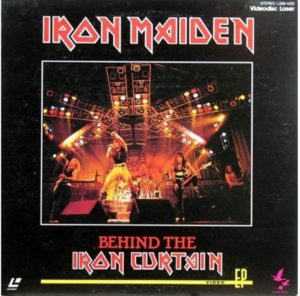
classic cold war artefact: Iron Maiden behind the Iron Curtain laserdisc (1985)
30 years on from the series of revolutions that symbolically culminated in the destruction of the Berlin Wall (the free opening of the Brandenburg Gate itself happened 30 years ago last month) it’s perhaps only natural that those who remember those times should be thinking of them. If you grew up with the cold war in the background (that is, any time really from the years after world war two up until the end of the 80s), the war itself may have constantly ebbed and flowed, but the communist eastern bloc was, monolithically (technically at least duolithically, but that’s not a thing) omnipresent in a way that now seems as unlikely and distant as the Austro-Hungarian Empire. It was there at school (we had to learn about “East Germany” (the GDR or DDR), “West Germany” (FRG or BRD) and the differences between the two, the USSR /CCCP, the space race, the arms race, ‘Mutually Assured Destruction’ etc etc etc), it was there in sports (especially the Olympics, but “West Germany” was quite a big deal during the ten minutes that I liked football) and in entertainment. Usually this meant sinister, emotionless and robot-like communists being the bad guys in endless numbers of films and TV shows (classic example; Rocky IV, but see alsoRed Dawn, Red Heat ad infinitum – it was interesting, in a depressing kind of way to see this old view of ‘reds’ adopted, without irony in the third, inferior season of Stranger Things this year), but it wasn’t all bad – sometimes bands made a point of playing behind the Iron Curtain and talked about how great the audiences were; I remember Iron Maiden played in Poland, Hungary etc in the mid-80s which presumably was a logistical nightmare, but nice for their fans who mostly would only have been able to hear their music through unofficial or even (the same thing really) illegal channels.
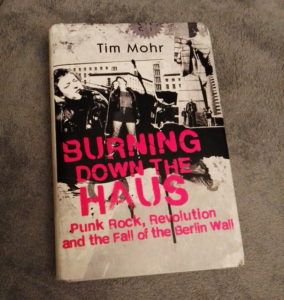
A few things have brought that period, and specifically the GDR, back to me recently; Tim Mohr’s superb book Burning Down The Haus – Punk Rock, Revolution and the Fall of the Berlin Wall (Dialogue Books, 2019), the work of the German photographers Ute and Werner Mahler and the Ostkreuz photography group, interviewed by Kate Simpson in issue 90 of Aesthetica Magazine (August/September 2019), the TV shows Deutschland 83 and Deutschland 86 which I just watched, somewhat belatedly and a series of John le Carré’s classic spy thrillers, notably A Small Town In Germany (1968).
The central realities of all of these things is pretty much the same; in East Germany, the state (specifically the secret police, the notorious Stasi) was watching you, and not only did they not care if you knew it, they wanted you to assume you were being watched.
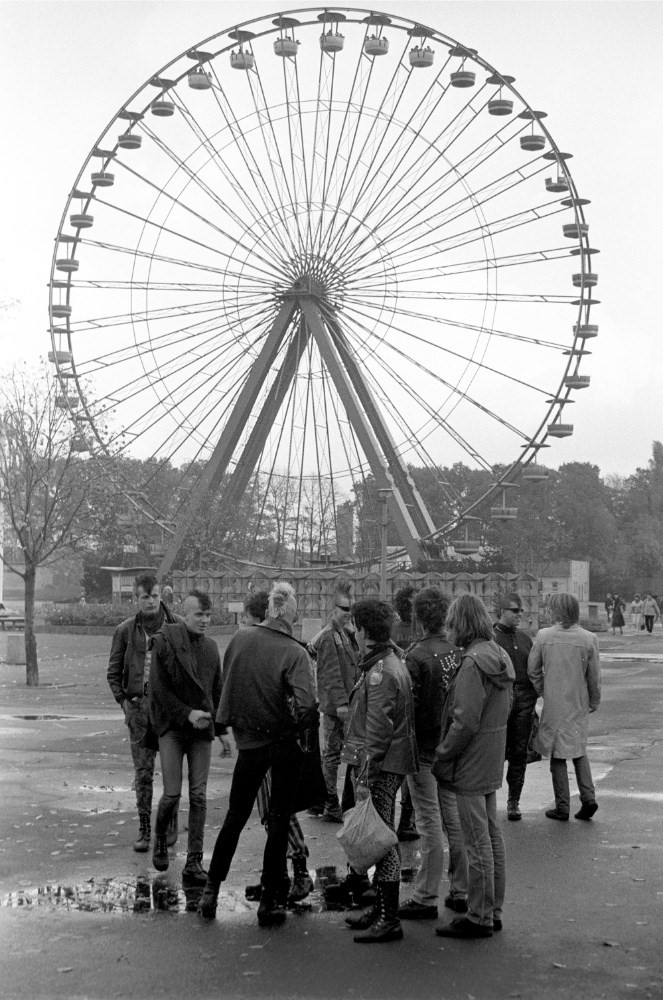
East Berlin punks at Planterwald, approx. 1981 by Harald Hauswald (Ostkreuz Agency)
One of the most chilling things in Tim Mohr’s book is the way that, from the beginning of the 80s until its end (punk seems to have had an extended lifespan in the GDR, partly because fashions were slower to take root and spread where the majority of the media was under state control, but also because it remained – from the music to the image – genuinely oppositional and rebellious, rather than being absorbed into mainstream pop culture) the punks were, as often as not arrested because of informants from their own families or even the bands themselves. Nevertheless, after a slow start, the bands multiplied, but in a planned economy with full employment its slogans were something like the opposite of the UK’s punk bands; Too Much Future being the classic East German punk statement; more info here. As Mohr notes, long before the advent of GDR punk, informing for the government was something like an epidemic. In fact, by 1952 – that is, just four years from the official founding of the nation – the Stasi had already recruited 30,000 informants (Burning Down The Haus, p.2), and that figure would rise exponentially throughout the decades. This was the reality that artists like photographer Ute Mahler were working in;
“Everyone knew that people were spying for state security. But nobody knew who. It could be anyone. We lived and breathed with this knowledge. In 1980, I stood at a May Day demonstration just below the grandstand. The demonstrators cheered at the government, which was on a podium above me. I got the impression that all the attendees were in agreement and were happy about it. Whilst editing the pictures, I discovered other faces in the crowd. That confirmed to me that you must look closely for what might be hidden.”
Ute Mahler, interviewed in Aesthetica, issue 90, p. 128
Action Force SAS figure, 1982: this creepy thing was one of the ‘good guys’
From a child in the UK’s point of view, the activities of the CND, the Greenham Common protestors, WarGames, Raymond Briggs’s When The Wind Blows and even silly things like the Frankie Goes To Hollywood Two Tribes video strengthened rather than diluted the sense that, beyond ‘the west’ there was a huge, sinister and implacable enemy. That video – bad lookalikes of Reagan and Chernenko wrestling – was absurd but actually made child me more aware of the seriousness of the global situation. For a start, I remember thinking the actors were bad lookalikes, but I knew approximately who they were meant to be and what it represented. Actually, although I was very familiar with Reagan I doubt whether I knew Chernenko by name; even now I had to look it up to write this as my only memories of a pre-Gorbachev Soviet leader relate to Andropov, for the simple reason that his name was funny. I vaguely remember him in association with a joking remark (when he died??) that “his hand dropped off”, but whether that was purely from the playground or from TV I don’t know. Even toys contributed to the doomladen atmosphere. The initial run of Action Force (the European release of GI Joe, although initially there was no back story or characters, just – as with the older UK Action Man – a lot of more-or-less accurate contemporary military equipment, including sinister SAS paratroopers with gas masks etc. As I was typing this, I remembered that I used to have a fairly extensive knowledge of the weaponry favoured by the Warsaw Pact vs. NATO troops, which is fun for kids. As far as I remember, although children’s entertainment in the UK wasn’t by and large as propagandist as Hollywood, there wasn’t anything much to counter the idea of the brainwashed, robotlike communist hordes, programmed by the state from birth. And, at no point before 1989 did it feel like that situation was about to change.
That feeling was as strong, or even stronger, inside the Eastern bloc, as Ute and Werner Mahler explain;
“The generations after us might find it hard to understand the complex workings of the GDR, as memory begins to move into the past. These new generations perhaps cannot imagine how one could live in such a country, where one could not officially say what we thought. … When we took pictures in the 1970s and 1980s, we would never have imagined that one day the GDR would not exist. At that time, we wanted to show life as we experienced it – just as it was. Today, the images act as documents from a vanished country. In this way, they are given a renewed sense of purpose.”
Ute & Werner Mahler, interviewed in Aesthetica, issue 90, p.124
Even, as Mohr explains, the day after the Berlin Wall fell, the Stasi were making arrests in something like the usual way, although the state quickly descended into chaos. But maybe everything feels permanent when you live through it; I remember when, what felt like 1000 years or so into Margaret Thatcher’s reich, we had had the Miner’s Strike, the Falklands war, there were millions of unemployed and it seemed like I had never met anyone who liked Thatcher, or anyone who voted for the Conservative Party and yet, come election time they still won. Maybe it’s more significant that I don’t remember anyone I knew being especially keen on Michael Foot or Neil Kinnock? But anyway; my memory is that by 1988, there was no feeling that the cold war was going anywhere; by 1990 it was over. Until I was 23 my only conscious experience was of a Britain run by a Conservative government, and then that was over.
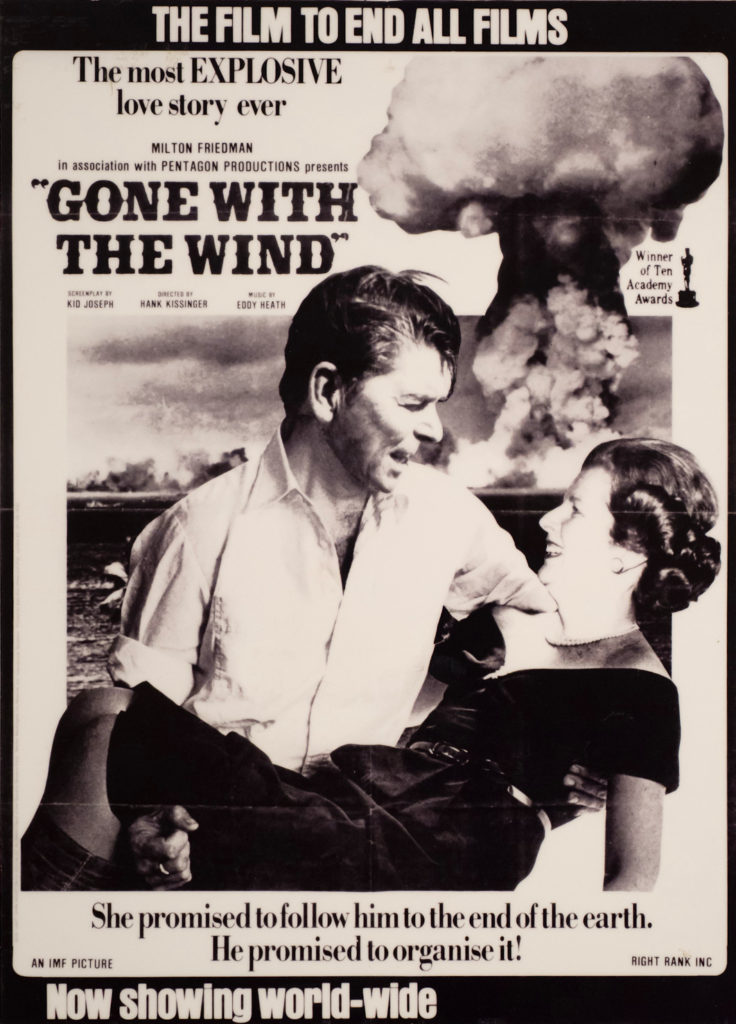
symbol from an 80s cold war childhoodBob Light and John Houston’s satirical Gone With The Wind poster, c.1981 – vividly brings back the era to me
One of the stranger things to find, looking back on the phantom communist enemy of my childhood is that, contrary to what appeared to be the case on TV at the time, the people of East Germany, discontented though they obviously were, did not necessarily want to become westerners. As depicted vividly in Deutschland 83 and even more so in Deutschland 86, Communism as practised through the GDR’s dictatorship was a failed ideal, but it remained for many, something like an ideal. The bands documented in Burning Down The Haus, like the immediately post-Communist East German club scene that Mohr experienced himself, were ‘radically egalitarian’. These were, after all, people raised in a system which preached the power of the people, and even enshrined in law the freedom of expression, although in practice it didn’t allow either of those things. Often bands or musicians – people who were routinely arrested, beaten by the authorities, held in prison awaiting trial for months and so on – had opportunities to flee to the west (or were even encouraged to by the authorities who couldn’t cope with them) but chose to stay and work for change. Fascism and consumerism were seen, not just by the authorities, but by the punks, as the enemies of freedom, and even when the punk revolt happened it was often aided by (which seems odd but makes a kind of logical sense) the Lutheran church, which had an uneasy but respectable existence within the state. This meant that not only the punks (who tended towards anarchism in the 19th century sense politically), but also environmentalists, peace activists and other dissidents the church protected and to a degree nurtured, were working under the auspices of an institution which also had essentially anti-capitalist principles at its heart.
Rebelling against a de facto egalitarian state in itself creates a strange situation, as Ute Mahler recalls;
“In the GDR, when the collective was praised as an ideal, we were all lone fighters. In this new society where individuality is so important to so many people – coming together is the key” quoted in Aesthetica, issue 90, p.124-7
And this is not really a paradox, even to an individualist; if the contrasting but ultimately similar oppressions of the 20th century, whether Nazi Germany, Stalinist Russia, Communist China etc – have taught us anything, it’s that totalitarian power structures, of whatever political hue value conformity above individuality; but also that political progress requires subjected peoples to firstly insist on their individuality, but also to act in concert with each other, to combine their voices in order to be heard.
Perhaps because a general election is looming as I write this, reading about the lost world of the eastern bloc and its failures (mostly the same failures as capitalism to be fair; poverty, starvation, oppression etc etc) begs the question; what is the country that you believe in, if not a reflection of yourself and what you want? The Eastern punks were patriotic in the sense that they wanted the freedom to be themselves, in an East Germany that recognised the right to have dissenting voices and views, to improve the experience of East German citizenship for all. But, like everyone else, they shared their country with the other by-their-own-admission patriots who believed in a completely different country. If you consider yourself a patriot, you are probably living in a country with lots of other patriots whose country has the same name as yours, but whose beliefs and ideals are not the same as yours. Those who fought and died for [name a country] in [name a war] and those who fought and died for [name an opposing country] in [the same war] were fighting for the same thing, but they were also not fighting for the same thing. The people who fought for Britain against the Nazis and the people who fought for Britain against the Zulus both were and were not fighting for the same country, though on an individual level the end result – their deaths, and the deaths of their enemies – was much the same.
Somewhere in a previous, equally muddled* article I mentioned the poet Edward Thomas. Against the WW1 poetry of super-patriot Rupert Brooke, or the “What passing-bells for these who die as cattle?” humanism of Wilfred Owen, you have to balance the entirely personal patriotism of Edward Thomas;
At the age of thirty-six there was no strong pressure on him to enlist, but in August 1915 he finally made up his mind… When his friend Eleanor Farjeon asked him why, he scooped up a handful of earth and said, ‘For this.’ Andrew Motion, ‘An Imaginary Life’, in Ways of Life, Faber & Faber 2008, p.102.
And no doubt that was true. But what he fought for doesn’t change the fact that what he was injured for (he survived the war, minus an arm) was the global ambitions of the small group of people then running the British Empire. In the end his patriotism and theirs amounted to the same thing; but they were not the same thing.
Thomas’s kind of patriotism is the one that I think most matches my own; despite being a lefty internationalist I am quite a patriotic person. I love Scotland and value it not because it’s the ‘greatest country in the world’ (not that I’m saying it isn’t; just that the concept itself is utterly meaningless I think) and not because it’s beautiful – which it undoubtedly is, but so is every country I’ve been to – but because it is uniquely itself. It’s the big picture and the details; the texture and the atmosphere, the things I like and the things I don’t like. What I’m really saying I suppose is just that it’s the country I know best, the one where all of my responses to the world were shaped – which is of course not something to run up a flagpole and if one somehow did there’s no reason that anyone else in the world should want to salute it. But it is patriotism nonetheless. One of the many ironies of our particularly irony-ridden times is that on the whole, the conservative/nationalist parties of whom there are suddenly it seems very many indeed, are by and large those least committed to any kind of environmental/green policies. Strange because if, like the Conservatives nominally are, you are all about pride in your culture and your country and your history, but aren’t really concerned about the welfare of the actual, physical country as a piece of land then what do you even think you stand for?
So anyway; in the world of 1988, the world of 1990 seemed unthinkable, but it happened anyway, because people wanted it. I know that as 2019 draws to an end the world is full of people, in Chile, in Hong Kong, in Iran and Sudan, in the USA and the UK; in every country, who want thoughtful, compassionate, democratic government and not repression, corruption and leaders who are quasi- or actual dictators. Who want to be represented, not ruled. And it’s not impossible.
* when I read my writing it makes me think of that episode of Peep Show where a disgruntled lapdancer says “If you can’t sum up all the aims in the first line then they’re too diffuse.” I think my writing tends to be a bit diffuse.**