a pressing necessity: International Women’s Day 2026

Firstly, the title comes from this short essay by one of my favourite historical figures, Rosa Luxemburg; it’s worth a read.
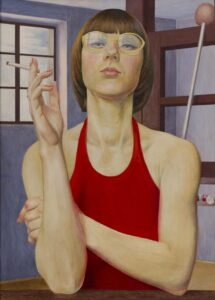
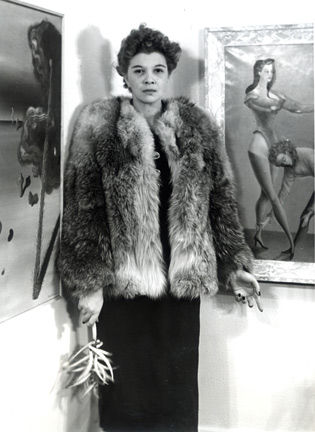
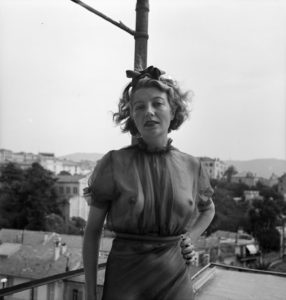
one of my favourite works of art by anyone ever; Monika Geilsdorf’s 1976 self-portrait

If anything demonstrates that half of the human race is in need of a special day to celebrate their achievements and raise awareness of the challenges they face, it’s the ongoing existence and high profile of International Women’s Day. I’m not here just to criticise it, so bear with me.

In a way it seems deeply patronising (not an accidental use of the word) that it even exists, since the celebration of IWD is in itself a sign that the patriarchy is in obnoxiously good health. Seems paradoxical, but look at the contrast between not just the profile of, but the nature of IWD, compared to International Men’s Day, which contrary to the belief of the frothing-at-the-mouth men on the misogynist fringe does exist (19 November), highlights the background that it exists against.

International Women’s Day commemorates the (ongoing) fight for Women’s rights, raises awareness of issues surrounding gender inequality and is a celebration of the achievements of women throughout the ages. International Men’s Day raises awareness of issues like suicide, self-harm, violence, homelessness etc; it’s a good thing, but it’s a much smaller and very different thing. Both international days are – necessarily – framed in the same way. The bad things that women have faced and continue to face – violent death, mutilation, violence, political, religious and social disenfranchisement – are the product of societies where women have been and in many ways continue to be second class citizens; the power structures they struggle with and against are overwhelmingly male and male-dominated. The problems that Men’s day raises, likewise come from men’s struggles to exist within that same socio-political/religious framework. The fact that I’ve spent half a paragraph about Women’s Day writing about Men’s Day is ironic but it’s also systemic.

Does that mean that IWD is a bad thing? Clearly not. There are women who, for a variety of reasons choose to denounce or simply opt out of the whole idea of it – as is their right – but the position of women has not improved so much over the past quarter century that the inequalities are merely historical, as seemed possible to envision around the end of the 1980s. And while the achievements of women in almost every field are acknowledged more now than ever, they are, depending on which sphere they take place in, often still seen as special cases; ‘women artists,’ ‘female plumbers’ etc, whereas terms from my childhood like ‘male nurse’ seem comically inappropriate (which isn’t to say that some people don’t still use them; but usually men, and for reactionary reasons).

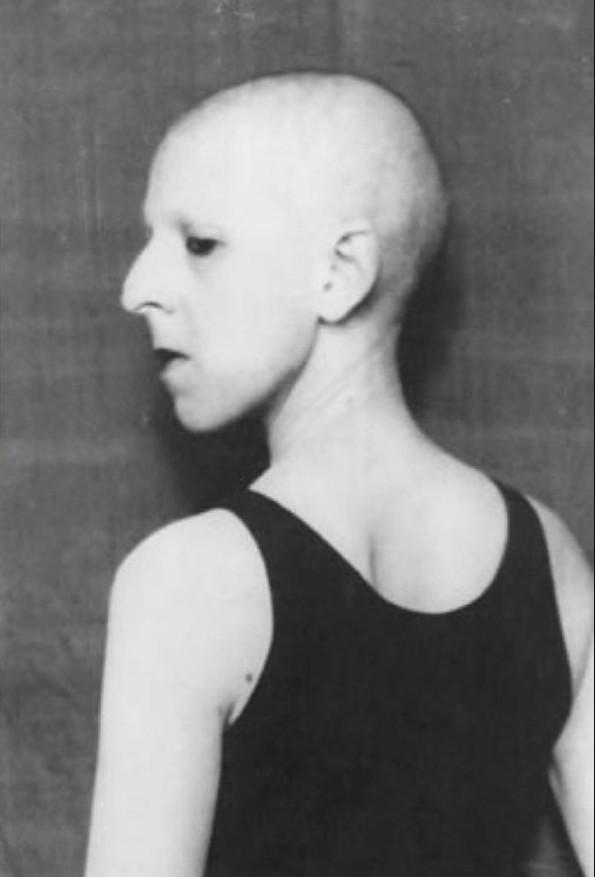
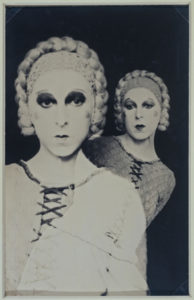
There’s also a valid argument that celebrating womens/mens days simply reinforces a binary that is merely a symptom of the old-fashioned, patriarchal system. It’s kind of undeniable; the name alone, International Women’s Day supposes “women” as a monolith. One of my favourite artists is the Surrealist Claude Cahun (born Lucie Schwob), whose work is often (by me, too) promoted as part of IWD celebrations of female artists, despite the artist’s unambiguous statement from Disavowals (1928) that “Neuter is the only gender that always suits me.” To ignore someone’s own personal identity in order to celebrate something about themselves that they specifically denied feels like a strange kind of tribute.
Nonetheless, nobody, not even Claude Cahun, denied that women do exist and that they have been and are (okay some people do loudly deny this bit) oppressed and subject to systemic inequalities.
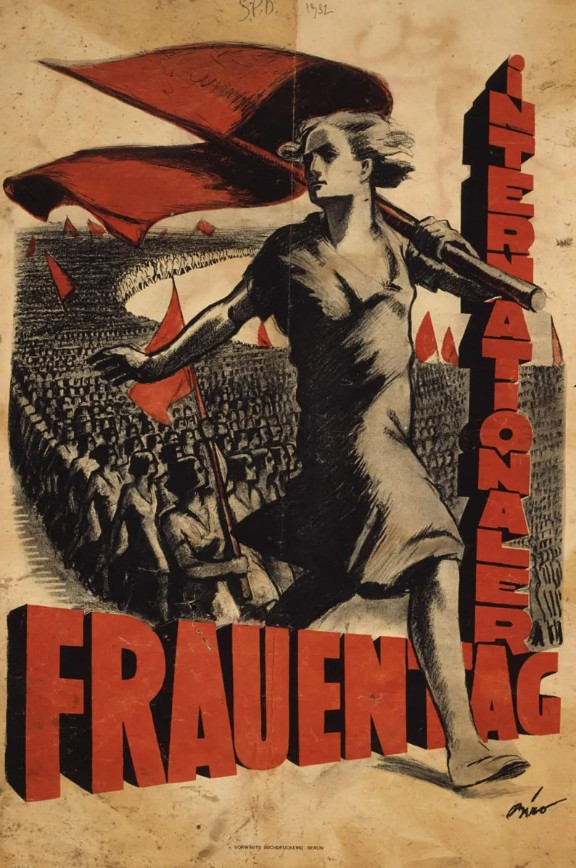
the great Hungarian artist Mihály Biró’s 1925 poster for International Women’s Day

What’s often overlooked now too is that International Women’s Day was historically – though not consistently – a socialist celebration. See here for an excellent exploration of its radical origins. Working Women’s Day – the date 8th March was chosen by Lenin, fact fans – was originally tied to issues of Workers’ Rights and the fight for equality more widely, but even in the Soviet Union the image softened over the years until eventually it –  ironically – came to celebrate women in traditional roles (mothers, wives) rather than revolutionary ones. Which is lame; but it’s easy to see why that link has eroded. The struggle for Women’s liberation was initially, and throughout its radical period in the 60s and 70s seen as analogous to the working class struggle – where women occupied a kind of working class, that is subordinate, position even within the working class. The gradual (but of course never total) amelioration of the rights of workers made aspects of the radicalism of the past feel dated and possibly unnecessary, though that is less true than it sometimes seems. Also, not all women were or are working class anyway, and class distinctions of that kind are not universal in every society in the world, but women’s marginalisation almost is.
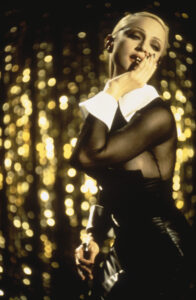
Madonna: “Erotica” (1992) dir Fabien Baron: not my mother’s feminism

Plus, people and perceptions change. My mother was a working class ‘Women’s Lib,’ Spare Rib-reading feminist of the 60s/70s, but although her views on Women’s liberation never really changed, from the 80s onwards she became puritanical in a way that now seems, to her children’s generation, a bit sexist, oddly. For example, she couldn’t see someone like Madonna (the popular entertainer, not the mother of Christ) and her ilk, however apparently empowered, as anything other than a manifestation of the retrograde desires of men, and she would probably have agreed with Morrissey that make-up is a lie, or even gone further to suggest that it’s a lie established by the patriarchy to keep women in their place. It’s a point of view, I suppose; but it’s also one that polices the image that women choose to project for themselves and so seems fundamentally anti-progressive, though I understand the logic of it.

Similarly, there are people who bemoan the loss of the ‘Class War’ aspect IWD, which I again understand, because I do think capitalism & patriarchy are bad and harmful to humanity in general and women in particular. But as a ‘working class’ male I also kind of reject it. Identifying with the system that labels you seems fundamentally unhelpful to me. I am ‘working class’ because that is the caste system established by a capitalist power structure, just as I would have been ‘peasant class’ centuries ago in a feudal society. Embracing that class identity seems far less attractive than altering society until its labels have no meaning anymore.

A fairer version of capitalism may not be the ultimate aim, but it would at least be a good thing. Marx’s ideal – I have a lot of time and affection for Marx, but I think he was often wrong, or at least that 21st century problems do not call for 19th century solutions – that inequality reaches crisis point so that revolution becomes a necessity feels to me very much like the apocalyptic thinking of those who want to immerse the world in war to bring about the second coming of Christ. The problem is – as we see, now, with war – that people, perhaps even generations of people, have to actually live their whole lives during that ‘crisis point’ which can continue, depending on the strength of the overarching system, almost indefinitely. Misery now, reward later is the self-serving bullshit the Christian church8 has been selling for 2000 years, I don’t think society is improved by adopting a well-meaning socialist version of it. Surely the life of even a single person is more important than the fulfilment of an ideology? Agree to disagree perhaps.

Which again has taken this away from International Women’s Day. When one is talking about half of the human race any kind of generalisation is bound to be wrong, but solidarity with people who are forced to struggle for equality as human beings within systems designed to keep them in a subordinate role never is.

It may be – especially in the social media age – that celebrations like International Women’s Day come under the banner of Bread and Circuses that the satirist Juvenal noted Imperial Rome offered to the people in lieu of the political power they held in the days of the old Republic. So should we get rid of them? No, would be my answer – quite the opposite, we should expand on them, turn them into actual holidays, raise awareness of every grievance that people have under a grossly unequal political system. If the ruling class of the Capitalist/Tech Oligarchy are offering circuses (where is the bread though?) to placate the people and keep them docile, then the very least their subjects can do to exert their will is to take over the circuses and to remake them in their own image, loud and unignorable.

Ah well, never mind, maybe soon there will be an International Humans Day where the (male) technocratic overlords agree to turn off AI for a day or something to show false solidarity with the rest of us. I won’t hold my breath though.

To end on something more positive, I’ve evangelised elsewhere about art history as a subject (here’s my one-line reason why everyone should study it; Art History is not just about the past, it encompasses everything that’s important about the present; politics, religion, gender, philosophy, personal, national and local identity – and studying the subject and freeing it from its historical assumptions and biases only makes it deeper and richer; plus you get to study fascinating, powerful and beautiful products of the human mind and body, too). Over the past decade or so the place of female artists within that history – and the profiles of individual women artists – has been explored more than ever before so that, although we are not yet at a point where women artists and male artists (and neither) just become ‘artists’ it’s no longer as unthinkable as that would have been when I studied art history 20 years ago.

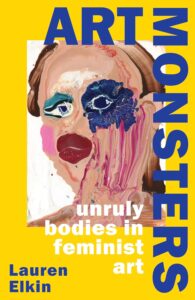
On a less exulted note, when I first started posting things on Instagram around a decade ago, books like Jennifer Higgie’s The Mirror and the Palette, Katie Hessel’s The Story of Art Without Men (2022), Eiderdown Books’ superb Modern Women Artists series, Phaidon’s Great Women Artists (2019) and (my favourite) Lauren Elkin’s Art Monsters (2023) didn’t yet exist.

Some of my favourite artists – Jenny Saville, Hannah Höch, Gabriele Münter– were women and, like most female artists they made works that on one level transcend gender, as I think all great art does, but were also formed from an unmistakably female point of view (just as I would say Picasso’s art is unmistakably male). Female artists were, in short, making art that only female artists could make, (I’d actually go further and say that all great artists regardless of gender make art that only that individual can make, but that doesn’t change the basic point).

I found, and it’s still true, about art in general and not only – though especially – by women, that the more you look, the more you find and so when I started regularly posting art by female artists, most of whom were new to me, I began keeping a kind of database of artists and their birthdays. So here it is, in simplified form. There are many, many omissions (especially of sculptors – not so much my thing – and contemporary artists, whose birthdays are often not so easy to find) and it will always be a work in progress, but I think it’s worth sharing here anyway (and in birthday order, so you can see if you share your birthday with a fantastic artist; why not?) Happy International Women’s Day!.

JANUARY
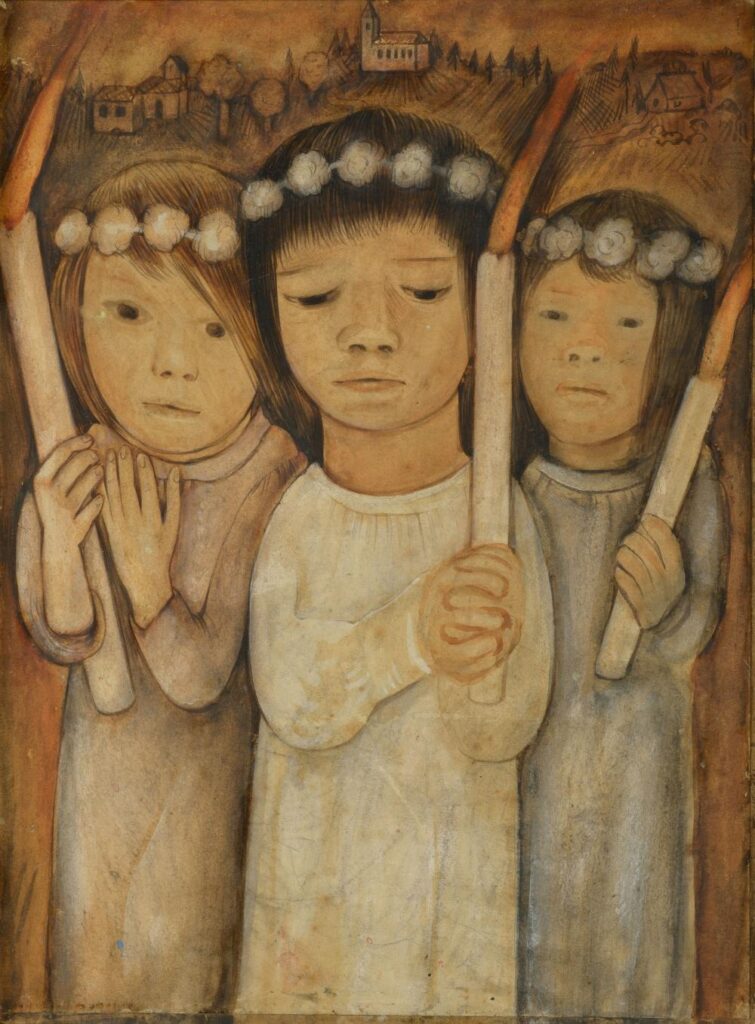
Children with Burning Torches (1920s) by Tina Bauer-Pezellen, an artist I love but can never find much information about

Selma Gubin born 01-Jan 1905
Rita Kernn-Larsen born 01-Jan 1904
Lynette Yiadom-Boakye born 01-Jan 1977
Selma Plawneek-des Coudres born 02-Jan 1883
Slava Raskaj born 02-Jan 1877
Sylvi Kunnas born 03-Jan 1903
Maruja Mallo born 05-Jan 1902
Margaret Modlin born 05-Jan 1927
Madame Yevonde born 05-Jan 1893
Ruth Gikow born 06-Jan 1915
Sanja Ivekovic born 06-Jan 1949
Franciska Clausen born 07-Jan 1899
Fahrelnissa Zeid born 07-Jan 1901
Wanda von Debschitz-Kunowski born 08-Jan 1870
Alida Jantina Pott born 08-Jan 1888
Julie Wolfthorn born 08-Jan 1864
Tina Bauer-Pezellen born 09-Jan 1897
Annemarie Heinrich born 09-Jan 1912
Maxa Nordau born 10-Jan 1897
Nora Heysen born 11-Jan 1911
Marcia Marcus born 11-Jan 1928
Rosalba Carriera born 12-Jan 1673
Hannah Hirsch-Pauli born 13-Jan 1864
Lilla Cabot Perry born 13-Jan 1848
Alice Pike Barney born 14-Jan 1857
Berthe Morisot born 14-Jan 1841
Eve Sonneman born 14-Jan 1946
Louise Blair Daura born 15-Jan 1905
Sabine Lepsius born 15-Jan 1864
Gerta Overbeck born 16-Jan 1898
Teddy Røwde born 16-Jan 1911
Alexandra Ekster born 18-Jan 1882
Cindy Sherman born 19-Jan 1954
Marianne Stokes born 19-Jan 1855
Sophie Tauber-Arp born 19-Jan 1889
Leyly Matine-Daftary born 19-Jan 1937
Maxine Albro born 20-Jan 1893
Hertha Spielberg born 21-Jan 1890
Annemarie Jacob born 22-Jan 1891
Kiki Kogelnik born 22-Jan 1935
Maria Luiko born 25-Jan 1904
Emilie von Hallavanya born 26-Jan 1874
Katarzyna Kobro born 26-Jan 1898
Yva (Else Ernestine Neulander-Simon) born 26-Jan 1900
Jeanne Selmersheim-Desgrange born 27-Jan 1877
Maria Tlusty born 27-Jan 1901
Bertha Muller born 28-Jan 1848
Alice Neel born 28-Jan 1900
Elisabeth Büchsel born 29-Jan 1867
Anna Susanna Fries born 30-Jan 1827
Teresa Feoderovna Ries born 30-Jan 1874
Amrita Sher-Gil born 30-Jan 1913
Masa Feszty born 31-Jan 1894
Elena Liessner-Blomberg born 31-Jan 1897
Cornelia Macintyre Foley born 31-Jan 1909

FEBRUARY
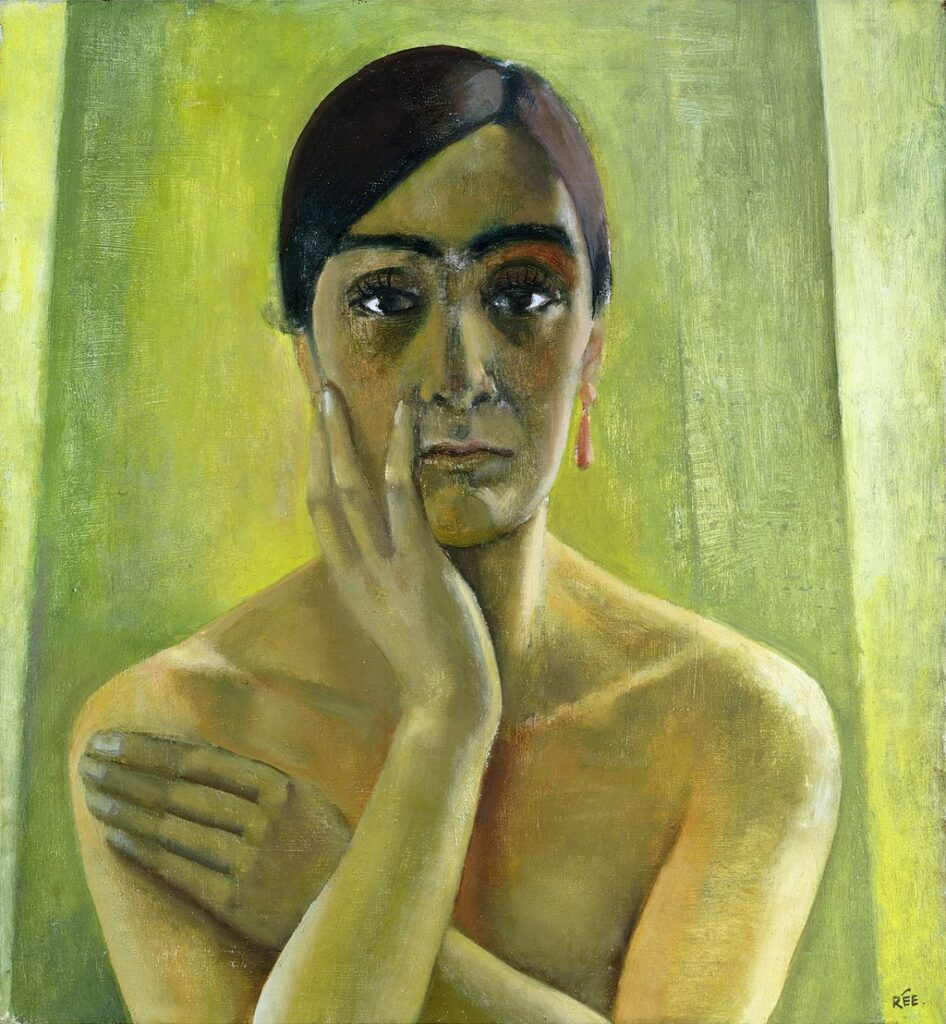
Anita Rée – self portrait (1930)

Doris Lee born 01-Feb 1905
Kris Torne born 01-Feb 1867
Sybil Atteck born 03-Feb 1911
Helen Forbes born 03-Feb 1891
Henriette Petit born 03-Feb 1894
Katherine Read born 03-Feb 1723
Georgina de Albuquerque born 04-Feb 1885
Marthe Hirt born 04-Feb 1890
Minna Köhler-Roeber born 04-Feb 1883
Ksenia Boguslavskaya born 05-Feb 1892
Jeanne Bieruma Oosting born 05-Feb 1898
Dorothea Maetzel-Johannsen born 06-Feb 1886
Arte Topalian born 06-Feb 1906
Kaete Lassen born 07-Feb 1880
Paula Modersohn-Becker born 08-Feb 1876
Anita Ree born 09-Feb 1885
Celia Calderon born 10-Feb 1921
Eva Frankfurther born 10-Feb 1930
Dorte Clara Wolff (Dodo) born 10-Feb 1907
Annelise Kretschmer born 11-Feb 1903
Léa Lafugie born 11-Feb 1890
Kate Diehn-Bitt born 12-Feb 1900
Marie Vassilieff born 12-Feb 1884
Marta Hegemann born 14-Feb 1894
Marie Vorobieff (Marevna) born 14-Feb 1892
Dora de la Torre born 14-Feb 1924
Mary Adshead born 15-Feb 1904
Grethe Jurgens born 15-Feb 1899
Gertrude Abercrombie born 17-Feb 1909
Greta Hällfors-Sipilä born 19-Feb 1899
Hazel Janicki born 19-Feb 1918
Gabriele Munter born 19-Feb 1877
Else Berg born 19-Feb 1877
Maria von Heider-Schweinitz born 20-Feb 1894
Lía Correa Morales born 20-Feb 1893
Grace Carpenter Hudson born 21-Feb 1865
Delhy Tejero born 22-Feb 1904
Gundula Schulze Eldowy born 23-Feb 1954
Martha Cunz born 24-Feb 1876
Alice Bailly born 25-Feb 1872
Broncia Koller-Pinnell born 25-Feb 1863
Hilde Hamann born 26-Feb 1898
Alexandra Povorina born 26-Feb 1885
Annie Swynnerton born 26-Feb 1844
Teresa Condeminas i Soler born 27-Feb 1905
Eva-Maria Bergmann born 28-Feb 1941
Julia Thecla born 28-Feb 1896

MARCH
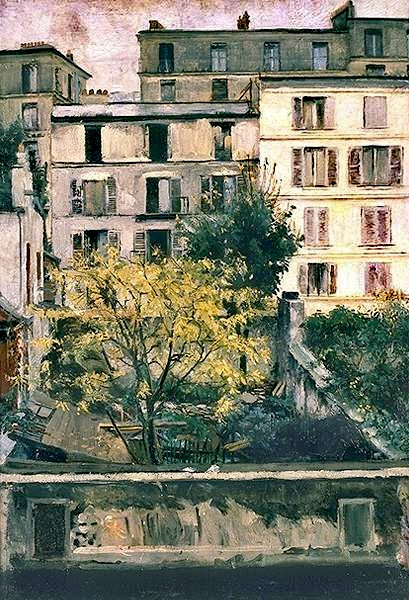
Maria Slavona – Houses in Montmarte (1898)

Marcelle Cahn born 01-Mar 1895
Erika Streit born 01-Mar 1910
Lola Cueto born 02-Mar 1897
Agda Holst born 02-Mar 1886
Judith Alpi born 03-Mar 1893
Gussy Hippold-Ahnert born 03-Mar 1910
Anne Ratkowski born 03-Mar 1903
Ellen Emmet Rand born 04-Mar 1875
Charmion Von Wiegand born 04-Mar 1896
Gertrude Fehr born 05-Mar 1895
Clara Ledesma Terrazas born 05-Mar 1924
Maria Blanchard born 06-Mar 1881
Pauline Boty born 06-Mar 1938
Maria Uhden born 06-Mar 1892
Marisa Roesset Velasco born 06-Mar 1904
Aenne Biermann born 08-Mar 1898
Constance Mayer born 09-Mar 1774
Annalize Pilasik born 10-Mar 1903
Rita Angus born 12-Mar 1908
Zofia Atteslander born 12-Mar 1874
Elaine De Kooning born 12-Mar 1918
Marie Eberhard born 12-Mar 1897
Idelle Weber born 12-Mar 1932
Lizzy Ansingh born 13-Mar 1875
Andree Bosquet born 13-Mar 1900
Diane Arbus born 14-Mar 1923
Annemarie von Jakimow-Kruse born 14-Mar 1889
Maria Slavona born 14-Mar 1865
Mary Pratt born 15-Mar 1935
Gerda Wegener born 15-Mar 1886
Maria Austria born 19-Mar 1915
Marie Ellenrieder born 20-Mar 1791
Renee Sintenis born 20-Mar 1888
Alix Ayme born 21-Mar 1894
Greta Kempton born 22-Mar 1901
Lea Grundig born 23-Mar 1906
Marie Howet born 24-Mar 1897
Charley Toorop born 24-Mar 1891
Petrona Viera born 24-Mar 1895
Therese Debains born 25-Mar 1897
Johanna Kampmann-Freund born 25-Mar 1888
Käthe Loewenthal born 27-Mar 1878
Elga Sesemann born 28-Mar 1922
Dora Carrington born 29-Mar 1893
Cecile Walton born 29-Mar 1891
Helene Riedel born 30-Mar 1901

APRIL
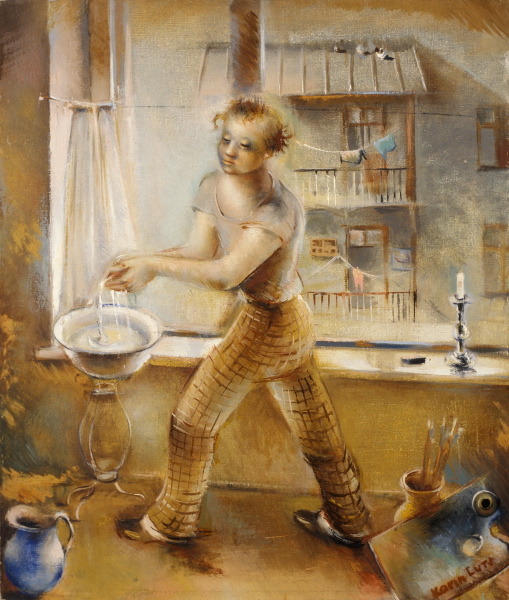
Karin Luts – The Artist (1937)

Gertrude Bohnert born 02-Apr 1908
Emilie Charmy born 02-Apr 1878
Stella Snead born 02-Apr 1910
Hermine Aichenegg born 03-Apr 1915
Francesca woodman born 03-Apr 1958
Constance Marie Charpentier born 04-Apr 1767
Ruth Smith born 05-Apr 1913
Leonora Carrington born 06-Apr 1917
Jeanne Hebuterne born 06-Apr 1898
Kata Kalivoda born 06-Apr 1877
Hilde Rubinstein born 07-Apr 1904
Lilly Steiner born 07-Apr 1884
Annemirl Bauer born 10-Apr 1939
Gunvor Gronvik born 10-Apr 1912
Frances Foy born 11-Apr 1890
Adélaïde Labille-Guiard born 11-Apr 1749
Maggie Laubser born 14-Apr 1886
Olga Boznanska born 15-Apr 1865
Elizabeth Catlett born 15-Apr 1915
Princess Elisabeth Vilma Lwoff-Parlaghy born 15-Apr 1863
Laura Alma-Tadema born 16-Apr 1852
Inji Efflatoun born 16-Apr 1924
Charlotte Salomon born 16-Apr 1917
Hermine David born 19-Apr 1886
Eva Gonzales born 19-Apr 1849
Dod Procter born 21-Apr 1890
Raquel Forner born 22-Apr 1902
Ottilie Roederstein born 22-Apr 1859
Lee Miller born 23-Apr 1907
Christine Bacheler Nisbet born 24-Apr 1902
Lyubov Popova born 24-Apr 1889
Bridget Riley born 24-Apr 1931
Mary Brandt (Perez) born 25-Apr 1917
Mela Muter born 26-Apr 1876
Doro Ording born 26-Apr 1901
Nathalie Kraemer born 28-Apr 1891
Else Fischer-Hansen born 29-Apr 1905
Mainie Jellett born 29-Apr 1897
Karin Luts born 29-Apr 1904
Ruth Meier born 29-Apr 1888
Juana Romani born 30-Apr 1867
Thea Schleusner born 30-Apr 1879
Joronn Sitje born 30-Apr 1897

MAY
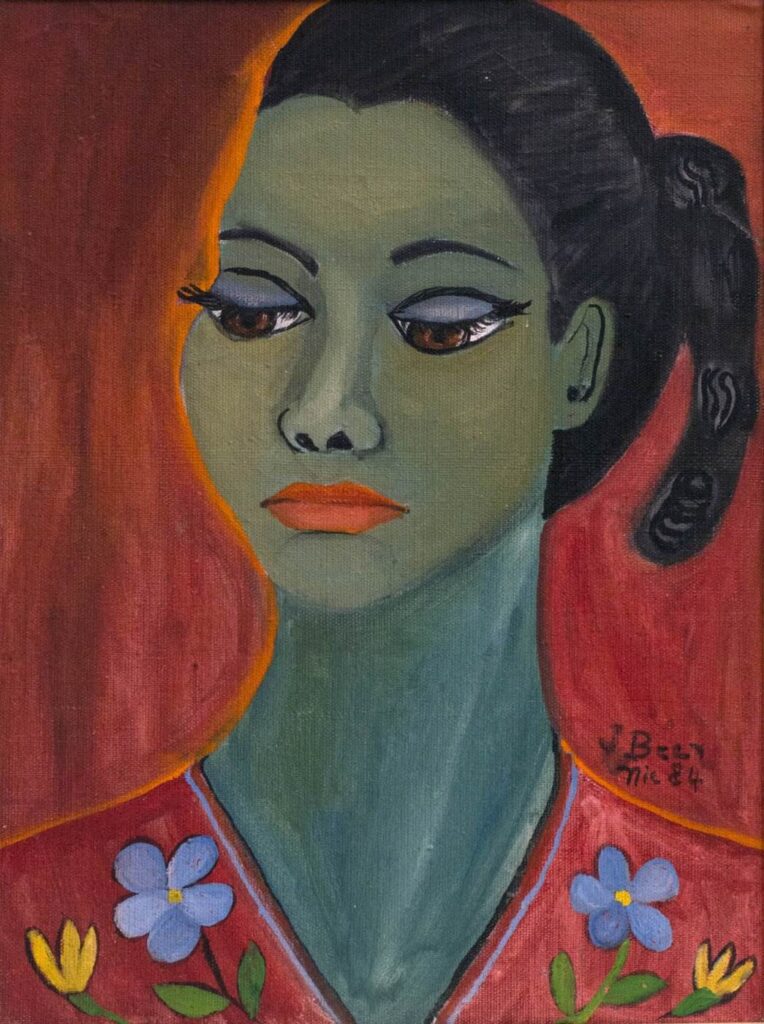
June Beer – Woman in Red (self portrait), 1984

Cecilia Beaux born 01-May 1855
Romaine Brooks born 01-May 1874
Elsa Thoresen born 01-May 1906
Eva Aeppli born 02-May 1925
Peggy Bacon born 02-May 1895
Chinwe Chukwuogo-Roy born 02-May 1952
Brigitte Fugmann born 03-May 1948
Stina Forssell born 03-May 1906
Geta Bratescu born 04-May 1926
Sylvia Pankhurst born 05-May 1882
Celeste Woss y Gil born 05-May 1891
Lucie Citti Ferreira born 06-May 1911
Suzy Freylinghuysen born 07-May 1911
Marion Gilmore born 07-May 1909
Dore Meyer-Vax born 08-May 1908
Felicita Pauluka born 08-May 1925
Paula Gans born 09-May 1883
Stanislawa de Karlowska born 09-May 1876
Hanna Klose-Greger born 09-May 1892
Grete Stern born 09-May 1904
Frida Konstantin born 10-May 1884
Helene von Taussig born 10-May 1879
Eva Schulze Knabe born 11-May 1907
Ilske Schwimmer born 11-May 1915
Monika Brachmann born 12-May 1944
Paula Lauenstein born 12-May 1898
Charlotte Wankel born 12-May 1888
Sara Afonso/Affonso born 13-May 1899
Louise Seidler born 15-May 1786
Stella Bowen born 16-May 1893
Tamara de Lempicka born 16-May 1898
Laura Wheeler Waring born 16-May 1887
Bele Bachem born 17-May 1916
June Beer born 17-May 1935
Martha Bernstein born 17-May 1874
Kati Horna born 19-May 1912
Clara von Rappard born 19-May 1857
Ellen Auerbach born 20-May 1906
Lily Furedi born 20-May 1896
Margret Hofheinz-Döring born 20-May 1910
Maria Hiller-Foell born 21-May 1880
Marisol Escobar born 22-May 1930
Erszebet Korb born 22-May 1889
Julia Diaz born 23-May 1917
Charlotte Berend-Corinth born 25-May 1880
Anita Magsaysay-Ho born 25-May 1914
Vally Wieselthier born 25-May 1895
Fanny Harlfinger-Zakucka born 26-May 1873
Amelie Lundahl born -May 1850
Heidi Vogel born 27-May 1951
Anna De Weert born 27-May 1867
Anna-Eva Bergman born 29-May 1909
Marlow Moss born 29-May 1889
Vanessa Bell born 30-May 1879
Audrey Flack born 30-May 1931
Magdalena Mira Mena born 30-May 1859
Carmen Herrera born 31-May 1915
Mireya Lafuente born 31-May 1905
Hilla von Rebay born 31-May 1890

JUNE
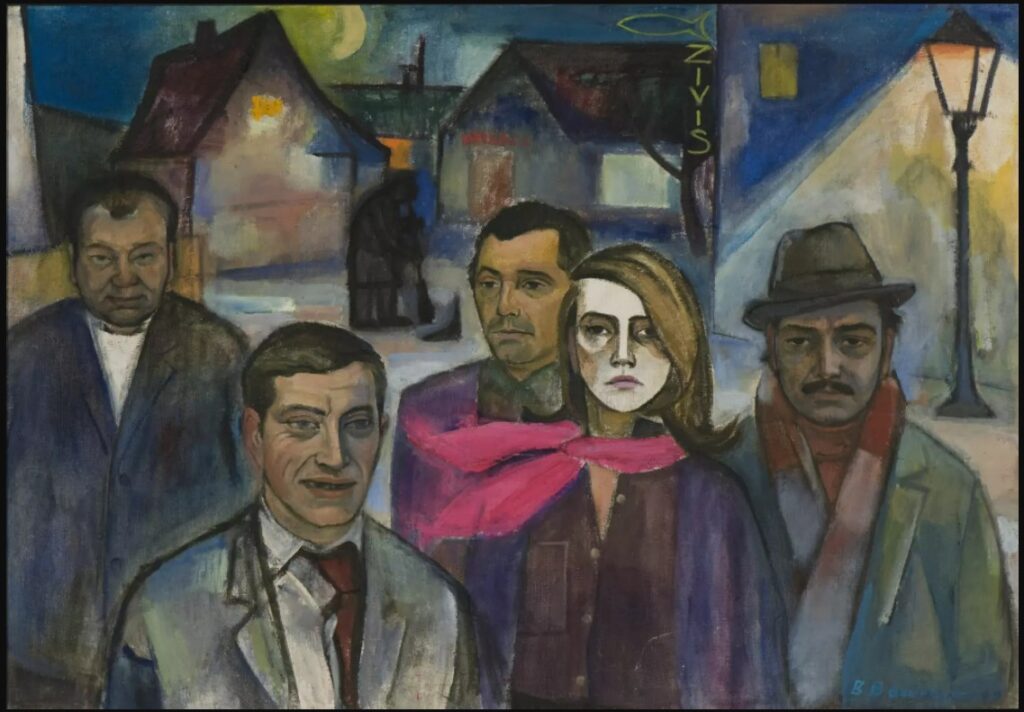
Biruta Baumane – Group Portrait (1969)

Vera Nilsson born 01-Jun 1888
Lotte B Prechner born 01-Jun 1877
Greta Gerell born 02-Jun 1898
Louise Amans born 05-Jun 1850
Winifred Knights born 05-Jun 1899
Biruta Baumane born 06-Jun 1922
Ricarda Jacobi born 07-Jun 1923
Laura Rodig born 07-Jun 1901
Alice Rahon born 08-Jun 1904
Montserrat Gudiol born 09-Jun 1933
Oda Krohg born 11-Jun 1860
Priscilla Warren Roberts born 13-Jun 1916
Pan Yuliang born 14-Jun 1895
Agnes Tait born 14-Jun 1894
Erna Lincke born 15-Jun 1899
Edith Meyer von Kamptz born 15-Jun 1884
Fritzi Brod born 16-Jun 1900
Henriette Browne born 16-Jun 1829
Irma Lang-Scheer born 17-Jun 1901
Margarete Kubicka born 20-Jun 1891
Emilia Bertole born 21-Jun 1896
Gwen John born 22-Jun 1876
Wangechi Mutu born 22-Jun 1972
Hilde Rakebrand born 22-Jun 1901
Olga Rozanowa born 22-Jun 1886
Madge Tennent born 22-Jun 1889
Lilo Raymond born 23-Jun 1922
Elena Shegal born 23-Jun 1924
Meraud Guinness born 24-Jun 1904
Helen Lundeberg born 24-Jun 1908
Alice Frey born 25-Jun 1895
Kay Sage born 25-Jun 1898
Vilma Eckl born 26-Jun 1892
Coba Ritsema born 26-Jun 1876
Helene Perdriat born 27-Jun 1889
Catherine Yarrow born 27-Jun 1904
Ali Goubitz born 28-Jun 1904
Florence Henri born 28-Jun 1893
Nan Youngman born 28-Jun 1906
Hannelore Neumann-Tachilzik born 29-Jun 1939

JULY
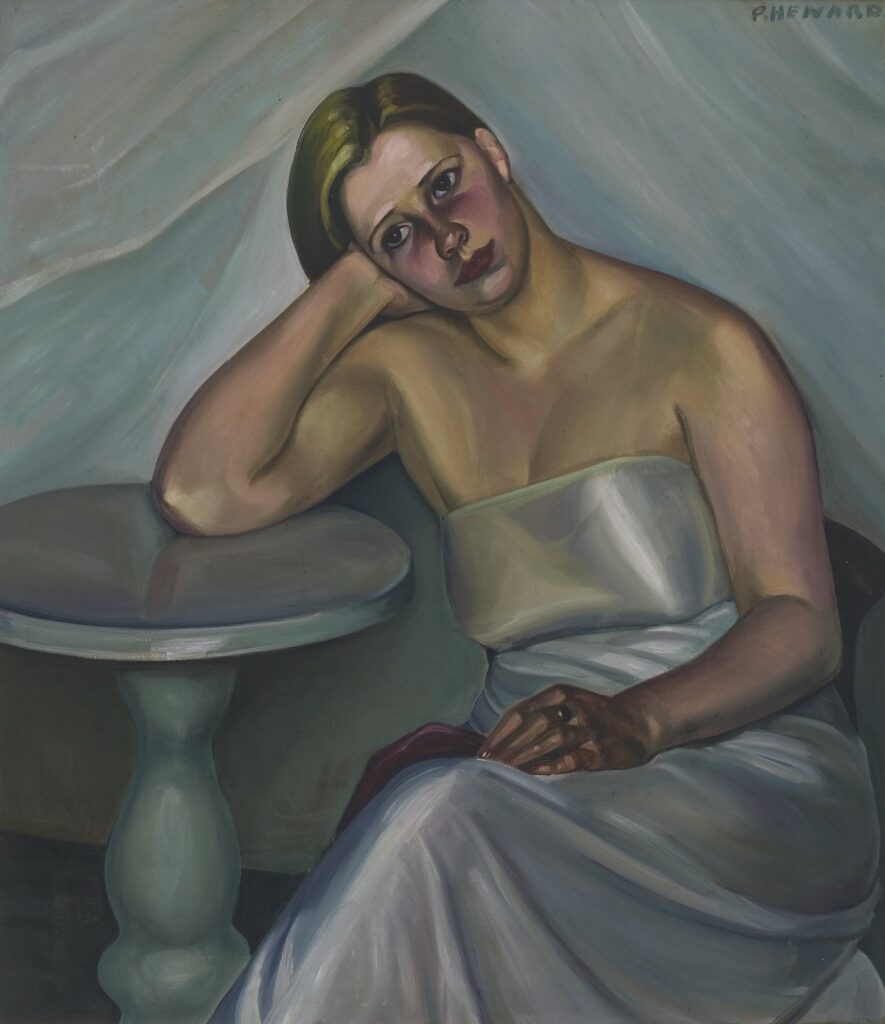
Prudence Heward – Portrait of an unknown Woman c.1920s

Herminia Arrate born 01-Jul 1896
Elizabeth Lochrie born 01-Jul 1890
Prudence Heward born 02-Jul 1896
Lydia Mei born 02-Jul 1896
Rahel Szalit-Marcus born 02-Jul 1894
Georgina Klitgaard born 03-Jul 1893
Petra Flemming born 06-Jul 1944
Frida Kahlo born 06-Jul 1907
Unica Zurn born 06-Jul 1916
Artemisia Gentileschi born 08-Jul 1593
Kathe Kollwitz born 08-Jul 1867
Carmen Mondragon (Nahui Olin) born 08-Jul 1894
Maria Tupper Hunneus born 09-Jul 1893
Helene Schjerfbeck born 10-Jul 1862
Luise Kornsand born 11-Jul 1876
Bertina Lopes born 11-Jul 1924
Ruth Starr Rose born 12-Jul 1887
Honore Desmond Sharrer born 12-Jul 1920
Helene Arnau born 13-Jul 1870
Alice Brasse-Forstmann born 13-Jul 1903
Elena Huerta Muzquiz born 15-Jul 1908
Giselle Kuster born 15-Jul 1911
Berenice Abbott born 17-Jul 1898
Marie Petiet born 20-Jul 1854
Marta Astfalck-Vietz born 21-Jul 1901
Greta Freist born 21-Jul 1904
Maral Rahmanzadeh born 23-Jul 1916
Anna Dorothea Therbusch born 23-Jul 1721
Wanda Wulz born 25-Jul 1903
Alba Calderon (de Gil) born 27-Jul 1908
Nelly van Doesburg born 27-Jul 1899
Sofia Bassi born 28-Jul 1913
Mathilda Rotkirch born 28-Jul 1813
Anna Stainer-Knittel born 28-Jul 1841
Grace Pailthorpe born 29-Jul 1883
Bettina Shaw-Lawrence born 29-Jul 1921
Friedl Dicker-Brandeis born 30-Jul 1898
Maria Szantho born 31-Jul 1897
Doris Zinkeisen born 31-Jul 1897

AUGUST
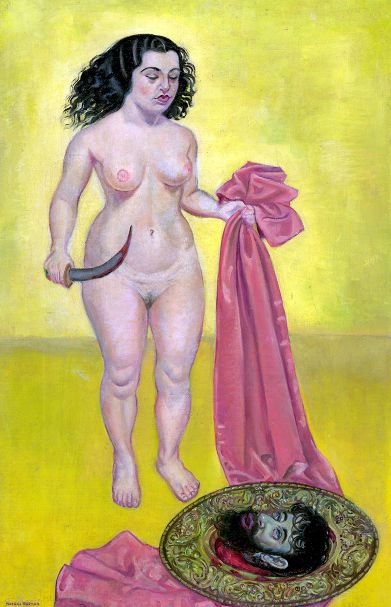
Macena Barton – Salome (1930s?)

Rachel Baes born 01-Aug 1912
Ida Gerhardi born 02-Aug 1862
Gretel Haas-Gerber born 02-Aug 1903
Maria Wiik born 03-Aug 1853
Laura Knight born 04-Aug 1877
Hedda Sterne born 04-Aug 1910
Edith Dettmann born 04-Aug 1898
Margit Graber born 05-Aug 1895
Irene Rice Pereira born 05-Aug 1902
Macena Barton born 07-Aug 1901
Maria Caspar-Filser born 07-Aug 1878
Lili Orszag born 08-Aug 1926
Tove Jansson born 09-Aug 1914
Eliane de Meuse born 09-Aug 1899
Cornelia Paczka-Wagner born 09-Aug 1864
Rogi Andre born 10-Aug 1900
Margret Bilger born 12-Aug 1904
Marianne Fieglhuber-Gutscher born 12-Aug 1889
Nola Hatterman born 12-Aug 1899
Ernestine von Kirchsberg born 12-Aug 1857
Helene Roth born 12-Aug 1887
Gluck (Hannah Gluckstein) born 13-Aug 1895
Xenia Cage born 15-Aug 1913
Marie Goth born 15-Aug 1887
Zsuzsi Robos born 15-Aug 1929
Tamara Natalie Madden born 16-Aug 1975
Käthe Ephraim Marcus born 16-Aug 1892
Gunnvor Advocaat born 17-Aug 1912
Gudrun Petersdorff born 17-Aug 1955
Anna Ancher born 18-Aug 1859
Kyra Markham born 18-Aug 1891
Florine Stettheimer born 19-Aug 1871
Lette Valeska born 20-Aug 1885
Hedwig Holtz-Sommer born 22-Aug 1901
Agnes Lawrence Pelton born 22-Aug 1881
Ebba Carstensen born 23-Aug 1885
Agnes Cleve born 23-Aug 1876
Hannah Frank born 23-Aug 1908
Mariette Lydis born 24-Aug 1887
Henriette Paula Häberlin born 25-Aug 1882
Dorothea Tanning born 25-Aug 1910
Fanny Rabel born 27-Aug 1922
Olga Costa born 28-Aug 1913
Else Lohmann born 29-Aug 1897
Sughra Rababi born 29-Aug 1922
Martha Schrag born 29-Aug 1870
Anna Zinkeisen born 29-Aug 1901
Siri Deckert born 30-Aug 1888
Leonor Fini born 30-Aug 1907
Amy Sherald born 30-Aug 1973
Ida Kerkovius born 31-Aug 1879

SEPTEMBER
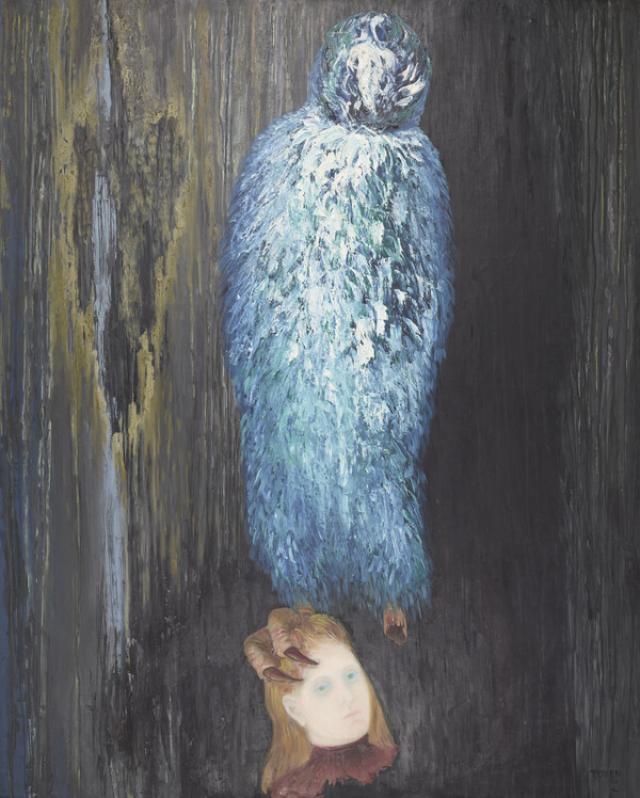
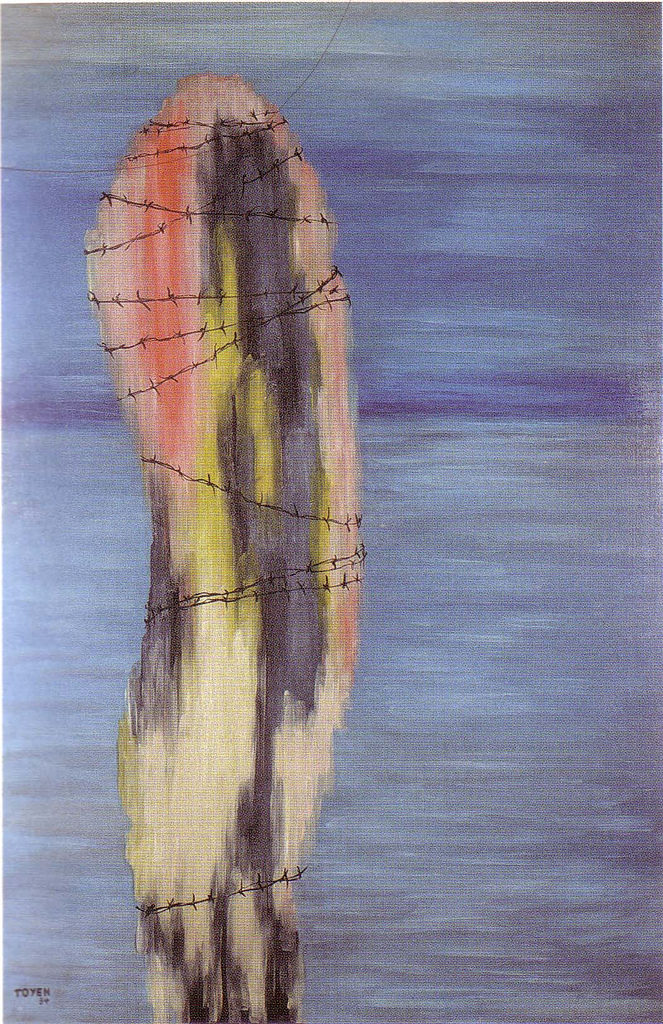
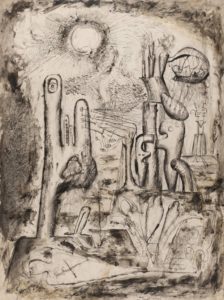
Toyen – The Message of the Forest (1936)

Adriana Bisi Fabbri born 01-Sep 1881
Mario Miguel Mollari 01-Sep 1930
Hilda Rix Nicholas born 01-Sep 1884
Augusta Roszmann born 01-Sep 1859
Mina Carlson-Bredberg born 02-Sep 1857
Else Meidner born 02-Sep 1901
Elin Danielson-Gambogi born 03-Sep 1861
Helene Funke born 03-Sep 1869
Lis Bertram-Ehmsen born 05-Sep 1897
Piti (Francis) Bartolozzi born 06-Sep 1908
Marie-Gabrielle Capet born 06-Sep 1761
Rosa Rolanda born 06-Sep 1896
Hanna Bekker vom Rath born 07-Sep 1893
Maria Lassnig born 08-Sep 1919
Mimi Parent born 08-Sep 1924
Anna Walinska born 08-Sep 1906
Aurora Reyes Flores born 09-Sep 1908
Consuelo Remedios González del Bianco born 10-Sep 1911
Marianne von Werefkin born 10-Sep 1860
Bona di Mandiargues born 12-Sep 1926
Nan Goldin born 12-Sep 1953
Lili Pancu born 13-Sep 1908
Eva Cederström born 15-Sep 1909
Hope Gangloff born 15-Sep 1974
Rosalie Gwathmey born 15-Sep 1908
Cordelia Urueta Sierra born 16-Sep 1908
Alla Horska born 18-Sep 1929
Maud Sulter born 19-Sep 1960
Hilda Belcher born 20-Sep 1881
Denise Bellon born 20-Sep 1902
Genevieve Springston Lynch born 20-Sep 1891
Else Hagen born 21-Sep 1914
Toyen born 21-Sep 1902
Anne Winterer born 21-Sep 1894
Hansl Bock born 22-Sep 1893
Irena Rüther-Rabinowicz born 22-Sep 1900
Esphyr Slobodkina born 22-Sep 1908
Suzanne Van Damme born 22-Sep 1901
Suzanne Valadon born 23-Sep 1865
Maina-Miriam Munsky born 24-Sep 1943
Tilsa Tsuchiya 24-Sep 1928
Marguerite Zorach born 25-Sep 1887
Suzi Gablik born 26-Sep 1934
Arcangela Paladini born 29-Sep 1596

OCTOBER
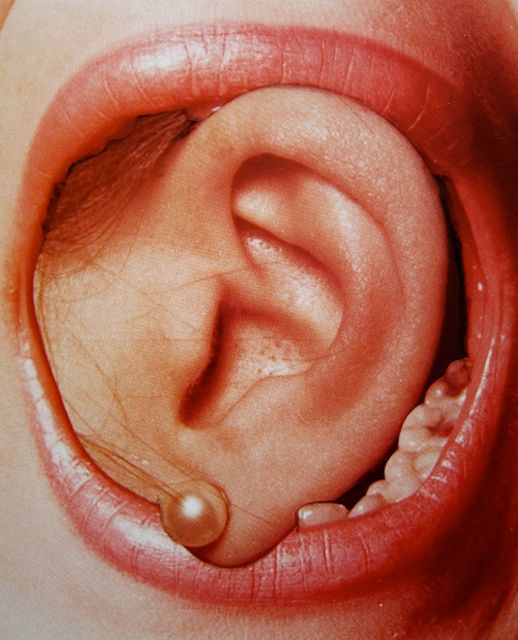
Penny Slinger – I Hear What You Say (1973)

Marianne Brandt born 01-Oct 1893
Alice Prin (Kiki de Montparnasse) born 02-Oct 1901
Elisabeth Sophie Cheron born 03-Oct 1648
Kathleen Walne born 03-Oct 1915
Ester Ellqvist born 04-Oct 1880
Ellen Thesleff born 05-Oct 1869
Graciela Aranis born 06-Oct 1908
Meret Oppenheim born 06-Oct 1913
Nina Arbore born 08-Oct 1889
Elise Ransonnet-Villez born 08-Oct 1843
Faith Ringgold born 08-Oct 1930
Louise Rösler born -Oct 1907
Ithell Colquhoun born 09-Oct 1906
Zelia Salgado born 10-Oct 1904
Linda Kogel born 11-Oct 1861
Grete Csaki-Copony born 12-Oct 1893
Paula Deppe born 12-Oct 1886
Nadezhda Petrovic born 12-Oct 1873
Ruth Bernhard born 14-Oct 1905
Vilma Vrbova born 14-Oct 1905
Minna Citron born 15-Oct 1896
Lilly Hildebrandt born 16-Oct 1887
Elisabeth Chaplin born 17-Oct 1890
Cata Dujšin-Ribar born 17-Oct 1897
Agnes van den Brandeler born 18-Oct 1918
Jeanne Mandello born 18-Oct 1907
Bettina von Arnim born 19-Oct 1940
Jacqueline Marval born 19-Oct 1866
Ottilie Reylaender born 19-Oct 1882
Else-Christie Kielland born 20-Oct 1903
Gustava Engels von Veith born 20-Oct 1879
Penny Slinger born 21-Oct 1947
Lygia Clark born 23-Oct 1920
Rina Lazo (Wasem) born 23-Oct 1923
Marie-Louise von Motesiczky born 24-Oct 1906
Claude Cahun born 25-Oct 1894
Katalin Ladik born 25-Oct 1942
Ruth Light Braun born 26-Oct 1906 2003 oa
Marthe Donas born 26-Oct 1885 1967 oa
Bep Rietveld born 26-Oct 1913 1999 oa
Blanche-Augustine Camus born 27-Oct 1884
Julie Hagen-Schwarz born 27-Oct 1824
Sigrid Hjerten born 27-Oct 1885
Mary Moser born 27-Oct 1744
Paraskeva Clark born 28-Oct 1898
Bertha Müller born 28-Oct 1848
Alice Lex-Nerlinger born 29-Oct 1893
Louise Abbema born 30-Oct 1853
Maria Izquierdo born 30-Oct 1902
Angelika Kauffmann born 30-Oct 1741
Erna Schmidt-Carroll born 30-Oct 1896
Marie-Laure de Noailles born 31-Oct 1902
Marie Laurencin born 31-Oct 1883
Jóhanna Kristín Yngvadóttir born 31-Oct 1953

NOVEMBER
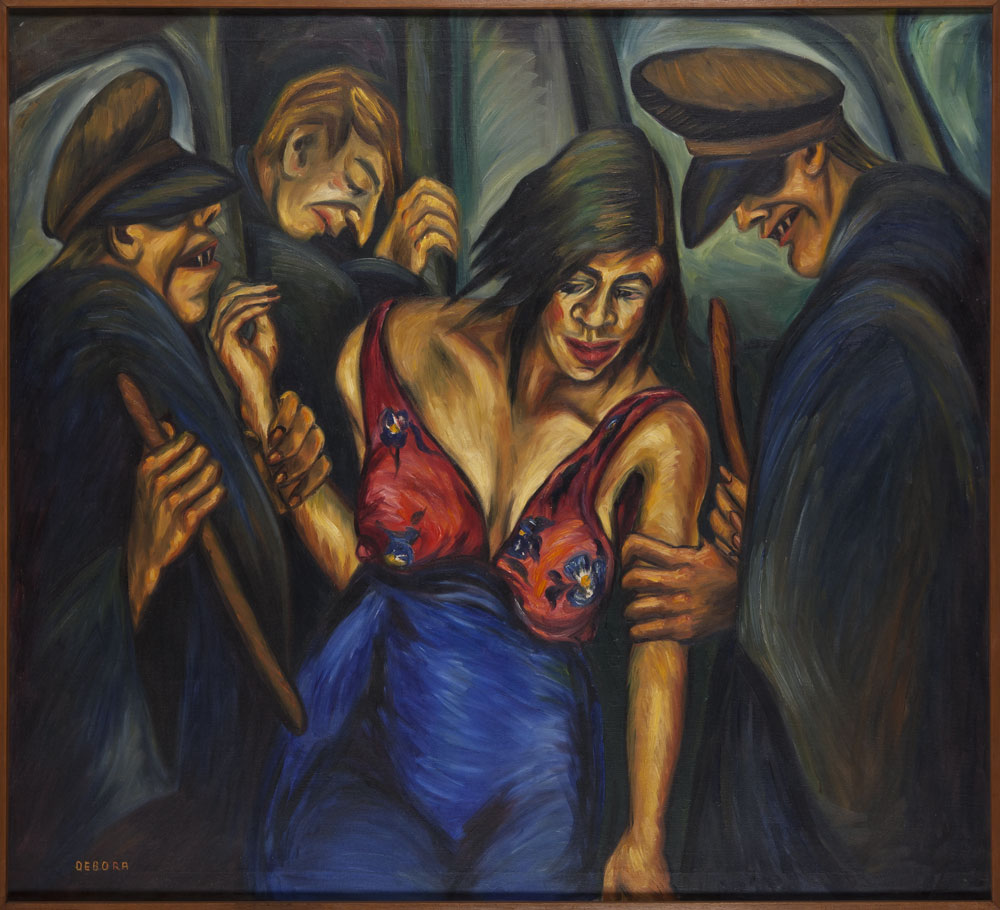
Débora Arango – Justice (c.1944)

Hannah Hoch born 01-Nov 1889
Hedwig Woermann born 01-Nov 1879
Venny Soldan-Brofeldt born 02-Nov 1863
Lois Mailou Jones born 03-Nov 1905
Lilias Torrance Newton born 03-Nov 1896
Charlotte Buresova born 04-Nov 1904
Elena Luksch-Makowsky born 04-Nov 1878
Milena Pavlovic-Barili born 05-Nov 1909
Ann Brockman born 06-Nov 1899
Elsa Haensgen-Dingkuhn born 07-Nov 1898
Sonja Kovačić – Tajčević born 07-Nov 1894
Angeles Santos Torroella born 07-Nov 1911
Elizabeth Sparhawk-Jones born 08-Nov 1885
Emmy Bridgwater born 10-Nov 1906 1999 oa
Lisette Model born 10-Nov 1901
Debora Arango born 11-Nov 1907
Carry Hess born 11-Nov 1889
Magda Langenstraß-Uhlig born 11-Nov 1888
Mary Kessell born 13-Nov 1914
Ekaterina Savova-Nenova born 13-Nov 1901
Sonia Delaunay born 14-Nov 1885
Julie Manet born 14-Nov 1878
Tina Blau born 15-Nov 1845
Miriam Schapiro born 15-Nov 1923
Elisa Counis born 16-Nov 1812
Katharina Sieverding born 16-Nov 1944
Louise Dahl-Wolfe born 19-Nov 1895
Lily Harmon born 19-Nov 1912
Marianne Breslauer born 20-Nov 1909
Angelika Hoerle born 20-Nov 1899
Germaine Krull born 20-Nov 1897
Elisabeth Jerichau-Baumann born 21-Nov 1819
Jeanne Mammen born 21-Nov 1890
Dora Maar born 22-Nov 1907
Bridget Bate Tichenor born 22-Nov 1917
Else Hertzer born 24-Nov 1884
Mary Foote born 25-Nov 1872
Sara Shamma born 26-Nov 1975
Audrey Buller born 27-Nov 1902
Gretchen Wohlwill born 27-Nov 1878
Mabel Alvarez born 28-Nov 1891
Hedwig Marquardt born 28-Nov 1884
Else Wex-Cleemann born 29-Nov 1890
Fridel Dethleffs-Edelmann born 30-Nov 1899

DECEMBER
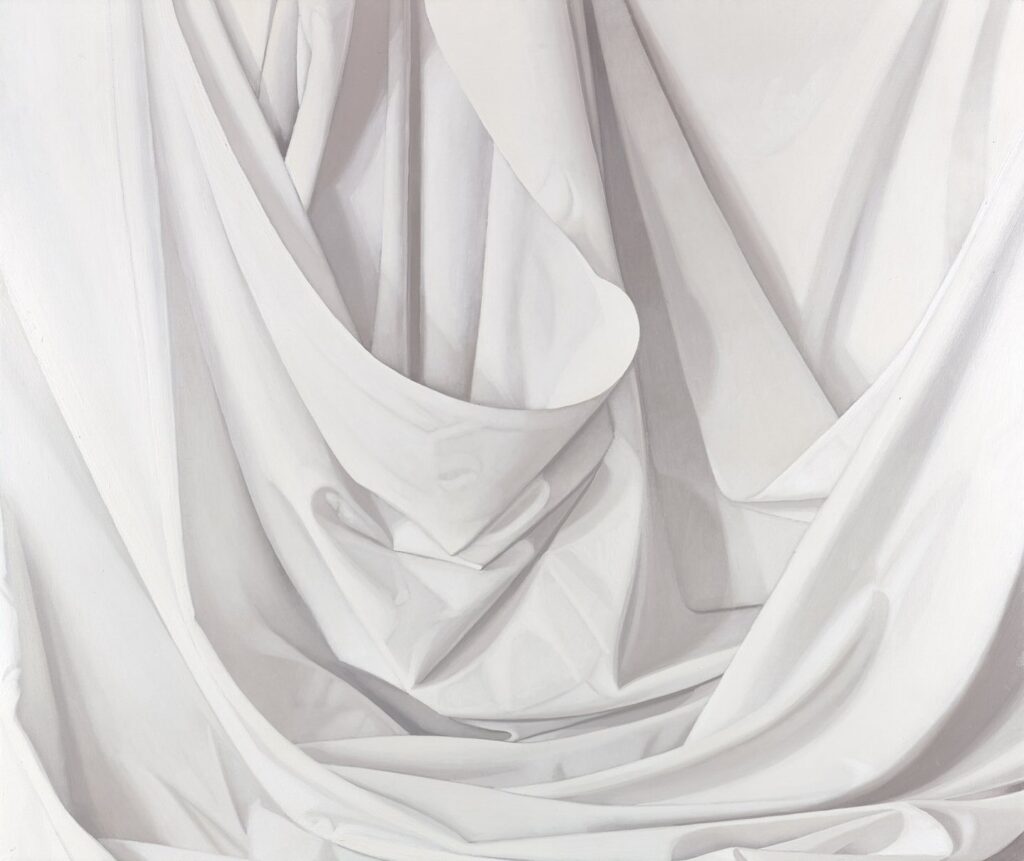
Alison Watt – Alabaster (1998)

Eileen Agar born 01-Dec 1899
Jenny Mucchi-Wiegemann born 01-Dec 1895
Emilie Mediz-Pelikan born 02-Dec 1861
Marion Adnams born 03-Dec 1898
Dorte Helm born 03-Dec 1898
Grace English born 04-Dec 1891
Elfriede Lohse-Wächtler born 04-Dec 1899
Louise Catherine Breslau born 06-Dec 1856
Margaret Brundage born 09-Dec 1900
Louise de Hem born 10-Dec 1866
Zinaida Serebriakova born 10-Dec 1884
Olga Terri born 10-Dec 1916
Irène Zurkinden born 11-Dec 1909
Alison Watt born 11-Dec 1965 alive
Ragnhild Keyser born 12-Dec 1889
Emily Carr born 13-Dec 1871
Alice Sommer born 13-Dec 1898
Aino Bach born 14-Dec 1901
Remedios Varo born 16-Dec 1908
Bertha Wegmann born 16-Dec 1846
Suze Robertson born 17-Dec 1855
Jane Graverol born 18-Dec 1905
Ewa Kierska born 18-Dec 1923
Lucie Cousturier born 19-Dec 1876
Therese Schwartze born 20-Dec 1851
Trude Fleischmann born 22-Dec 1895
Margit Anna born 23-Dec 1913
Luvena Buchanan Vysekal born 23-Dec 1873
Alma del Banco born 24-Dec 1862
Sigrid Maria Schauman born 24-Dec 1877
Dorothy Johnstone born 25-Dec 1892
Ragnhild Kaarbo born 26-Dec 1889
Stella Steyne born 26-Dec 1907
Augusta von Zitzewitz born 26-Dec 1880
Annott (Jacobi) born 27-Dec 1894
Aisha Galimbaeva born 29-Dec 1917
Adela ber Vukić born 30-Dec 1888
Lucile Blanch born 31-Dec 1895
Beatrice Mandelman born 31-Dec 1912
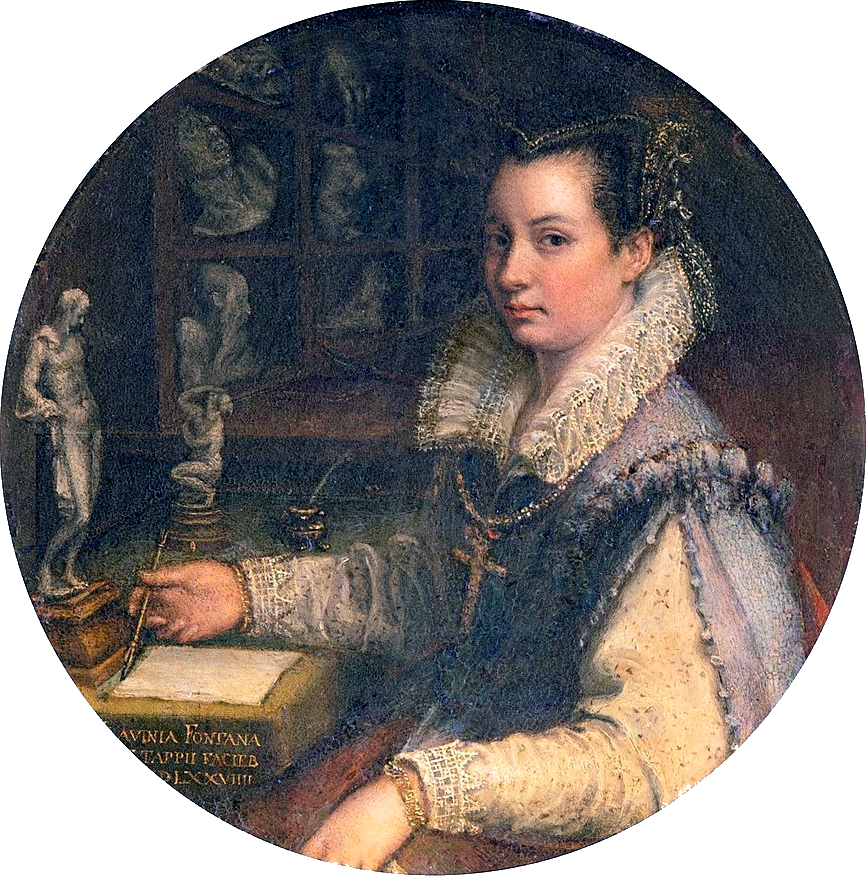
Self-Portrait in the Studio (1579), by Lavinia Fontana, generally considered to be the first professional female artist

bathroom blade runners – who polices the toilet police?

The prejudice against transgender people in the UK has, after years of furious lobbying, reached the level of a moral panic, and thanks to the pressure of the lobbyists (and perhaps even more, the money behind them) transphobia is now essentially written into British law. It feels like bad form to quote oneself, but four years ago I wrote “The unstated aim [of a moral panic] is the reiteration of a prevailing – often obsolete – orthodoxy … And coincidentally or not, whatever the panic happens to be about, it’s usually the same orthodoxy that is being reinforced and promoted.” That’s true here. The stated aim of the pressure groups – and now, the legislation – is to protect women, ostensibly from male violence, but not only does the law not do that, it actually reinforces the status quo, where crimes against women are often overlooked and always inadequately policed.

It’s a policy that doesn’t try to benefit anybody, not even those who have rabidly pursued it – but, indirectly it benefits the very group it purports to punish; male abusers of women.

Claude Cahun in 1928 – “Neuter is the only gender that always suits me”

At its core there’s a fundamental irony embedded into the moral panic about trans people. The heart of the issue is that there are people who simply don’t want trans people – primarily but not only, trans women – to exist at all. But in trying to wish trans people out of existence, what the transphobes are really doing is insisting on their presence, heightening it (and simultaneously using trans people as a way of defining their own “normal” identities too) and of course punishing them for their continued existence.

The idea of trans people just existing and being accepted as the people they are, obviously isn’t any kind of threat to society. But then, choosing an invisible ‘enemy within’ has always been the (essentially deflecting) agenda of paranoid reactionaries and is such a familiar trope that there’s really no need to list the atrocities these kinds of policies have led to throughout history. Under normal circumstances, the trans women and trans men vilified by activists and politicians are just women and men; the woman who works in your office, the man at the supermarket checkout, a teacher, a librarian, a lifeguard; you perhaps. But when looked at through the eyes of the paranoid bigot, that very unobtrusiveness becomes sinister; someone ‘posing as’ a lifeguard or ‘infiltrating’ a school to pursue their malevolent agenda.

The worst thing about a law that denies the identity of a group of people is, naturally, the impact it has on those people – but it also does nothing to address the problems it’s disingenuously put forward to solve. Male violence against women, wherever it happens, is a serious problem in British society. And yet at every stage – from early displays of ‘light-hearted’ misogyny and harassment among children and teenagers to actual physical assault – society and the law tend not to take it seriously, with the result that crimes are under-reported and under-prosecuted and punishments are often laughably mild. At the same time though, harassment and assault et cetera already are criminal offenses, and they don’t become any more criminal, or any better policed, by persecuting a minority group. In fact, the opposite is true, since the focus on trans women as potential aggressors takes the focus away from the people who are overwhelmingly, the perpetrators of violence against women – cisgender men. It’s essentially misogynistic and threatens the very safety of the women it pretends to protect.

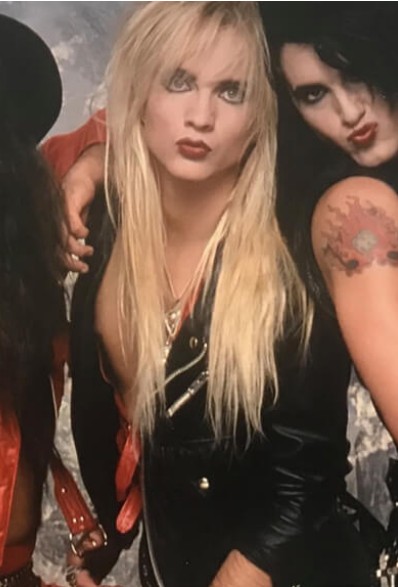
the late cis-gender, heterosexual musician Vinnie Chas in 1989 – which toilet should Vinnie have used?

It’s perhaps important to point out that the Supreme Court’s ruling states that the legal definition of a woman is based on biological sex at birth, so that only those born female are recognized as women under the Equality Act. It’s simplistic (human biology isn’t) and it doesn’t mention bathrooms at all. But the toilet is central to the ideology of ‘gender critical’ activists. Policing who uses which bathroom is a bizarre preoccupation of the anti-trans lobby, but it’s indicative of the generally perverse and in one sense unserious nature of their obsession with trans people. That being so, public toilets have ended up being a key battleground in the debate around trans rights in Britain.

The question of how ‘correct’ toilet usage is enforced throws up the immediate problem of who polices it and what the criteria are for using a gender-specific toilet. It’s not enough to say, as the Supreme Court ruling implies, that women’s bathrooms are for those who are biologically female from birth, because in many cases there’s no obvious way, short of an invasive genital inspection, of working that out – and there shouldn’t be. In any kind of free and democratic society, the way someone presents themselves, the way they dress, or the hairstyle and aesthetic they adopt – in short, their identity – is nobody else’s business unless they explicitly make it so, and setting up some kind of ‘toilet police’ can only increase the harassment of women, both trans and cis.

The kind of concern I expressed above often leads to accusations of hysteria, but just this week, the prominent anti-trans campaigner Maya Forstater explicitly said this: “Not being allowed into the mens by rule does not mean you have the right to go into the ladies. That may seem unfair, but these are life choices people make. If you make extreme efforts to look like a man, don’t be surprised if you are denied entrance to the ladies.” It’s hard to know where to start with this venomous nonsense. But for a start, what does “extreme efforts to look like a man” entail? What is ‘looking like a man’ anyway? Which man? These fools come across like Mary Whitehouse wringing her hands over Boy George’s appearance on Top of the Pops 40 years ago.

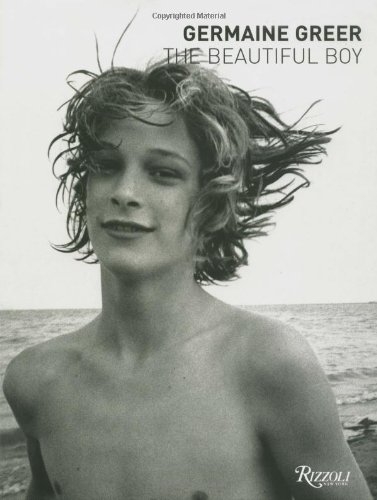
The Beautiful Boy (2003) by genuine TERF Germaine Greer; but is this boy manly enough to use the Gents?

For some women, regardless of their gender at birth or their sexual orientation, just having a short haircut or choosing to wear trousers is enough for some people to accuse them of looking like men, regardless of what their intentions were when choosing a haircut or getting dressed that morning. The idea of not being ‘allowed’ into one or other toilet surely also entails some kind of enforcement. There are so few public toilets in the UK with human attendants that presumably, existing bathroom staff can’t expected to take on the duty of somehow determining who is an acceptable ‘customer’, but someone will have to, if it’s not just empty rhetoric – which it may well be. It also creates a genuine possibility of toilet vigilantism, which sounds hilarious, until you really think about it. And what qualifies someone to be a toilet police officer or bathroom blade runner anyway? Is there a recognition test they need to pass? Will there be gender-determining questionnaires or apps, or inspections?

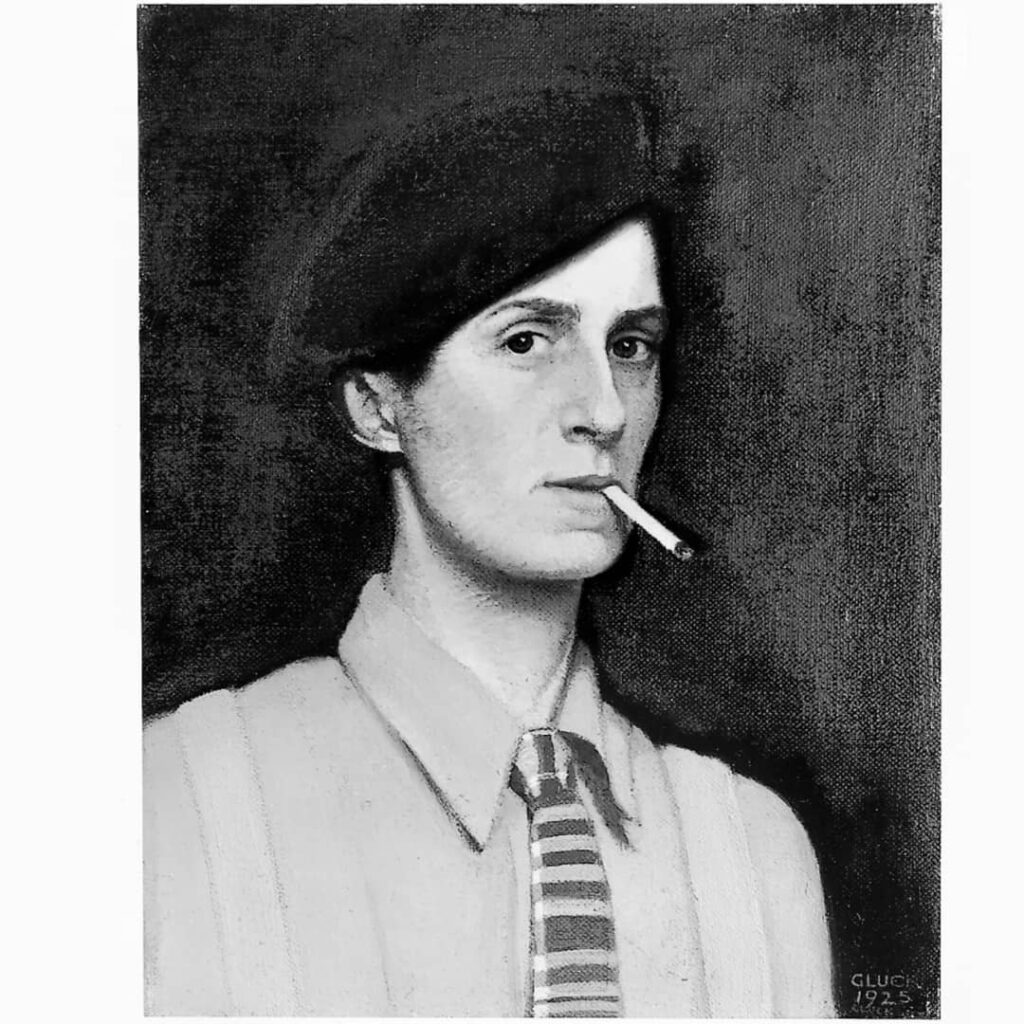
The British cis-gender, 100% female artist ‘Gluck’ (Hannah Gluckstein) a century ago in 1925 – which toilet should she have used?

Presumably until now there have been no laws dictating who can use which bathroom and yet, men (including trans men) tend to use the men’s and women (including trans women) tend to use the women’s, without any resulting fuss. Somebody who lurks in any bathroom with the intention of assaulting someone is already breaking, or planning to break the law and nothing about this legislation seems likely to deter those few people determined enough to do such a thing. What seems far more likely is that people innocently needing to use public toilets – and it’s not something most people do except in the direst need – will face some kind of additional unpleasantness, especially if their physique and appearance isn’t one that fits within a standard, traditional gender norm.

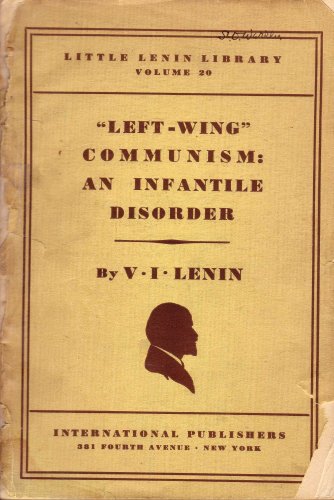
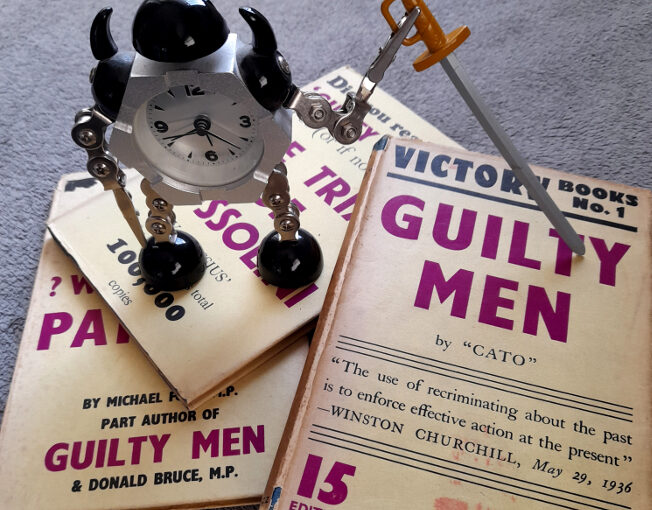
TERF (trans-exclusionary radical feminist) is a useful shorthand term for people like Forstater and JK Rowling, but it also gives them a validity that they don’t deserve, because difficult to see any kind of feminism, either radical or orthodox, in a policy that requires women to conform to a specific kind of approved appearance to be accepted in female-only spaces. I would like to be able to substitute the term ‘right-wingers’ for TERFs, but in fact this whole issue reinforces my growing feeling that the ‘left’ and ‘right’ binary is no longer useful when looking at political and cultural issues. I am definitely left-wing, but then so, one would hope, is the Communist Party of Britain, which publicly supports the Supreme Court’s ruling. But I shouldn’t be surprised, because the mistake I – and many people, it seems – make is assuming that communism is left-wing. If I really examine what I mean by ‘left-wing’ I find that the correct word would be the much abused and misunderstood one, ‘liberal.’ And, as no less than V.I. Lenin went to great pains to explain in 1920’s charmingly-titled pamphlet “Left-Wing” Communism: An Infantile Disorder, there’s nothing inherently liberal or democratic about communism. It’s easy to forget that, because left vs. right feels so logical, but history proves the point – if left-wing meant what people think it means, and communism was left-wing, then the Hitler-Stalin Pact would have been completely unthinkable. Whereas, looking at both Nazi Germany and Stalin’s USSR it seems not only logical but inevitable.

Uncle Vlad’s toxic 1920 pamphlet

Hitler and Stalin’s ideologies diverged in many, quite fundamental ways, but at heart, both were about power – who has it, and who is subject to it and can be coerced by it. And as citizens of the kind of society that wants to police who uses its toilets, we might want to consider that.

But even though an attack on the trans community is an attack on the freedom and individuality all of of us, and even with all of the serious issues and implications involved, from the corruptibility of British politicians to the possible dystopian outcomes for our society, the most important point by far is to remember that this is happening now, and that the explicit target is a small community that includes some of the UK’s most vulnerable people. It’s evil and it’s indefensible, but it’s not irreversible – so those who object should make their voices heard.

meted out to the man

Although Mr Musk’s*  recent statement about history’s most notorious dictators (“Stalin, Mao and Hitler didn’t murder millions of people. Their public sector workers did”) is – surely not unexpectedly – ignorant and abhorrent, he is making a serious point that’s worth remembering, even if his reasons for doing so come from a paranoid, (wouldn’t normally go straight for the WW2 analogy but he already did, so why not?) bunker-mentality sense of self-preservation.

Hitler was the main architect of the Holocaust and other Nazi atrocities – from murder to mental/physical torture to the indoctrination of children in a misanthropic ideology – and so he therefore bears the largest part of the moral responsibility for it. BUT, he genuinely wasn’t standing there in the streets of Warsaw or the hills of Ukraine, swinging small children by the legs and smashing them to death against walls or leading groups of half-starved prisoners into ravines and machine-gunning them, or even holding a gun to the heads of those who did those things to make sure they did it.

*nice innit? Sounds kind of like a fox from an old children’s book

Stalin’s policies led, both directly and indirectly to the death of millions, but he wasn’t personally there in the salt mines working people to death, or stabbing them in the head with ice-picks or torturing and shooting them because their vision of communism differed from his, or simply because they refused to agree with him.

Likewise, Mao Zedong instigated vast, dehumanising programs that decimated the people of his country through famine and starvation and led campaigns that ruthlessly wiped out political opponents – but he did it with words or with a pen, not with bullets or by actually snatching food from people’s mouths.

In all of those cases, those atrocities happened for two reasons; most importantly, because the instigators, Mao, Stalin and Hitler, wanted it; they just would not have happened without those three individuals and the world would be a different place. But they also happened because others, most of whose names are now unknown to us without a lot of tedious and depressing research, were willing to make it happen. The people who murdered and tortured did those things, some no doubt more enthusiastically than others, because they were paid to do so. Now, there are people ending international aid to starving children, or impeding Ukraine’s fight against the invading forces of Russia, or firing veterans or ‘just’ setting up armed cordons around car dealerships and arresting people that they or their superiors think, or are pretending for ideological reasons to think are dangerous aliens – and whatever the level of enthusiasm, they are essentially doing those things because they are being paid to.

Some of these people (it doesn’t matter which era or regime you apply this to, as bodycam and mobile phone footage testifies) perform additional cruelties which they aren’t specifically being paid for, and that their leaders may never even know about, just because they can and because it gratifies them in some way, while others are simply following the orders they are given.

But ‘just following orders’ – complicity, in a word – wasn’t considered a reasonable defence in the war trials of 1945 and it still isn’t one now. And the reptilian act of formulating and issuing dehumanising orders, even (or perhaps especially?) without personally committing any atrocities oneself isn’t any kind of defence at all. It was and should be part of any prosecution’s case for maximum culpability.

Leaders require followers and followers need leaders, but you don’t have to be either one.


2024 – welcome to the/a future(s)


Another year – and the actual name of the year itself gets ever stranger and more unlikely and exotically futuristic, if you grew up in the era when the film 2001: A Space Odyssey was still set in the future. And here’s the annual attempt to get something onto this site at the beginning of the year – just made it in the first week this time – and hopefully, to post more often. The goal is a minimum of once a month but I think goals are better than resolutions so that’s as far as I will go.

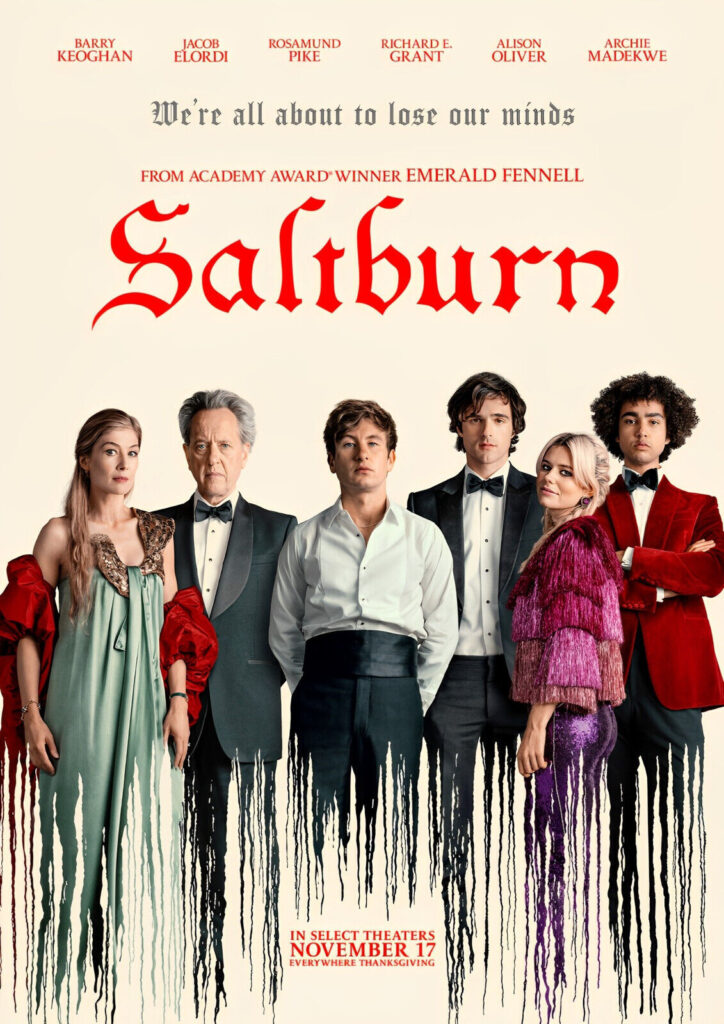
2023 was the usual mixed bag of things; I didn’t see any of the big movies of the year yet. I have watched half of Saltburn, which so far makes me think of the early books of Martin Amis, especially Dead Babies (1975) and Success (1978) – partly because I read them again after he died last year. They are both still good/nasty/funny, especially Success, but whereas I find that having no likeable characters in a book is one thing, and doesn’t stop the book from being entertaining, watching unlikeable characters in a film is different – more like spending time with actual unlikeable people, perhaps because – especially in a film like Saltburn – you can only guess at their motivations and inner life. So, the second half of Saltburn remains unwatched – but I liked it enough that I will watch it.
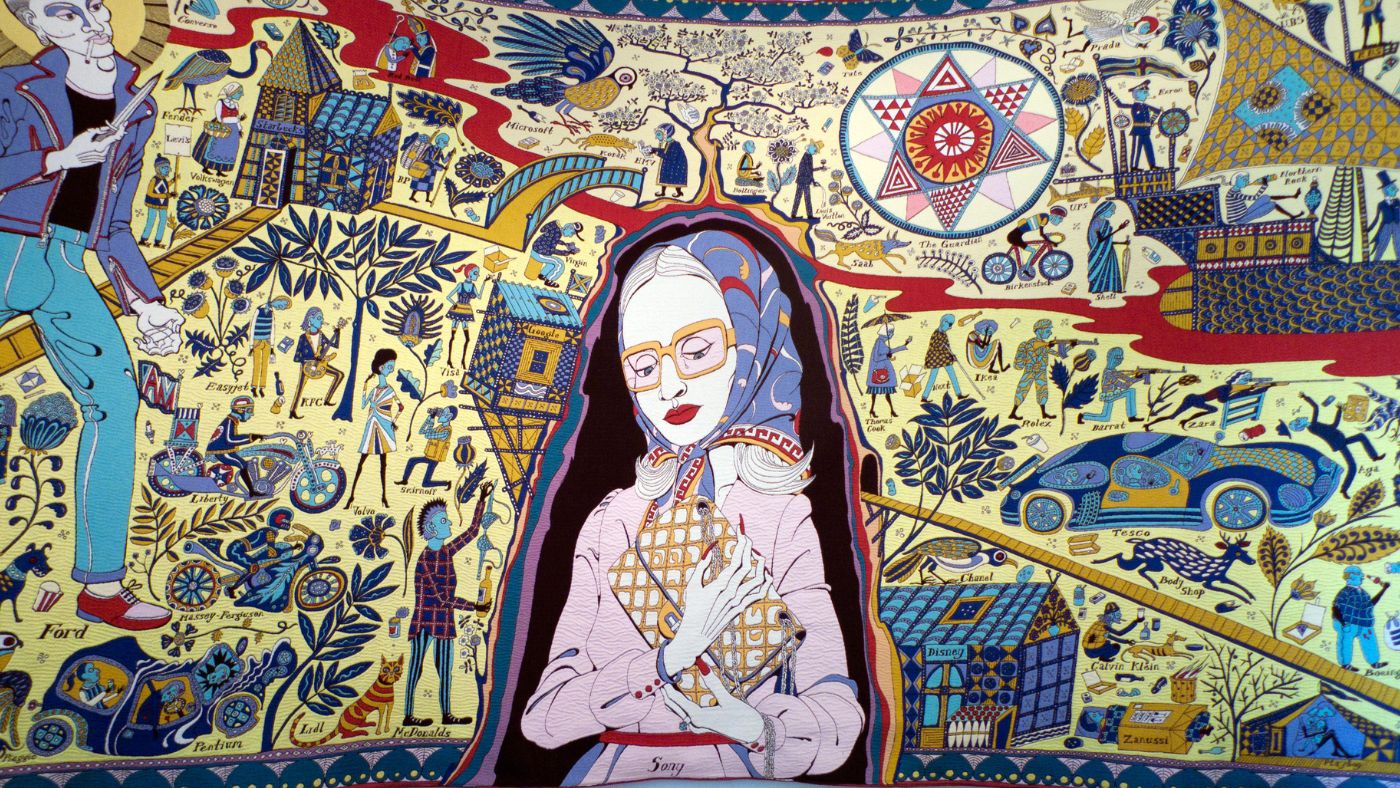
Grayson Perry – The Walthamstow Tapestry (detail)

I didn’t see many exhibitions last year but am very glad that I caught Grayson Perry’s Smash Hits in Edinburgh. I didn’t really plan to see it as assumed in advance I wouldn’t like it, but in fact I loved it and ended up having a new respect for GP that only partly evaporates whenever I see him on TV.

Kristin Hersh by Peter Mellekas

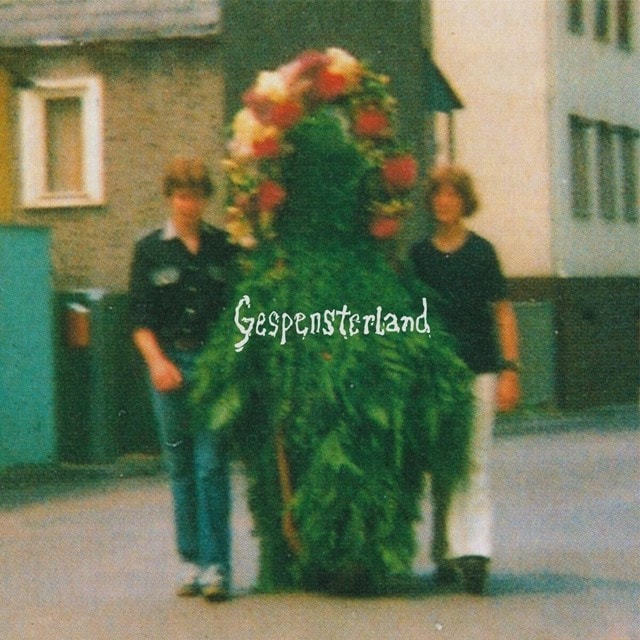
I can’t be bothered going in depth about my favourite music of the year because the year is over and I’ve written about most it elsewhere. Old teenage favourites came back strongly: Kristin Hersh’s superb run of albums continued with Clear Pond Road. I hadn’t thought a lot about Slowdive in years but I really liked Everything is Alive and was very pleased to see them get the kind of acclaim that mostly eluded them when I was buying their first album a million years ago. Teenage Fanclub’s Nothing Lasts Forever and Drop Nineteens’ Hard Light were good too, and The Girl is Crying in her Latte by Sparks was probably my favourite of theirs outside of their early 70s classics. There were some excellent black metal (or black metal-related) albums too; much as I don’t like to think of Immortal without Abbath, Demonaz did himself proud with War Against All. Niklas Kvarforth returned to form with the brilliant Shining and Skálmöld’s Ýdalir is as good as anything they’ve recorded. In less guitar-oriented genres, I loved Kid Koala’s Creatures of the Late Afternoon and the latest Czarface record but my favourite album of the year if I had to choose one was the loveably lo-fi and enigmatic compilation Gespensterland.

I read lots of good books in 2023 – I started keeping a list but forgot about it at some point – but the two that stand out in my memory as my favourites are both non-fiction. Lauren Elkin’s Art Monsters: Unruly Bodies in Feminist Art  is completely engrossing and full of exciting ways of really looking at pictures. I wrote at length about Elena Kostyuchenko’s I Love Russia here. Kostyuchenko introduced me to a country that I only knew via history and stereotypes and her book is an exercise in what good journalism should be – informative, interesting, compassionate and readable. Both of these books cut across a wide range of subjects and examine unfamiliar things but also analyse the familiar from unfamiliar points of view; you should read them, if you haven’t already.
 

It’s no great surprise to me that my favourite books of the year would be – like much of my favourite art – by women. Though I think the individual voice is crucial in all of the arts, individuals don’t grow in a vacuum and because female (and, more widely, non-male) voices and viewpoints have always been overlooked, excluded, marginalised and/or patronised, women and those outside of the standard, traditional male authority figures more generally, tend to have more interesting and insightful perspectives than the ‘industry standard’ artist or commentator does. The first time that thought really struck me was when I was a student, reading about Berlin Dada and finding that Hannah Höch was obviously a much more interesting and articulate artist than (though I love his work too) her partner Raoul Hausmann, but that Hausmann had always occupied a position of authority and a reputation as an innovator, where she had little-to-none. And the more you look the more you see examples of the same thing. In fact, because women occupied – and in many ways still occupy – more culturally precarious positions than men, that position informs their work – thinking for example of artists like Leonora Carrington, Kay Sage or – a bigger name now – Frida Kahlo – giving it layers of meaning inaccessible to – because unexperienced by – their male peers.
The fact that women know more about themselves but also more about men than men do – because they have always had to – gives their work an emotional and intellectual charge often missing from those who belong comfortably within a tradition. This is a pretty well-worn idea – it’s why outsiders like Van Gogh or dropouts like Gauguin’s work speaks to us more clearly than the academic, tradition-bound art that they grew up with. Anybody on the margins, in whatever sense, of “mainstream society” has to have a working knowledge of that society, just to exist. Society has far less need to understand or even notice those people. – therefore their points of view are likely to not only be more individual, but more acute when it comes to observing the world in which they live. Class, race, gender; all of these things are always fascinatingly central to art and art history and the gradual recognition of that fact is making art history ever more exciting and vibrant. For now at least; we live in a time of conservative backlashes which attempt to restore order to those with a comfortable position within yesterday’s world – there will probably be an art historical backlash at some point, and the reputations of the mainstream stars of art in Van Gogh and Gauguin’s day, like William-Adolphe Bouguereau will find their reputations restored.

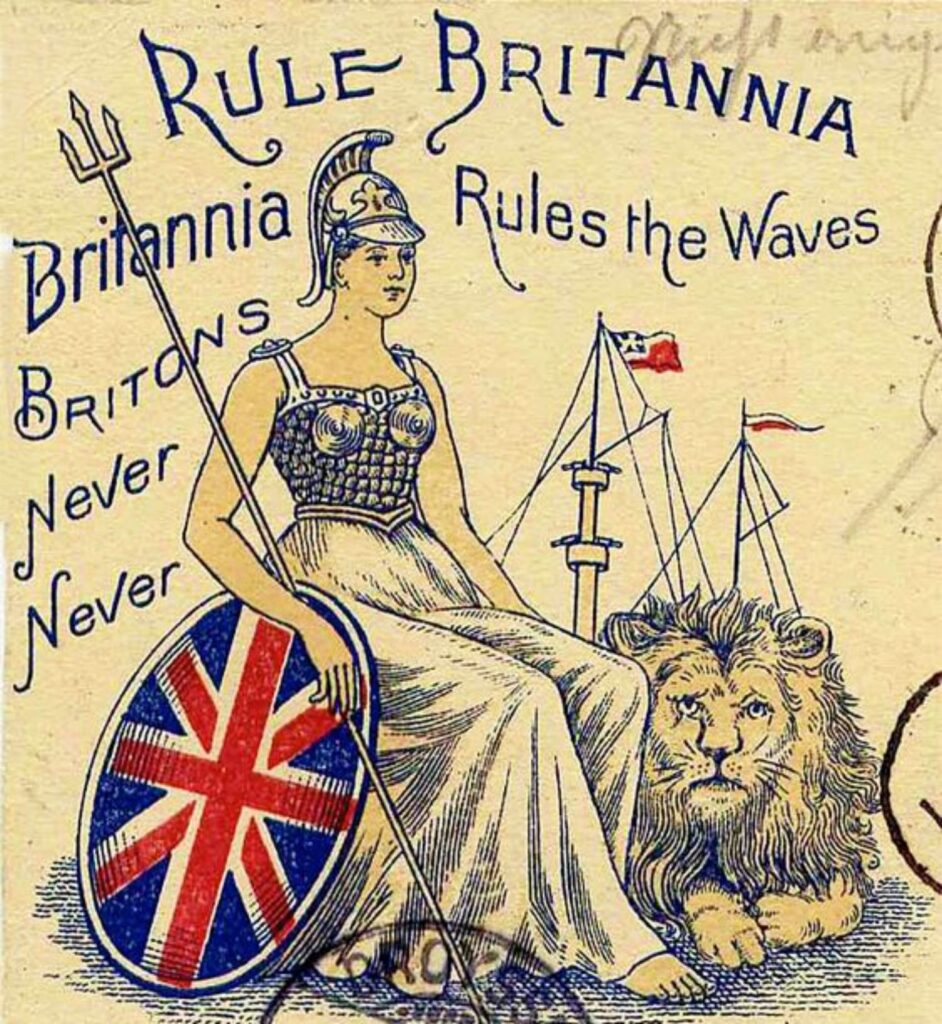
If that backlash comes, it will be from the academic equivalent of those figures who, in 2023 continued to dominate the cultural landscape. These are conservative (even if theoretically radical) people who pride themselves on their superior rational, unsentimental and “common sense” outlook, but whose views tend to have a surprising amount in common with some of the more wayward religious cults. Subscribing to shallowly Darwinist ideas, but only insofar as they reinforce one’s own prejudices and somehow never feeling the need to follow them to their logical conclusions is not new, but it’s very now. Underlying  ideas like the ‘survival of the fittest’, which then leads to the more malevolent idea of discouraging the “weak” in society by abolishing any kind of social structure that might support them is classic conservatism in an almost 19th century way, but somehow it’s not surprising to see these views gaining traction in the discourse of the apparently futuristic world of technology. In more that one way, these kinds of traditionalist, rigidly binary political and social philosophies work exactly like religious cults, with their apparently arbitrary cut off points for when it was that progress peaked/halted and civilisation turned bad. That point varies; but to believe things were once good but are now bad must always be problematic, because when, by any objective standards, was everything good, or were even most things good? For a certain class of British politician that point seems to have been World War Two, which kind of requires one to ignore actual World War Two. But the whole of history is infected by this kind of thinking – hence strange, disingenuous debates about how bad/how normal Empite, colonialism or slavery were; incidentially, you don’t even need to read the words of abolitionists or slaves themselves (though both would be good to read) to gain a perspective of whether or not slavery was  considered ‘normal’ or bad by the standards of the time. Just look at the lyrics to Britain’s most celebratory, triumphalist song of the 18th century, Rule Britannia. James Thomson didn’t write “Britons never, never, never shall be slaves; though there’s nothing inherently wrong with slavery.” They knew it was something shameful, something to be dreaded, even while celebrating it.
But anyways, the kind of avowedly forward-looking people we that are saddled with now, with their apparent concern for the future of the human species – especially the wellbeing of thus far non-existent future humans, as opposed to actual real living humans are, unlike the Amish, okay with progress, in the material sense of cars, computers, aircraft, spacecraft. But that only makes their core concern with traditional values and what is natural/unnatural even more nonsensical. If the defining thing about human beings is nature – men are like this, but not like that, women are like that, but not this; that nature dictates that compassion and medical science ate wasted on the weak and inferior, etc, then why draw the line at controlling gender and reproduction? Why get excited about the use of vaccines, or whether or not people “should” eat meat? If nature/”natural” really is the be all end all of human existence, why wear clothes, drive cars, cook food, use computers, build houses?  At what point does nature dictate what we do or can or should do? Isn’t everything humans do inherently natural because we have the capacity to do it and actually do do it?

Again, despite the supposed rationalism that fuels the superiority complexes of so many powerful people in whatever sector, their bullshit traditional ideas are dictated against – and always have been – by the lived experience of almost everyone in the world. If ‘real men’ are strong, rational and above all heterosexual, how come most of us will have met, throughout our lives, emotional, irrational men who can’t cope with pressure, who aren’t in control of themselves or their environment? How come homosexuality has existed since the beginning of recorded time and does not go away no matter how traditional or repressive society becomes or how much generation after generation insists that it is unnatural? If ‘real women’ are weak, gentle, sentimental, maternal, submissive and above all heterosexual, how come (etc, etc, etc, etc) Because of decadent western society? Well Western society is partly founded on the ideas of Ancient Greece, which though pretty misogynistic, famously did not have quite the same views on sexuality. And how come these people equally exist in every other society too? Could it be that traditional ideas of ‘human nature’ have nothing to do with actual nature but have always existed in western patriarchal societies simply to reinforce the status quo in the interests of those at the top of the hierarchical tree? From monarchies to oligarchies to modern democracies and communist states – all of which have their own ruling class, even when it is explicitly labelled otherwise – it’s been in the interest of those in charge to prevent anything which fundamentally changes the way things work.

For similar reasons, people in western society (perhaps elsewhere; I am no expert) who live unremarkable and mediocre lives within essentially complacent, and often apolitical circles are increasingly drawn to right rather than left wing extremism to gain prominence and (importantly) material success. Extremist views across the spectrum are entertainingly “edgy” and titillating to people who like to be entertained by controversy and/or shocked by outrageous behaviour, but right-wing views are far more acceptable within the media – and therefore are far more lucrative and rewarding – because they don’t threaten the financial basis that underpins the media and political structure.

So in short – only joking, this will be a long sentence (deep breath). If comedian or podcaster A) gains millions of followers who are excited about disruptive ideas that undermine the state by questioning the validity of the (sigh) mainstream media, by interrogating ideas of media ownership and the accumulation of wealth and power and so on, that represents a genuine threat to Rupert Murdoch, Viscount Rothermere, Meta and Elon Musk in a way that comedian or podcaster B), gaining millions of followers who lean towards ideas that disrupt society by attacking progressive, egalitarian or (sigh) “woke” culture does not. Regardless of the actual or avowed political beliefs of these media magnates, is comedian/podcaster A or comedian/podcaster B going to be the one they champion in order to tap into the zeitgeist (which media magnates have to do to survive)?

BUT ANYWAY, it would be nice to think that these things would be less central or at least more ignorable in 2024. It would also be nice if people in power could not enable the worst elements in society (where the two things are separable). It would be more than nice if the governments of the world would listen to people and end the butchering of helpless civilians. It’s important to remember that it is in the interests of governments – even relatively benign ones – that people in general feel powerless. But we’re not. If making resolutions works for you then make them, if not then don’t, if you have goals then aim for those and you may achieve something even if not everything you want to achieve. But if something is unacceptable to you, don’t accept it. You may have money, power, time or you may have little more than your own body and/or your own mind, but those are 100% yours and the most important things of all. Happy New Year and good luck!

a portrait of the author as a young arse

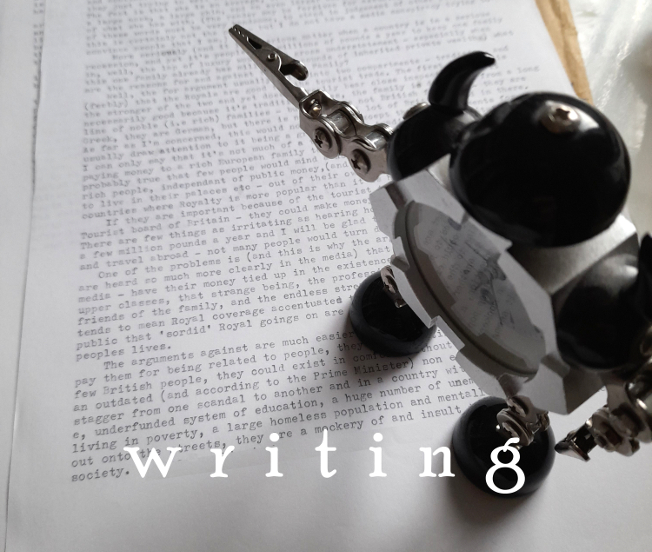
early attempts at writing (and drawing)

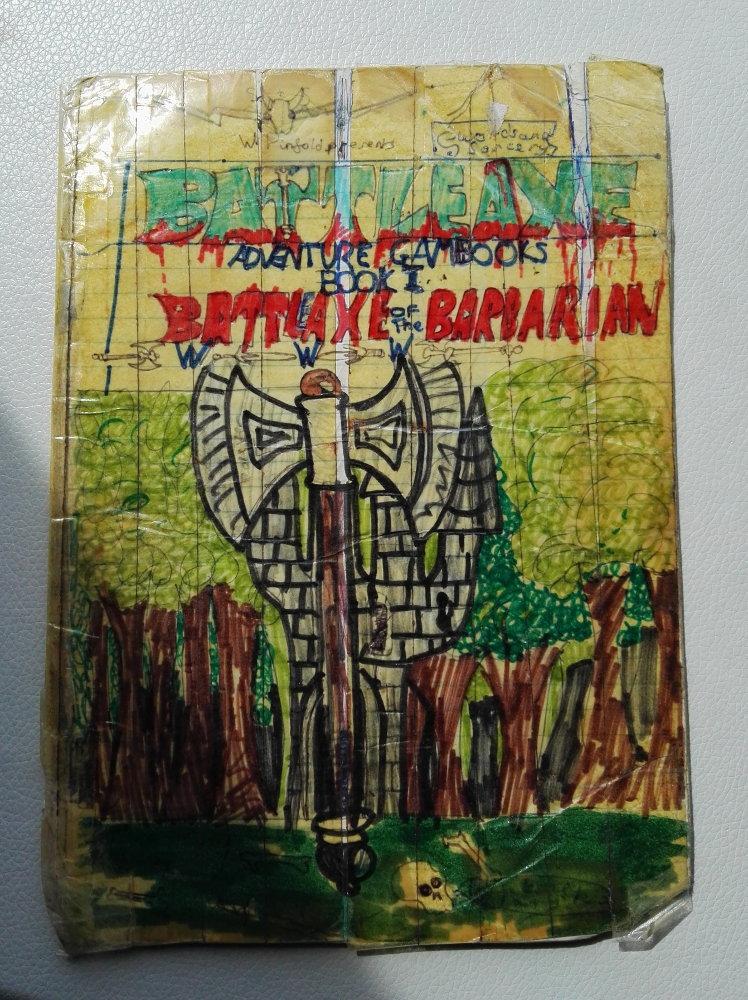
Between the ages of 19 and 21, I wrote a series of notes (the longest is about a page, so somewhere between a sketch and a mini-essay I guess) that made up a kind of summary of my worldview at the time. At this point I don’t remember why I wrote them, but I’m sure it wasn’t for its own sake; they were probably things that were to be “boiled down” and processed and incorporated somehow into poetry, strange though that sounds. From an early age, I always wanted to write. The first things I remember voluntarily writing apart from some comic strips are simplified versions of the kind of fantasy gamebooks that were then hugely popular with kids. The Swords & Sorcery series (more about that by one of the other authors of the series here) emulated Steve Jackson and Ian Livingstone’s hugely popular Fighting Fantasy single-player role-playing gamebooks pretty shamelessly but were lots of (complicated) fun to write, though few of them were actually finished. These were followed by (and/or written parallel to) various short horror stories, but in the long adolescence that seems to have lasted in my case from 15 until 25 or so, I mostly wrote poetry. It’s fair to say that it was not good. The notes though, are fun.

They cover a range of topics – politics, religion, aesthetics, social issues, ecology, the monarchy – and are exceptionally embarrassing to read. But interesting too, because although I do of course remember being 19-21, I otherwise only have the distorting mirror of my own memory to go by, and my own taste in music, books etc, which give a kind of connection to ur-me. But these notes must be pretty much what I thought, expressed to the best of my ability (or thereabouts). They reveal some interesting things I had not realised about my younger self. Although I generally did fairly well in English at school, I now see that my spelling was quite erratic (especially on words ending in -itely, which I always wanted to make -ately, like ‘definately’) and that I must not have learned the it’s/its rule until later. The pieces were typed on an actual typewriter as I didn’t own a computer at the time, which was not actually all that strange back then. More to the point though, by that age my always-terrible handwriting had deteriorated to the point where I found it hard to read things I had written after any length of time had lapsed.

The socio-political/geographical background to the notes was the bitter, tail end of the UK’s thousand year Tory Reich that I grew up in. Thatcher had by then gone, but the evolution/mutation into the Major era had made very little difference, except insofar as John Major himself was vastly inferior as a hate figure than Thatcher had been.

It’s funny; the arrogance and certainty of youth is well-known, but I’m still very surprised to find it in myself. I have rarely met anyone less sure of themselves or more reticent than my late-teens/early-20s self, but that doesn’t come across at all, except in a few deliberately self-deprecating caveats, and there’s an infuriating cockiness to some of the writing that I not only don’t identify with, but really hate; what’s mortifying is that I was genuinely trying to think deeply about the issues I covered so shallowly. Oh well, I hope I wasn’t actually that obnoxious in everyday life, but who knows? (anyone who knew me). On the other hand, my actual views don’t seem to have changed as much as I would have expected. I was more of a libertarian, albeit a left-wing one then, perhaps a bit more pessimistic, but on the whole I would still find myself on the same side of most of the arguments I am making, which is reassuring.
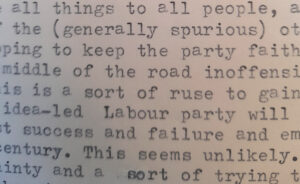
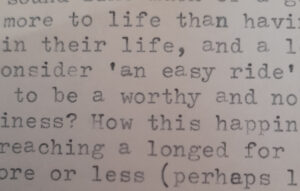
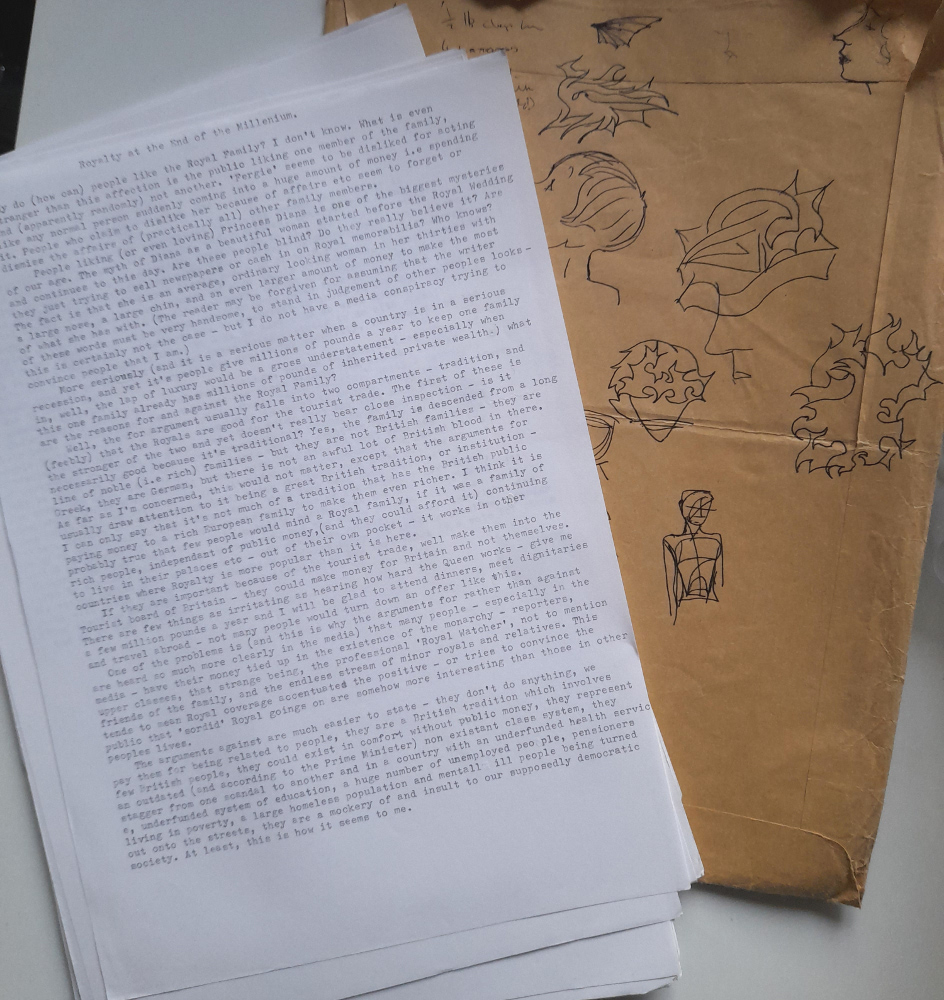
I don’t intend to transcribe very much of the writing here because I can’t bear to, mostly, but here’s a synopsis of the contents of the documents and there will be a couple of more extended examples below that illustrate how much/little/comically times have changed since then (the mid-1990s)

I don’t know if these were ever in any order, but here’s what I have:

“Classic Myths” – examining, in very little depth or detail, how things become “classics.” It ends with the question (re. literature) “how many great works have disappeared into the mists of time due to personal taste or political, religeous [sic] or moral qualms on the part of the academics of the past?” At this point I was reading the long out-of-fashion (and out of print) poetry of Robert Southey which was, to be honest mostly pretty hard going – but I was determined to like his early, pro-revolutionary work from his ‘Pantisocracy’ days with Coleridge, and I did, when I could find it anywhere.

“The Eye of the Beholder – One” This was me complaining about how Hollywood/popular culture/fashion were making standards of beauty ever more bland in a diminishing returns/vicious circle kind of way. Its exceptionally snooty tone was coloured by the fact that I was discovering the movies of the silent and pre-Hays code era and my own personal objects of desire were people like Louise Brooks, Joan Blondell and Marlene Dietrich. Sample of tone: “Sadly this means that when a certain actor or actress is in a hit film, similar actors and actresses will appear in similar films and so on and on, to ever-diminishing effect, until a new trend (snowboarding and dark hair, perhaps) transforms the screen for a few months or weeks(…) this ever-growing supply and demand for something familiar makes it hard for original voices to be heard, or any kind of innovation or talent to gain an audience.😬


“Religion Crazy” – This is pretty much what you’d expect from an atheist teenager, full of such blinding revelations as “Religion has often looked to me like a cunning scheme invented by some ancient tyrant to keep the peasants in their place” and, even better, “intolerance of religion and the religious is a vice I magnanimously allow myself to indulge in.” My own lack of belief hasn’t changed in the slightest since the days when I used to look around the room during the morning recitation of the Lord’s Prayer at Primary School, to see who else had their eyes open. But I though I don’t necessarily disagree with him (and actually am him), I don’t really feel much kinship with the writer of these lines, or especially his tone, now: “Am I to believe in a petty, small-minded god who creates something only to punish and destroy it? Maybe in a bored or indifferent god, as is suggested by its (had to correct it, sorry) conspicuous absence in the last few centuries. Perhaps it is more interested in ants than people, and appears to them all the the time.

“Sexuality and Children” Luckily I was aware even then that this was an alarming and “rather dodgy” title, but essentially it was about the debate then ongoing about gay parents adopting children. My attitude (as with many of my then-attitudes) was essentially a slightly shaky but very teenage libertarian one: who is entitled to tell other adults how to live their lives? “Aside from (fairly ridiculous) superstitious quibbles which can be disregarded at once, (by me anyway) there is no reason on Earth why it is the business of any but those directly involved.” I still think the same thing, more or less but again the tone is, to be kind, insufferably annoying.


“Not Winning isn’t Losing” – politics, kind of. Contains nuggets like “My ideal political situation is unworkable (…) (it) amounts to well behaved anarchy.” But again, I still believe parts of it, despite painfully naive bits, like “The impossibility of a left-wing political ideal does not mean it is hopeless – indeed the opposite is true. Because it can never be attained, there would always be a working towards it – the lack of destination would improve the journey. The effect of a constant working towards a state of freedom and equality would inevitably lead to and ever-improving state of more freedom and more equality – which can not be bad.

“Books” – this is funny, so I’ll write about it in more depth later


“Power Crazed”  This is one single line, which I hope isn’t true: “There can never be a good Prime Minister, because Prime Ministers are people whose ambition is to rule the country.

“Limits” – an excruciating piece about nationalism/patriotism and so forth, in which our author pompously concludes “As far as I’m concerned, I find it absolutely impossible to feel either proud or ashamed of anything that occurred completely beyond my control – race, sex (I guess I meant as in gender), sexuality – or where I was born.”

“Money” – a blindingly obvious revelation that the idea of money is, when you look at it, kind of silly. “Why is gold a valuable metal? Presumably because it looks nicer than other metals, and there is less of it.” etc, etc


“Tripping on the Catwalk” In which I make my ignorance about the fashion industry obvious, and which includes the bizarre statement that “its nearest relative is perhaps the academic world of the university. It is completely self supporting, untouched by recession, mainly due to the fact that it is run by bored rich people for bored rich people.” I am now fairly sure that this isn’t 100% true. I also predicted “an eighties-style big shoulders revival (though with a nineties twist of course) before the turn of the millennium.” I don’t remember if that happened or not, but it’s happened since then.

“Royalty at the End of the Millennium” – Oddly, this is one of the longer pieces. As it’s as topical in the new reign of Charles III as it was then (?) I’ll deal with it later

“Part(l)y Politics One” Despite the parenthetical ‘l’ this is pretty much about party politics. In short; the Conservative Party is contemptible (“I have to assume some right-wingers are intelligent, though I have seen little evidence of this”). But I also seem to be saying that because conservatism is based on the fear of change and the desire for stability, plus an array of standard human failings; ignorance, fear, confusion, greed etc, it will always appeal to a large part of the population.

I theorise, not entirely inaccurately, about a pattern that I hadn’t then seen in action and which I later saw parts of in action – because Conservative governments appeal to the worst in people, they REALLY have to mess up before they get voted out. So therefore, any prospective left-wing government will spend a good deal of time un-wrecking the country, with consequent hardships. The public and opposition will naturally blame those in charge for those hardships, the problem then becomes that a progressive party gets voted out, but the incumbent right wing party inherits a country on the mend, which they take credit for, before ruining everything again. That’s not exactly how Tories – Labour – Tories played out in our time but it still feels plausible and at least not untrue.

“interlude” – between the two “Part(l)y Politics” pieces there’s a short kind of non sequitur in which I claim that the politics of the left, taken to their furthest extreme (i.e. ideologically, rather than in real life) is “a nice, if unworkable idea based on equality and human rights” while the politics of the right taken to their furthest extreme is ”at best an extremely nasty and distressingly workable idea based on hatred, repression and manipulation.” Not sure I agree with either of those statements now, though I think my heart was in the right place.

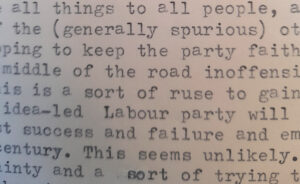
“Part(l)y Politics Two”in which I complain that the Labour Party (and by extension any party of “the workers” is hopelessly compromised by a system in which becoming an MP is an ordinary middle class career choice, rather than being a kind of glorified shop steward. This was the Neil Kinnock/John Smith/Margaret Beckett era and I complain about the same thing that every Labour-voter-by-default has complained about ever since: that Labour in opposition try too hard to be all things to all people, appeal to Tory voters, are middle-of-the-road and inoffensive rather than truly progressive etc. It’s all very pessimistic: “We can only hope that this [middle-of-the-road inoffensiveness] is a sort of ruse to gain power, whereupon the new and hopefully forceful, idea-led Labour Party will throw off its current greyness, the spectre of past success and failure and emerge as a strong socialist party for the twenty-first century (…) The conservatives ‘accuse’ the Labour Party of being the same old socialist party underneath. This seems sadly unlikely – we understand socialism to be a system based on fairer distribution of wealth and of equality etc etc – the Labour Party does not seem to be offering this. We will vote for them, because there is no one else to vote for.

“Opposites Attract” – this is a self-pitying whine about how “the plain or ugly are naturally attracted to the good looking, the handsome, the beautiful. The good looking, the handsome and the beautiful are naturally attracted to the good looking, the handsome, the beautiful. Beauty is in the eye of the beholder, but few beholders’ eyes will want to linger very long on the truly unattractive person.” I actually wrote this stuff down.

“Inhumanity” Here it is: “’Man’s inhumanity to man’ is a phrase used to describe acts which are definingly human. What other species would (or could) have had the atomic bomb, or the holocaust? It is a deceptive and cowardly phrase.” Well alright then.

“Food Philistine” – A strange and very silly short piece in which I discover that my attitude to food (though I had “no aversion to it”) was “the same as my attitude to sleep – if I could do without it, I would.” I don’t feel that way about either food or sleep now, really and until now I didn’t realise I had ever felt that way.

“Money, money, money” In short, class = wealth. The problem with Britain is (I seem to be saying) that the upper class control the wealth of the working class while the complacent middle class are indifferent as long as they are comfortable & therefore provide the upper class with a comfortable mattress to insulate them from the should-be-revolutionary consequences of their greed. It may be true?

“The Eye of the Beholder Two” – this time it’s all about how I prefer brutalist architecture to old churches etc and prefer the “drab emptiness” of municipal parks, deserted backstreets etc to epic, panoramic landscapes. Nowadays I like all of those things.

“Responsibility” A “pro choice” rant that, I’m glad but surprised to say, reads exactly like the social media posts of ‘pro choice’ people in the last few years – it begins “The anti-abortion lobby, for all their rhetoric about the sanctity of human life, seem to disregard entirely (and with great relish) the quality of human life. Indeed, they seem to enjoy inflicting misery wherever they go.” And it ends with the even more 2020s-ish: “To the anti-abortionist, the human being is only a human being until it is born. After that it is not their problem.” I was right then and still am now: yay me.

“Censored” In which I get on my high horse about the right to watch violent horror movies: “When I hear that a member of the British Board of Film Classification has embarked on an orgy of violence and mayhem using a chainsaw, I will begin to believe that film violence has an effect on the viewer (if it happens twice.)” I DO think it has an effect on the viewer – actually, I hope it does, or why even bother? Disturbing things should be disturbing. But my views on censorship (if no harm is done in the making of it then who has the right to say an adult shouldn’t watch it) are pretty much the same. I probably believe in ‘classification’ and parental responsibility more now than I did then though.

“A Fair Day’s Pay…” Manual workers should be at the top of the pay pyramid as their work is harder and more necessary, but pen pushers are in charge of wages etc so it’ll never happen, he seems to be saying.

“Animals” A very dubious piece in which I query the relative value of human beings and other animals, slightly in favour of other animals, or at least not in favour of us humans.

“Power Corrupts – Small time” Power corrupts – this is an indisputable fact,” I say – but is it? Anyway, my premise is that dictators are bad and all, but for really corrupt power you have to look at school teachers and small-town police officers.

“Grown Men and Women” – Me, moaning about sport

“How to Spoke Proper” – In short,“speaking properly” (in the UK sense) is a classist fantasy based on the random fact that the BBC happened to be founded in the south of England. This may or may not be true.

“Rules of Attraction” – “Sexuality has nothing to do with morality,” he says, “I am attracted to members of the opposite sex because I was born this way – so if I saw a member of my own sex who looked like a member of the opposite sex in a way that I found attractive, I would naturally be attracted to them, for as long as they looked like an attractive female. I do not see how there can be anything wrong with this, or any variation of it.” This sounds like an argument with some lurking real-life subtext, but to the best of my knowledge now, it wasn’t.

“The Sea” – it’s about the sea, which I apparently felt very strongly about. I still love the sea but can’t imagine writing very emotionally about it.

“Philosophy”As an atheist is there any more logical philosophy than to live a life of pure hedonism? I seem to conclude not, but for me at the time this was a purely hypothetical question

“Against Nature” –  Here it is in full: “Humankind is natural, as much a part of nature as anything else on the planet. Everything humankind does is natural. The worst it can do (selfishly speaking) is to kill itself off, which in a universal sense, would be no big loss.” I was in some ways a very standard teenager I guess. Joy Division was probably my favourite band at that point

So, here are the more extended bits.

>Firstly, I’ve chosen “Books” because it is the one that most amusingly makes the 1990s seem like it was a million years ago. My main argument is that though people were (as they always seem to have been) predicting the death of the printed word, books are unlikely to be replaced by anything else. But let young Will explain it, as his Nostradamus-like powers of prediction don’t seem to have anticipated the Kindle. More strangely, he does not seem to be aware of laptops, didn’t they already exist in the mid-90s? Surely! To be fair to him though, “we” still prefer a book to a kindle or tablet which I can’t stand using unless it’s the only way to read something.

Anyway, the death of books will not happen, he says, because…
They are convenient, we [he often calls himself ‘we’] cannot imagine taking even a small computer on a train or plane, or to the beach or on holiday in our suitcase – though this may be possible in the future. We like to go back a page and reread something, whilst[!] keeping our place on the page we have reached. We like the thought, whether we actually do it or not, of being able to read Wordsworth in the mountains of the Lake District – we feel that a keyboard and a screen would take away a rather large part of the romance of this.”

Royalty at the End of the Millennium” is fun because it’s surprisingly still topical (up to a point) and begins by saying things, far more grumpily, that I probably still think. I’ll transcribe as much of it as I can bear, with the faulty punctuation and repetition intact because the tediousness is part of the fun. Still, it’s odd and a bit alarming to find a UKIP-ish tone intruding re. the funding of the Royal family, even if I thought I was playing Devil’s avocado (as I might have said) at the time.

Why do (how can) people like the Royal Family? I don’t know. What is even stranger than this affection is the public liking one member of the family, and (apparently randomly) not another. ‘Fergie’ seems to be disliked for acting like any normal person suddenly coming into a huge amount of money i.e. spending it. People who claim to dislike her because of affairs etc seem to forget or dismiss the affairs of (practically all) other family members.
People liking (or even loving) Princess Diana is one of the biggest mysteries of our age. The myth of Diana as a beautiful woman started before the Royal Wedding and continue to this day. Are these people blind? Do they really believe it? Are they just trying to sell newspapers or cash in on Royal memorabilia? Who knows? The fact is that she is an average, ordinary-looking woman in her thirties with a large nose, large chin, and even larger amount of money to make the most of what she has with.*  (The reader may be forgiven for assuming that the writer of these words must be very handsome, to stand in judgement of other peoples looks – this is certainly not the case – but I do not have a media conspiracy trying to convince people that I am).
More seriously (and it is a serious matter when a country is in a serious[!] recession, and yet it’s people give millions of pounds a year to keep one family in, well, the lap of luxury would be a gross understatement – especially when this one family already has millions of pounds of inherited private wealth). What are the reasons for and against the Royal Family?

Well, the for argument usually falls into two compartments[?] – tradition, and (feebly) that the Royals are good for the economy via the tourist trade. The first of these is the stronger of the two and yet doesn’t really bear close inspection – is it necessarily good because it’s traditional? Yes, the family is descended from a long line of noble (i.e. rich) families – but they are not necessarily British families. They are Greek, they are German, but there is not an awful lot of British blood in there. As far as I am concerned, this would not matter, except that the arguments for usually draw attention to it being a great British tradition, or institution. I can only say that it’s not much of a native tradition that has the British public paying money to a European family to make them even richer.”

Some more highlights – this is just too tedious to write out in full:
There are few things as irritating as hearing how hard the Queen works – give me a few million pounds a year and I will be glad to attend dinners, meet dignitaries and travel abroad – not many people would turn down an offer like this.
The arguments against are much easier to state – they don’t do anything, we pay for them for being related to people, they are a British tradition which involves few British people, they could exist in comfort without public money, they represent an outdated (and according to the Prime Minister) non-existant class system, they stagger from one scandal to another and in a country with an underfunded health service, underfunded system of education, a large homeless population and mentally ill people being turned out onto the streets** they are a mockery of and insult to our supposedly democratic society.”

So there we have it, an unexpected meeting with my apparently slightly intense, smart-assed but ridiculous younger self. Nice to catch up but I’m not sure I’d want to hang out with him!

*Yes, I genuinely wrote “to make the most of what she has with”

**I assume this has something to do with the “care in the community” scandal that seemed to be unfolding during the last few years of the Thatcher/Major era


11 June 1936: The International Surrealist Exhibition

Sheila Legge, ‘the Surrealist Phantom’,  photograph by Claude Cahun

Thursday, June 11th, 1936. Ominous, disturbingly relatable context; one week earlier, Mussolini had authorised his troops to kill the prisoners they had taken in the war that followed Italy’s invasion of Ethiopia. Shortly thereafter, Haile Selassie, Emperor in exile, would appeal to the League of Nations against the Fascists, but of the 57 member states, only a handful imposed sanctions against Italy. One of those was the Republic of Spain, which within a month would itself be shattered by civil war. Earlier that spring, Hitler had goose-stepped his troops into the Rhineland in contravention of the Treaty of Versailles. Even in London itself, the alarm caused by the organised marches of Oswald Moseley’s British Union of Fascists, would, by the end of the year, result in the Public Order Act, banning the wearing of political uniforms in any public place.

On that Thursday though*, in Trafalgar Square on a hot, clammy morning, (June 1936 was notable for unsettled and unseasonal weather) a young woman with a head apparently made of flowers stood among the pigeons. A dreamlike, haunting, alarming and perhaps ridiculous figure for dreamlike, haunting, alarming but definitely ridiculous** times. Underneath the flowers and wedding dress was a human being, the artist and poet Sheila Legge, but on that day, in combination with that costume and a few accessories (a raw pork chop and/or just a prosthetic leg, depending which account you believe) she became ‘the surrealist phantom’*** and drew crowds to the opening of the International Surrealist Exhibition at the New Burlington Galleries.

Claude Cahun – Self Portrait (1929)

* sadly, it was also the day that Robert E. Howard, creator of Conan the Barbarian committed suicide

**For the next few years, while the tension in UK and Europe inexorably rose, there was also a more than normal amount of reported paranormal activity, with both the International Institute for Psychical Research and its rival the Society for Psychical Research logging record numbers of hauntings and reports of poltergeist activity. Also, it’s worth remembering that in the 30s, Hitler had a ‘Charlie Chaplin moustache’, rather than the other way around

***  or rather, a surrealist phantom; also present, though not exhibiting in the show, was Claude Cahun, one of the most enigmatic figures of 20th century art, apparently taking photographs, one of which is presumably the image of Sheila Legge used above

The incongruity of the flower-headed apparition was an embodiment of the intention of the surrealist movement as initially laid out in 1924 by its founder, André Breton, who was master of ceremonies at the opening of the London exhibition:

“I believe in the future resolution of these two states, dream and reality, which are seemingly so contradictory, into a kind of absolute reality, a surreality.”

Manifesto of Surrealism (1924), translated by Richard Seaver & Helen R Lane in Manifestoes of Surrealism (Ann Arbor paperbacks, 972, p.14)

Yves Tanguy – I Am Waiting For You (1934)

For all of its apparent frivolity too, the flower-headed phantom was calculated to provoke a reaction beyond being simply an advertisement for an exhibition. Its irrational beauty, Arcimboldo-meets-Dalí,  was manifestation as manifesto, remembering Breton’s railing against

“the hate of the marvellous which rages in certain men, this absurdity beneath which they try to bury it. Let us not mince words: the marvellous is always beautiful, anything marvellous is beautiful, in fact only the marvellous is beautiful”(ibid.)

Giorgio de Chirico, The Square (1913)

The exhibition offered the public many different kinds of marvellous; there were over 400 exhibits – paintings, sculptures and‘surrealist objects’ as well as an array of ‘ethnographic’ items from diverse cultures around the world and ‘natural objects interpreted’. Around 60 artists were represented, including most of the ‘big names’ of European surrealism, alongside a range of less well-known, home grown British artists. It showed, too, that surrealism was always a broader church than its critics tended to give it credit for. In the exhibition, surrealism was less a style or set of styles (many of the artists represented were not necessarily surrealists per se) and more a way of seeing, or a way of being. This was embodied in artworks as diverse as Giorgio de Chirico’s ominous dreamscapes, Hans/Jean Arp’s evocative wood reliefs, Constantin Brâncuși’s Vorticist-influenced sculptures and a generous selection of Picassos, from cubist masterpieces to his latest works, alongside surrealist paintings that were already taking on an iconic aspect, by the group’s most prominent members and associates, including Dali, Max Ernst, Magritte, Miro and Klee.

Hans Arp – The Forest (1918)

Radically, the exhibition also included works by eleven female artists* – not a huge amount percentage-wise, but an extremely  significant proportion by the standards of the time; and among that ten were some of the most important artists (of any gender) of the era.

* Eileen Agar, Jacqueline B., Leonor Fini, Dora Maar, Maruja Mallo, Meret Oppenheim, Grace Pailthorpe (hailed by Breton as ‘the best and most truly surrealist’ of British artists), Toyen,  Sophie Taueber-Arp, Margaret Nash, Gala Dali, Sheila Legge

 The exhibition was hugely successful, with over 25, 000 visitors attending during its month-long run, and it fulfilled what surrealism could be, both to its adherents and to its critics. It was profound, it was disturbing; it was also at times very silly.  Notoriously, Dalí gave an inaudible speech while wearing a deep sea diving suit from which he had to be rescued, while Breton and Paul Éluard delivered more comprehensible lectures, volume-wise at least. In the original manifesto, Breton had written, “We really live by our fantasies when we give free rein to them” but that was in 1924; if surrealism had started out in part as an offshoot of Dada, a reaction to the horrors of World War One and a rejection of the rationalist values of the 19th century that had led to it, the atmosphere of the 30s was (and was felt at the time to be) distinctively pre-war.

Pablo Picasso – Seated Woman in a Red Hat (1934)
Constantin Brâncuși – The Chimera (1918)


The official Surrealist Group of 1936 (that is, the main group among the many surrealist streams of 1936, as Breton’s regular fallings out with those close to him led to a series of splinter groups) was, explicitly, a political organisation. Some key original members, such as the ‘prophet of surrealism’ himself, Robert Desnos (of whom Breton said “Desnos speaks Surrealist at will”) were opposed to the aligning of the group with a left-wing political cause. Desnos’ fate – arrested by the Gestapo, sent to Auschwitz and then Buchenwald before finally dying in Terezin concentration camp of typhoid in 1945, however, showed that for those without the financial means of Breton and Dalí, politics could not be easily avoided. But more than that, the nature of surrealism itself was entirely incompatible with the totalitarianism that was marching across Europe:

“Among all the many misfortunes to which we are heir, it is only fair to admit that we are allowed the greatest degree of freedom of thought. It is up to us not to misuse it. To reduce the imagination to a state of slavery…is to betray all sense of absolute justice within oneself. Imagination alone offers me some intimation of what can be…” Manifesto of Surrealism (1924) p.4-5.

Reuben Mednikoff – The Stairway To Paradise (1936)


Dalí – perhaps not surprisingly, given his aristocratic background – was less comfortable than Breton was with the politics of the far left, but although often portrayed as a simple narcissist (wrong; he was not simple), he was very aware of the psychology underlying the ideological dogma that was overtaking Europe, arguing in 1935 that the moral hunger left by the weakening of state religion had led a people “systematically cretinized by machinism” and suffering from “ideological disorder” towards Hitler and his vision of the Third Reich. (actually what he said is far more Dalí-esque and funny; Hitler’s followers…

seek in vain to bite into the senile and triumphant softness of the plump, atavistic, tender, militaristic, and territorial back of any Hitlerian nursemaid. [This]irrational hunger…is placed before a cultural dining table on which are found only . . . cold and insubstantial leftovers.” The Conquest of the Irrational, 1935)

the opening of the International Surrealist Exhibition; Dali in diving suit

As was clear from the existence of the British Union of Fascists, Britain in 1936 was far from immune from ‘ideological disorder’ – but despite the fact that the BUF was entrenched enough in society to be running an annual summer camp at Bognor Regis(!), the ideology was not all on the right. Breton, although vehemently Marxist, was not entirely comfortable with the polarising climate of the era, as his speech, The Political Position of Today’s Art given to the “Leftist Front” in Prague in 1935 makes clear:

E.L.T. Mesens – Mask to be used for insulting Aesthetes (collage, 1929)

“These banners that have suddenly begun to flap over Europe, setting a common or social front, a single front or a red front over against a national front, the last battle formation of capitalism, are of a sort to imbue me more and more deeply with the idea that we live in an era in which man belongs to himself less than ever… [The Surrealists] find themselves in the face of a dilemma: either they must give up interpreting and expressing the world in the ways in which each of them finds the secret of within himself and himself alone – it is his very chance of enduring that is at stake – or they must give up collaborating on the practical plan of action for changing the world” April 1, 1935  Manifestoes of Surrealism, p.213

The same year however, perhaps more comfortable on his home turf in Paris, when speaking to the Congress of Writers, Breton made it clear that he intended to have his cake and eat it;

“Transform the world,” Marx said; “change life,” Rimbaud said. These two watchwords are one for us.”

René Magritte – The Difficult Crossing (1926), shown in London

Considered leftist radicals by the right and as decadently bourgeois by the left, surrealism was caught between two ideologies that both managed to miss the entire point of the movement. This was not a ‘centrist’ organisation; it was radical, egalitarian and concerned above all with freedom, especially freedom of thought. Breton had written, “Our brains are dulled by the incurable mania of wanting to make the unknown known, classifiable.” (Manifesto of Surrealism p.9), but it was this ambiguity that troubled most of the opponents of Surrealism. The iconic Belgian surrealist René Magritte, who was represented by no less than 14 works in the exhibition, shared Breton’s sentiments;

“People who grasp for symbolic meanings fail to grasp the inherent poetry and mystery of the image. No doubt they sense this mystery, but they wish to get rid of it. They are afraid. By asking ‘what does this mean?’ they express a wish that everything be understandable. But if one does not reject the mystery, one has quite a different response.  One asks other things.” (Magritte, Suzi Gablik, Thames & Hudson 1970, p.11)

Leonor Fini with her painting ‘Game of Legs’ which was exhibited at the London show

In fact, for all his aristocratic bearing (a quirk of personality rather than a representation of his actual background), Breton, with his touchstones of Marx, Freud and Rimbaud, was less elitist than the pro-Stalin communist intelligentsia of the British art world could be. The main criticism of upper class critics like Anthony Blunt (who, significantly, was covertly working as a spy for Stalin’s USSR at the time) was that Surrealism had no clear message and would therefore be difficult for the proletariat to understand, championing instead ‘Socialist Realism’ as the preferred avant-garde art movement of the Communist Party.

This basic, patronising idea – ‘ordinary people won’t understand it’ – leaving aside the fact that it ignores Breton & Magritte’s deliberate ambivalence towards ‘understanding’ – was still at the heart of critical attitudes to surrealism as recently as Charles Harrison’s excellent English art and Modernism 1900-1939 (Yale University Press 1981). The division between the Surrealists (I really should decide when that word should and shouldn’t be capitalised) and the communist Artists’ International Association (AIA) is characterised by Harrison (p. 314-5) by the idea that the surrealists were reluctant to let go of the uniqueness of the artist and the artist’s vision. This idea presupposes that the ‘proletariat’ is a kind of homogeneous mob which doesn’t share the individual uniqueness of artists, which is obviously wrong. Breton, who was ultimately concerned with that uniqueness, never seems to have subscribed to the idea of the working class as an unthinking and simple-minded mass. Indeed, his lifelong aim was to make an artist or poet of everyone.

But the idea of surrealism as part controversialist nonsense, part artistic elitism persisted. Even Herbert Read – one of the pre-eminent art critics of the period, modernist and a Marxist – despite being involved in the staging of the exhibition itself – tended to evaluate surrealism negatively in the revolutionary scheme of things, compared to pure abstraction, saying :

[Surrealism is]“a negative art… a destructive art; it follows that it has only a temporary role” whereas abstract art “has a positive function. It keeps inviolate, until such time as society will once more be ready to make use of them, the universal qualities of art” Five On Revolutionary Art  (1935, Artists’ International Association)

But in fact, Dalí in his 1929 Declaration had already pre-empted this criticism; “Surrealism is destructive, but it destroys only what it considers to be shackles limiting our vision” and arguably the idea of a rarefied ‘pure art’ which is somehow divisible from human nature and human experience is one of those shackles.

Paul Nash – Harbour and Room (1932-6), one of several outstanding works by British artists at the show

Despite the negativity of parts of the leftist establishment, Breton was keen to stress in his Prague address that fascism was the enemy of all progressive art;

“Hitler and his acolytes are, unfortunately, very well aware that it was necessary not only to persecute Marxists, but to forbid all avant-garde art in order to stifle leftist thought even for a short time” Manifestoes of Surrealism, p.233

Wilhelm Freddie with one of the artworks seized by customs on their way to the exhibition

Ironically, despite the controversy surrounding surrealism there was very little opposition to the London exhibition from the ‘establishment’ as such, aside from the seizure of some works by the Danish artist  Wilhelm Freddie on pornography charges. And although the AIA were not especially supportive of surrealism in general (as Harrison points out, “many of the aspirations of the AIA members were kept alive by a roseate vision of the conditions of art – and life – in Stalinist Russia” English Art and Modernism,  p.313), the differences between factions could be put aside when occasion demanded it. In November 1936, the Surrealists and the AIA together challenged the government’s position on the Spanish civil war in their Declaration on Spain by explicitly siding against the fascists. The two groups joined forces again in 1938 to exhibit Picasso’s Guernica in protest at events in Spain, significantly showing the painting not just in the New Burlington Galleries, but also in the Whitechapel Gallery in the heart of the working class East End.  (Matthew Gale, Dada and Surrealism, Phaidon 1997, p.346-9)

Toyen – Prometheus (1934)

Although largely male-dominated, the fact that the Surrealist group’s aims were to create a revolution in the mind/spirit before, or simultaneous with, a social revolution meant that whereas for groups like the Communist Party, equality of the sexes was something to think about after the revolution had been won (an attitude christened ‘brocialism’ by Sarah Ditum in an excellent recent article for The New European issue #97, May 31 2018, p.19-21) ideas of gender and sex at both a conscious and subconscious level were central to the group’s work. This inevitably resulted in much objectification and a preoccupation with woman-as-muse, but Breton’s championing of female artists was rarely paternalistic, even if it was as otherworldly as all of his writing;

“The cry for freedom received an absolutely noble and authentic answer in the work of Toyen, work as luminous as her own heart yet streaked through by dark forebodings.” Surrealism and Painting, translated by Simon Watson Taylor, MacDonald & Co, 1972, p.210

Toyen in Paris, c.1925-6

The Czech artist Toyen (born Marie Čermínová) was represented in the London exhibition by two oil paintings and was definitive of the kind of artist drawn to the surrealist cause. Politically an anti-Stalinist communist, her work defies easy analysis, as did Toyen herself. Sometimes characterised by those who knew her as transgender, sometimes as an androgynous lesbian, sometimes as an almost femme-fatale-like heterosexual temptress (she could, pretentiously no doubt, be labelled sur-gender) her name, seemingly chosen for its non-gender specific quality – and the few photographs of her that exist, tend to encourage the mythologising of her rather than clarifying her true nature. And that is surely the point; had she wanted to be easily pigeonholed, she could have left something unambiguous behind.

Cecil Collins – Angel Images and Negative Spectres in Conflict (1933)

Browsing the catalogue of the Surrealist Exhibition of 1936, with its mixture of high art (oil paintings, sculpture), photographs, found objects and disconcerting titles is to look into the troubled heart and dreams of a profoundly troubled time. The general perception of surrealism may be of something self consciously ‘weird’ but even that shows that if surrealism is anything, it is profoundly human. The fact that the work of an artist as idiosyncratic as Toyen could be seen by 25,000 people in London at a time when totalitarianism closed down independent thought across Europe and beyond, demonstrates that, despite the disapproval of the champions of socialist realism, surrealism was as revolutionary – and as successful – an art movement as there has ever been. After all, if a revolution doesn’t allow people to express their essential person-hood then why bother to fight fascism at all?


These are things I read before writing this:

Eileen Agar in France, 1937

Karla Tonine Huebner – Eroticism, Identity and Cultural Context: Toyen and the Prague Avant-Garde (2008). I can’t recommend this highly enough, incredibly enlightening and fascinating and you can read it all here

Andre Breton – Manifestoes of Surrealism (translated by Richard Seaver & Helen R Lane, Ann Arbor paperbacks, 1972) Essential surrealist reading and fun, a lot of the time. I can never decide how much I like Breton, but when he’s good, he’s good

Matthew Gale – Dada and Surrealism (Phaidon, 1997) I think the best short overview of the two schools and their connections that I’ve read; he covers a lot of ground

Sarane Alexandrian – Surrealist Art (Thames & Hudson, 1970) A very personal look at the main surrealist movement by someone who was there for a lot of it. Alexandrian thinks quite deeply, but at the same time is absolutely Breton’s man, so some of the most interesting surrealists outside of the orbit of Paris don’t get much space

Dora Maar – The Simulator (1935-6)

Jennifer Mundy (ed.) – Surrealism – Desire Unbound (Tate Publishing, 2001) One of the absolute best books on surrealism I’ve read; fantastic essays, brilliantly illustrated.

Arthur Cravan, Jacques Rigaut, Julien Torma, Hacques Vaché – 4 Dada Suicides (trans. Terry Hale, Paul Lenti, Iain White, Atlas Anti-Classics, 2005) Has very little to do with the actual article above but it’s such an amazing book & does give some authentic background to the earliest days of surrealism

all of the pictures in this article (apart from the photo of Sheila Legge) were shown in the exhibition – as far as I can tell; the names of  works in the catalogue aren’t always very reliable

Angel Planells – Midday Sorrow (1932)