
real horrorshow

Then there was the close-up gulliver of this beaten-up starry veck, and the krovvy flowed beautiful red. It’s funny how the colours of the like real world only seem really real when you viddy them on the screen.
Now all the time I was watching this I was beginning to get very aware of like not feeling all that well… But I tried to forget this, concentrating on the next film which came on at once, my brothers, without any break at all. This time the film jumped right away on a young devotchka who was being given the old in-out by first one malchick then another then another then another, she creeching away very gromky through the speakers and very like pathetic and tragic music going on at the same time. This was real, very real…
What it was now was the starry 1939-45 War again and it was a very blobby and liny and crackly film you could viddy had been made by the Germans. It opened with German eagles and the Nazi flag with that like crooked cross that all malchicks at school love to draw… Then you were allowed to viddy lewdies being shot against walls, officers giving the orders, and also horrible nagoy plots left lying in gutters, all like cages of bare ribs and white thin nogas. Then there were lewdies being dragged off creeching… Then I noticed, in all my pain and sickness, what music it was that like crackled and boomed on the sound-track, and it was Ludwig van, the last movement of the Fifth Symphony, and I creeched like bezoomny.”  Anthony Burgess – A Clockwork Orange (1962), Penguin Modern Classics, p.70-78

In the twenty or so minutes before I had breakfast this morning, I looked at my phone and saw an armour-wearing police officer in Brussels attempt to assault a peaceful protester who was walking away from him and then saw the officer be knocked out by a less peaceful protester and left lying in the street, I saw a photograph of dozens of dead protesters in Iran in body bags, read a warning (or rumour?) that prisons in Iran are overwhelmed and so the authorities are releasing prisoners after injecting them with some kind of potassium-based agent which causes them to die within 48 hours of their release, I saw a really amazing 1984 live performance by John Cale that I’d never come across before, I saw a moronic incel-type video where a grown man was ‘educating’ young people (you’d assume men, but I think its intended audience was actually young girls) about the “Madonna-Whore complex,” though the presenter either didn’t realise or preferred not to acknowledge that Freud coined the term to describe a psychological disfunction and not to describe the natural state of humankind, I saw a funny old clip of the Young Ones, I saw an artist showing off a powerful and moving new painting, while explaining that their work was being stolen by AI companies, I read horrific details of abuse from the Epstein files, and heard so far unfounded claims about outlandishly horrific things that are imagined to be in the Epstein files, I saw/heard two outstanding actors being subjected to inadvertent racist abuse at the BAFTA awards, I saw old photos of atrocities in the Belgian Congo, a funny clip of Alan Partridge performing Kate Bush’s “Wuthering Heights”, I saw a short video about how Emerald Fennell’s Wuthering Heights film is not like the book and that’s okay and another video about how Emerald Fennell’s Wuthering Heights whitewashes Heathcliff’s ethnicity and isn’t okay, I saw an alarming report about how AI will soon cause a global water shortage, I saw a great old interview clip with the artist Francis Bacon, an AI video purporting to be the sex-trafficker Ghislaine Maxwell enjoying her freedom, a real video of dead children in Gaza, I read details from the Epstein files of a successful plot to replace the British Prime Minister Theresa May, I saw old (but less old than you’d hope) postcards showing lynchings in the Southern United States with onlookers smiling at the camera while a corpse hangs in front of them, I saw a nice old clip of Slowdive performing “Catch the Breeze” in the early 90s, saw horrendous photos of a dead Iranian child killed by the regime there, read an explanation for the slow-of-thinking of why carpet bombing Iran wouldn’t actually help the Iranian people, saw a video of the latest Russian assault on Ukraine on the fourth anniversary of Russia’s invasion of that country, read an ‘explanation’ of why the whole Ukraine war is Fake News, saw a video about how the whole Royal Family is culpable for Prince Andrew’s predatory behaviour, another video about how Andrew’s arrest is an overreaction, footage from this year of a peaceful protester being shot by ICE agents in the USA, a German metal musician telling the crowd at Wacken that his band opposes racism, homophobia and right-wing extremism, heard a prominent extreme right wing politician in the UK stating that only his party can protect the UK from right-wing extremists, saw someone suggest that AI videos of fake sexual abuse might actually be helpful in reducing real sexual abuse, read an explanation of why AI altered videos of women and children is obviously harmful, saw some incredible art by artists who were complaining about censorship on social media sites, saw but didn’t take in lots of stuff about sports, watched a great old clip of Captain Beefheart and his Magic Band, scrolled past what seemed to be disinterested videos about how great AI is, but which were actually advertisements for AI. All of this was of  all of course punctuated by many, many commercials that I didn’t take in enough to remember. It was real horrorshow.
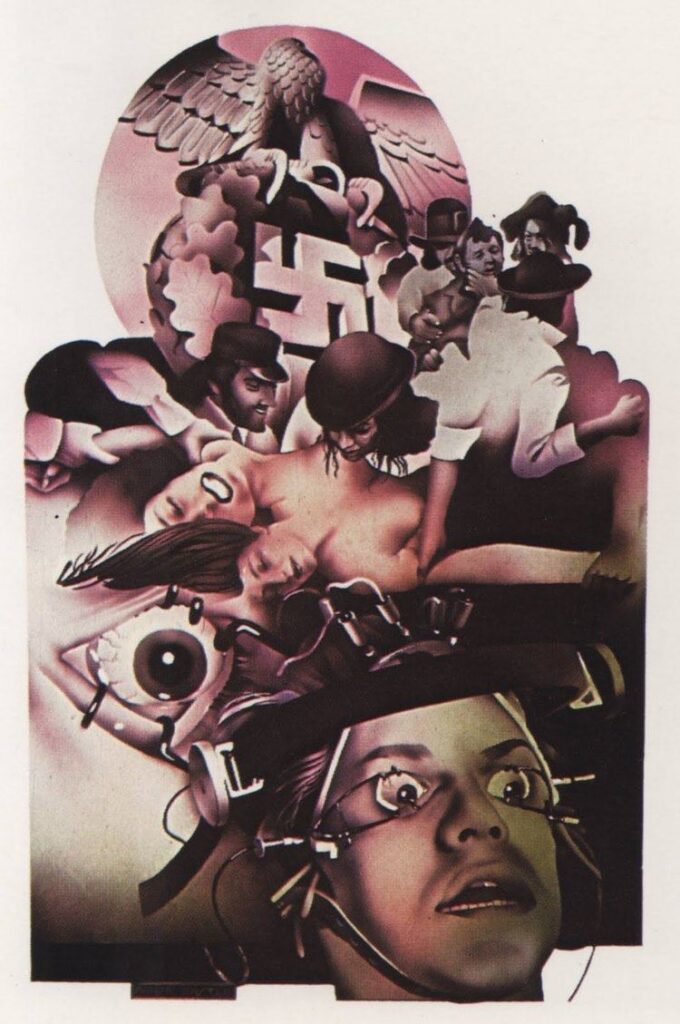
One of artist Philip Castle’s promotional paintings for Kubrick’s A Clockwork Orange (1970)

Unlike Anthony Burgess’s Alex, who is being subjected to the fictional Ludovico Technique, a kind of aversion therapy, I was voluntarily exposing myself to this barrage of beauty and horror, and also unlike him I was free to stop it whenever I wanted to, which doesn’t of course prevent one’s brain from processing it – you can’t unsee a picture any more than you can un-ring a bell. A Clockwork Orange was written at the beginning of the 1960s, at the tail end of the 1950s paranoia about the way the media – meaning in those days mostly cinema, magazines and pop music – were fuelling juvenile delinquency. That paranoia exacerbated the generation gap which had already been made more prominent by the dividing line of World War Two. A reading of something like Hamlet suggests that there’s always been a generation gap, but it was in the 50s and 60s that it became a permanent, deliberate and indeed lucrative feature of western consumer culture.

In 1970, the year that Stanley Kubrick’s film of A Clockwork Orange was released, one of Burgess’s peers, JG Ballard wrote The Atrocity Exhibition. Nothing about social media in 2026 would have surprised Ballard. If A Clockwork Orange was partly the product of society’s fears about rock ‘n’ roll, beatnik culture youth violence and communism, The Atrocity Exhibition was incubating during a period of widespread concern that a generation of young people was growing up seeing unfiltered images of the horrific events of the Vietnam War, intercut with commercials and entertainment features as they ate their breakfast every morning.
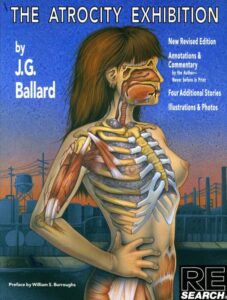
JG Ballard’s experimental novel The Atrocity Exhibition

That was unprecedented – nearly everything is generally unprecedented it seems – and the fear was that, on the one hand these children would grow up inured to violence and horror and unable to differentiate between reality and entertainment, and on the other that their daily intake of atrocities was unconsciously being absorbed in a way that would eventually manifest itself as generational trauma. That was a natural concern at a time when it had only recently become acknowledged that World War One had left scars not just on those who survived it, but the whole of culture, and when the unprocessed horrors and consequences of World War Two were leading to a rise in neo-Nazism alongside a trivialisation of actual 1930s Nazism. Trauma begets trauma and trauma never ends, it seems, and that Vietnam experience has become the normal way of things in the social media age. The fact that some of the most powerful men in the world belong to that war-and-breakfast generation may or may not be relevant to where we are now.

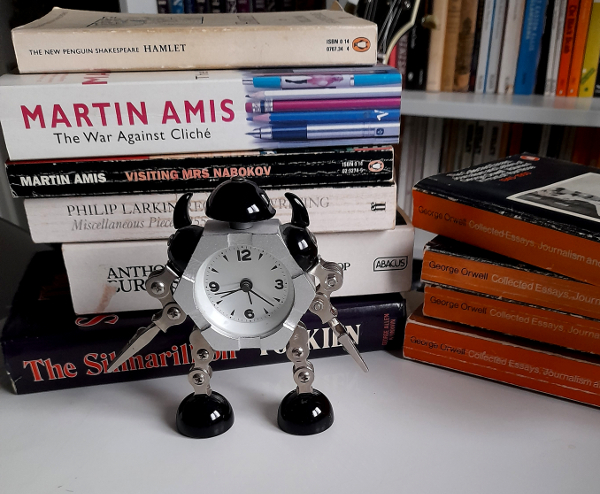
So is my pre-breakfast bombardment a bad thing? Who knows, but it doesn’t seem like it could be a good thing. As Martin Amis wrote, when the (really quite tame) schlock horror movie Child’s Play 3 was being implicated in two different murder cases, “It’s nothing to boast about, but there is too much going on in my head for Chucky to gain much sway in there. Probably the worst that Chucky could do to me is to create an appetite to see more Chucky, or more things like Chucky.” He goes on to say that in the case of people already predisposed for whatever variety of reasons, to commit murder, “Chucky is unlikely to affect anything but the style of your subsequent atrocities.”* That seems right; the problem with seeing atrocities day in, day out isn’t that it wants to make normal people commit them. It is very depressing though. And the thought that my wearying daily experience might be – probably is – mirrored in the life of a deprived or abused child with nothing to look forward to but more deprivation and abuse is deeply unsettling.

*Martin Amis – The War Against Cliché (2001), p.17.
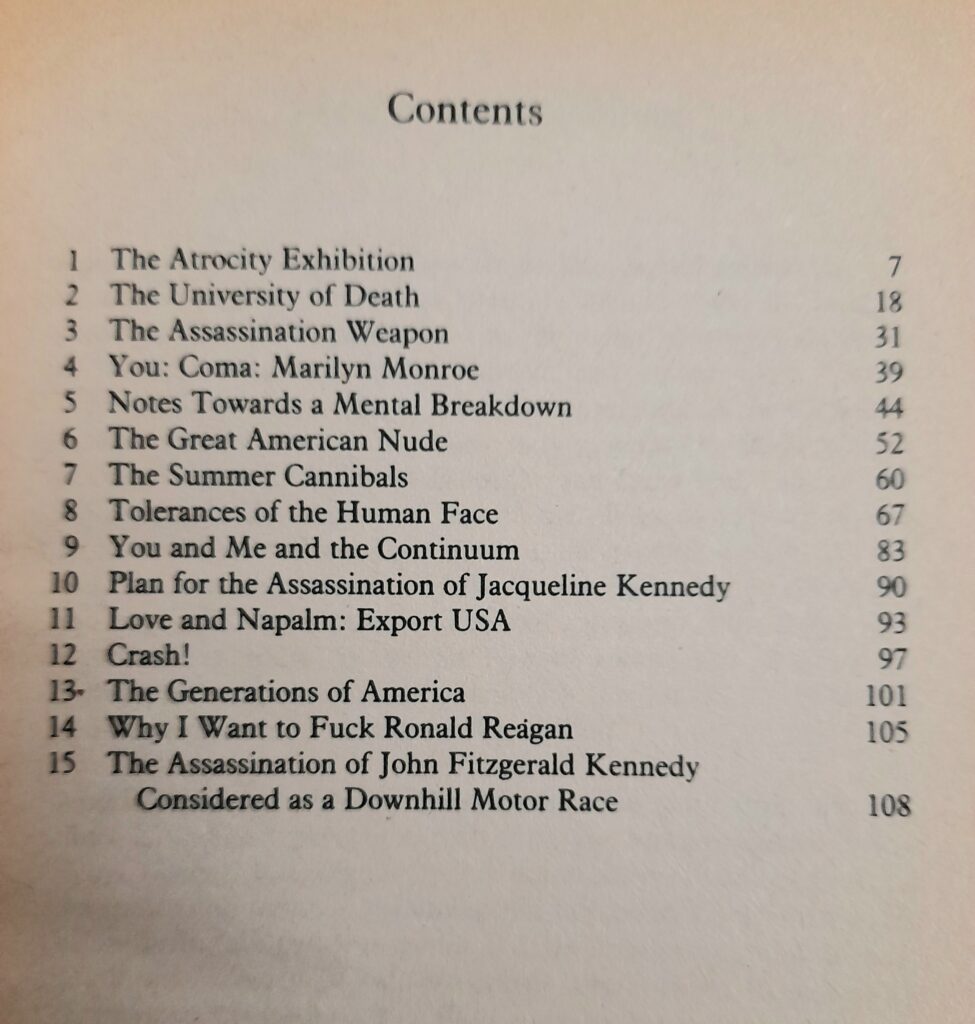
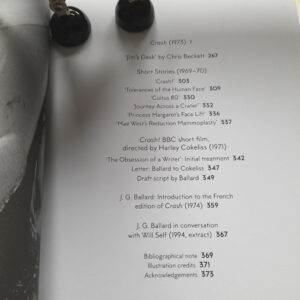
The Atrocity Exhibition contents page, the experience of scrolling through social media embodied in satirical poetry

So why do it? Partly conditioning I suppose; in my case my morning look at social media not doom-scrolling, though I’m as guilty as anyone of periods of that. In A Clockwork Orange, the presence of Beethoven’s music – the only thing that Alex uncomplicatedly loves – appearing in the films that make up his therapy is an unfortunate coincidence, but in my case the nice things – the songs, the interview and comedy clips are there because they are the kind of things I consciously search for and the algorithm that wants to keep me there therefore supplies more of them. And it fills the gaps with whatever people I follow are talking about – Iran, Gaza, copyright infringement – and whatever its owners want to push at any given moment. Which right now, seems to be right-wing politics, salacious conspiracy theories and AI.

It feels like there should be some conclusions to be drawn from all this, but I don’t know what they are; maybe it’s too soon. But it seems deeply ironic that something very close to what was envisioned sixty years ago as an extreme and inhumane form of aversion therapy should be willingly engaged in by millions of people as part of their daily routine. When Anthony Burgess gave his sociopathic but jovial teenage narrator the slang term real horrorshow to denote enthusiastic approval he knew what he was doing.
passive-digressive

There are two kinds of people* – those who like forewords, introductions, prefaces, author’s notes, footnotes, appendices, bibliographies, notes on the text, maps, diagrams etc, and those who don’t. But we’ll get back to that shortly.

* there are more than two kinds of people. Possibly infinite kinds of people. Or maybe there’s only one kind; I’m never sure

A few times recently, I’ve come across the idea (which I think is mainly an American academic one, but I might be completely mistaken about that) that parentheses should only be used when you really have to use them (but when do you really have to?) because anything that is surplus to the requirements of the main thrust of one’s text is surplus to requirements full stop, and should be left out. But that’s wrong. That criticism can be and is extended to anything that interrupts the flow* of the writing. But that is also wrong.

*like this¹     

Unless you happen to be writing a manual or a set of directions or instructions, writing isn’t (or needn’t be) a purely utilitarian pursuit and the joy of reading (and of writing) isn’t in how quickly or ‘efficiently’ (whatever that means in this context) you can do it. Aside from technical writing, the obvious example where economy just may be valuable is poetry – which however is different and should probably have been included in a footnote, because footnotes are useful for interrupting¹ and expanding on text without separating the point you’re making from the point you’re commenting on or adding to.

                                                                                                                                                           ¹but bear in mind that if the interrupting is deliberate – people don’t write footnotes by accident – then it’s not a negative thing²                       

²and it can sometimes be funny

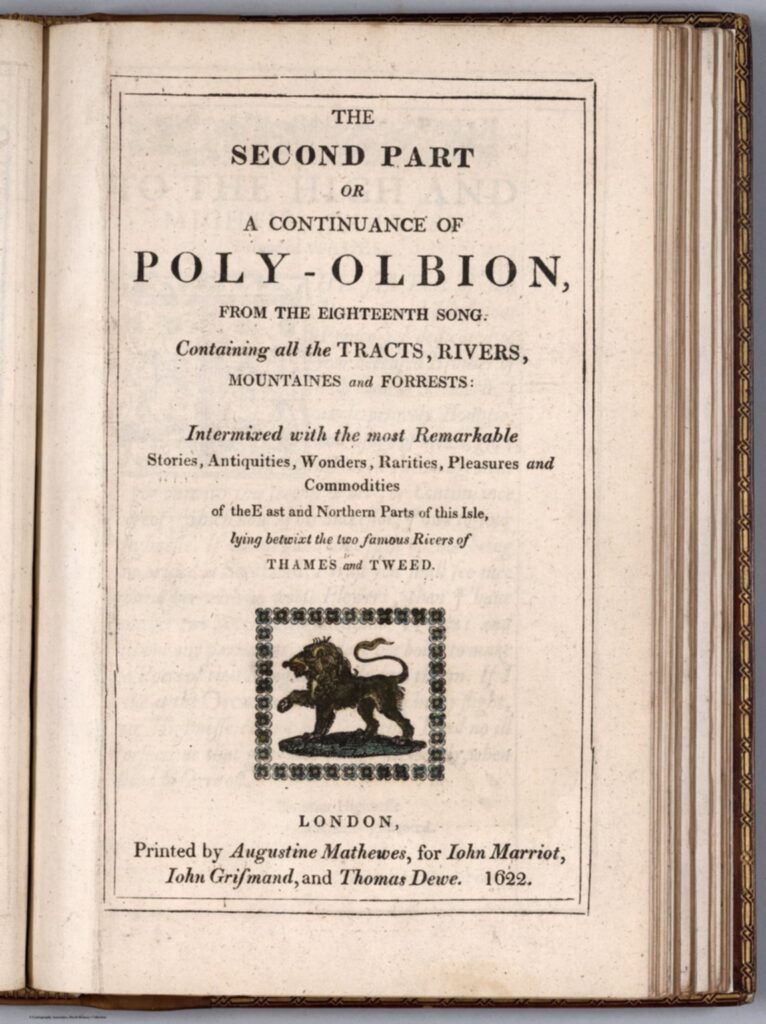
Poly-Olbion – that’s how you write a title page to pull in the readers

I would argue (though the evidence of poetry itself – especially the kind of expansive, long-winded poetry that I’m quite fond of, like Paradise Lost, Spenser’s Faerie Queen and Michael Drayton’s Poly-Olbion or even Craig Raine’s History – the Home Movie – perhaps argues against me) that a poem should be* the most economical or at least the most effective way of saying whatever you have to say. But even as I write that, it seems obvious that economical and effective are not necessarily the same thing. Some things can be expeessed in a few words, others can’t

* poets, ignore this; there is no should be in poetry

Clearly (yep), the above is a needlessly convoluted way of writing, and can be soul-achingly annoying to read; but – not that this is an effective defence – I do at least do it on purpose. As anyone who’s read much here before will know, George Orwell is one of my all-time favourite writers, and people love to quote his six rules for writing, but while I would certainly follow them if writing a news story or article where brevity is crucial, otherwise I think it’s more sensible to pick and choose. So, Orwell says;

Never use a metaphor, simile, or other figure of speech which you are used to seeing in print. Absolutely; although sometimes you use them because they are familiar, if making a specific point, or being amusing. Most people, myself included, just do it by accident; because where does the dividing line fall? In this paragraph I have used “by accident” and “dividing line” which seem close to being commonly used figures of speech (but then so does “figure of speech”). But would “accidentally” or something like “do it without thinking” be better than “by accident?” Maybe.

Never use a long word where a short one will do. The key point here is will do. In any instance where a writer uses (for example) the word “miniscule” then “small” or “tiny” would probably “do”. But depending on what it is they are writing about, miniscule or microscopic might “do” even better. Go with the best word, not the shortest, unless it’s also the best.

If it is possible to cut a word out, always cut it out. Note that Orwell wrote ‘always’ here where he could just have said If it is possible to cut a word out, cut it out. Not everything is a haiku, George.

Never use the passive where you can use the active. Surely it depends what you’re writing? If you are trying, for instance, to pass the blame for an assault from a criminal on to their victim, you might want a headline that says “X stabbed after drug and alcohol binge” rather than “Y attacks X.” You kind of see Orwell’s point though.

Never use a foreign phrase, a scientific word, or a jargon word if you can think of an everyday English equivalent. Both agree and disagree; as a mostly monolingual person I agree, but some words and phrases (ironically, usually ones in French, a language I have never learned and feel uncomfortable trying to pronounce; raison d’etre or enfant terrible for example) just say things more quickly and easily (I can be utilitarian too) than having to really consider and take the time to say what you mean. They are a shorthand that people in general understand. Plus, in the age of smartphones, it really doesn’t do native English speakers any harm to have to look up the meanings of foreign words occasionally (I do this a lot). The other side of the coin (a phrase I’m used to seeing in print) is that with foreign phrases is it can be very amusing to say them in bad translations like “the Tour of France” (which I guess must be correct) or “piece of resistance” (which I am pretty sure isn’t). So as long as you are understood (assuming that you want to be understood) use them any way you like.

Break any of these rules sooner than say anything outright barbarous. It’s hard to guess what George Orwell would have considered outright barbarous (and anyway, couldn’t he have cut “outright”?) but anyone reading books from even 30, 50 or a hundred years ago quickly sees that language evolves along with culture, so that rules – even useful ones – rarely have the permanence of commandments.

So much for Orwell’s rules; I was more heartened to find that something I’ve instinctively done – or not done – is supported by Orwell elsewhere. That is, that I prefer, mostly in the name of cringe-avoidance, not to use slang that post-dates my own youth. Even terms that have become part of normal mainstream usage (the most recent one is probably “woke”) tend to appear with inverted commas if I feel like I must use them, because if it’s not something I would be happy to say out loud (I say “woke” with inverted commas too) then I’d prefer not to write it. There is no very logical reason for this and words that I do comfortably use are no less subject to the whims of fashion, but still; the language you use is part of who you are, and I think Orwell makes a very good case here, (fuller version far below somewhere because even though I have reservations about parts of it it ends very well):

“Each generation imagines itself to be more intelligent than the one that went before it, and wiser than the one that comes after it. This is an illusion, and one should recognise it as such, but one ought also to stick to one’s world-view, even at the price of seeming old-fashioned: for that world-view springs out of experiences that the younger generation has not had, and to abandon it is to kill one’s intellectual roots.”

Review of A Coat of Many Colours: Occasional Essays by Herbert Read. (1945) The Collected Essays, Journalism and Letters of George Orwell Volume 4. Penguin 1968, p.72 

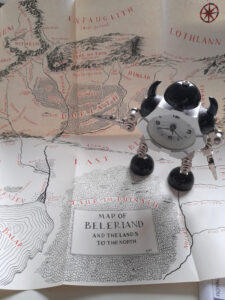
the fold-out map in The Silmarillion is a thing of beauty

Back to those two kinds* of people: I am the kind of person that likes and reads forewords, introductions, prefaces, author’s notes, footnotes, appendices, bibliographies, notes on the text, maps and all of those extras that make a book more interesting/informative/tedious.

*I know.

In one of my favourite films, Whit Stillman’s Metropolitan (1990), the protagonist Tom Townsend (Edward Clements), says “I don’t read novels. I prefer good literary criticism. That way you get both the novelists’ ideas as well as the critics’ thinking. With fiction I can never forget that none of it really happened, that it’s all just made up by the author.” Well, that is not me; but I do love a good bit of criticism and analysis as well as a good novel. One of my favourite pieces of writing of any kind, which I could (but choose not to) recite parts of by heart, is the late Anne Barton’s introduction to the 1980 New Penguin Shakespeare edition of Hamlet*.

*All of the New Penguin Shakespeare introductions that I’ve read have been good, but Barton’s is in a different league. John Dover Wilson’s What Happens in Hamlet (1935, though the edition I have mentions WW2 in the introduction, as I remember; I like the introduction) is sometimes easy to disagree with but it has a similar excitement-of-discovery tone to Anne Barton’s essay

I love Hamlet, and I’ve read it quite a few times, but I’ve read Barton’s introduction many more, to the point where phrases and passages have become part of my mind’s furniture. It’s a fascinating piece of writing, because Professor Barton had a fascinating range and depth of knowledge, as well as a passion for her subject; but also and most importantly because she was an excellent writer. If someone is a good enough writer* you don’t have to be interested in the subject to enjoy what they write.

* Good enough, schmood enough; what I really mean is if you like their writing enough. The world has always been full of good writers whose work leaves me cold

Beyond the introduction/footnote but related in a way are the review and essay. Another of my favourite books – mentioned elsewhere I’m sure, as it’s one of the reasons that I have been working as a music writer for the past decade and a half, is Charles Shaar Murray’s Shots from the Hip, a collection of articles and reviews. The relevant point here is that more than half of its articles – including some of my favourites – are about musicians whose work I’m quite keen never to hear under any circumstances, if humanly possible. Similarly, though I find it harder to read Martin Amis’s novels than I used to (just changing taste, not because I think they are less good), I love the collections of his articles, especially The War Against Cliché and Visiting Mrs Nabokov. I already go on about Orwell too much, but as I must have said somewhere, though I am a fan of his novels, it’s the journalism and criticism that he probably thought of as ephemeral that appeals to me the most.

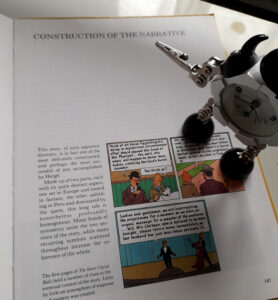
a scholarly approach to comics

All this may have started – as I now realise that lots of things in my writing did – with Tolkien. From the first time I read his books myself, I loved that whatever part of Middle-Earth and its people you were interested in, there was always more to find out. Appendices, maps, whole books like The Silmarillion extended the enjoyment and deepened the immersion in Tolkien’s imaginary world. And they were central to that world – for Tolkien, mapping Middle-Earth was less making stuff up than it was a detailed exploration of something he had already at least half imagined. Maybe because I always wanted to be a writer myself – and here I am, writing – whenever I’ve really connected with a book, I’ve always wanted to know more. I’ve always been curious about the writer, the background, the process. I’ve mentioned Tintin lots of times in the past too and my favourite Tintin books were, inevitably, the expanded editions which included Herge’s sketches and ideas, the pictures and objects and texts that inspired him.

I first got one of those Tintin books when I was 9 or so, but as recently as the last few years I bought an in many ways similar expanded edition of one of my favourite books as an adult, JG Ballard’s Crash. It mirrors the Tintins pretty closely; explanatory essays, sketches, notes, ephemera, all kinds of related material. Now just imagine how amazing a graphic novel of Crash in the Belgian ligne claire style would be.*

*a bit like Frank Miller and Geof Darrow’s fantastic-looking, insanely detailed, but not all that memorable Hard Boiled (1990-92) I guess, only with fewer robots-with-guns shenanigans and more Elizabeth Taylor

a scholarly approach to cautionary 1970s semi-pornography/horror: the expanded Crash

A good introduction or foreword is (I think) important for a collection of poems or a historical text of whatever kind. Background and context and, to a lesser extent, analysis expand the understanding and enjoyment of those kinds of things. An introduction for a modern novel though is a slightly different thing and different also from explanatory notes, appendices and footnotes and it’s probably not by chance that they mainly appear in translations or reprints of books that already enjoyed some kind of zeitgeisty success.

When I first read Anne Barton’s introduction to Hamlet, I already knew what Hamlet was about, more or less. And while I don’t think “spoilers” are too much of an issue with fiction (except for whodunnits, which I have so far not managed to enjoy), do you really want to be told what to think of a book before you read it? But a really good introduction will never tell you that. If in doubt, read them afterwards!

Some authors, and many readers, see all of these extraneous things as excess baggage, surplus to requirements, which obviously they really are, and that’s fair enough. If the main text of a novel, a play or whatever, can’t stand on its own then no amount of post-production scaffolding will make it satisfactory.* And presumably, many readers pass their entire lives without finding out or caring why the author wrote what they wrote, or what a book’s place in the pantheon of literature is. Even as unassailably best-selling an author as Stephen King tends to be a little apologetic about the author’s notes that end so many of his books, despite the fact that nobody who doesn’t read them will ever know that he’s apologetic about them. Still; I for one would like to assure his publisher that should they ever decide to put together all of those notes, introductions and prefaces in book form, I’ll buy it. But would Stephen King be tempted to write an introduction for it?

* though of course it could still be interesting, like Kafka’s Amerika, Jane Austen’s Sanditon or Tolkien and Hergé (them again) with Unfinished Tales or Tintin and Alph-Art

That Orwell passage in full(er):

“Clearly the young and middle aged ought to try to appreciate one another. But one ought also to recognise that one’s aesthetic judgement is only fully valid between fairly well-defined dates. Not to admit this is to throw away the advantage that one derives from being born into one’s own particular time. Among people now alive there are two very sharp dividing lines. One is between those who can and can’t remember the period before 1914; the other is between those who were adults before 1933 and those who were not.* Other things being equal, who is likely to have a truer vision at the moment, a person of twenty or a person of fifty? One can’t say, though on some points posterity may decide. Each generation imagines itself to be more intelligent than the one that went before it, and wiser than the one that comes after it. This is an illusion, and one should recognise it as such, but one ought also to stick to one’s world-view, even at the price of seeming old-fashioned: for that world-view springs out of experiences that the younger generation has not had, and to abandon it is to kill one’s intellectual roots.”

*nowadays, the people who can or can’t remember life before the internet and those who were adults before 9/11? Or the Trump presidency? Something like that seems right


ghost cities of cyberspace


Tell me now, I beg you, where
Flora is, that fair Roman;
Archippa, and Thaïs rare,
Who the fairer of the twain?
Echo too, whose voice each plain,
River, lake and valley bore;
Lovely these as springtime lane,
But where are they, the snows of yore?¹

François Villon, Ballade des dames du temps jadis(1461)¹

My uncle died two years ago now, but his Instagram account is still there. How many dead people live on in their abandoned social media accounts? The future never seems to arrive, never really exists, but history never ends. For over a quarter of a century, social media has mirrored and shaped lives, always evolving, but leaving behind its detritus just like every other phase of civilisation. Where are the people we were sociable with on the forgotten single-community (bands, hobbies, comedy, whatever) forums and message boards of the 90s and 2000s², or the friends we made on MySpace in 2005? Some live on, ageing at an only slightly faster rate than their profile pictures (Dorian Gray would now age privately at home, his picture migrating untouched from MySpace to Facebook to Twitter to Instagram to TikTok etc), but others seem lost, vanished, dead? But still partially living on in archaic digital forms, like those sunlit American families in the home movies of the 50s and 60s.

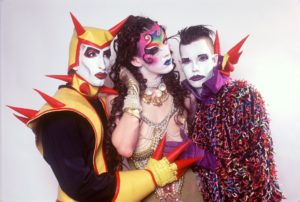
Club Kids 1992 – Keda, Kabuki Starshine, and Sacred Boy, Copyright Michael Fazakerley

Twenty-five years is a long, generation-spanning time, but, just as abstract expressionist art essentially still lives on, in almost unaltered forms but no longer radical – long past the lifetimes of Rothko, Jackson Pollock and de Kooning, so the (just) pre-internet countercultural modernity of the late 80s and early 90s survives. The shock-monster-gender-fluid-glam-trash of Michael Alig and the Club Kids (captured brilliantly in the 1998 ‘shockumentary’ Party Monster and in James St James’s luridly fantastic memoir Disco Bloodbath and, less brilliantly, in the somewhat unsatisfactory 2003 movie Party Monster) was still prevalent back in the Myspace era³ and lives on and still feels current on Instagram and Tiktok and reality TV and in whatever is left of the top 40. Increasingly bulimic pop culture eats reconstituted chunks of itself and just as the 60s haunted the early 90s, bringing genuine creativity (Andrew Weatherall, to pick a name at random) and feeble dayglo pastiche (Candy Flip, to deliberately target a heinous offender), a weird and distorted (if you were there) amalgam of the 1980s and 90s haunts the 2020s, informing both the shallow dreck that proliferates everywhere and some of the genuine creativity of today.

‘I’m ready now,’ Piper Hill said, eyes closed, seated on the carpet in a loose approximation of the lotus position. ‘Touch the spread with your left hand.’ Eight slender leads trailed from the sockets behind Piper’s ears to the instrument that lay across her tanned thighs.

entering cyberspace in William Gibson’s Mona Lisa Overdrive (1988) Grafton Books, p.105.

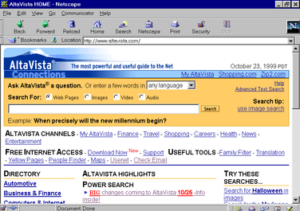
Alta Vista, 1999

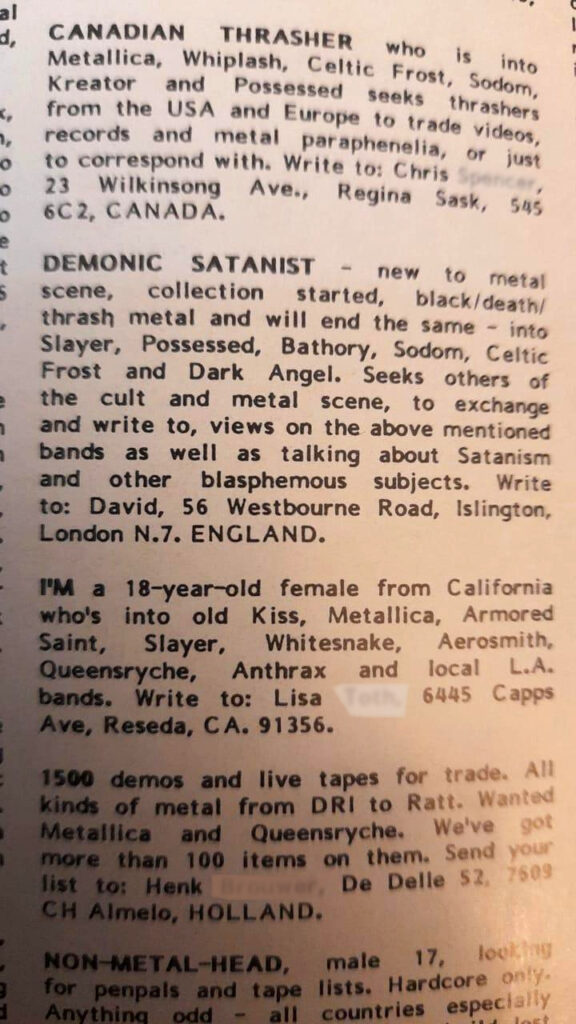
Cyberspace, like any landscape which people have inhabited, has its lost cultures and ruins, which become ever more remote and unknowable with the passing of the years. But like Macchu Picchu or the Broch of Gurness, they retain a sense that it all meant something significant once. The not-quite barren wastelands of Geocities and Xanga, the ruined palace of MySpace – a Rosetta stone partly effaced with dead links and half forgotten languages; photobucket, imageshack, tripod, what do these mean if you’re 15? Would the old, useable interface of MySpace seem as charmingly quaint and remote to the “youth of today” as the penpal columns in the pages of ’80s music magazines do?

Looking for friends all over the world, Metal Forces magazine, 1987

Funny to think, but there was a time when Lycos, Alta Vista and Ask Jeeves were peers of Google, and when Bebo rivalled Facebook and Twitter, both now seemingly in senile phases of their development. Until very recently Facebook (Meta) and Twitter were brands that were seemingly unassailable, but empires do fall, albeit more slowly than bubbles burst.And meanwhile, the users of social networks age and die and give way to generations who don’t remember them, but look on their works, just as the Incas and the Iron Age Orcadians are remembered for their monuments, if nothing else. Depressing, when you think about it; probably won’t write about history next time.


It’s funny. Don’t ever tell anybody anything. If you do, you start missing everybody.  JD Salinger, The Catcher In The Rye, Penguin, 1958, p.220

Geocities; this is what the future used to look like

¹ translated by Lewis Wharton in The Poems of François Villon, JM Dent & Sons, 1935, p54. Not reading French – I seem to go on about that a lot – this is my favourite translation I’ve come across, although apparently it’s a pretty free one, judging by the literal – but still quite nice – one here

² the continuing success of Reddit suggests that people never really grew discontented with the interface of the Kiss online fanclub c. 2005 (etc etc)

³It’s weird to note that the Club Kids would be considered – even without the murder etc – just as outrageous today as in the late 80s, even though their aesthetic was itself put together from a mix of Bowie, gore movies, Japanese pop culture etc etc. But then – as I think I recently noted somewhere – there are people who still find the word fuck outrageous, after something like a millennium.

4Online and mainstream culture, even after this quarter century, remain mysteriously separate. Online news unfolds as it happens, but meanwhile in the daytime world, mainstream culture hangs on to husks even older than Geocities; publicly owned TV news shows don’t look to what’s happening now, but pore over the front pages of newspapers – yesterday’s news… today! – simultaneously being redundant and ensuring that newspaper owners’ views get publicity beyond their dwindling readership and therefore giving them an artificial sense of relevance. Which is really just about money, just as Google and Facebook are; the crumbling aristocracy of print media, its tendrils still entwined with the establishment, versus the new money, steadily buying its way in.