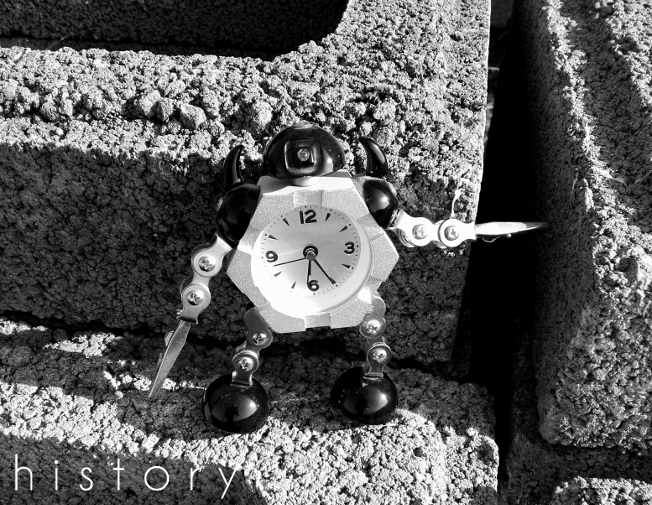
messages from the past for the future


Sitting down to write this, a month after breaking my leg and having to grapple with hitherto-unconsidered questions like ‘how do I usually sit on a toilet’? and one week before a General Election where my preferred of the apparently plausible outcomes is an unsatisfactory coalition government, it feels strange and maybe wrong to be looking backwards. But, disturbing and reassuring in more or less equal measures, I think it’s a good way to look forward to whatever happens next.

I remember as a child, looking at a stamp album that had belonged to (I think) my dad (or maybe his dad) when he was a child. Even for someone with no interest in stamps, and less interest in collecting them, it was a peculiar and fascinating book; unfamiliar places, people, even currencies. The thing that stands out the most in my memory though is a stamp from Bosnia, a name which at the time I hadn’t heard before and which sounded as unlikely and frankly made-up as countries like Syldavia and Borduria that I knew from Tintin books. That memory itself has a strange and silly quality now, but at the time (somewhere in the mid-80s would be my guess) Bosnia was as fantastical to a child (or me at least) as I expect the Socialist Federative Republic of Yugoslavia would be to Primary school pupils now.
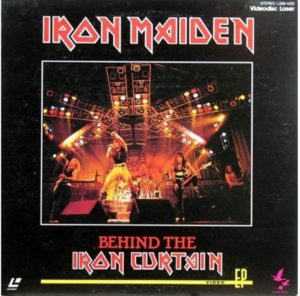
classic cold war artefact: Iron Maiden behind the Iron Curtain laserdisc (1985)

30 years on from the series of revolutions that symbolically culminated in the destruction of the Berlin Wall (the free opening of the Brandenburg Gate itself happened 30 years ago last month) it’s perhaps only natural that those who remember those times should be thinking of them. If you grew up with the cold war in the background (that is, any time really from the years after world war two up until the end of the 80s), the war itself may have constantly ebbed and flowed, but the communist eastern bloc was, monolithically (technically at least duolithically, but that’s not a thing) omnipresent in a way that now seems as unlikely and distant as the Austro-Hungarian Empire. It was there at school (we had to learn about “East Germany” (the GDR or DDR), “West Germany” (FRG or BRD) and the differences between the two, the USSR /CCCP, the space race, the arms race, ‘Mutually Assured Destruction’ etc etc etc), it was there in sports (especially the Olympics, but “West Germany” was quite a big deal during the ten minutes that I liked football) and in entertainment. Usually this meant sinister, emotionless and robot-like communists being the bad guys in endless numbers of films and TV shows (classic example; Rocky IV, but see also Red Dawn, Red Heat ad infinitum – it was interesting, in a depressing kind of way to see this old view of ‘reds’ adopted, without irony in the third, inferior season of Stranger Things this year), but it wasn’t all bad – sometimes bands made a point of playing behind the Iron Curtain and talked about how great the audiences were; I remember Iron Maiden played in Poland, Hungary etc in the mid-80s which presumably was a logistical nightmare, but nice for their fans who mostly would only have been able to hear their music through unofficial or even (the same thing really) illegal channels.
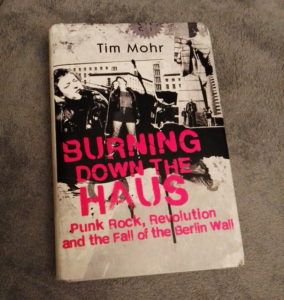
A few things have brought that period, and specifically the GDR, back to me recently; Tim Mohr’s superb book Burning Down The Haus – Punk Rock, Revolution and the Fall of the Berlin Wall (Dialogue Books, 2019), the work of the German photographers Ute and Werner Mahler and the Ostkreuz photography group, interviewed by Kate Simpson in issue 90 of Aesthetica Magazine (August/September 2019), the TV shows Deutschland 83 and Deutschland 86 which I just watched, somewhat belatedly and a series of John le Carré’s classic spy thrillers, notably A Small Town In Germany (1968).
The central realities of all of these things is pretty much the same; in East Germany, the state (specifically the secret police, the notorious Stasi) was watching you, and not only did they not care if you knew it, they wanted you to assume you were being watched.

East Berlin punks at Planterwald, approx. 1981 by Harald Hauswald (Ostkreuz Agency)

One of the most chilling things in Tim Mohr’s book is the way that, from the beginning of the 80s until its end (punk seems to have had an extended lifespan in the GDR, partly because fashions were slower to take root and spread where the majority of the media was under state control, but also because it remained – from the music to the image – genuinely oppositional and rebellious, rather than being absorbed into mainstream pop culture) the punks were, as often as not arrested because of informants from their own families or even the bands themselves. Nevertheless, after a slow start, the bands multiplied, but in a planned economy with full employment its slogans were something like the opposite of the UK’s punk bands; Too Much Future being the classic East German punk statement; more info here. As Mohr notes, long before the advent of GDR punk, informing for the government was something like an epidemic. In fact, by 1952 – that is, just four years from the official founding of the nation – the Stasi had already recruited 30,000 informants (Burning Down The Haus, p.2), and that figure would rise exponentially throughout the decades. This was the reality that artists like photographer Ute Mahler were working in;

Everyone knew that people were spying for state security. But nobody knew who. It could be anyone. We lived and breathed with this knowledge. In 1980, I stood at a May Day demonstration just below the grandstand. The demonstrators cheered at the government, which was on a podium above me. I got the impression that all the attendees were in agreement and were happy about it. Whilst editing the pictures, I discovered other faces in the crowd. That confirmed to me that you must look closely for what might be hidden.”

Ute Mahler, interviewed in Aesthetica, issue 90, p. 128

Action Force SAS figure, 1982: this creepy thing was one of the ‘good guys’

From a child in the UK’s point of view, the activities of the CND, the Greenham Common protestors, WarGames, Raymond Briggs’s When The Wind Blows and even silly things like the Frankie Goes To Hollywood Two Tribes video strengthened rather than diluted the sense that, beyond ‘the west’ there was a huge, sinister and implacable enemy. That video – bad lookalikes of Reagan and Chernenko wrestling – was absurd but actually made child me more aware of the seriousness of the global situation. For a start, I remember thinking the actors were bad lookalikes, but I knew approximately who they were meant to be and what it represented. Actually, although I was very familiar with Reagan I doubt whether I knew Chernenko by name; even now I had to look it up to write this as my only memories of a pre-Gorbachev Soviet leader relate to Andropov, for the simple reason that his name was funny. I vaguely remember him in association with a joking remark (when he died??) that “his hand dropped off”, but whether that was purely from the playground or from TV I don’t know. Even toys contributed to the doomladen atmosphere. The initial run of Action Force (the European release of GI Joe, although initially there was no back story or characters, just – as with the older UK Action Man – a lot of more-or-less accurate contemporary military equipment, including sinister SAS paratroopers with gas masks etc. As I was typing this, I remembered that I used to have a fairly extensive knowledge of the weaponry favoured by the Warsaw Pact vs. NATO troops, which is fun for kids. As far as I remember, although children’s entertainment in the UK wasn’t by and large as propagandist as Hollywood, there wasn’t anything much to counter the idea of the brainwashed, robotlike communist hordes, programmed by the state from birth. And, at no point before 1989 did it feel like that situation was about to change.

That feeling was as strong, or even stronger, inside the Eastern bloc, as Ute and Werner Mahler explain;

“The generations after us might find it hard to understand the complex workings of the GDR, as memory begins to move into the past. These new generations perhaps cannot imagine how one could live in such a country, where one could not officially say what we thought. … When we took pictures in the 1970s and 1980s, we would never have imagined that one day the GDR would not exist. At that time, we wanted to show life as we experienced it – just as it was. Today, the images act as documents from a vanished country. In this way, they are given a renewed sense of purpose.”

Ute & Werner Mahler, interviewed in Aesthetica, issue 90, p.124

Even, as Mohr explains, the day after the Berlin Wall fell, the Stasi were making arrests in something like the usual way, although the state quickly descended into chaos. But maybe everything feels permanent when you live through it; I remember when, what felt like 1000 years or so into Margaret Thatcher’s reich, we had had the Miner’s Strike, the Falklands war, there were millions of unemployed and it seemed like I had never met anyone who liked Thatcher, or anyone who voted for the Conservative Party and yet, come election time they still won. Maybe it’s more significant that I don’t remember anyone I knew being especially keen on Michael Foot or Neil Kinnock? But anyway; my memory is that by 1988, there was no feeling that the cold war was going anywhere; by 1990 it was over. Until I was 23 my only conscious experience was of a Britain run by a Conservative government, and then that was over.

symbol from an 80s
cold war childhood
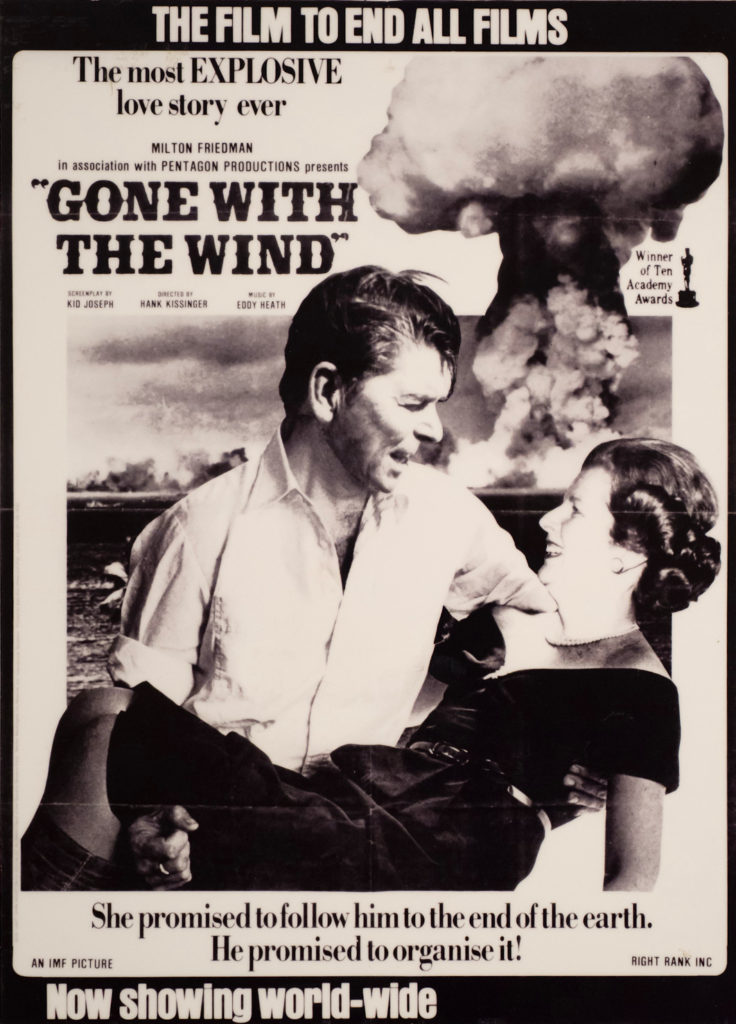
Bob Light and John Houston’s satirical Gone With The Wind poster, c.1981 – vividly brings back the era to me

One of the stranger things to find, looking back on the phantom communist enemy of my childhood is that, contrary to what appeared to be the case on TV at the time, the people of East Germany, discontented though they obviously were, did not necessarily want to become westerners. As depicted vividly in Deutschland 83 and even more so in Deutschland 86, Communism as practised through the GDR’s dictatorship was a failed ideal, but it remained for many, something like an ideal. The bands documented in Burning Down The Haus, like the immediately post-Communist East German club scene that Mohr experienced himself, were ‘radically egalitarian’. These were, after all, people raised in a system which preached the power of the people, and even enshrined in law the freedom of expression, although in practice it didn’t allow either of those things. Often bands or musicians – people who were routinely arrested, beaten by the authorities, held in prison awaiting trial for months and so on – had opportunities to flee to the west (or were even encouraged to by the authorities who couldn’t cope with them) but chose to stay and work for change. Fascism and consumerism were seen, not just by the authorities, but by the punks, as the enemies of freedom, and even when the punk revolt happened it was often aided by (which seems odd but makes a kind of logical sense) the Lutheran church, which had an uneasy but respectable existence within the state. This meant that not only the punks (who tended towards anarchism in the 19th century sense politically), but also environmentalists, peace activists and other dissidents the church protected and to a degree nurtured, were working under the auspices of an institution which also had essentially anti-capitalist principles at its heart.

Rebelling against a de facto egalitarian state in itself creates a strange situation, as Ute Mahler recalls;

“In the GDR, when the collective was praised as an ideal, we were all lone fighters. In this new society where individuality is so important to so many people – coming together is the key”  quoted in Aesthetica, issue 90, p.124-7

And this is not really a paradox, even to an individualist; if the contrasting but ultimately similar oppressions of the 20th century, whether Nazi Germany, Stalinist Russia, Communist China etc – have taught us anything, it’s that totalitarian power structures, of whatever political hue value conformity above individuality; but also that political progress requires subjected peoples to firstly insist on their individuality, but also to act in concert with each other, to combine their voices in order to be heard.

Perhaps because a general election is looming as I write this, reading about the lost world of the eastern bloc and its failures (mostly the same failures as capitalism to be fair; poverty, starvation, oppression etc etc) begs the question; what is the country that you believe in, if not a reflection of yourself and what you want? The Eastern punks were patriotic in the sense that they wanted the freedom to be themselves, in an East Germany that recognised the right to have dissenting voices and views, to improve the experience of East German citizenship for all. But, like everyone else, they shared their country with the other by-their-own-admission patriots who believed in a completely different country. If you consider yourself a patriot, you are probably living in a country with lots of other patriots whose country has the same name as yours, but whose beliefs and ideals are not the same as yours. Those who fought and died for [name a country] in [name a war] and those who fought and died for [name an opposing country] in [the same war] were fighting for the same thing, but they were also not fighting for the same thing. The people who fought for Britain against the Nazis and the people who fought for Britain against the Zulus both were and were not fighting for the same country, though on an individual level the end result – their deaths, and the deaths of their enemies – was much the same.
Somewhere in a previous, equally muddled* article I mentioned the poet Edward Thomas. Against the WW1 poetry of super-patriot Rupert Brooke, or the “What passing-bells for these who die as cattle?” humanism of Wilfred Owen, you have to balance the entirely personal patriotism of Edward Thomas;

 At the age of thirty-six there was no strong pressure on him to enlist, but in August 1915 he finally made up his mind… When his friend Eleanor Farjeon asked him why, he scooped up a handful of earth and said, ‘For this.’
Andrew Motion, ‘An Imaginary Life’, in Ways of Life, Faber & Faber 2008, p.102.

And no doubt that was true. But what he fought for doesn’t change the fact that what he was injured for (he survived the war, minus an arm) was the global ambitions of the small group of people then running the British Empire. In the end his patriotism and theirs amounted to the same thing; but they were not the same thing.

Thomas’s kind of patriotism is the one that I think most matches my own; despite being a lefty internationalist I am quite a patriotic person. I love Scotland and value it not because it’s the ‘greatest country in the world’ (not that I’m saying it isn’t; just that the concept itself is utterly meaningless I think) and not because it’s beautiful – which it undoubtedly is, but so is every country I’ve been to – but because it is uniquely itself. It’s the big picture and the details; the texture and the atmosphere, the things I like and the things I don’t like. What I’m really saying I suppose is just that it’s the country I know best, the one where all of my responses to the world were shaped – which is of course not something to run up a flagpole and if one somehow did there’s no reason that anyone else in the world should want to salute it. But it is patriotism nonetheless. One of the many ironies of our particularly irony-ridden times is that on the whole, the conservative/nationalist parties of whom there are suddenly it seems very many indeed, are by and large those least committed to any kind of environmental/green policies. Strange because if, like the Conservatives nominally are, you are all about pride in your culture and your country and your history, but aren’t really concerned about the welfare of the actual, physical country as a piece of land then what do you even think you stand for?

So anyway; in the world of 1988, the world of 1990 seemed unthinkable, but it happened anyway, because people wanted it. I know that as 2019 draws to an end the world is full of people, in Chile, in Hong Kong, in Iran and Sudan, in the USA and the UK; in every country, who want thoughtful, compassionate, democratic government and not repression, corruption and leaders who are quasi- or actual dictators. Who want to be represented, not ruled. And it’s not impossible.

* when I read my writing it makes me think of that episode of Peep Show where a disgruntled lapdancer says “If you can’t sum up all the aims in the first line then they’re too diffuse.” I think my writing tends to be a bit diffuse.**

**See?
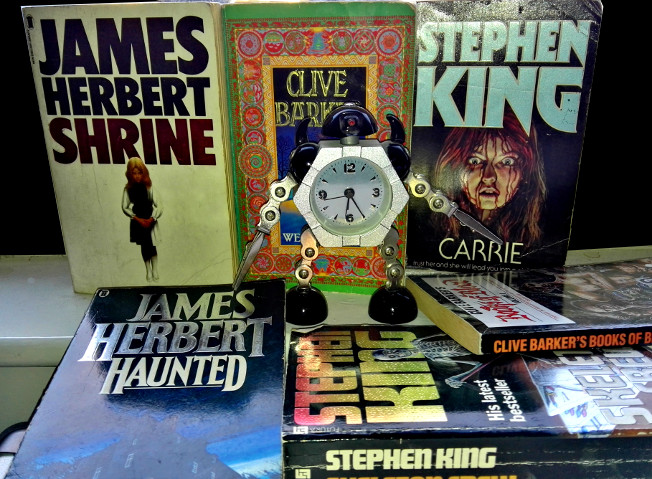
old books, old eyes, new readings


In Richard Linklater’s reputedly anti-nostalgic, but actually still quite nostalgic 1993 film Dazed and Confused, Matthew McConaughey’s Fonz-like character Wooderson articulates his Fonzhood in a way that – as far as I remember – the actual Fonz never does*: “That’s what I love about these high school girls, man. I get older, they stay the same age.” That quote popped into my head, in a sardonic kind of way, when I recently re-read the book that was the subject of this previous article, Richard Laymon’s Tread Softly. When reading books you first loved at an impressionable age, time makes Woodersons of us all; it’s the slightly eerie feeling of meeting old friends, only you have aged and they have stayed the same; except of course that in staying the same, they have changed too, because your perspective has changed. What once seemed profound may seem trite, what “you” once related to, you may not; re-encountering your youth – or even more so, your childhood – through books is as complex a feeling as looking at old photographs of yourself can be.

* to be fair to the Fonz, it would be hard for him to have this kind of perspective on the creepier aspects of his Fonzhood since, by the time he was in his 40s, the Happy Days “high school students” he lurked around were themselves in their 30s

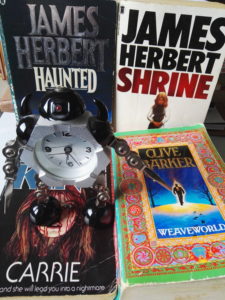
What Wooderson specifically draws attention to, and what we are forced to do, is to relate to the things we once liked from the perspective of an older person. And this is where the “genre fiction” comes in. As a teenager, especially from the ages of I think 13 to 17, my preferred reading was, in order of importance, horror, heroic fantasy and science fiction. Recently, in addition to Tread Softly, I have re-read a few books that were among my favourites in my mid-teens (The Rats, Lair, Shrine, The Dark and The Fog by James Herbert, It and Carrie by Stephen King and Weaveworld by Clive Barker) and, for the first time, what struck me about all of them (ego alert) was that I am now older than all of the main protagonists, including the ‘grownups’ in It and the parents in Tread Softly. Which of course is partly because I am now older than the authors of those books were when they wrote them; a strange thought – it’s possibly just me, but I don’t think one ever feels older than an author whose books you read when young, even when their youth is obvious. Not that the age of an author necessarily correlates to the age of their characters, but there seems to be something about the horror genre in particular that makes writers simplify and sketch the main – non-villainous – characters, rather than draw them in vivid detail. Perhaps it’s because some degree of identification with the main character makes the horror more effective, and a certain amount of vague/generic-ness is necessary to make as many readers as possible identify with those characters. I think this is pretty much explicitly what James Herbert did with his ‘everyman’ heroes.

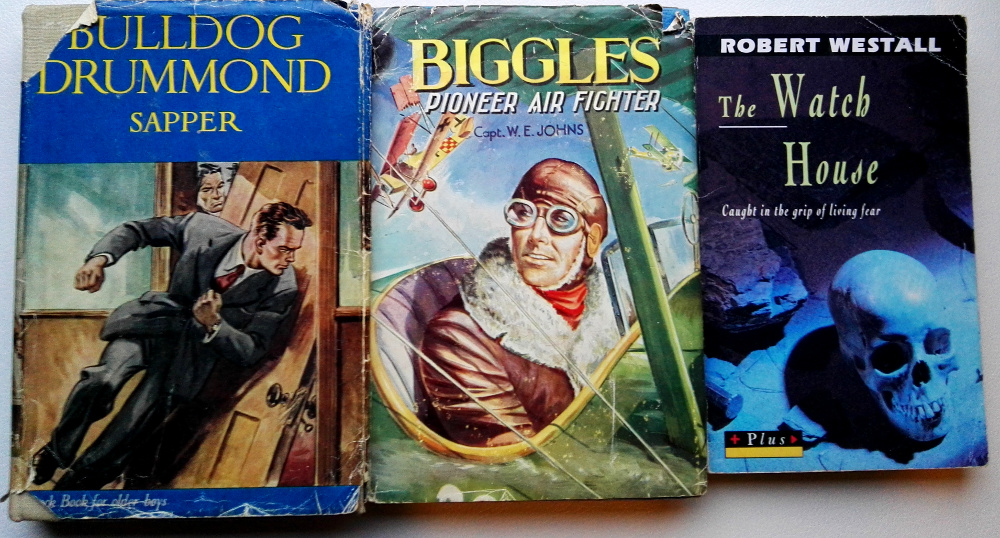
For a variety of reasons, it’s a strange thing to try to engage with your teenage taste in books, far more difficult than it is with music, or with the books one loved as a child. For a start, and with no disrespect intended to the authors, what has to be borne in mind with some of these books is that they weren’t necessarily (or definitely weren’t) aimed at the 14-15 year old who was reading them. When reading childrens’ books, adult me can be – CS Lewis’ Narnia books are perhaps the classic example – uncomfortably aware of the feelings and attitudes – the ‘adultness’ in fact – of the author behind the book. Sometimes – as with Jan Mark’s Thunder & Lightnings (there’s an insightful article about this excellent book here), or the best of Robert Westall’s novels – it gives me a new respect for a writer who until now I was mainly nostalgic about. Other times less so; for all the informative qualities, animal welfare concerns and anthropological information in Willard Price’s Adventure series (which I loved), the core idea of the two wholesome young American boys travelling the world, encountering its cultures with genuine (if occasionally paternalistic) respect and then catching its animals & shipping them off to zoos and safari parks, feels pretty uncomfortable. Far more so in fact than Biggles or Bulldog Drummond, where even child-me was aware of the dated imperialist attitudes and (in Bulldog Drummond especially) almost (or I’m tempted to think actually) parodic levels of jingoistic racism. But Willard Price wasn’t dealing in knowingly crass, simplistic thrills as  “Sapper” was.

childhood favourites

He was a genuinely philanthropic, genuinely respectful, extremely knowledgeable naturalist and social worker and I did in fact learn a lot from his books. But one of the things I learned – and I don’t think it was a bad thing to learn – was that the enlightened attitudes of yesterday, although certainly preferable to the unenlightened ones – are not necessarily the enlightened attitudes of today.

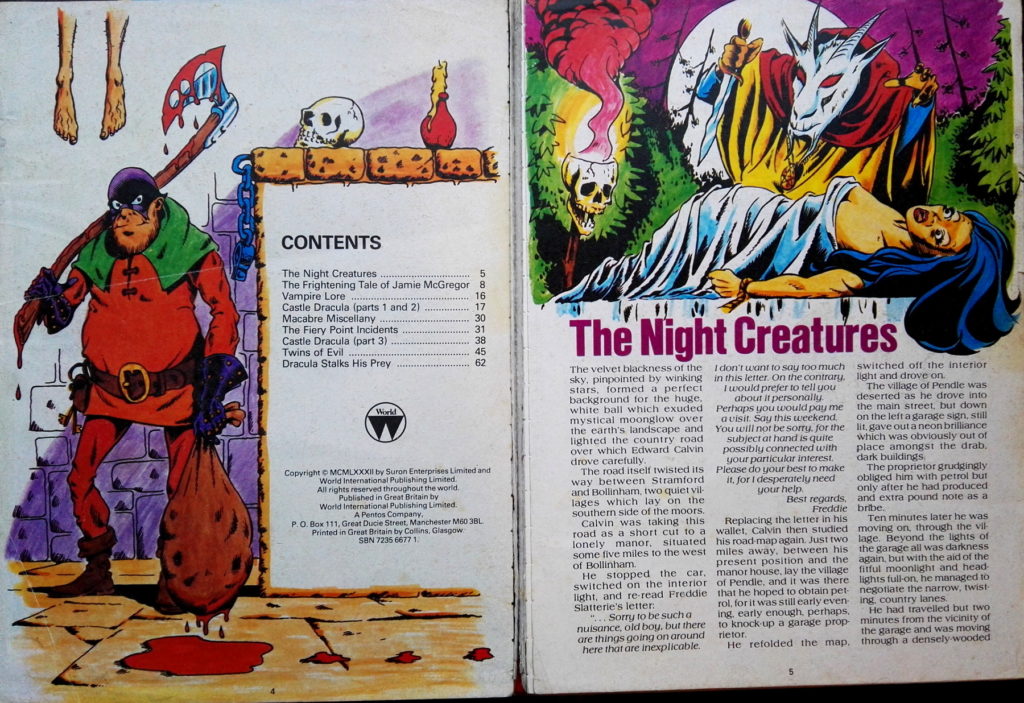
the beginnings of horror fandom? Dracula’s Spinechillers Annual
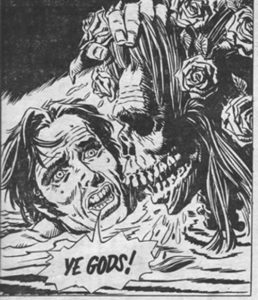
Julio Vivas’ artwork for The Drowning Pond

My interest in horror was probably first awakened when I was still very much a reader of Biggles & co. I loved the Dracula’s Spinechillers Annual I had got for Christmas when I was (I think) 8 or thereabouts. Around that age I also loved the (vastly inferior 80s) Eagle comic  horror spin-off Scream! (which only seemed in my world to exist as ‘specials’ and never as a regular comic) Nevertheless, various things from Scream!, most notably a somewhat folk horror-ish story called The Drowning Pond with its illustrations of a skeleton with flowers in its long hair is still very vivid in my mind. And here it is!


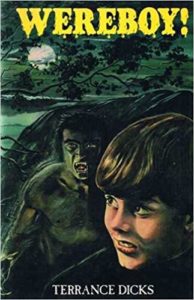
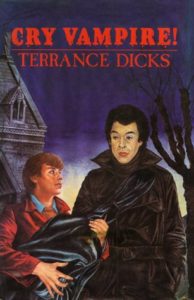
Non-comics-wise, I remember borrowing (Doctor Who author) Terrance Dicks’ Cry Vampire! And Wereboy! from the Mobile Library (itself a very 80s detail although I’m sure they still exist) and loving them, and, later in Primary School Robert Westall’s The Scarecrows, The Watch House, The Wind Eye and The Devil on the Road made a big impression on me (and still stand up well when read as an adult). As a devotee of the phenomenally successful Fighting Fantasy gamebook series, I recall being particularly impressed by the horror-themed House Of Hell, which was very different from the swords & sorcery (or sci fi) leanings of the rest of the series.
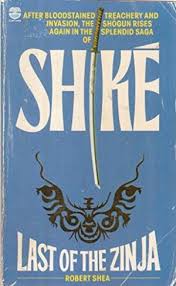
“Zinja” Jesus.

Interestingly (I use that word advisedly, with the caveat; ‘to me’) my interest in gore was parallel to, but not at all dependent on horror. I remember in my English class, at the age of (I think) 12, having to write a story based on Robert O’Brien’s Mrs Frisby And The Rats Of NIMH, and writing, under the influence of Robert Shea’s supremely dodgy Shike: Last of the Zinja books, about ninja rats attacking their enemies and slicing their intestines into ‘spaghetti’. So I was quite ready for James Herbert already.

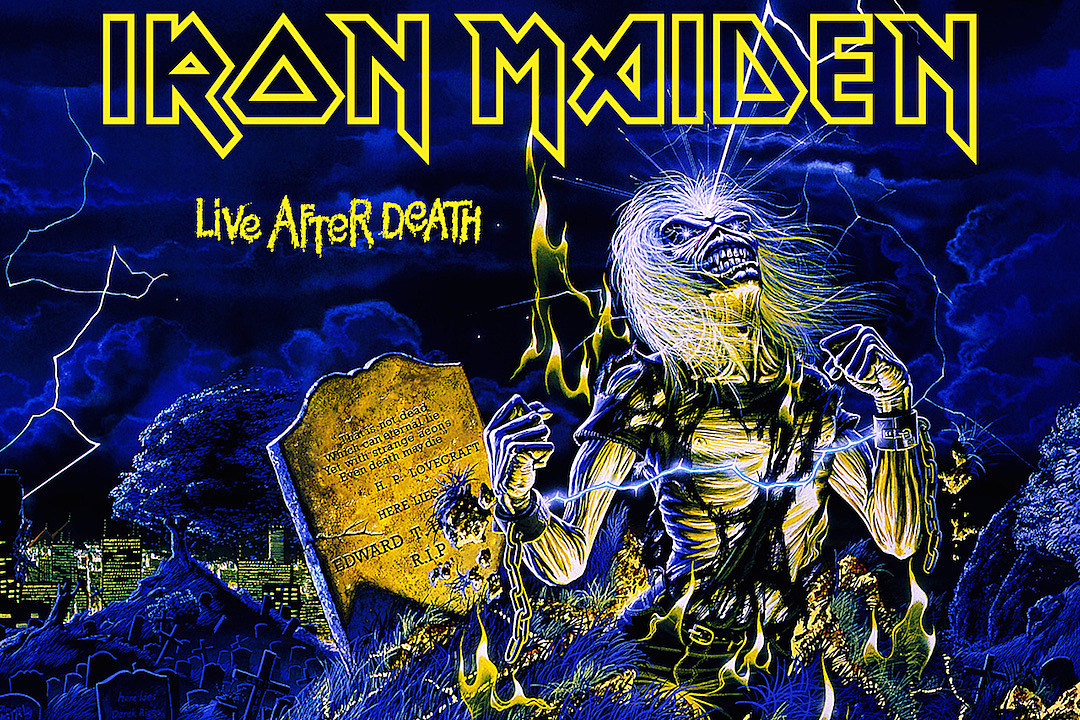
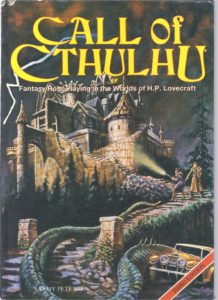
Herbert wasn’t the first ‘adult’ horror author I read though. I think that was HP Lovecraft, who I came to through two sources he would probably have found incomprehensible. Firstly, heavy metal (he is quoted on Eddie’s gravestone on arguably Derek Riggs’ finest – and certainly my favourite as a child – Iron Maiden album cover, Live After Death (1985)) and I came across him again a little later, through the roleplaying game Call of Cthulhu. Not that I played it (though I would have liked to) but as a subscriber to Games Workshop’s White Dwarf  magazine (essentially, I now realise, for the pictures) I became aware of it and my interest in Lovecraft grew.

Derek Riggs’ finest (Iron Maiden) painting? Live After Death (1985) Lots of blue, lots of yellow & a bit of white; genius
Games Workshop’s 80s edition of Call of Cthulhu

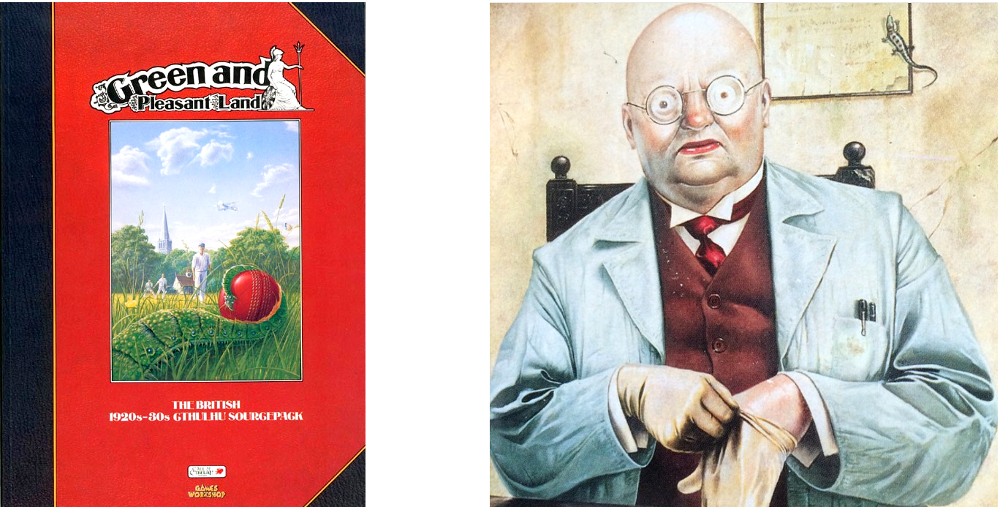
Before reading any actual Lovecraft, I’m pretty sure that I borrowed the game itself in its hardback book edition from the local library (this would either be the Rats of NIMH year or the year after). Shortly thereafter I then borrowed (from the same library – Cupar) a hardback edition of Lovecraft’s The Shadow Out Of Time and other stories and since then, Lovecraft has been one of the few writers I’ve never ‘grown out’ of, or lost interest in. As such, he fades from this article now except for two more observations; firstly, Lovecraft’s protagonists – sensitive, articulate, terrified – are clearly Lovecraft himself. The author died when only a few years older than I am now, but both Lovecraft and his characters will I think always feel older to me than I do. People – like Michael Moorcock (another teenage favourite) – who don’t like Lovecraft’s writing, usually don’t like the florid style and neurotic tone of his stories – the elements which to me are his real strengths as a writer and make his writing – although widely imitated – genuinely inimitable; no-one else captures that tone. Secondly, that first Lovecraft book I read had no illustration on the cover (on the whole I think Lovecraft has been badly served by artists and illustrators, though I love many of their efforts – and anyway it’s his own fault the illustrators so often fail). but two pictures were instrumental in making me want to read his work; there was the art for a Call of Cthulhu module called Green And Pleasant Land that was advertised prominently in White Dwarf, and a Les Edwards painting (possibly unrelated to Lovecraft in origin) used in the Call of Cthulhu book. (Edwards’ Croglin Vampire*, also used in the book was a superb picture too, though less Lovecraftian*)

Lovecraftian inspirations: the cover of a sourcebook for UK based Cthulhoid adventures (left; still love tentacle-meets-cricket) and a Les Edwards painting used in Call of Cthulhu

*Still very interesting however; read about the ‘real’ Croglin vampire here

So anyway; although I have very shadowy memories of reading the opening of Cujo (I think my mum had it) and seeing the film versions of Cujo and Christine, the first horror novels I remember reading in their entirety are James Herbert’s The Rats and Stephen King’s Pet Sematary and It. I remember an interview in FEAR magazine issue two, James Herbert said that the characters in his novels were ‘everyman’ – and in his early novels in particular, it’s a very specific kind of everyman; In The Rats (1974), we meet Harris, “teaching art to little bastards whose best work is on lavatory walls. Jesus Christ!” and “At thirty two he was back [in the East End], teaching little facsimiles of his former self…” while in The Fog (1975) we find that “At thirty-two, [environmental investigator] Holman was still young enough to be angered by the seeming lack of resolution shown by his superiors when he himself had taken great risks to ferret out the proof they asked him to provide.
Variations on these characters – tough, working or lower-middle class, cynical about the motives of those in charge; thirty two – are essentially versions of the young(ish) James Herbert himself, which is understandable, and they were to appear in the majority of his books until the mid-to-late 80s, when he seems to have become interested in characters with a little more individuality. Those ‘everymen’ – Harris, Holman, Pender, Culver, Bishop – are little more than ciphers, characters made of a few (mostly) well-selected details but overall as relatively simple as the dangers they face – that is, rats, fog, more rats, a fog-like darkness etc.

When the stories get more complex, as with The Spear, The Jonah and the aforementioned Shrine, it’s noticeable that the characters do too. In Shrine, the hero, Gerry Fenn is actually younger than usual (29) but even more jaded; a wannabe tabloid journalist(!) who we first meet “tired, angry and a little drunk” and ranting about “rent-a-left” loonies. As a teenager I took James Herbert’s statements about politics at face value (this isn’t quite a quote but I’ll keep the inverted commas as what he said in that issue of FEAR was definitely something like “I’m not anti-right, I’m not anti-left, but those in power always look after themselves”). Now – especially after reading his final novel Ash (2012) perhaps the most unintentionally funny book I’ve ever read – Herbert’s apparently apolitical stance seems – like his everyman character and his ‘have your cake and eat it’ attitude to sex (describe it in titillating detail but punish the characters who indulge in it illicitly) – pretty reactionary, although his point about the powers that be is of course a valid one. But still; maybe the strangest thing about reading James Herbert as an adult is not the paranoia about what governments get up to, or the preoccupation with violent death; it’s that supposed everyman. I guess as a young teenager I saw him/them as simply ‘an adult’, but as an adult – and an older one than most of those characters are – I see him/them as… a bit of an asshole really, which mars the enjoyment of the books a little for me. But maybe just for me; possibly ‘everyman’ really is a centre-right-to-borderline-fascist asshole. Complicating things further, sometimes – as in Shrine and especially some of Herbert’s later books like Creed – it seems like we are definitely supposed to view the character as unsympathetic/unpleasant, which is odd in that it diminishes the effect of the horrors they experience to some extent; the effect is a little like those ‘ghost hunters’ type of TV shows, where noisy, aggressive people blunder around in the dark taunting spirits for not showing themselves and then scream like hysterical children at the least noise or drop in temperature; good.

icons of 80s horror

By contrast, Stephen King is interesting, in that the book that made his name – Carrie – has no hero at all to speak of, just Carrie herself, and the impersonal voices of the various documents that tell her story. As a teenager I wasn’t very keen on the book and found it, despite its brevity, far harder to read than It. I don’t think I really understood its popularity either. Reading it now, I find it far more impressive and effective, maybe because as a teenager, King’s insight into teenagers and their lives seemed unremarkable (ie I literally didn’t give it any thought) whereas now I think it’s one of the key features of almost all of his work that I like the most. In Carrie, as in It, the vividness of the horror is increased by the framing of the story. In It the story is being told “now” (although now is obviously the 80s) and segues into the 1950s sections in a self-consciously cinematic (or televisual) ‘flashback’ kind of way, whereas in Carrie, we know right from the beginning that Carrie’s story has already ended and become history. Although that sounds like it should have a distancing effect, what it actually does is give a feeling of reality. We don’t so much empathise with the characters as look on at their plight – but King is a good enough storyteller to engage the reader’s empathy without having to put them directly into the characters’ shoes.

Stephen King and James Herbert both brought a sense of modern-ness to the horror genre in the 1970s (not that they were the only ones, but for me they were the most important for the 80s horror fiction explosion, Herbert possibly less so in the USA), but they did so through almost opposite means. Both abandoned the gothic/melodramatic/romantic element of horror that had been at the genre’s heart, but after that, they part ways. Herbert is modern via the immediacy of his bluntly explicit descriptiveness; a very 1970s matter-of-factness; cold, harsh and almost industrial (the Throbbing Gristle of horror literature maybe?); horror with no politeness. Carrie, has a cold, clinical, matter-of-fact quality, but it’s entirely unlike Herbert’s – it isn’t about the viscera. With The Rats, James Herbert was telling a nasty story, as vividly and convincingly as he could, to make it feel real. With Carrie, Stephen King heightens the reality by saying this isn’t a ‘story’ at all; this is what happened. As a teenager I mostly preferred James Herbert, but as an adult I find that Stephen King is far easier to enjoy. From the adult perspective, King’s teenagers are still teenagers; in fact even more so than they seemed at the time; whereas Herbert’s adults are ciphers, or in his more developed characters, people who on the whole I just don’t like.

Although I mentioned James Herbert, Stephen King and Clive Barker as a kind of trinity of 80s horror in my Richard Laymon article, Barker is and always was the obvious odd man out of the trio. Firstly because – with a few exceptions – the standard idea of ordinary people encountering horrible things isn’t his primary kind of story. In fact the idea of ‘ordinary people’ isn’t one that I associate with Barker at all; not because (as far as I can tell) he is dismissive of everyday kind of characters, it feels more like he just doesn’t really believe in them. In Weaveworld (1987), the hero is to all intents & purposes ‘ordinary’ – “His name is Calhoun Mooney, but he’s universally known as Cal. He is twenty-six, and has worked for five years at an insurance firm in the city centre.” We first meet Cal trying to catch an escaped racing pigeon. A working class Liverpudlian in the 80s seems the very epitome of ordinariness, but as his name indicates, there’s always something a little otherworldly about Cal (even compared to for instance, the villainous, magic-using  Shadwell, who fits in in Cal’s prosaic world far more easily than Cal himself seems to). I can’t remember if I felt this way about Cal, or the book itself when I first read it (another library acquisition I think, I certainly read it at the time of its first paperback edition if not before). He seems a younger, stranger character than I remembered; but then the whole book feels stranger. Not so much the overtly fantastical parts, but the Liverpool-set opening chapters.

Without thinking much about it, I had always assumed that Weaveworld was set “nowadays”, i.e. in the late-80s, when it was published, but there are odd mentions, such as the police arriving in a ‘Black Maria’ – I don’t know when the UK police stopped using black vans, but I know that even in my earliest recollections (late 70s/early 80s) they were white – that make the Liverpool Barker describes feel both specific and vaguely unreal. Is this intentional? Clive Barker grew up in working class Liverpool himself, in the 60s and 70s, but was not much older than Cal Mooney when writing Weaveworld (I wouldn’t be at all surprised if he started writing it when he was 29 in fact). And yet;  I remember seeing him on TV around the time the book was published and being surprised at his relative lack of a Liverpool accent; perhaps because of his background in theatre and experimental filmmaking he seemed at ease on television, but always has a hint of the otherworldly quality I associate with his work. Weaveworld  has been ‘in development’ in Hollywood for years, but I’d say that unless they can somehow go back in time and get the young Clive Barker, the production will never have the right Cal Mooney. In fact this 1988 interview with both Clive Barker and James Herbert could almost be with “Mooney” and “Harris” and probably tells you everything you need to know about the differences between the two authors’ work; If Harris, Holman et al are James Herbert and the gritty urban settings of London and its environs are their natural habitat, then Cal Mooney equally is Clive Barker, and ghost-Liverpool and the magical world of The Fugue is his. And I’m not sure either author had it in them – at that time at least – to write convincingly about the world of the other, even if they had wanted to.

So what of it all? I don’t know; are there conclusions here? Reading favourite teenage books is like visiting your school long after you left it – everything is familiar, but smaller than you remembered. Genre fiction is by its nature somewhat generic, and is largely plot, rather than character-driven. Lovecraft again is an exception, because somehow his stories manage to be neither plot, nor character driven, so much as they are perspective-driven; sometimes the horror, omnipresent in his best work, has very little narrative to fuel it, just a tone of voice. The heroines and heroes of most of the horror, fantasy and sci-fi I used to devour as a teenager were mostly there as stand-ins for the reader, or for the writer. Most horror authors whose careers last any length of time start to write novels about writers, just as successful musicians start writing songs about being on tour. Going all the way back to Mary Shelley and Bram Stoker, the villains in horror have always been more memorable than the heroes (actually, Frankenstein is more complex than just hero/villain, but I’ll stand by it), in the 80s with horror cinema this becomes even more noticeable…

At some point a real conclusion will come to me and I’ll add it here; until then, the thing I love about these stories? I get older, they stay the same age.


Weekly Wafflings


For a variety of reasons, it’s been far longer than intended since I last posted anything here. So this is now the first of my weekly updates, which will mostly, I hope, be posted every Friday.

It’s been a funny summer; a house move, a lot of nice weather interspersed with a lot of rain, and (ongoing) the most unsettling national/international situation I can remember living through, which has involved are-evaluation of what I believe in politically and so forth – but I have a bigger summer review type thing in the pipeline at some point, so this is just a quick note until I have something more substantial to post. Onwards!

Current listening

I’ve heard a lot of good music recently, both old & new; in regular rotation have been: Egor Galcest_kodama_coverrushin’s beautiful Once and Domenicano, Frank Zappa & the Mothers of Invention’s Burnt Weenie Sandwich  and Uncle Meat, The Beau Brummels (who are never quite as good as I want them to be – ie not as good as The Lovin’ Spoonful) but have some really good songs, Kenny Drew & Niels-Henning Ørsted Pedersen’s Duo, Bessie Smith, a really interesting album called Stations by i am rhino and ruin  which I’ll write about in more detail at some point, the wonderful Annette Hanshaw, John Baizley, Nate Hall & Mike Scheidt’s Songs of Townes Van Zandt, Louis Prima & Keely Smith, Maki Asakawa, Myriam Gendron’s Not So Deep As A Well, Japanese Breakfast, Alcest’s Kodama, Nick Jonah Davis’ House of Dragons, The Pastels, everything I could find by the brilliant Stupid Daikini, the new Wardruna album, Yurei’s Night Vision, Nick Cave & The Bad Seeds’ Skeleton Tree, Madder Mortem’s Red In Tooth And Claw (which reminds me in some ways of the amazing Jingo de Lunch album Perpetuum Mobile) and Rachel Mason’s forthcoming and very addictive Das Ram, among other things, which brings me to…

Albums of the Year

kristin-hersh-wyatt-at-the-coyote-palace-book-coverI haven’t started making an actual list yet, but it’s that time of year when some albums have firmly earned their place in the AOTY list and others are looking likely. It would be nice if Prophets of Rage released an album, but oh well. I’ve no idea how long the list will be, but I can say at this point that it will certainly include Bowie’s Blackstar, Iggy Pop/Tarwater/Alva Noto’s Leaves of Grass (not really an album but I’ll make an exception), Darkher’s Realms, Emma Ruth Rundle’s Marked For Death and Kristin Hersh’s amazing new book/double album Wyatt at the Coyote Palace.
*coincidence of the week!*

there are currently two lovely & sad (though otherwise not alike) songs called ‘Guadalupe’ regularly visiting my ears; one by the aforementioned Kristin Hersh and the other by Esmé Patterson.

Current Reading

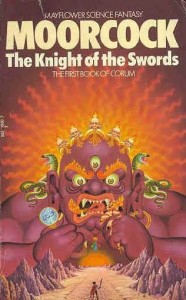
I read Gail Carriger’s The Custard Protocol books way too fast and then spent the summer reading other things, notably Truman Capote’s In Cold Blood which was just as gripping and vivid and horrible as I remembered and Michael Moorcock’s two Corum trilogies (now on the last volume) which have been surprisingly comforting, not just because they are old favourites, but because of the rational but not backwards-looking philosophy that underlies Moorcock’s writing, even when the books are at their most corumtypically ‘heroic fantasy’/swords and sorcery in their stories and action:

“Do you know that you dream of these gods – that you are stronger than they – that when you are fearful, why then you bring fearsome gods upon yourselves? Is this not evident to you?”

“Everything may exist for a short while – even justice.  But the true state of the universe is anarchy. It is the mortal’s tragedy that he can never accept this.”

Other forms of entertainment

Grim times call for light entertainment (sometimes anyway); and I have watched and enjoyed an inordinate amount of Columbo and M*A*S*H in recent weeks/months; which suggests that war and murder are more soothing than one might expect. Less ephemerally, I have been looking at lots of art, mainly online inevitably, and am especially liking Awol Erizku at present for his re-framing & questioning of art history. So here’s his lovely Girl With A Bamboo Earring:

vermeer_bamboo_600


Until next week…

The Third Monthly Report: March 2016

By this point, 2016 has started to develop its true character, mainly based on famous people dying and political and religious extremism: halcyon days! Ah well, never mind, I’ve listened to, looked at and read lots of things which passed the time pleasantly and helped to block out the nasty stuff: so that’s nice. Re those things, more below…

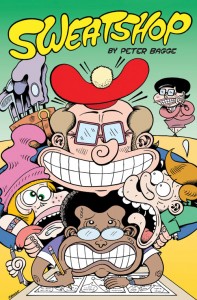
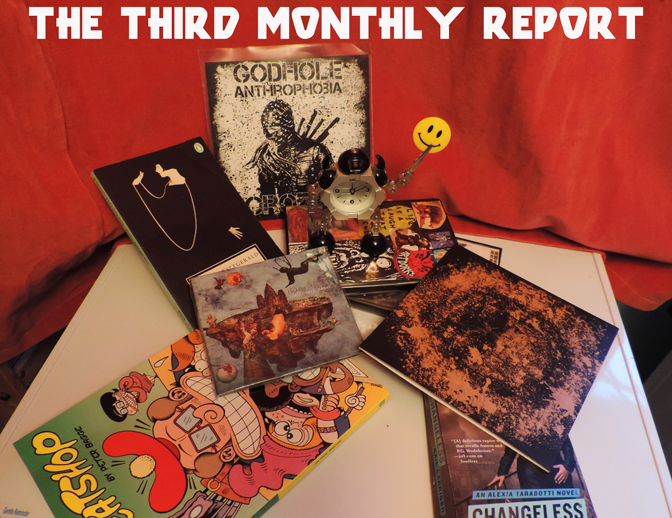
Sweatshop by Peter Bagge (Fantagraphics Books)

1 baggeAt first, Sweatshop feels more like one of Peter Bagge’s more lightweight, knockabout strips like Batboy or Studs Kirby, and compared to the brilliant Woman Rebel it is, but there’s more substance to the characters in Sweatshop than you’d think. This is perhaps because the situation (a group of ambitious young cartoonists working for a grouchy, reactionary, but famous old cartoonist to produce his well-known but trivial newspaper strip) is one close to the hearts of Bagge and his own team of artists. It’s funny and silly, but also well plotted and with some sharp observations about the world of cartooning as well as human relationships etc; a good book in fact.
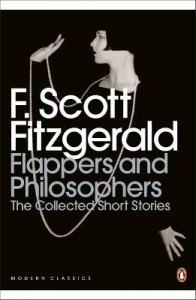


Various short stories by F. Scott Fitzgerald 

fsfThe selection I have was collected by Penguin Classics in Bernice Bobs Her Hair and other stories) I first read Fitzgerald’s short stories when I was a teenager and have gone back to them every now and then. I’m always surprised by how funny and sad they are. I bought Bernice Bobs Her Hair because of the beautiful photo of Louise Brooks on the cover and I’m glad to see Penguin are still using it for a similar book of Fitzgerald’s stories.


Anthrophobia by Godhole/Crozier & Godhole’s s/t EP (Mind Ripper Collective)

godhoI had already heard both of these great releases but when I saw that Mind Ripper were selling them on vinyl 7″s ridiculously inexpensively. Anthrophobia is a brilliant meeting of two very different musical personalities, with Godhole’s intensely emotive and strangely catchy powerviolence being distorted almost to the point of non-music by Crozier’s harsh noise; it’s bracing and not at all pretty, but it has a real impact and is worryingly addictive. The same is true of the Godhole EP, although it is relatively more disciplined insofar as it sounds like a band, rather than a catastrophic nightmare.
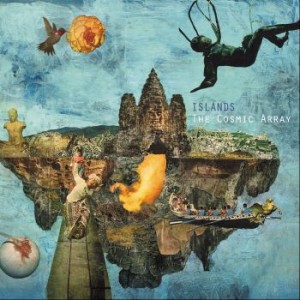


Islands by The Cosmic Array (Folkwit Records)

cosmicFor 99% of the time, a complete contrast with the above (though the second half of Drones is surprisingly noisy and atonal), I was especially impressed by the forthcoming Cosmic Array album because I didn’t expect to like it at all. “Alt country/Americana”, ‘immersive and cinematic’ or not, is not really my thing* but in fact this album brings together a beautifully peculiar space-age melancholy that has (to me) hints of the Flaming Lips, Spacemen 3, My Little Airport and even the BMX Bandits and a sound that is a hybrid of UK indie and alt country (Fire Up The Sky is, strangely, almost shoegaze-alt country; actually, Moose’s XYZ was a great shoegaze/Americana album, so maybe not so strange?). Anyway; the songs are catchy and nice, Paul Battenbough and Abby Sohn are really good, expressive vocalists and it really is a big, widescreen cinematic sound as advertised; so put aside anti-country prejudices (if like me you have them) and give it a listen.


*BUT: check out Hale (2012) by The Sterling Sisters if you’ve never heard it: great


Gensho by Boris with Merzbow 

GD30OB2-N.cdr

From mellow Welsh-American music to Japanese heavy noise; Gensho includes a cover, swathed in echo and delay, of perhaps my favourite My Bloody Valentine song, Sometimes and that kind of sums up the album; it’s beautiful and haunting and harsh and (only occasionally) nearly unlistenable, but it’s great. Merzbow’s harsh, but essentially malice-free abstract noise takes (to say the least) the slightly saccharine edge off of the more pop/shoegaze direction Boris has been making over the last few albums and Boris’ essential musicality makes Merzbow feel less like an experiment to test the capabilities of your speakers/ears; less background/white noise-like. It’s a great partnership and I’d like them to explore it further.


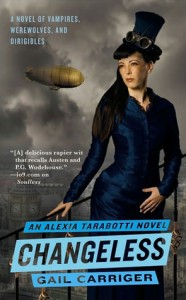
Changeless by Gail Carriger (2010) 

gail

 A lightning-fast re-read for possibly my favourite of Gail Carriger’s brilliantly witty and tongue-in-cheek steampunk novels concerning the soulless heroine Alexia Tarabotti; I don’t really believe in having crushes on fictional characters, but if I did, I would. I think it was at the end of this book that I realised how much feeling I had invested in the characters. Although she is often compared to PG Wodehouse (fair enough in a way), I’d say (if forced to compare) that for me, Gail Carriger combines the lightness of tone and depth of feeling that I find in two of my favourite ever books; The Rock Pool by Cyril Connolly and Afternoon Men by Anthony Powell.


Bacteria Cult by Kaada/Patton (Ipecac Recordings)      

kaadabacteria The third collaboration between Mike Patton and John Erika Kaada is, despite the ominous title, an extremely wide ranging and often light-toned (if moody, in the film-soundtrack sense) collection of dramatic and sometimes operatic (but not always melodramatic) pieces, ranging from the strangely Tom Waits-like Papillon to the Morricone-ish Black Albino. It’s a perfectly judged album, Mike Patton’s voice(s) interweaving with the orchestra to create individual pieces that are at the same time short and vast;too involving to be ‘background music’ it really does sound like an epic soundtrack in search of who knows what kind of film.
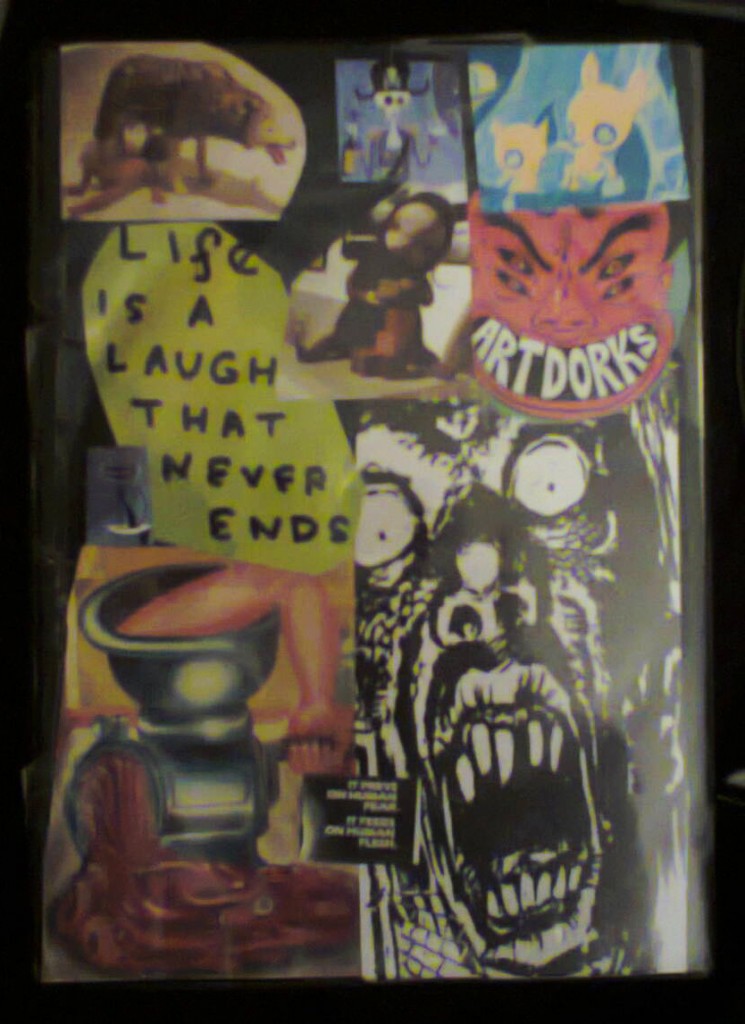
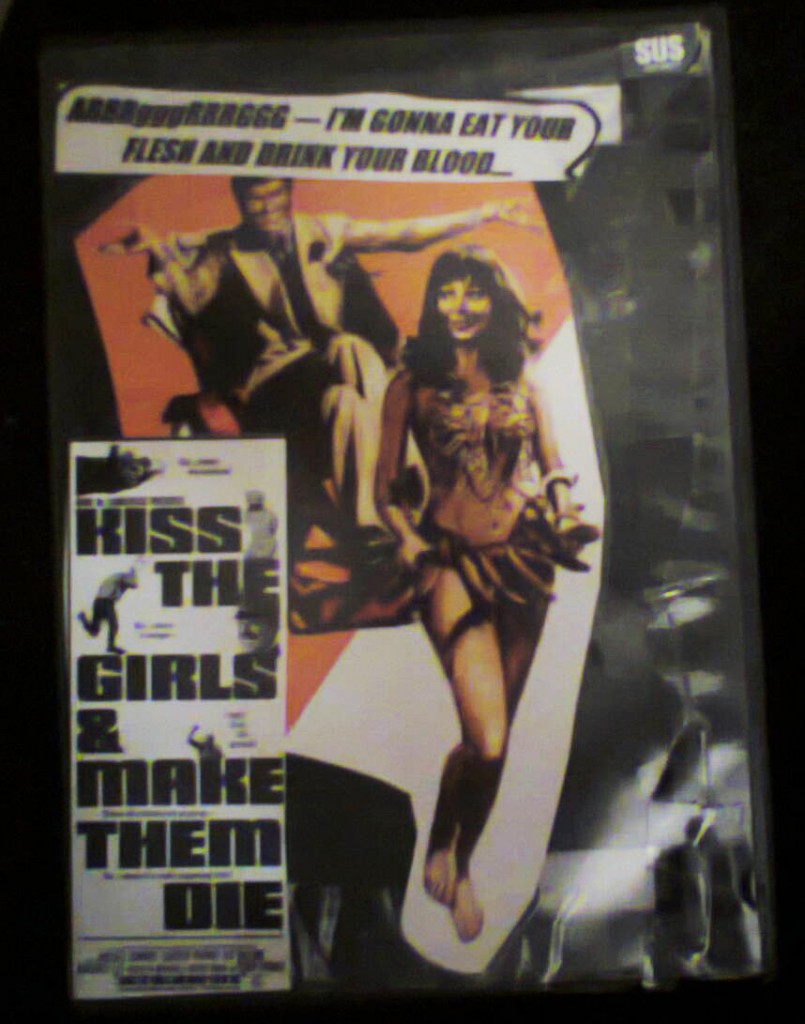


I also rediscovered to mix CDs (never sounds as good as ‘mixtape’) made for me by a friend years ago which embody all that is great about a classic mixtape; I didn’t know all the songs (or bands) before I heard them and I didn’t end up being a fan of everything on them, but there’s something about a home-compiled (nowadays people would probably say ‘curated’) tape of someone else’s music that is fascinating and entertaining, plus these have fantastic collage artwork. I hope the ‘youth of today’ still makes these kinds of things! Anyway, offered here as a kind of playlist not of my making: much of which is recommended –

WEIRD MIX

  1. VHS or Beta – Heaven  weird
  2. Toadies – Possum Kingdom  
  3. This Mortal Coil – Holocaust 
  4. Thee Headcoats – I’m Unkind
  5. The Locust – Skin Graft At 75
  6. Strung Out – Tattoo
  7. The Specials – Too Much, Too Young
  8. Sneaker Pimps/Portishead – Water
  9. An Albatross – The Great Sarcophagus
  10. At The Drive In – This Night Has Opened My Eyes
  11. The Buggles – Video Killed The Radio Star
  12. Billie Holiday – On The Sunny Side of the Street
  13. Billy Bragg/Wilco – Ingrid Bergman
  14. Blondie – One Way Or Another
  15. Bouncing Souls – Break Up Song
  16. Bright Eyes – Something Vague
  17. Cat Power – Where Is My Love?
  18. Cranes – Lilies
  19. The Faint – There’s Something Not As Valid When The Scenery Is A Postcard
  20. Fugazi – Waiting Room
  21. Go-Gos – Lust To Love
  22. The Mars Volta – Son et Lumiere
  23. Mates of State – I Got A Feelin
  24. Mates of State – I Have Space
  25. The Misfits – Scream
  26. Screeching Weasel – Zombie

STUFF + THINGS

  1. Bright Eyes – The Calendar Hung Itselfstuff
  2. Gogol Bordello – Bulla Bulla
  3. Ima Robot – Dirty Life
  4. Ima Robot – Twist + Shout
  5. Frou Frou – Breathe In
  6. Placebo – Blind
  7. Devandra Banhart – My Ships
  8. Devandra Banhart – Legless Love
  9. The Cramps – Eyeball in my Martini
  10. Nightmare of You – Thumbelina
  11. Nightmare of You – In The Bathroom
  12. Jets To Brazil – Chinatown
  13. Sleater Kinney – Funeral Song
  14. Sleater Kinney – Dig Me Out
  15. Sonic Youth – 100%
  16. Tegan and Sara – Walking With A Ghost
  17. Tiger Army – Never Die 
  18. Tilt – Libel
  19. The Weakerthans – Wellington’s Wednesdays
  20. Yeah Yeah Yeahs – Date With The Night
  21. William Shatner – I Wanna Sex You Up
  22. The Smiths – The Boy With The Thorn In His Side
  23. Scarling – City Noise
  24. Roy Orbison – In Dreams

and there you have it: March 2016 – onwards!


The Second Monthly Report: February 2016


A short month, but full of things, not least my own birthday! So plenty of stuff to discuss…

Unfortunately, David Bowie is still dead and in fact has been more productive than ever as a commercial entity, as music, magazines, TV shows, pop stars and books pay tribute to the great man.

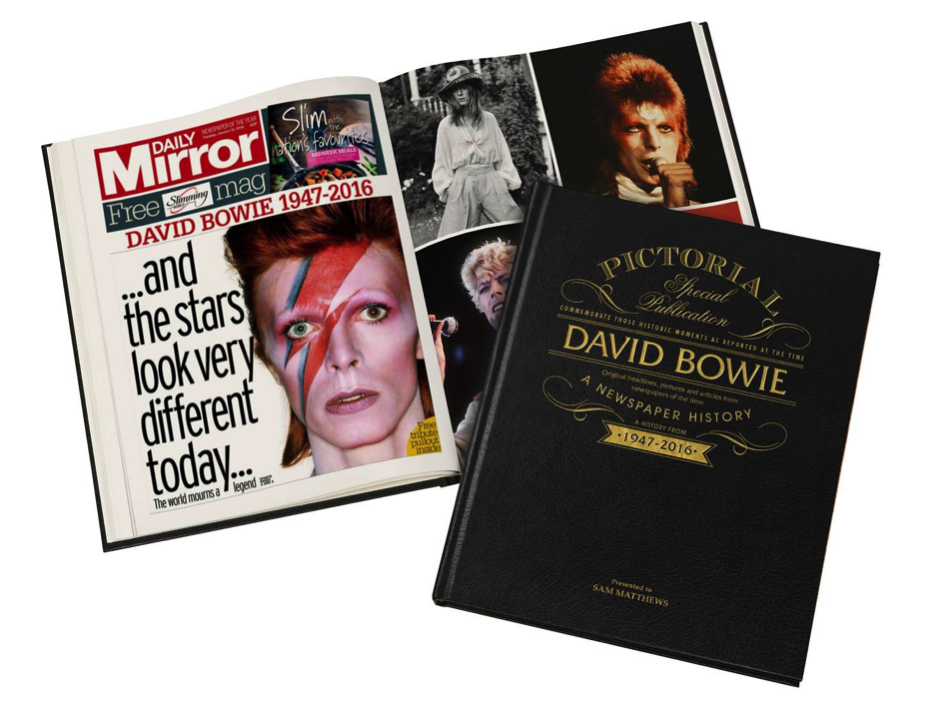
One of the more unusual books to appear in the wake (sorry) of Bowie’s death is the (big even for a coffee table) book: produced by the personalised gifting website ijustloveit.co.uk:

David Bowie: A Newspaper History

meer

Published in a large (indeed, tabloid newspaper) format, but with an embossed leather cover, David Bowie: A Newspaper History is an extremely fascinating but mostly not at all heartwarming memento of a career of dazzling highs and normal human lows as seen through the distorting lens of The Daily Mirror; revealed here – in case you didn’t suspect it – as a sensationalist tabloid that never really understood anything about the man except for his fame and newsworthiness. Although there is some introductory scene-setting concerning the outrageously long-haired Bowie of 1965 (with a great full-page photo) and a brief snippet about his Man Who Sold The World man-dress, the book really takes off, as one would expect, in 1972, when Bowie became a household name after the Ziggy-era singles began to chart, to the bemusement of the older generation and, one assumes, the readers of the Daily Mirror.

For the next few years, the Mirror veers between the predictable extremes of fashion icon idolatry and ‘has-he-gone-too-far?’ tabloid outrage. So we see David and Angie, the toast of the fashion world, David and Lulu, the ‘odd couple’, ‘Bowie Goes Straight!’ as glam rock dies, depressingly muck-raking coverage of David and Angie’s separation (“ZOWIE: boy in the middle”), rumours about his love life, innuendo about his drug use, continuing surprise at the longevity of his career and good health. What makes the book so fascinating is that the Bowie stories are framed with whatever else was going on at the time; political scandals, murder, adverts for banks, cheap chicken, New Mirror Bingo, all giving a vivid and immediate contemporary context that a biography can only do justice through exposition and anecdote. It also incidentally shows how central Bowie was, and continued to be, to popular culture in the 70s and 80s; film and television, Live Aid, riots in Brixton, new advances in technology and marketing (‘Vote for the songs you want to hear on Bowie’s 1990 tour’); Bowie was there, leading, following, keeping his distance or taking part; it’s no wonder his absence is felt so keenly.

If the tabloid culture of the 70s and 80s was deplorable but kind of fun in its eminent shockability, worse was to come in the 90s. The Mirror may(?) have been a cut above The Sun or News of the World, but its journalism epitomises the tabloid culture where anything private is ‘secret’, non-married partners are invariably ‘lovers’ and the language used is a bizarre mixture of pedestrian illiterate-friendly English, salacious puritanism and puerile baby-talk. From being the ‘bizarre pop phenomenon’ of the 70s and ‘pop chameleon’ of the 80s, Bowie now becomes just ‘rock star David Bowie’ and the Mirror wants to have its cake and eat it; being shocked and condemnatory where there is suspicion of drug use or disharmony between Bowie and ex-bandmates, shocked/amused by anything vaguely unusual that Bowie said/did/wore (We can be hairdoes..), but also devoting ‘heartwarming’ stories to anything that normal famous people do; a full page is devoted to the birth of his daughter (Daddy Stardust) and his recovery from heart surgery (I AM HUNKY DORY).

snobo

In amongst all this are a some genuinely interesting pieces; a fairly short and shallow interview with Alun Palmer in 2003 is fascinating because the Mirror wanted to know about things that NMEMojo etc didn’t; his health, his personal life, his smoking; everything in fact except the actual music he was making.

In more recent times it all becomes a bit reprehensible; Aladdin Retirement (2012) attempts to pry into his private life and quotes nameless ‘friends’ about his desire to avoid the limelight without the slightest sense of irony or self-awareness. Even worse are the frankly vile speculations by ex-music journalists who should know better concerning his flurry of activity in 2013 (DOES A TRAGIC REASON LIE BEHIND THE THIN WHITE DUKE’S RETURN?) which fizzle out as Bowie doesn’t die and the paper loses interest, instead satisfying itself as usual with photos of Bowie caught off-guard, looking normal and, sin of sins, his age.

And then, inevitably, comes Blackstar (Album of the Week no less; actually a very good review) and then the obituaries; the hypocritically respectful overviews of his life and career intercut with whatever snippets and details they could get on the state of his health during the final months of ‘secrecy’ while he fought cancer.

David Bowie: A Newspaper History is a fascinating, absorbing book. Fans, people who have followed Bowie’s career and work will find in it hundreds of photographs they may not have seen before, the kind of stories that don’t make it into serious biographies, but also a peculiar parallel universe where their hero is distorted into somebody that only unbelievers will recognise; David Bowie the ‘superstar’.

Highly recommended; in an odd way it’s a very fitting memorial to a life lived in public, even if it leaves a funny, slightly bitter taste in the end.


Some music that occupied the ears during February:

The reliably interesting Folkwit Records have a few excellent new releases:

RivsAstrophysics Saved My Life is the second album by folk-rock group Rivers of England and it’s a rich, accessible and pleasant album that wears its unorthodox aspects very lightly. The most audible reference point is less folk (let alone ‘folk rock’) and more the jazzy John Martyn of Solid Air, although Rivers of England’s sound is never quite as unearthly as that comparison suggests, not least because singer/songwriter Rob Spalding has a David Gray-like (though not David Gray-sounding) directness in his vocal performances that is very different from John Martyn’s allusive, intuitive delivery.  It’s a strong set of songs that seems set for mainstream success; they would be an eminently suitable festival band, so hopefully they should be on some main (or at least big) stages this summer.
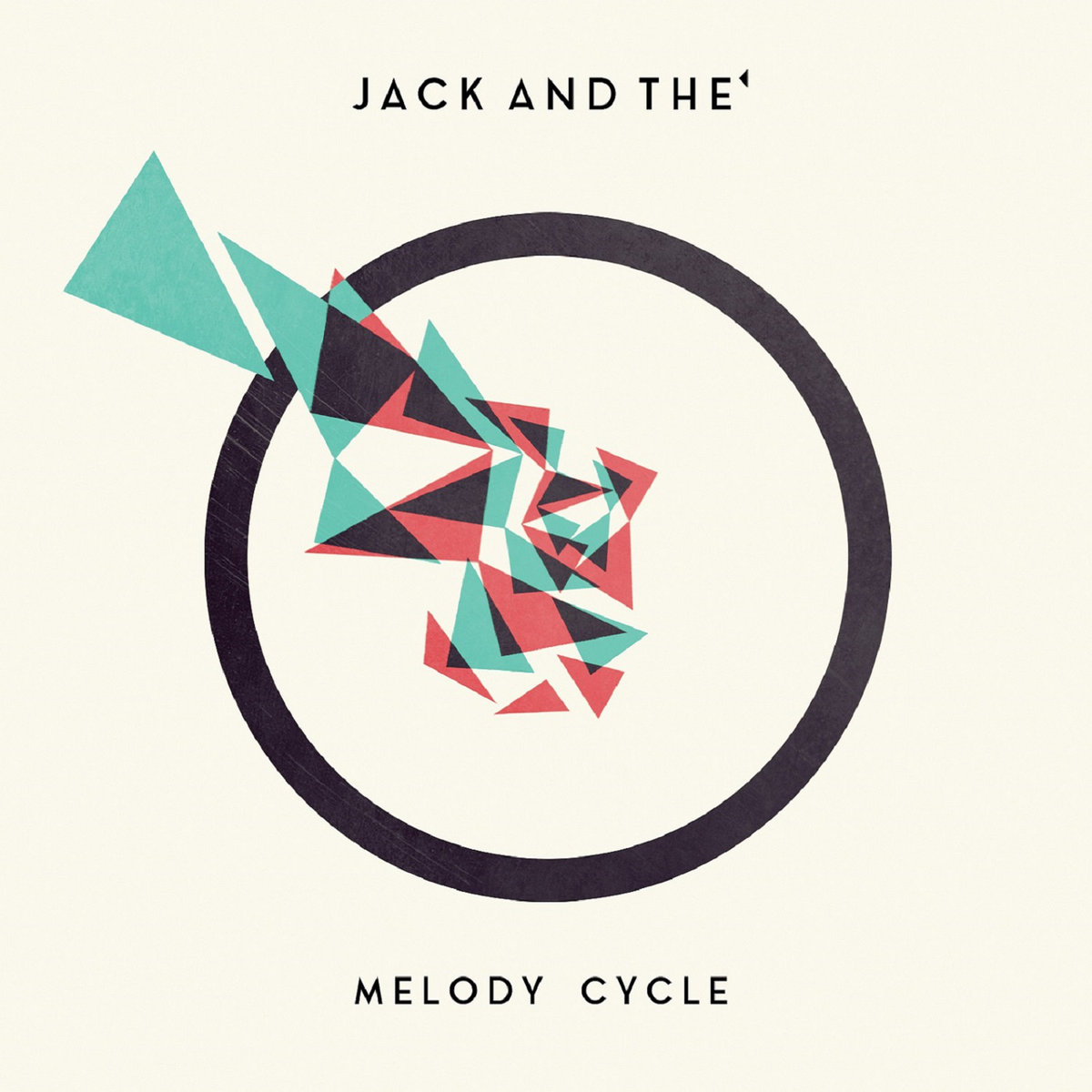


jackanLess ‘normal’ and slightly more my cup of tea is Melody Cycle  by Jack And The’, the musical project of Edinburgh-based French multi-instrumentalist Julien Lonchamp.

The album presents, in beautiful widescreen clarity, a kind of incidental-TV-music-baroque-jazz-pop that has a breezy charm that veers towards twee-ness at times, but is so brilliantly orchestrated that its complexity never overwhelms its sunny, life affirming quality. If you imagine The Beach Boys’ immortal ‘Aren’t You Glad‘ being played by a French version of Cornelius’ old band Flipper’s Guitar aided by Roy Wood-era ELO on strings and woodwind and you are not only being weird but possibly getting close to the sound of Jack And The’; better just to listen to Melody Cycle though, that way you’ll know exactly what it sounds like.


Away from Folkwit, I fell in love with sound artist Lisa Busby‘s superb Fingers In The Gloss, lutenist Josef van Wissem‘s beautiful new album When Will The Bright Day Come and the Iggy Pop/Tarwater/Alva Noto Walt Whitman release Leaves of Grass and some great songs by awesome synth-punk/pop duo Sex Cells but as I’ve written about those in depth on the brilliant site Echoes and Dust I shan’t discuss them further here; but check them out though. Also great is the new Hexvessel album, When We Are Death, see the new issue of Zero Tolerance Magazine (issue 071) for more on that, including my interview with frontman Mat McNerney (also of Grave Pleasures, CODE, DHG etc)


arktis-2-01In a heavier vein than the Folkwit records, my favourite metal musician Ihsahn is preparing to release his new album Arktis. through Candlelight Records. Where Das Seelenbrechen (my favourite Ihsahn album to date) mixed avant-garde electronica, classic songwriting, Scott Walker-ish experimentation and rock and metal elements, Arktis. feels like a true successor to the first two Ihsahn albums, The Adversary and angL. It’s an unashamedly, exuberantly heavy metal album for the most part, and while it isn’t without experimental elements it feels like Ihsahn is concentrating more on songwriting, the riff and having fun; and it’s great.



holocaustSpeaking of unashamed heavy metal, an unexpected treat to (belatedly) come my way was the latest albums by Scottish NWOBHM legends HolocaustReleased through Sleaszy Rider RecordsPredator is 100% a classic metal album, displaying that the band have lost none of the fire or power that brought them to the world’s attention with The Nightcomers back in 1981. As with fellow NWOBHM survivors Saxon, the band’s approach bears little resemblance to the kind of nostalgic pastiches of 80s metal made by so many modern ’80s style’ bands, instead drawing on the same impulses that made the NWOBHM so vital in the first place; passion, skill, good songwriting and an absolute disregard for the dictates of fashion.
Predator isn’t only a great set of songs, it’s a heavy metal album for the twenty-first century and not just for ageing metal warriors longing for the golden age of their youth. They will like it too though.


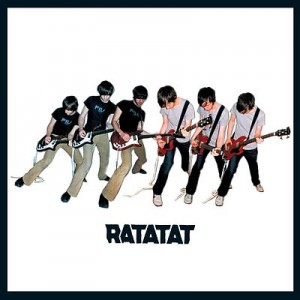
RatatatcoverAway from current releases, birthday presents allowed me to overdose on the works of RATATAT, specifically their perfect debut album as well as LP3 and LP4. RATATAT are an interesting band to study chronologically, since their work manages to be both hard to label and surprisingly homogenous in itself. LP3 feels like the most experimental of the three (of all their albums in fact), but it’s a slightly deceptive perception, since LP4  was mostly recorded in the same sessions, so it’s mostly a matter of selection. It feels as though the duo are attempting to explore all of the possibilities within a fairly narrow range of sounds/styles and since their latest album Magnifique (2015) is perhaps their best to date, they hopefully still have plenty of exploring to do.



NationofMillionsGoing back in time, but never sounding more relevant than it does in 2016, Public Enemy‘s immortal It Takes A Nation Of Millions To Hold Us Back was being played probably too loud in my earphones for much of the month. Listening to Chuck D’s incredible delivery on songs like Louder Than A Bomb (to me one of the best rap performances I’ve heard) two things spring to mind; firstly that Chuck D has the perfect balance between power/authority/style and coherently getting his message across, and secondly that, from the perspective of Public Enemy in 1988, the USA in 2016 is probably both better and worse than they could have foreseen.

 

If all Public Enemy had done was to inform and warn though, they would certainly have been important, but they wouldn’t necessarily have been one of the great musical groups of all time; It Takes A Nation Of Millions… is also a superb album just as sound. Terminator X’s innovative sampling and superlative turntable skills and Flavor Flav’s irrepressible personality bring as much to the album as Chuck D’s more authoritative persona and it’s no surprise that the album was embraced by kids and critics, people of all races and nations; that’s what classic albums do.


lencoOlder still, Leonard Cohen‘s Songs From A Room is an album I knew but didn’t own and it seems as good a place as any to start with his work. Strangely, I mainly know the songs from trying to learn to play the guitar with them (I can’t remember why, but the songbook for Songs From A Room and a Songs of George Formby were the only two chord books I had for years; sounds like a charity shop purchase). Maybe it’s because I spent large chunks of late adolescence listening to Joy Division, Cranes, The Smiths etc, but I don’t find Leonard Cohen at all depressing; and really, if as people often claim apologetically, ‘he isn’t really a singer, he’s a poet’, then what is Bob Dylan, or even Lou Reed? Cohen’s voice may not be flamboyant, but it’s inherently musical, and it delivers his emotionally complex lyrics with perfect clarity. The musical sparseness of the album too is a plus, stripped of late 60s ornament, it is timeless and beautiful.
I read some books in February too.


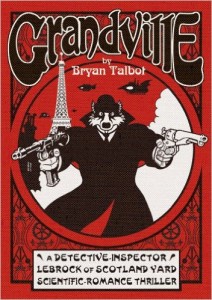
grandAn extremely fun, quick, easy but not simple read was the first volume of Bryan Talbot‘s graphic novel series Grandville. Named in honour of the French caricaturist Grandville* the series consists of old fashioned ‘scientific romance thrillers’ that are part pointed steampunk satire, part Rupert the Bear; a very satisfying mixture as it turns out, and beautifully designed and drawn too. As it happens, Bryan Talbot had already drawn possibly my favourite ever steampunk comic art in his tenure as artist on Nemesis The Warlock in 2000AD comic. His ‘Gothic Empire’ episodes are beautifully atmospheric, some of the finest artwork from one of 2000AD’s golden ages.

*Jean Ignace Isidore Gérard; Freddie Mercury was also a fan, the imagery of his final Queen album Innuendo was influenced by Grandville


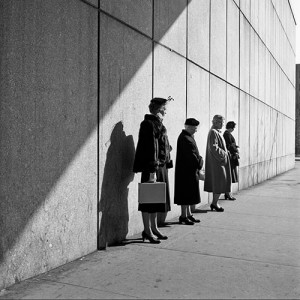
vvAnother book with pictures is the brilliant Viviavv2n Maier: Street Photographer edited by John Maloof and published by powerHouse Books. Another beautifully designed book, it collects the amazingly evocative street photos of Vivien Maier, taken from the 1950s onwards but not discovered until after her death in 2009. As a record of the minutiae of everyday life in big cities in days gone by, her photographs would be valuable enough; but they are also the testament to a genuinely remarkable photographic talent, a photographer who knew exactly what would make a good picture and how to capture it, both naturally and strikingly.
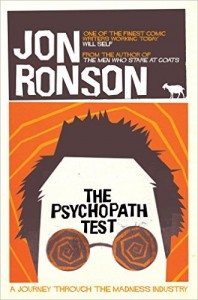


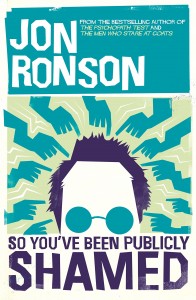
psychAs February ends, I’m reading Jon Ronson‘s now famous Theronso Psychopath Test. A superb and funny investigation into the nature of madness of various types, it retrospectively suffers a little from its own success, the ideas and stories having been widely disseminated since publication (Channel 4’s Psychopath Night etc) and on the whole I think I prefer his latest, So You’ve Been Publicly Shamed (recently published in paperback) which should be made mandatory reading for anyone who uses social networking sites or thinks that the world needs to hear their opinion. It’s genuinely one of the best books I’ve read in a long time and manages to say something new and meaningful about the ways the world has changed over the last few years while no-one was paying attention, except to their computers and phones.
Oh; here’s five minutes of your life you’ll never get back:

https://www.youtube.com/watch?v=jsBAmwSgX7w


Anyway, onwards: March!

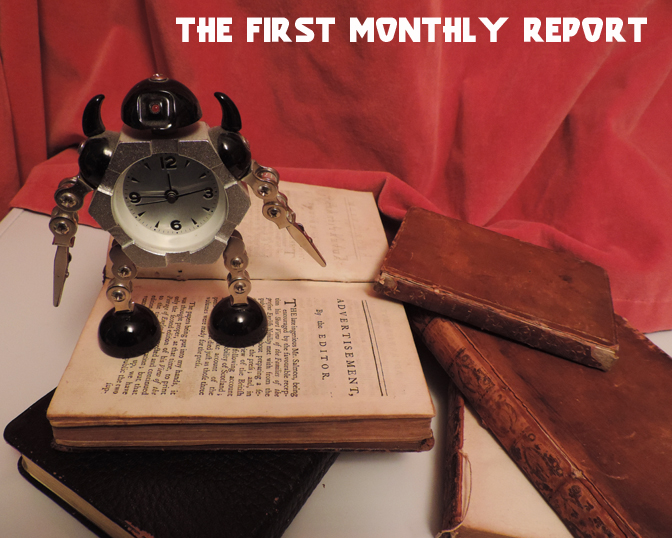
The First Monthly Report: January 2016


Along with some tragic deaths, abysmal weather and so forth, 2016 began with lots of good stuff, some of it inevitably acquired at christmas, like for instance…

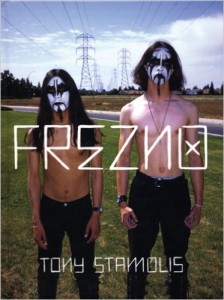
FREZNO by Tony Stamolis (Process Books, 2008)

frez

Frezno is great partly because photographer Tony Stamolis’ hometown Fresno is, or appears to be, pretty much anywhere. The great cities of the world have their special charm and character, their iconic structures and buildings, their famous associations. Fresno has wasteland, litter, housing projects, car parks, people, stuff. Most of us see this kind of stuff every day, but mostly we don’t really notice it. Tony Stamolis not only notices it, but records it. His eye for significant detail is unerring; this isn’t an accumulation of lowlife sleaze and slum glamour, it’s life as it is it is lived by people everywhere, the poetry of unglamorous everyday-ness; which was good enough for James Joyce after all.

Conny Ochs – Future Fables (Exile on Mainstream)

conny-ochs-future-fables

This is one of those surprisingly rare albums that is really all about the songs. Conny Ochs has worked in a variety of alt-rock and Americana-ish styles, but here style takes second place to classic, simple songwriting; catchy tunes with guitars/bass/drums that are the perfect vehicle for Ochs’ expressive voice and thoughtful lyrics. Not in the style of anyone, but if you like Elliott Smith or early Neil Young, check this out.

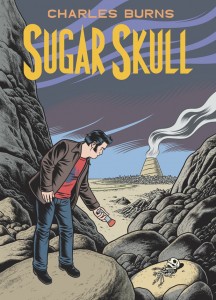
Charles Burns – Sugar Skull (Jonathan Cape, 2014)

burnsy

Charles Burns ends his utterly grotesque but beautifully drawn three part graphic novel with a typically enigmatic, but thankfully satisfying final part. The story is virtually impossible to summarise, but feels like an (autobiographical?) adolescent-becomes-adult rights of passage story told as a dream narrative by William Burroughs and HP Lovecraft and illustrated by Herge. The hard-edged drawing style and psychological horror makes for an uneasy but gripping mixture and if the trilogy is in the end less emotionally disturbing than Burns’ oddly anguished The Black Hole, it’s more readable and probably his most artistically accomplished work to date.

Richie Hawtin – From My Mind To Yours (Plus 8)

hawtin

Richie Hawtin returns, laden down with honorary doctorates, to demonstrate that techno, reduced to beeps, beats and peculiar noises, can be as expressive and unique as any music can in the hands of a master. Pristine sound, nocturnal atmospheres and abrasive textures make this a classic of headphones techno, although you probably can dance to it, if that’s your thing.

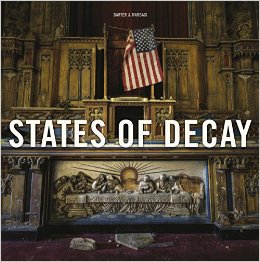
States of Decay – Daniel Barter & Daniel Marbaix (Carpet Bombing Culture, 2013)

states

Carpet Bombing Culture’s series of beautifully produced books on Urban Exploration and abandonment goes to the USA with this stunning collection of photographs of mysteriously abandoned and neglected theatres, railway stations, churches, industrial sites and hotels, captured in all their haunting, haunted beauty. As with most Urbex books, it’s the strange mix of nostalgia, sadness and disbelief that makes this so special.

Abbath – Abbath (Season of Mist)

abbath

There was every reason to expect something like a repeat of Abbath’s solo project I, whose Between Two Worlds (2006) was a good, fun metal album with some great moments. But the former Immortal frontman significantly upped the ante with this powerful (but still fun) collection of black-tinged metal anthems that proved that whoever won the name and wrote the lyrics, the spirit of Immortal resided in the man who gave it one of the most distinctive voices and faces in metal. Appropriately triumphant.

There’s definitely more; but this will do for now 🙂


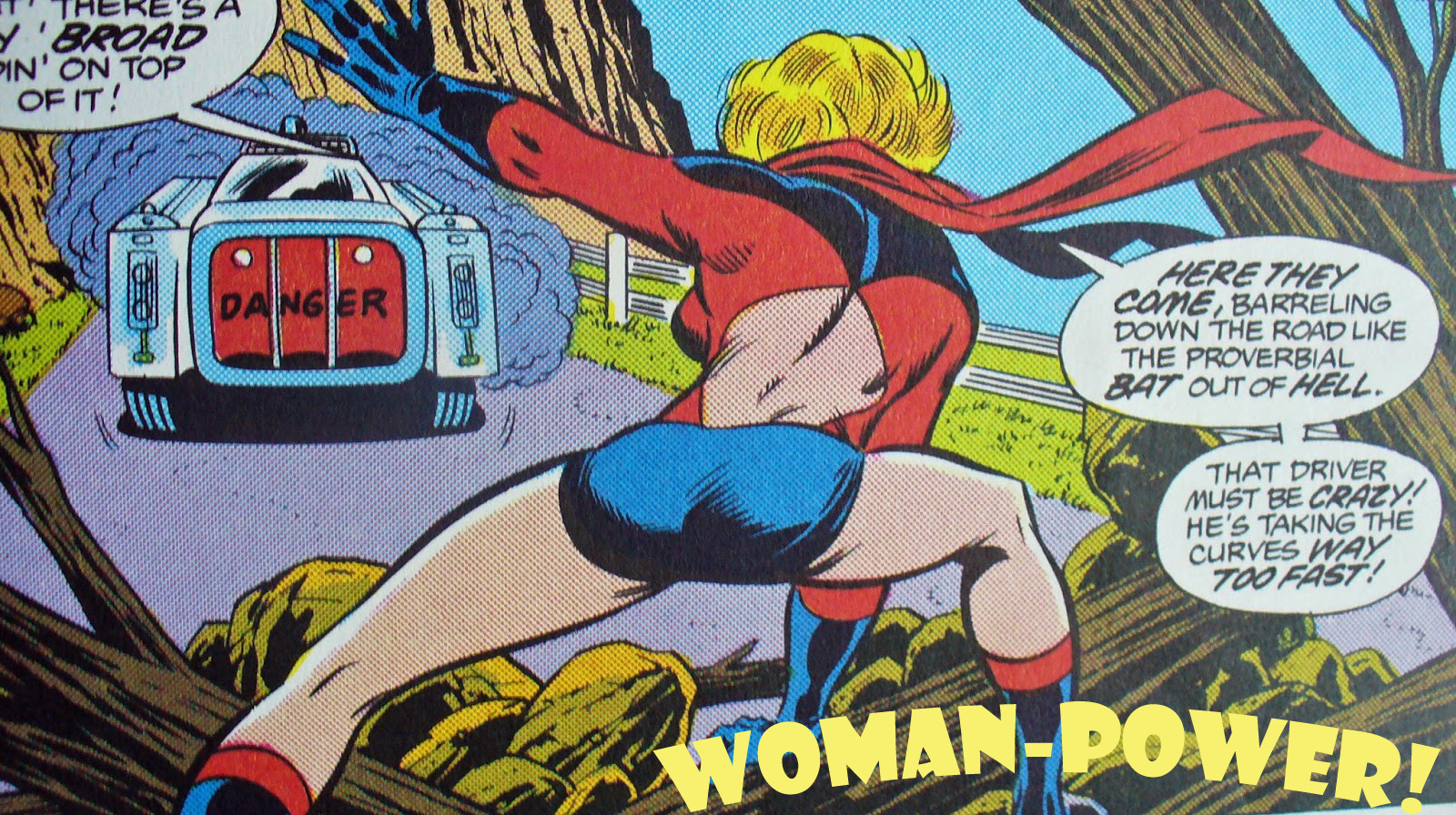
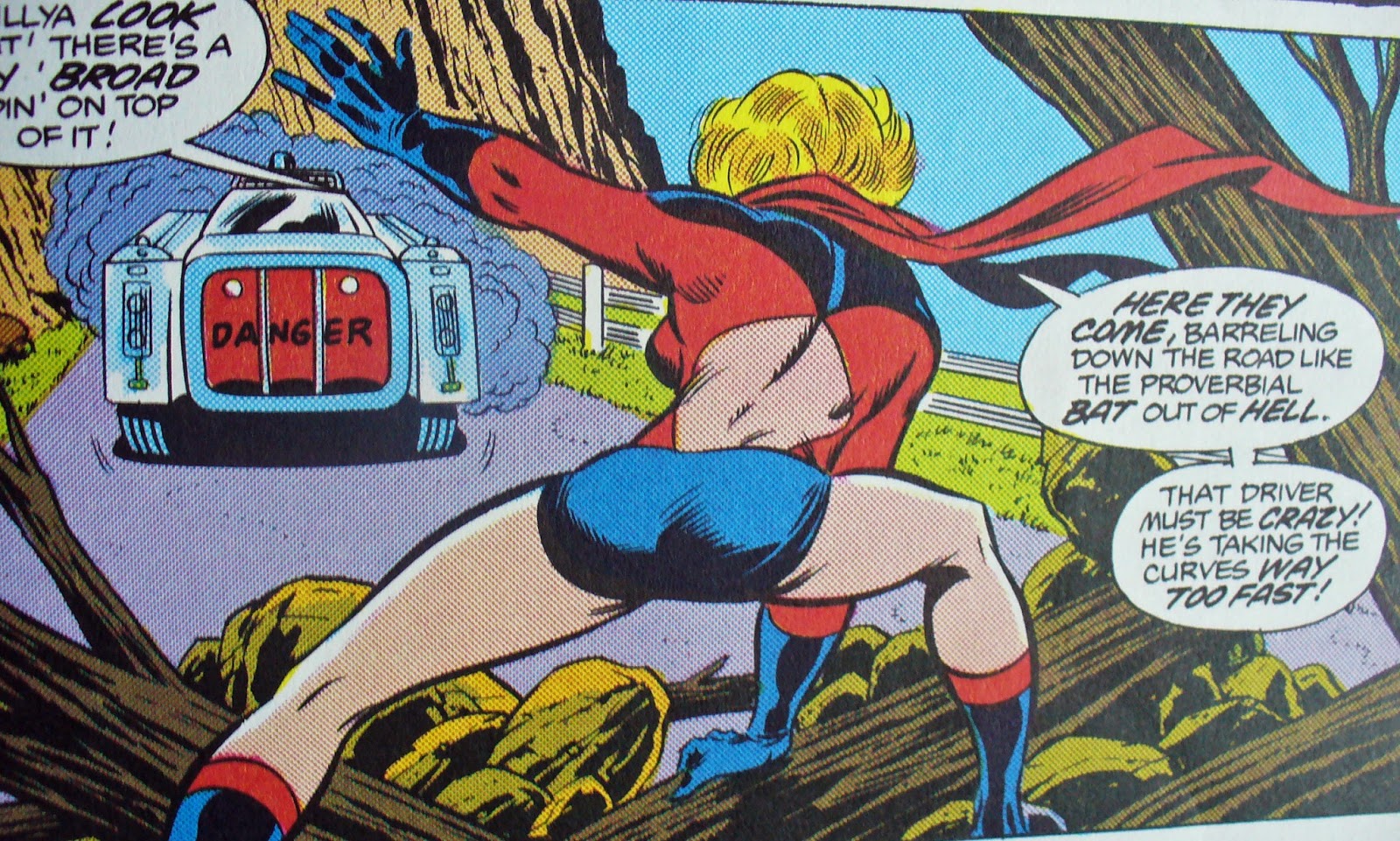
Woman Power! Ms Marvel & 1970s ‘Farrah Fawcett Feminism’

woman power

Problem: It’s the 70s, you are editor-in-chief for Marvel Comics, the biggest (or joint-biggest) comicbook publisher in the USA. Your readers are mostly fairly young; you want to move with the times. Your top titles regularly receive mail from female readers who want to feel represented, not just as a sidekick or team member, but as a bona fide title character.

DC has Wonder Woman after all, and for all her old-fashioned qualities, she is iconic. Marvel doesn’t (yet) do ‘old fashioned’. Simple; except for the fact that the majority of the readership (and indeed the vast majority of comicdom’s creators) is still male. By and large, these young men and boys are okay with empowered, intelligent and charismatic women. They do want them to be sexy though. After all, to be ‘an ordinary person’ is kind of not what superheroes are about, and in the comicbook universe of the time (and even now, mostly), the superheroine is ‘feminine’ (ie curvy), athletic and fond of tight clothing, where her male counterparts are musclebound and fond of tight clothing. So…

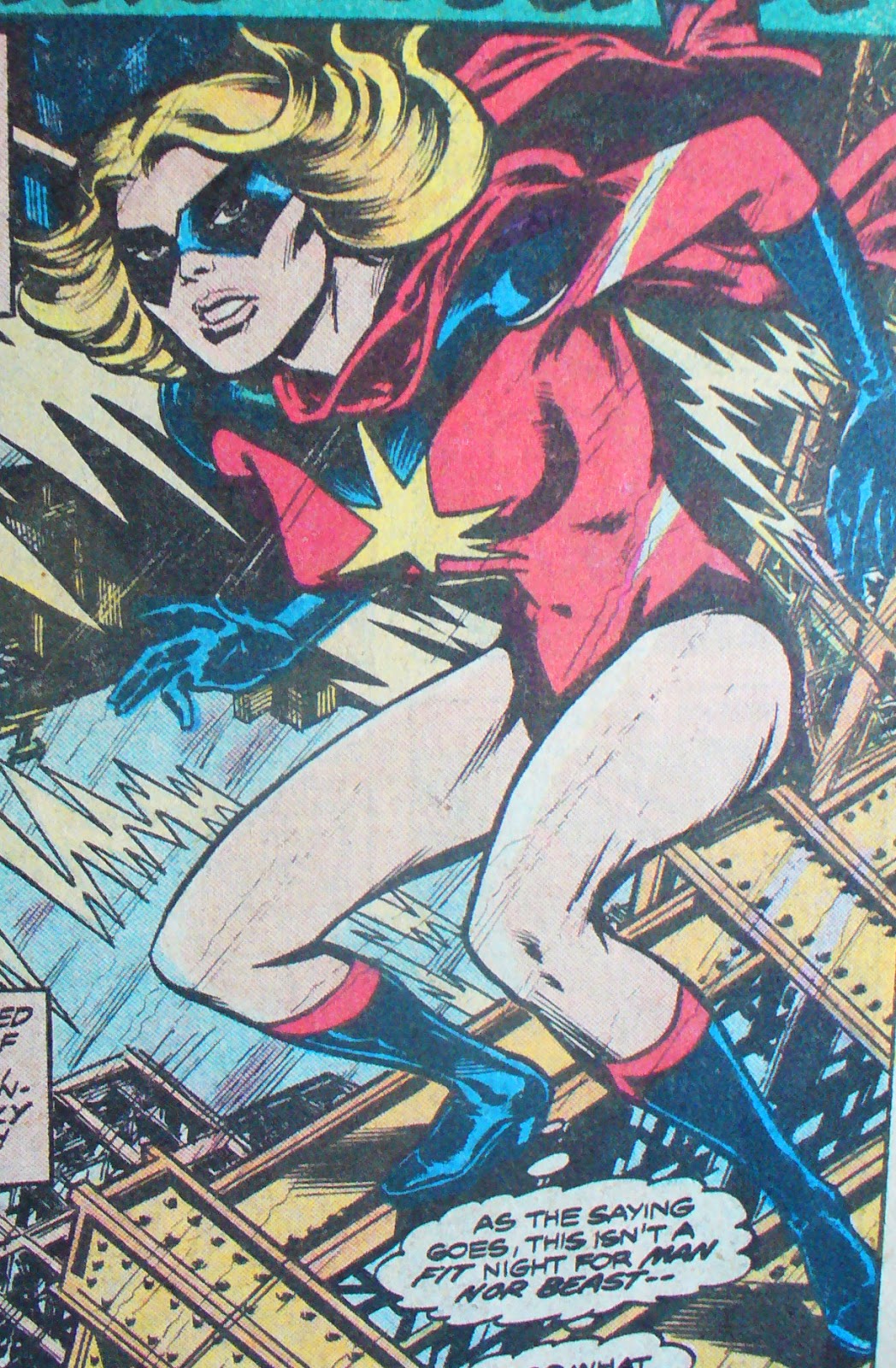
Ms Marvel – whose name alone is strongly redolent of the 70s – was one of many comics launched by Marvel in that period to cash in on (or, more charitably, to fulfil a recognised demand for) a specific phenomenon or corner of the comics market hitherto neglected; at the high end of the scale, they attempted to redress the racial balance of their output a little with Luke Cage; Power Man  (and, a few years before that, the superior Black Panther) and far further down the ladder of actual relevance, Captain Britain was launched as part of the then-new Marvel UK imprint (and, several leagues of magnitude more trivial even than that, with the great Dazzler they cashed in on the disco craze), but Ms Marvel was all about a very glamorous, Charlie’s Angels*/Cagney & Lacey, 1970s version of feminism. Despite the disclaimers around their creation, there’s a lot to be said for these kind of characters; comic readers are used to different artists/writers stamping their personal style on Wonder Woman, Batman, Superman, Spider-man & co; but anything perceived as messing with an icon (witness the Supermullet fiasco of the early 90s) does not go down well. These kind of less venerable characters are far more flexible; writers and artists can experiment with them, change them with the times and, if the central core is strong enough, all is well (which is not to say people don’t have their favourite teams/stories etc; see below).

*she even borrowed Farrah Fawcett’s iconic hairstyle, albeit in a manner more suitable to gymnastic crime fighting. Unlike the Angels though, she had no ‘Charlie’ pulling her strings…

joe
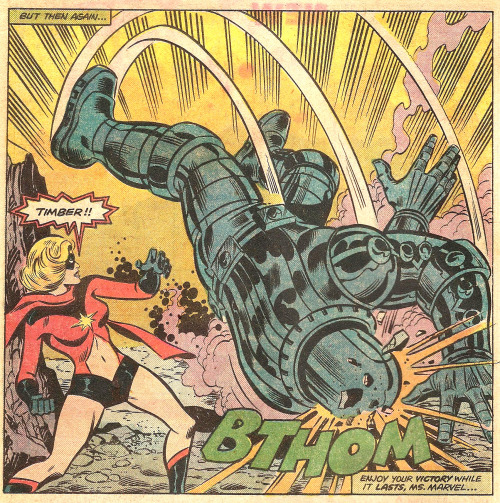
a typical moment of Ms Marvel Mayhem

 
In the original Ms Marvel series, Carol Danvers was a successful journalist who, in a moment of slightly uninspired (but damn it,  still brilliant!) Stan-the-Man-ism became a female version of Marvel B-list superhero Captain Marvel (himself rather uninspired & definitely not to be confused with the legendary golden age Captain Marvel later known as Shazam.)

As a Marvel title in its own right, Ms Marvel didn’t run for long, but at its best it is pure entertainment with a slightly compromised but definitely not half-hearted message of female empowerment. Although (naturally) a sexy superheroine, Carol Danvers was the usual put-upon Marvel character, endlessly worrying about work deadlines, angry bosses etc. However, her insistence on her equality with (or her evident superiority to) her male colleagues (leotarded and otherwise) and her general lack of husbands or steady boyfriends – though old news in the world of actual real people by 1977 – was refreshing in the muscles and capes world of the Marvel Universe.

Mainly written by the eternally underrated Chris Claremont, the comic had heart and action aplenty, although at times the superheroics (Ms Marvel battled an endless list of Marvel’s more ridiculous non-iconic villains during her brief run) get in the way of the rather more fun soap opera-like elements of the strip.

mooneysinnott
Mooney & Sinnott make Ms Marvel look good

The nearest thing the book had to a regular art team was Marvel greats Jim Mooney and Joe Sinnott, perhaps not as glamorous as John Buscema or Jack Kirby, but with their own stylish, hard-edged approach, which in the early issues gave the series a bold, dynamic feel in keeping with its forthright character. Although other artists were to draw Ms Marvel, it is undoubtedly the Mooney/Sinnott team (like the individualistic work of Mike Vosburg on the generally quite comparable Savage She-Hulk around the same time) that gives Ms Marvel its vibrant character.

shulk
Mike Vosburg’s individualistic She-Hulk


The only ‘star’ artist to ever draw Ms Marvel in her original 70s series was the great (and sadly now late) Carmine Infantino, who gave her a finely detailed, subtle sparkle very different from the  feel of the classic issues, but it was too little, too late and shortly after premiering a new, vastly less good (though at least not second hand) outfit (which however seems popular with cosplayers, which is something), the comic was cancelled.  Ms Marvel herself continued (and continues) to pop up all over the Marvel universe,* but it’s the Claremont/Mooney/Sinnott issues that have that special something missing from many a ‘better’ comic series.

*2019 update; she finally got her own movie, kind of. Captain Marvel wasn’t quite Ms Marvel, but it was good

It’s easy to mock the sometimes clunky melodrama of Ms Marvel, but in fact the book is absolutely typical of Marvel comics in the late 70s, regardless of gender. Her outfits (especially the original/best) are no skimpier than most Marvel heroes, and her domestic woes are absolutely on the same level as Peter Parker and co, and in that sense Ms Marvel; glamorous, tough, funny and hard-done-by, is a true feminist icon of her era; albeit one designed to entertain while reflecting the changing social landscape, rather than actually challenging the status quo. It’s just a shame, though not a surprise, that in the 70s, no woman actually got to write or draw her strip.

carminefanto
Carmine Infantino’s stylish and elegant Ms Marvel