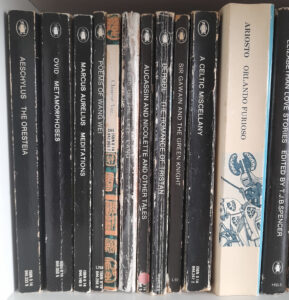

instead of a story

Alas, I am not a young writer; I have been writing for many years. But recently I came across Ray Bradbury’s advice for young writers, put in the simplified form of a challenge: read one poem, one short story and one essay per day, preferably from different eras and different fields and write one short story per week. I first saw a version of it as a 30-day challenge, but then saw something else that said Bradbury’s bigger theory was that if continued over the course of a year, nobody could write 52 bad stories in a row, which I dispute. But still, it’s a fun idea.

I already read every day, I already write every day; but it’s nice to get better at something and the discipline of it is (I think) oddly appealing.
In fact, what Bradbury said (at least in 2001 at The Sixth Annual Writer’s Symposium by the Sea) –  is considerably more elaborate and quite a lot less appealing – but probably even better as advice:

“I’ll give you a program to follow every night, a very simple program…one poem a night, one short story a night, one essay a night, for the next 1,000 nights. From various fields: archaeology, zoology, biology, all the great philosophers of time, comparing them…But that means that every night then, before you go to bed, you’re stuffing your head with one poem, one short story, one essay—at the end of a thousand nights, Jesus God, you’ll be full of stuff, won’t you?”

So anyway, I started my own version of the challenge last Friday (though truth be told, I didn’t do my reading before bed in every case, just at various times during the day). So far been a very nice thing to do. A sort of caveat is that so far I’ve been relying on books I already own and that therefore one might assume I’ve already read. In most cases I had, but as everyone who accumulates books knows (especially if some have been bought for a specific purposes, such as academic studies) there are things that remain unread, or at least not fully read for decades, while remaining on your mental I will read this list.

I only chose things that, if I had read them it was so long ago that I had little or no memory of them. As it turned out, I tended to have a very different idea of what they were like from how they seem to me now; it was interesting.

What struck me most forcibly over the course of a few days was how I value different things in different media. Understanding is the main one: reading a story and feeling that I didn’t fully grasp it really bugged me and spoiled my enjoyment of it. Reading an essay and feeling that I didn’t fully understand it made me think that the writer had failed to communicate their ideas as well as they might have (for someone of my mental capacity at least; I am not, and don’t pretend to be everyone’s ideal reader). But in poetry the feeling that comes from the work is (to me) almost independent of the meaning, which had little to do with how much I did or didn’t engage with a poem. I’m not sure I felt that way when I was younger and read a lot more poetry than I do now.

The first poets I really loved as a teenager were to an extent ‘difficult’ – Sylvia Plath, early WH Auden and TS Eliot. But at some point in my 20s my favourite poet became Philip Larkin (whose work I still love) and I think to some extent I absorbed his attitudes toward obscure or modernist poetry and began to value clarity of meaning more than anything. Now, decades later I find that clarity needn’t be one thing: no poem I read this week had anything more immediately vivid and clear than the opening lines from Seamus Heaney’s Cairn-Maker. Whether I ‘understand’ the poem as a whole I don’t know, but these lines feel miraculously precise and evocative and the rest of the poem is no less impressive: I loved it

He robbed the stones’ nests, uncradled
As he orphaned and betrothed rock
To rock…

Seamus Heaney, ‘Cairn-maker’, from Wintering Out (Faber & Faber, 1972).
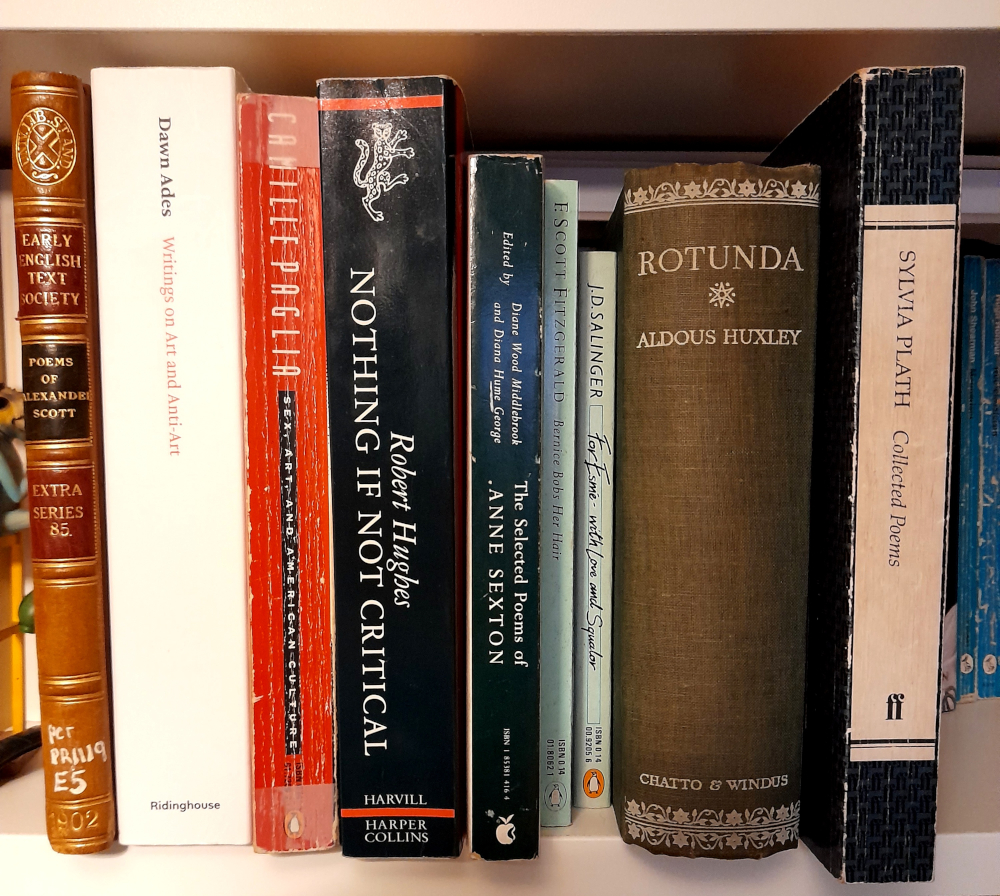
So anyway, here’s my first week, or 8 days since apparently I can’t count. Hang around at the end for my own (lack of a) story:

FRIDAY

Essay: Camille Paglia – Sexual Personae: the cancelled preface (1990) Back in the early 90s, before libertarianism became almost exclusively a right-wing preserve I loved Camille Paglia’s macho & egotistical writing: it was exciting and stimulating. Turns out it still is, but to 21st century me it’s also as infuriating as it is interesting and it seemed like every time she makes a good point (which is often) she unfailingly follows it up with some reactionary/annoying point that feels uncannily like something from the unpleasant side of the current culture war.

Poem: Wang Wei – Written at My House near the Wang River at a Time of Incessant Rain (c.750 AD). This is a very pretty and mysterious poem, more a collection of brilliantly delicate images than any kind of narrative.

Short Story: JD Salinger – Pretty Mouth and Green My Eyes (1948). I love The Catcher in the Rye, but aside from that was always a bit disappointed by Salinger’s work. Having not read this since I was probably 21 I was quite taken aback by how good it is: incredibly bitter and ironic, I loved it.

SATURDAY

Essay: Robert Hughes – Paul Gauguin (1988) I half expected to find this a little dated given the advances in Gauguin scholarship since the 80s (especially as I recently read Sue Prideaux’s phenomenal and game-changing biography Wild Thing) but in fact Hughes’ disdain for the various conflicting legends of Gauguin and his focus not on his supposed primitivism, but his actual sophistication and technical skill make this an excellently concise overview of a sometimes misunderstood artist

Poem: Anne Sexton – For John, Who Begs Me Not to Enquire Further (1960). I love Anne Sexton and this is a typically raw, intense and enigmatic poem, which may (I’m not sure) be saying ‘don’t just dismiss me as my mental illness.’ The thought that lingered with me after reading it was a very relatable one; it’s the hope that gets you.

Short Story: Story: F. Scott Fitzgerald – A Short Trip Home (1927) This was very gripping and atmospheric, more of a tough thriller type story than I’d normally associate with FSF (who I like a lot). I really enjoyed reading it, but the ending felt like a letdown and definitely not something a (much less literary) genre writer would have done. After I’d read it I kind of felt like I’d missed the point somehow; not my favourite sensation after reading a story (this was a late night one though, so might have to revisit it when wide awake in case it was just me)

MONDAY

Essay: Olivia Laing – Lamentations (2017) This was an excellent little essay about religious art which I was bound to like, partly because I like religious art, partly because Laing’s point aligns with my beliefs – basically, there’s no need for afterlife, we have life – but mostly because she is a very good writer.

Poem: Douglas Dunn – 13 steps and the 13th of March (1985) and After the War (1972) – I ended up reading two Dunn poems because I’d just heard that he died. He’s not a poet whose work I’ve ever loved (though I’ve never disliked him either), but these were good. The first, from a book of poems about the death of his wife is very sensitive and restrained and moving, but I think I preferred the second, which was about childhood and war and trauma and had a kind of oblique intensity that I thought was very effective

Story: Will Self – Between the Conceits (1994) – One of my favourite stories I read this week. Self’s surrealism was perhaps over-hyped in the early 90s but I really loved his work. At some point (not for any particular reason) I stopped keeping up with his stuff, though I still like it whenever I read it (especially his journalism). This was very funny, very straightforwardly written and deeply weird, it reminded me, very unexpectedly, of Clive Barker, another of my favourite writers in that period, though their prose styles are wildly different

MONDAY

Essay: Christopher Hitchens – The New Commandments (2010) – I love Christopher Hitchens, both before and after his transformation from being a radical left-wing writer to being am unusual right-wing one (more is made of that transformation than I think should be – almost all of his political beliefs remained the same, from reading his excellent memoir Hitch-22 it was mostly a reaction – I think an unfortunate one, it certainly didn’t bring him any happiness – to the aftermath of 9/11). But this was a fun, very sensible and amusing deconstruction/reconstruction of “the” 10 commandments (which as he points out are really only 10 of the many commandments in the Bible).

Poem: Thomas Hoccleve – On Richard II’s Burial at Westminster (1413) – This was unexpectedly one of the poems I loved reading the most. Reading medieval English can be difficult but there’s something very vivid and moving about the language. This poem is basically a religious/political one that’s filled with a sense of relief, it’s about how Henry V was putting things back on track after a period of chaos and strife (which wasn’t however over) by treating the bones of a dead king with the appropriate respect.

Story: Aldous Huxley – Half-Holiday (1926) – again I loved this – Monday was a good reading day! My favourite Huxley isn’t the Brave New World/Doors of Perception/Heaven & Hell Huxley, but the one that wrote uncomfortable and sometimes bitter social comedies like Antic Hay and Point Counter Point. This was a typically sad little story about a poor, awkward young man with a bad stutter who fantasises about picking up fashionable, posh girls and tries to do so, with painful results.

TUESDAY

Essay: George Orwell – World Affairs, 1945 (1945) This was a depressing but extremely accurate prediction of what was about to happen (the Cold War), that was written after VE day but before the atom bombs dropped.

Poem: Seamus Heaney – Cairn-Maker (1972) I first read Heaney at school and therefore had a slight aversion to his work, but at some point in my 20s I ended up getting all of the books he’d written to date, which got harder to understand as they went along. This is a superbly-written poem, the imagery is so immediate that it took me by surprise. In the end I couldn’t decide if it’s a purely a descriptive poem or not – I think it probably isn’t but it worked for me on that level. I think it has the most precisely chosen words I read for this ‘challenge’- loved it.

Story: Charles Bukowski – Swastika (the title is actually a swastika, not the word) (1969-72?) – God this was lame. Very enjoyable but completely silly story about an unnamed US president (Nixon, presumably) being kidnapped and having his body taken over by Hitler while he is put in Hitler’s body. Okay, Charles. I do like Bukowski but his quality control was non-existent.

WEDNESDAY.

Essay: Karl Marx – Investigation of Tortures in India (1857) I like Marx the journalist a lot; this was a good, clear (oddly Orwell-like, or the other way around, logically) examination of the scandal then coming to light of torture being used by the British administrators in India, for the purpose of extorting money. Typically there was an official inquest, but it blamed the Indian enforcers and so on and cleared the higher up white people of blame. Marx cuts through their bullshit nicely.

Poem: Sylvia Plath – Private Ground (written 1960/1, published 1971) – Sylvia Plath was my favourite poet for years, but the poems I remember are mostly famous ones from Ariel (1965). This one, about cleaning up a (family I assume) garden and draining the pond before winter, has superb word choices, especially for the dead baby fish (like orange peel). The overall mood is full of a chilly melancholy rather than Plath’s more dramatic horror etc.

Story: JG Ballard – The Reptile Enclosure (1963) – I’ve read so many Ballard stories over the years and I know I’d read this but I couldn’t remember what happened in it. It’s an excellent and very ‘Ballardian’ surreal little story that begins in a kind of mundane way being about a married couple who are unromantically putting up with each other, but typically ends in catastrophe.

THURSDAY

Essay: Charles Baudelaire – The Modern Public & Photography (1859) – This was an excellent & extremely prescient article about how the virtues of art and photography are different & how photography was being weaponised by the talentless in a war against art: seemed a bit over the top in a way but there was one paragraph which could have been written today about AI and would be just as true.

Poem: Andrew Motion – Leaving Belfast (1978) – this was a very nice, straightforwardly written but ambivalent poem about leaving Belfast and with it ‘the troubles’ – very effectively evoking the strain of living with an implicit but rarely openly stated threat.

Story: Thomas Burke – Tai Fu and Pansy Greers (1916) – I bought Thomas Burke’s sensational (and often pretty racist) short story collection Limehouse Nights when I was very interested in silent cinema (several of his stories were made into highly successful films like Broken Blossoms). The stories are all concerned with street life in what was then London’s Chinatown and the characters are down-and-outs, drug users, prostitutes etc: it’s shockingly un-genteel for English writing of the era. This was a sleazy, melodramatic but very readable and in some ways quite modern story. It felt quite Americanised in a Damon Runyan way, but I think that’s because it’s so rare to read the street slang etc of pre-war Britain, which was far more modern than the acceptable fictionalised speech of the era.

FRIDAY

Essay: Dawn Ades – Paolozzi, Surrealism, Ethnography (1985) – Dawn Ades is one of my favourite writers on art and this was interesting piece about the relationship between surrealism & ‘the primitive’ which was quite different from the usual modernist primitvism of Picasso or the German Expressionists. The strong anti-colonial aspect of Surrealism (which people often overlook) made their use of ‘foreign’ art quite different and in this case Ades talks about using ethnographic material as much to highlight the alien qualities of contemporary Western art and culture as to make foreign art seem alien and new

Poem: Alexander Scott – Departe, Departe, Departe (c.1550s) – I love reading medieval Scots even more than medieval English (though they are very similar; but there’s something so nice and distinctive about the way Scots has ‘Qu’ instead of W: I love ‘quhat’ instead of what, ‘quha’ instead of who etc). This is a beautiful, very conventional romantic ballad but I loved the way that reading (quietly but aloud to myself) it makes it comprehensible where at first it looks opaque. It’s full of odd words like ‘spreit’ which, from context you quickly realise is ‘spirit’.

Story: Milan Kundera – The Hitchhiking Game (1969) – This was interesting because it was the first Kundera story I ever read, back when I was a teenager. At the time I found him very grown up and kind of cool, but now he seems like the kind of unreconstructed 60s man who would call women ‘chicks’. It’s a good, horrible little story and (a distinction I’m not sure is worth making) sexist without I think being actually misogynistic: Kundera likes women, he just thinks of them as a species apart from men. But really, it’s a gripping little story about the illusion/delusion of romance, that’s looked at in such a ‘manly’ way that it’s kind of funny. When I was younger I would never have thought of Milan Kundera as a simple-minded, macho Hemingway kind of writer (no offense to either of them) but that’s how he seems in this story.

***

So, I did the reading – but although I have written a lot in the past week (my favourite thing was writing up an interview I did with the Faroese singer Eivør, who was great) I didn’t write a story. I do write fiction occasionally (as a teenager I kind of assumed I’d be a novelist one day; so far, I’m not) and over the years have written quite a lot of stories of one kind or another, mostly horror.

I’m sure at some point during my – to put it in tedious online speak – ‘Bradbury journey’ I will write a story. I did have the germ (or seeds: which is smaller?) of an idea which could be a story but which I don’t feel inclined to develop at present, so here’s that:

The idea comes from the possible relationship between two sources: there’s a famous passage in the Bible (Mark 5:9, the internet says) in which Jesus meets a possessed man. Even for an atheist, the Bible is an endless source of fascinating ideas, but why this particular passage popped into my head I don’t know – maybe because it’s nearly Halloween? Jesus talks to the possessor(s) of the man – although I see online that people who don’t understand the meanings of words are following the tradition of referring to ‘a demon named Legion.’ FFS; it’s hardly unclear: the voice even says “we are many.” Look up what legion means! I don’t think it’s intended as the ‘Royal we’. Maybe if the translators responsible for the King James version, instead of writing “My name is Legion”  had used the just as accurate “We have many names,” people would get it. But it would be a sad loss; it’s a powerfully sinister and resonant phrase.

Anyway; I was also thinking about something I’d read where a newspaper (can’t remember which, I think the Times, but wouldn’t like to state it with authority) cited in a story either ChatGPT or Claude as a source, like they would any interviewee. The journalist did not take into account that the ‘Claude’ who a teenager is asking about their acne, the ‘Claude’ that someone is asking to sift through a lengthy legal document to point out its salient points and the ‘Claude’ who is being used to select military targets aren’t one person called Claude; Claude the agony aunt is not aware of the information that Claude the legal aid and Claude the missile-aimer are giving to different users, although if asked it could probably find out. Claude’s name, in other words is Legion: how that is developed into the narrative of a short story I don’t know, but I do know that it could be. So that’ll do for now. Onwards!
lost and found in translation

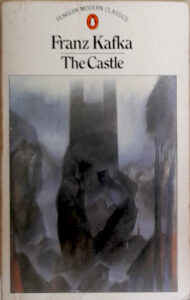
“Nothing was to be seen of the Castle hill; fog and darkness surrounded it; not even the faintest glimmer of light was present to suggest that the Castle was there.” Franz Kafka, The Castle, translated by Jon Calame & Seth Rogoff, 2014, Vitalis Verlag

“The Castle hill was hidden veiled in mist and darkness, nor was there even a glimmer of light to show that a castle was there.” Franz Kafka, The Castle, translated by Willa & Edwin Muir, 1930, my edition Penguin Modern Classics, 1984

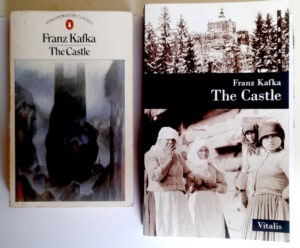
The Castle (Penguin, 1984) vs The Castle, (Vitalis, 2014)

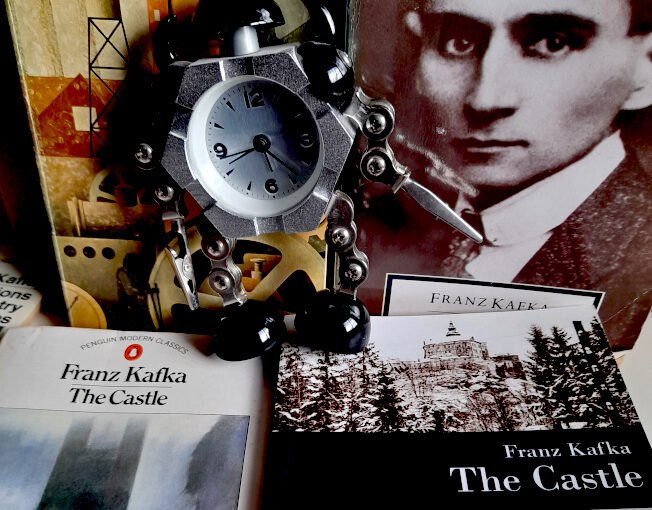
I have a possibly bad habit of buying multiple copies of books I love, if I see them for a good price, especially if they have a cover that I like and don’t already have. Fairly often, I won’t actually read the new-to-me edition unless I happen to be in the mood for that particular book at the time of the purchase, because after all, it’s the same book. Or at least it usually is. I’ve had my 1984 Penguin Modern Classics paperback of Kafka’s The Castle for decades, though it was already second hand when I bought it. I first read the book at high school, a falling-to-bits old hardback from the school library. I have no idea which edition that was, but when I read it again in my early 20s, the novel seemed just as I remembered, just as obscurely relatable and with that specific atmosphere that is a big part of what makes something ‘Kafka-esque’. That school version was almost certainly some edition of the 1930 translation by the fascinating Scottish couple Willa and Edwin Muir. They were the first translators of Kafka in English and theirs was and to some extent still is the standard version. Indeed, it was that couple who introduced Kafka and his particular aura to the English-reading world; which is quite a big deal when you think about it.

Recently, in a charity shop, I came across a copy of The Castle that I hadn’t seen before, with a cover I was immediately drawn to. It’s from 2014 and though it’s in English it’s was put out by by Vitalis books, a publisher which, judging by its Wikipedia entry, sounds uniquely suited to disseminating the works of Kafka, a German-speaking Czech Jew who was raised in a Yiddish-speaking household:

Vitalis Publishing is the only German literary publisher in the Czech Republic. Founded in 1993 by Austrian-born physician and medical historian Harald Salfellner, it harks back to the cultural heyday of the fin de siècle before 1914, a period of shared German, Czech, and Jewish influence. The publishing program features Czech (Jan Neruda, Božena Němcová), German (Gustav Meyrink, Rainer Maria Rilke), Jewish (Oskar Wiener, Oskar Baum), and Austrian (Adalbert Stifter, Marie von Ebner-Eschenbach) authors as common representatives of Bohemian literature.

Lots there to be curious about, but let’s stick to Kafka for now. My old Penguin paperback of The Castle, which features two chapters not included in the original 1930 UK edition (which were separately translated by Eithne Wilkins & Ernst Kaiser), is from of my least favourite stylistic phase of the Penguin Modern Classics series. At that point in the early 80s, the spines of the books, in a nostalgic nod to the classic early days of Penguin, were orange and white, while the covers were white with (mostly) modernist paintings chosen to more-or-less fit the books. The Castle does have a nice cover illustration, by Elizabeth Pyle, but otherwise the design is a little drab. The book is 298 pages of fairly but not unreadably small print. The Vitalis edition is far more stylish and the cover artwork uses a beautifully evocative photograph of (Bohemian?) “Peasant women” from 1918 and a photograph of Friedland (or Frýdlant) castle in Czechia. The type looks around the same size as the Penguin edition, but though the book is slightly bigger than the Penguin, it has 382 pages.
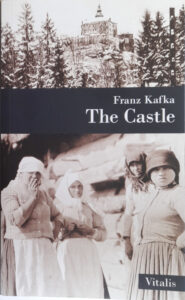
Even allowing for the fact that the Vitalis Castle includes nice, dark, moody and scratchy illustrations by Karel Hruška, it’s a noticeably longer book, and the reason for that is revealed in the two quotes at the top of the page. The Muirs’ prose – like Edwin Muir’s own poetry, which is worth checking out – is terse and spare, but also flexible and evocative. It’s the “voice” that Kafka has had for me since I was a teenager. It also has the benefit – or at least I think it’s a benefit, more later – of having been translated close to Kafka’s own time. When that first British edition of The Castle was published and Edwin Muir wrote in his introduction “Franz Kafka’s name, as far as I can discover, is almost unknown to English readers,” he was talking about an author who had only been dead for six years, and the book itself had only been in print in Kafka’s own language for four years.
Calame and Rogoff’s writing is slightly more lyrical to my ears/eyes, a little more long-winded, but in its way just as precise. I very much appreciate the two semi-colons in the first sentence of the passage above. The cumulative effect of their translation is a book which feels familiar but gently different. Another comparison, this time the opening of chapter 10:

“K. stepped out into the windswept street and peered into the darkness.” (Willa & Edwin Muir)
versus
“K. stepped outside onto the wildly windswept steps and peered into the darkness.” (Calame and Rogoff)

Which is the better sentence is just a matter of taste; the Muir version doesn’t feel especially superior to me, but on the other hand it does feel more ‘Kafka-esque’ – but is it? And what about this, from the end of chapter 15?

“And he pressed her hand cordially once more as he swung himself on to the wall of the neighbouring garden.” (Muirs)
versus
“He was still pressing her hand fervently as he swung himself onto the fence of the neighbouring garden.” (C&R)

Well; ‘cordially’ and ‘fervently’ are two very different things aren’t they? To me, that word choice significantly changes the tone of the passage. And this time, it’s the modern version that feels more redolent of Kafka as I think of him; which isn’t the same as saying it’s a better translation of the original text.
I have no idea whether it impacted on Calame and Rogoff or not, but modern translations of Kafka are made in a world where ‘Kafka-esque’ is a thing, and where Kafka himself – his image, with those big, dark, suspicion-filled eyes and his hypersensitive personality as revealed in his personal writings, prone to intense feelings of harassment and persecution – colour how we see his work. The Trial in particular feels like that persona, that image, in the form of a novel, and surely nobody embarking on a new translation of the book could be uninfluenced by its familiar Kafka-ness, regardless of how faithful or otherwise they were to the original text.

Faith and Faithfulness

witty (if dated) wordplay in Asterix

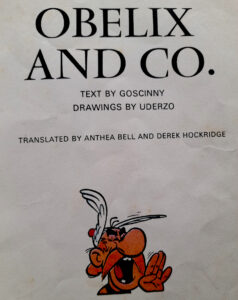
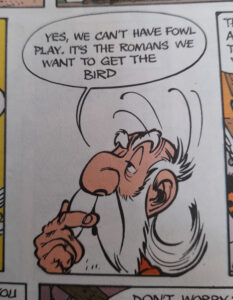
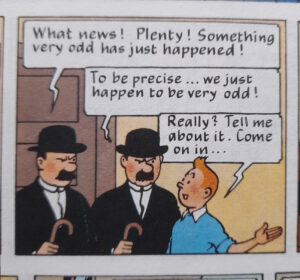
There’s a mystery to what faithfulness even means in translation – Google translate and AI are perfectly capable of making word-for-word translations of texts, but they seem somehow unable to make living, readable prose out of them. When I think of books that I’ve only ever read in translation (and I’ve never read more than maybe 6 or 7 pages of text in any language other than English or Scots, alas), going all the way back to childhood and the Asterix (René Goscinny, trans. Anthea Bell & Derek Hockridge) and Tintin (Hergé – Leslie Lonsdale-Cooper & Michael Turner) series’, I realise how much of the character of those books is owed to their translations.

In those particular cases the translations seem almost miraculously good. To capture witty wordplay, puns etc while also keeping the original narrative flowing is a formidable skill. I can’t help thinking that if I read literal translations of Tintin and Asterix, or learned to read French myself (let’s not get carried away) and read the originals, I would discover a new respect for both the translators and the original authors.

wordy whimsy in Tintin

Translating from one language to another seems like it should be a practical rather than artistic thing, but the extent to which Kafka’s work is ‘Kafka-esque’ in English is in some ways a choice, and as time goes on more and more choices are available to the translator of any text. The obvious choices – whether to be true, word-for-word, to an author’s text, or to their ‘voice’ and atmosphere, whether to provide a faithful translation or a ‘good read’ have always been there. But as time goes by, arguably just as important is the decision of whether to make a novel or piece of writing true to its time and place or to our own. This isn’t a small thing, it’s both the readability and the character of a book. The right thing to do presumably varies from book to book, but in my experience, you don’t really know what you prefer until you come across something you don’t like.

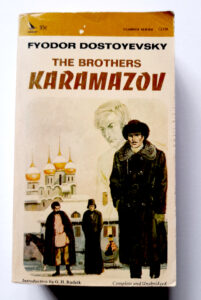
Dostoevsky presented as a trashy airport novel (with no translator credit)

With The Castle, although the more modern text felt different to me, it wasn’t a difference that spoiled or significantly altered my enjoyment of the book, it was just something I noticed. But those translation choices can be jarring. A recent example of this came when reading two novels by the Finnish author Arto Paasilinna – The Year of the Hare (1975) and The Howling Miller (1981). Both were (which I find obscurely annoying) translated into English from French translations rather than from Finnish, but while The Howling Miller (which I read first) was written in straightforward, simple and clear English prose which felt a bit basic, but entirely appropriate to the subject, the translator of The Year of the Hare made the (completely valid) decision to translate the casual, slang-filled prose of the French translation (and presumably the Finnish original) into supposedly modern and slang-filled British English, which was deeply irritating and also damaged the integrity of the novel. Standard phrases like “bloody hell” or whatever are one thing; so familiar as to seem timeless and universal. But slang dates quickly and is often generationally specific and can be weirdly embarrassing to read, if it’s not your slang.

Even worse in narrative terms, using regionally specific terms when you don’t change the distinctively ‘foreign’ names of characters or the setting of a book can give a feeling of unreality to the whole text. Quite possibly it’s just me, but reading a passage where a character called Kaarlo Vatanen, living in rural Finland, refers to having “twenty quid” in his pocket is kind of like reading Crime and Punishment and coming across something like “Shit! It’s the pigs!” hollered Raskolnikov. Don’t do that please. Similarly, recently reading a (very) American translation of Georges Bataille’s notorious 1928 novel The Story of the Eye made it a different kind of uncomfortable from the kind I remembered. Seemingly I’m okay with the murder, depravity, perversity etc, but somehow repeated references to the unnamed narrator and his fellow protagonists “jerking off” just took me too far out of early 20th century France to be enjoyable.

But even though I didn’t like the idiom the translators used for The Year of the Hare and The Story of the Eye, the arguments for doing it are pretty sound. When adapting a foreign, unfamiliar book for a new audience, making it accessible is clearly important. The Year of the Hare was published in 1975 and implicitly set in that period, so there’s nothing technically wrong with writing it in modern, slangy English, except that it’s not set in Britain and so it feels wrong to pedants like me. There  presumably is a 1920s French slang term for masturbation, but ‘jerking off’ feels so specifically American that it’s jarring – and I don’t think that’s just anti-Americanism, I feel like ‘wanking’ would have had a similar effect. Related, but probably more difficult is translating a classic novel into modern English. I’m not really a Dickens fan, but when I think of the few books of his that I’ve read, his prose seems entirely inseparable both from his stories and from his period. Does that mean that Tolstoy or Zola’s works should be translated into “Victorian” English? Annoying as that might well be, I’m tempted to say that for me, the answer is yes.

Positives and negatives

It’s a different kind of translation, but making books into films brings these kinds of questions into sharper focus. There have been several film adaptation of HG Wells’ The War of the Worlds, but for all of their virtues, if you return to Wells’s novel it seems obvious within the first few pages that though it’s eminently adaptable, any film of the novel set in 1898 would be far better (but presumably ridiculously expensive to make) than the existing versions. Similarly, no adaptation of Nineteen Eighty-Four except the venerable BBC adaptation starring Peter Cushing has quite captured the stark, bracing post-war, entirely British greyness (in a good way) of Orwell’s prose. That Cushing version feels right, but has its own negative points, especially cheapness, lack of definition (because old TV). But the tone is right. And it’s that tone, as much as anything, that people think of as “Orwellian,” even though outside of Nineteen Eighty-Four and (to a far lesser extent) Animal Farm, it’s really not the usual tone of his writing.

The other dystopian novel frequently paired with Nineteen Eighty-Four is Aldous Huxley’s Brave New World, but despite the relative closeness of age, class and education of Orwell (born 1903) and Huxley (born 1894), they could hardly be tonally further apart. As someone who first read and loved Huxley’s early, satirical social comedies like Antic Hay  (1923) (still my favourite) and Point Counter Point (1928), the thing that struck me most when I first read Brave New World (1932) is how similar it is in its prose. Although, unlike The War of the Worlds but like Nineteen Eighty-Four, it’s set in the future, any film of it should really be set in a 1930s future and have a slightly old fashioned, ‘Boy’s Own adventure’ flavour which seems completely at odds with the book’s grim dystopian reputation. When reading the novel, its tone (which feels more post-WW1 1920s than pre-WW2 1930s), feels entirely natural and is a part of what makes the book so readable. But is that tone there in modern foreign translations of the book? Possibly not, and when you think about it, why would it be?

The Bible and the Bloody Countess

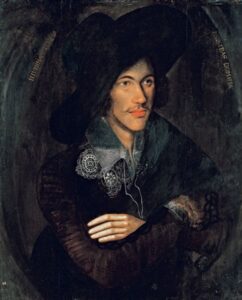
John Donne: a portrait of the poet as a young dandy

As anyone who has had to “do” Shakespeare at school – or who likes reading him – will know, 16th/17th century writers had a respect for and love of puns that is far removed from their current status as vessels of knowingly lame humour (that said, ‘brave new world’ is from Shakespeare, isn’t it?). It’s sad that that love of wordplay has become so debased, because even though I personally love puns even just as lame humour, it means we have to consciously think or analyse in order to appreciate the breadth of allusions and associations – and therefore feelings – that a writer could evoke in their readership (or a playwright in their audience) without having to labour a point.

Partly, it was easier to pun meaningfully before spelling was fully standardised. When John Donne wrote The Sun Rising* , it was risqué in the mild way it still is – the poet complains about the sunrise because he doesn’t want he and his girlfriend to have to get out of bed – but also in a far more daring way. To a Jacobean audience the sun (or sunne, or sonne) rising would automatically create an association with the son (of God) rising, a pun that transforms and strengthens the meaning of the poem, since, then as now (actually far more than now), the earthly representatives of God were not especially keen on young unmarried couples lying in bed together.

*published in 1633 but necessarily written earlier – he died in 1631 – and probably quite a lot earlier since he was known as a poet in his youth but a priest and preacher from 1615

And that textual richness isn’t just intended meanings and associations. As language evolves so does meaning, and so, whether one likes it or not, do associations. Since the 1960s, seeing the title The Sun Rising may well make people think of Rolf Harris’s 1960 novelty pop hit Sun Arise – a kind of well-intentioned but not unproblematic pastiche of Aboriginal Australian music that was a big hit all over the English-speaking world. Harris’s subsequent career as a popular children’s entertainer and, latterly, a hugely unpopular sexual predator make the already iffy song even more dubious, but even that creates its own set of unexpected cultural associations. Back in 1971, before settling definitively on a kind of bad taste, pantomime horror modus operandi, Alice Cooper (then the name of both the American rock band and its singer) experimented with a kind of general absurdist, transgressive approach. To that end, on their third (but first commercially successful) album Love It To Death, alongside paeans to troubled teendom (I’m Eighteen, Is It My Body?) and old horror movies (The Ballad of Dwight Frye), the band recorded an amusingly straight-faced cover of Sun Arise, just to be smartasses. Only 40 years later did the song turn out to be a masterstroke that unexpectedly fit in with their macabre and tasteless raison d’être after all; patience is a virtue, clearly.

But anyway, the idea of translating The Sun Rising, with even its intended meaning intact, into a language that doesn’t share common roots and words with English makes me think of Philip Larkin saying* (wrongly, I think) “A writer can have only one language, if language is going to mean anything to him.” It makes sense in a way – there can be an impersonal quality, especially when reading poetry in translation, that makes lots of translations feel the same as each other, not that that’s always a bad thing necessarily.

*in a 1982 interview with Robert Phillips in the Paris Review (Philip Larkin, Required Writing, p.69)

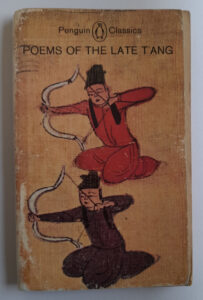
On that topic, another Penguin Classics book I love is the 1965 collection Poems of the Late T’ang, in which A.C. Graham translates the works of seven Chinese poets whose lives span more than a century, from 712 to 858 AD. In his introduction, Graham stresses the differences between poets, contrasting the ‘bare, bleak style’ of Meng Chiao (751 – 814) with the ‘strange and daring’ poetry of Meng Chiao’s friend Han Yü (768 – 824) but although I love both, I don’t really find a huge tonal difference between them (just to quote the first examples of each that he publishes):

Above the gorges one thread of sky:
Cascades in the gorges twine a thousand cords
(opening lines of Sadness of the Gorges)

And

A frosty wind harries the wu-t’ung, (parasol tree)
The crowded leaves stick wilting to the tree
(opening lines of Autumn Thoughts)

It might just be me, but I don’t even detect major differences between the poetry of between Tu Fu, writing in the 750s or 60s –

The autumn wastes are each day wilder:
Cold in the river the blue sky stirs
(opening lines of The Autumn Wastes)

and Li Shang-Yin, who was writing almost a century later:

The East wind sighs, the fine rains come:
Beyond the pool of waterlilies, the noise of faint thunder.
(Untitled)

I wouldn’t expect poets in English, centuries apart, to write this similarly, but of course the words I am reading are AC Graham’s and not Tu Fu’s or Meng Chiao’s. These are beautiful poems and if there’s a deficiency in them it’s mine, not the poets’ and certainly not the translator’s. In poetry this compressed and distilled there must be a whole world of meaning, allusion and subtlety – the sort of thing I can see (when forced to think about it) in Donne – that AC Graham was aware of but could only explain in footnotes and appendices. And I’m sure that’s exactly what Larkin referred to in his strictures about language. But if a writer can have only truly have one language, “if language is going to mean anything to him,” what about translators, who are almost always also writers in their own right? And what about unusual cases like JRR Tolkien or Anthony Burgess?

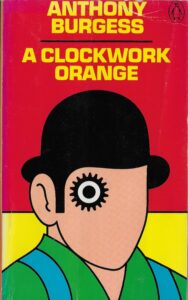
Burgess’s A Clockwork Orange is one of my all-time favourite novels – it’s also the product, very obviously, of someone who could speak and think, fluently, in a lot of languages. Ten is the number he usually gave, ‘with bits and pieces of others’. Burgess created the book’s slang, Nadsat, in order to write about ‘the youth’ in a way that didn’t date like real slang and it definitely worked. Rightly, I think, Burgess didn’t want a glossary of Nadsat terms in the book. Some publishers have added one anyway, but the book works far better if the reader just immerses themselves in the narrator’s voice and his disorienting world. But Burgess was only human, and in perhaps the novel’s weakest moment (because it takes us out of that world) he couldn’t resist pointing out that the language his young narrator Alex speaks isn’t just whimsy on the part of the author:
‘Quaint,’ said Dr Brodsky, like smiling, ‘the dialect of the tribe. Do you know anything of its provenance, Branom?’
‘Odd bits of rhyming slang,’ said Branom, who did not look quite so much like a friend any more. ‘A bit of gipsy talk, too. But most of the roots are Slav. Propaganda. Subliminal penetration.’
‘All right, all right, all right,’ said Dr Brodsky, like impatient and not interested any more.

I’ve always felt that Brodsky’s impatience is really Burgess’s mild embarrassment at finding himself pointing out how clever he is, but who knows? How A Clockwork Orange works in translation I can’t imagine, especially in countries with the Slavic languages Burgess borrows from, but I can imagine it must be both a joy and a nightmare to translate.

I hope for the sake of its readers that the translators who tackle A Clockwork Orange come up with words as horribly effective as Burgess’s. When Alex and his gang (yes, I know they are his droogs) come across a rival gang attacking a child, Alex says that they were “just getting ready to do something on a weepy young devotchka they had there, not more than ten, she creeching away but with her platties still on,” The word “creeching” is clearly just “screeching” without the s, but somehow it seems harsher, more intense, implying a rawness related as much to a croak as a screech; Burgess knew what he was doing. So, in his very different way, did Tolkien, another linguist, who gives the cultures and places of Middle Earth their individual, believable textures via languages that draw on real prototypes in the same way as Burgess’s Nadsat does. It’s also worth comparing Tolkien’s beautifully translated Beowulf with Seamus Heaney’s very different, but equally beautiful one. Both writers have a reverence for the original text and their interpretations are similar enough to suggest fidelity to the original – but they are also different enough to demonstrate just how flexible language can be.

That flexibility suggests that no text is truly beyond translation, and the fact that fictional cultures can be realistically portrayed by the words they and their creators use hints at the power inherent in language. Like any power, it can be used in negative ways as well as good ones. Translations can, or at least could, be withheld when it was felt expedient to do so, though the internet has probably made that more difficult. It seems trivial, but something that was (up until the 1960s I’d guess) fairly common and which I’ve occasionally come across in older books, are translations of foreign texts where the narrative lapses into its original language – or occasionally into French in books actually written in English – when the writing becomes ‘obscene.’

trashy 70s paperback of non-trashy 50s meditative biography

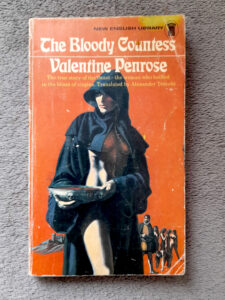
An example that springs to mind, because I have it, is the 1957 biography of the notorious medieval Hungarian Countess Erzsébet Bathory, written by the surrealist poet Valentine Penrose (nee Hugo). In its English translation – by the also somewhat notorious Scottish writer Alexander Trocchi – Penrose’s text is rendered into sensual English, except, that is, when Bathory’s predatory exploits against young peasant women in her orbit become too explicit, at which point the text lapses into French. No doubt the publisher, John Calder – who specialised in avant-garde literature and especially previously banned books – was wary of obscenity charges, which he would later fall foul of with Alexander Trocchi’s Cain’s Book and Hubert Selby Jr’s Last Exit to Brooklyn. Ironically, my 1970s NEL edition of The Bloody Countess, though by design a trashy, titillating exploitation-type paperback, reproduces the Calder text, elisions and all. It also features a lazy, sensationalist blurb on the cover which reveals that the publisher didn’t know that Valentine Penrose was a woman, which is unnervingly slapdash.

But even if British publishers self-censored for mostly legal reasons, the clear lesson that comes from old editions of transgressive texts is that those with a classical education – that is, the upper classes, who routinely learned Latin, Greek and French at school, but only they – could be entrusted to read all the sex and violence they liked. I’m in two minds over whether the reason for that is the literally patronising one of ‘protecting the children’ or the more generally patronising one that the upper class could be trusted with that kind of thing but the more animalistic and irrational lower classes might be led astray by it. Either way it’s kind of ironic, given that centuries earlier, the impetus for publishing anything at all in English was to allow the expanding literate population to read the Bible in their own language.

And if the translation of a modern text into modern English can create variations as different as a ‘cordial’ vs a ‘fervent’ hand-hold* imagine the pitfalls inherent in making the translation of an ancient text central into something comprehensible to a modern civilisation. And in the important case of the Bible, not just ‘an ancient text’ but a collection of various ancient texts, partly written in an obscure and difficult language. And add to that that key books of the text purport to be eye-witness accounts – but which are however written in Greek, reporting on sermons and parables originally delivered in spoken Aramaic, it’s clearly beyond the grasp of Google translate.

*if that seems trivial, imagine receiving an invitation to some kind of gathering that begins, “you are cordially invited to… versus “you are fervently invited to…” The second would seem a little offputting to me

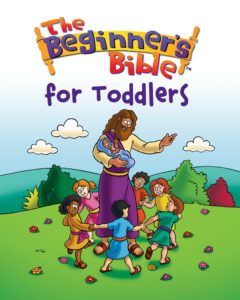
We’re used to the fact that almost everything in the Bible is open to interpretation, partly because by now ‘the Christian church’ is actually hundreds of Christian churches, each with its own version of what the Bible means, and that’s just talking about the Bible as it stands now. Taking into account the dubious question of how accurately modern translations relate to the original text, and how accurately the original text relates to the events it describes, it was always going to be a minefield. It doesn’t take much reading to discover that things as fundamental to the faith as the monotheistic nature of the Old Testament god, or how literally the Virgin birth should be taken in the New Testament are dependent on translations which may be approximate rather than precise. Just for one example, writers – both scholarly and crank-ish – have observed that the word used to describe Mary’s state, “parthenos” in ancient Greek texts generally means ‘a young woman’ and not necessarily, not even usually, a virgin. We’re immediately in murky waters. Because of that interpretation of that word it’s been credibly suggested (by Jane Schaberg, among many others) that in the Gospels God therefore only blesses Mary’s pregnancy, rather than causing it himself. Credibly, that is, if one’s main issue with the story of Jesus is the Virgin birth, rather than the existence of God in the first place.

possibly less begetting and smiting in this bible

However one chooses to interpret it, interpretation is required when looking at the texts of the Bible. It’s a record of events which has come down to us in much the same way as Homer’s Odyssey, and with as many different voices involved along the way. Even if one takes the Bible at face value – notoriously difficult, in its contradictory entirety – and accepts it as truth, it’s a deeply problematic text, to say the least. The Gospels were written down by followers of Jesus – who they knew personally, and worshipped – in the aftermath of his early death. For the parts of his life pre-dating their association with him, they are presumably relying on accounts given to them by the man himself. These would be based on his own memories of his youth and childhood – but for the circumstances of his own birth, thirty-three years earlier, he presumably only had the accounts of his parents (whether earthly or divine) to rely on. Unless Jesus spoke Greek (I feel like they would have mentioned it if he had), those memories were then translated into a different language with different allusions and associations from his own, before being subjected to centuries of edits and deletions, only later being given ‘authoritative’ editions (and different ones for different countries and sects), each of them offering its own truth, rather than one definitive truth.

So, whether we are reading Homer or Ovid or the Gospel of St Luke, or The Castle, or Asterix the Legionary in English, we are reading an adaptation, a work imagined into existence by more than one writer and if we’re lucky it’s Willa and Edwin Muir or Anthea Bell and Derek Hockridge. If we’re not so lucky we may end up inadvertently worshipping a false idol or something and, who knows, even facing eternal damnation if you believe in such things. It’s an important job.

credit where its due: the translators get (almost) equal billing with the authors