Between me thinking about writing something about what home and belonging means and actually starting to do it, it’s become a far more topical subject than I expected, which seems to be how these things go these days.
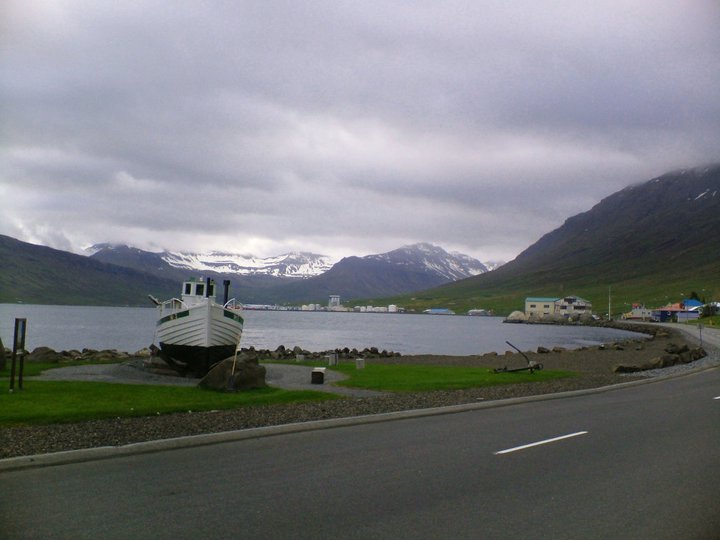
the outskirts of Neskaupstaður, Iceland
The initial impulse to write it came from several unconnected things; some photos I took in Iceland over a decade ago; the lyrics to the R.E.M. song “(Don’t Go Back to) Rockville;” a beautifully evocative description of a rundown railway station in a dusty, remote part of Austria-Hungary in the 1900s. That description felt especially poignant because Austria-Hungary is a country (and the Habsburg Empire an Empire) that no longer exists, but which must have felt permanent in its day and which people in the 1900s felt just as patriotic and loyal towards or just as ambivalent about as people now do towards the constituent parts of the United Kingdom or/and the UK itself. But all of that has retreated into the distance a little because as I write this, up and down the country – even in this little corner of rural Scotland – people are engaged in a protest of sorts. Unusually for a protest, it takes the form of doing something which has always been entirely acceptable to do and which no one has ever tried to discourage the protesters from doing; hanging up flags.
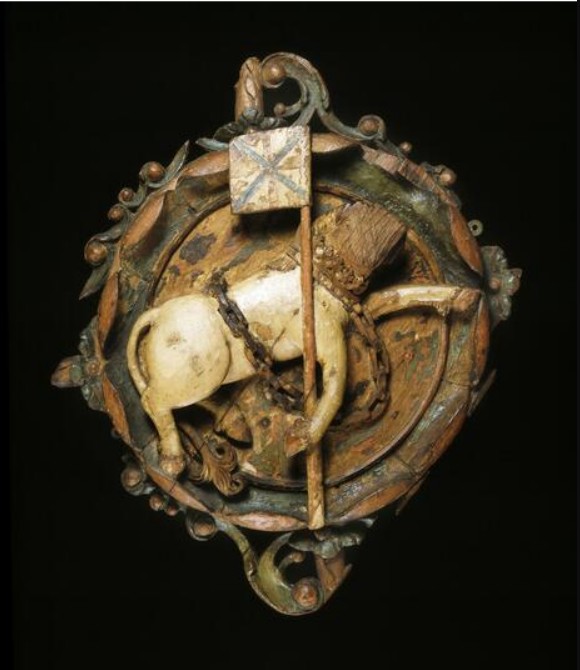
The seal matrix of Bishop William de Lamberton from the 1290s, the oldest extant physical use of the Saltire in Scotland
The flags that have made it onto the news – especially from the recent, ironically-named “Unite the Kingdom” right-wing rally in London, are mostly St George’s cross (the flag of England), interspersed with Union flags. In this village the flag fliers tend, naturally to instead display the Saltire/St Andrew’s cross (the flag of Scotland, reputedly the oldest national flag in Europe – which if its semi-mythical origins are correct actually predates the Kingdom of Scotland itself by a couple of centuries) and the Union flag.
Flags are, by design, simple and very easy to identify, but they are also kind of a blunt instrument when it comes to signalling. Other people in this area have been displaying the Saltire and the medieval Scottish flag (the Royal Banner; a rampant red lion on a yellow ground) with no Union flag. I presume this is some kind of anti-unionist/nationalist counter-protest but I may be wrong; to be sure I’d have to ask the flag fliers, and who wants to do that? Whatever else they are, national flags tend not to be especially inviting, particularly when displayed in their country of origin. Nearby I’ve also seen – in a more obvious counter-protest – people displaying Palestinian and Pride flags.
carved wooden ceiling boss of a unicorn carrying the Saltire from Linlithgow Palace, c.1617
It’s a regularly remarked-on (and ultimately meaningless) irony that the historical St George was a Turkish man of Palestinian descent, but less remarked on (though similarly meaningless in this context) that St Andrew, who the saltire represents, was born in what is modern day (Israel-occupied) Syria. Lions (though not red ones) are native to sub-Saharan Africa and India. And yet, for the people waving, wearing, hanging, painting or generally displaying the flags, these symbols of Syrian and Turkish-Palestinian saints and these African/Indian mammals (1 for Scotland, 3 for England, though confusingly the English ones were historically referred to as leopards, which scans less well for a football song lyric) are symbols, I presume, of home. And therefore the people displaying them for patriotic, political or intimidating purposes mostly don’t care what their origins are, which is fair enough. It’s my home too, but although I have no special feelings about the flags of Scotland or the UK, seeing them all over the place, rather than just on official buildings or big hotels is oddly alienating, just like seeing the stars and stripes on every other street on a trip to the USA was.
The flags of your nation, displayed in that nation, tell you two things; firstly, where you are – which you already know – and secondly, that somebody wants you to be very aware of where you are, which you still already know. Theoretically, people display flags for themselves and not for anybody else, but a flag by its nature is a signal and for most of the time, the person who flies it outside their home or paints it on the street or on some historical landmark, or puts a sticker on a bus shelter can’t see it, but anyone passing by can.
Because so many of the people involved in the current protests are xenophobic (not really derogatory; many of them are explicitly saying they are protesting against “migrants”. “I belong here,” is not a protest; and anyway nobody is disputing it. “You don’t belong here” is mostly what the protest is about) there’s been a lot of discussion about what kind of symbols our flags are and what, beside dead saints, they represent. Obviously, flags themselves aren’t racist, or at least are only as racist as the people displaying them. There are possibly a few exceptions; most obviously, I feel like any Jewish or Romany person has the right to feel victimised if someone is displaying a black swastika in white circle on red ground; I wouldn’t think it was outlandishly sensitive if an African-American person felt offended by someone waving a Confederate flag at them. Still, it’s strange the extent to which seeing the flag of your country everywhere makes that country feel like a different place from the one you grew up in.
But home is a strange thing anyway and ‘feeling at home’ in the comfortable sense of being where you are supposed to be, in the place that it feels natural to be, isn’t universal; clearly the protesters don’t feel it or they wouldn’t be protesting.
Philip Larkin in 1943 by Bruce Montgomery, looking like he should be on a Smiths album cover
The poet Philip Larkin – often seen as a definitively (I refuse to use the word ‘quintessentially’) English figure and sometimes derided as a ‘Little Englander,’ made some interesting observations about home that demonstrate how one-dimensional that (otherwise not unfair) assessment of him is. In The Importance of Elsewhere (1955), he argues (well, it’s a poem, not an argument; anyway, he says) that feeling lonely and out of place is a normal, appropriate and even a comforting response to being in alien surroundings (specifically Belfast) – “Strangeness made sense. The salt rebuff of speech,/Insisting so on difference, made me welcome.” The strangeness of the place itself “went/ To prove me separate, not unworkable.” On the other hand, feeling lonely and out of place in the place you come from and where you theoretically do belong does the opposite; and it possibly says unpleasant things about the place itself, too.
Larkin was right; for himself at least and therefore it’s not surprising to find that a slightly earlier poem (Places, Loved Ones, 1954) begins “No, I have never found / The place where I could say / This is my proper ground / Here I shall stay…..” A few years later, he obliquely questioned whether the idea of home is even desirable at all, since ‘belonging’ to anything can only ever be transitory – “Home is so sad. It stays as it was left, / Shaped to the comfort of the last to go” (Home is so Sad, 1958). Eventually and unexpectedly, he did find that place where he could say this is, etc, etc – which turned out to be Hull. He celebrated the city in a 1961 poem called Here – the title is surely a self-referential one, looking back to that fourth line of Places, Loved Ones, quoted above, Here is one of Larkin’s very few poems of belonging, but inevitably he celebrates the town for what would normally be considered its negative traits; inaccessibility, neglect and, if not actual unfriendliness, then at least a distant kind of reserve; “Here is unfenced existence: / Facing the sun, untalkative, out of reach.” He really was the Morrissey of 20th century English poetry.
Coventry was where Larkin came from, but though he wrote about it several times, it was never in the sense of feeling at home there. But if “feeling at home” means some kind of existential peace and contentment, there’s no real reason why that you should have any particular connection with the place you’re originally from, unless you happened to have an idyllic childhood. Equally, there’s no special reason why where you currently live should be where you feel at home, unless you are contented there like, presumably, the angry people with their flags and paint. But if they really love their country they certainly hide it well, not just because of their anger, but also how they treat the place and the mess they leave behind; they really do protest too much.
Morrissey with the American singer Phranc in 1992 by the great Kevin Cummins. Moz really is an unlikely right-winger
I’m loath to mention Morrissey again but a short side note seems relevant. For all his apparently xenophobic Englishness, Morrissey doesn’t (in common with many xenophobic, wealthy ‘patriots’) love England enough to actually live there. But to be fair, he rarely claims to love it at all; Morrissey is, thankfully, far more Larkin than Farage. The question of his (unusually complex but now undeniable) right-leaning politics goes back a long way, but when in 1992 he released the album Your Arsenal and alarm bells rang in the NME offices at the title of the song “The National Front Disco“, those NME scribes did him a disservice. He’s not foolish or racist enough to write a song actually glorifying the NF, though the song is definitely and maybe deliberately an uncomfortable one. In the lyrics he puts his finger (sympathetically or otherwise; it’s impossible to say) on the mentality of the kind of people currently waving placards telling foreigners to get out of “are country” (wish I was making that up). “There’s a country, you don’t live there / But one day you would like to / And if you show them what you’re made of / Then you might do.” That is really the essence of the march that happened last week in London and the smaller versions of it across the UK, including, dismayingly, one in Falkirk (one likes to think Scotland is above that kind of thing but realistically nowhere is, people being what they are).
‘Home’ is only on the most mundane level the place where you live, and the less mundane ideas of home are far more mysterious and often very personal. Without wishing to delve much into etymology, ‘home’ is a concept which even in its basic form as a noun (The place where a person or animal dwells, as the OED slightly creepily puts it) includes meanings that I don’t think I was aware of; “figurative. With reference to the grave or one’s state after death. Frequently with preceding adjective; ‘long home‘.” Apparently ‘long home’ was a common usage in Old English – and if you don’t belong in your grave then where do you belong? The long home is where the heart is; which makes me think of the last line of Wuthering Heights – surely one of the most beautiful endings to any deeply unpleasant novel:
I lingered round them, under that benign sky: watched the moths fluttering among the heath and harebells, listened to the soft wind breathing through the grass, and wondered how anyone could ever imagine unquiet slumbers for the sleepers in that quiet earth.Emily Bronte, Wuthering Heights, 1847
And then there’s home as in ‘too close to home,’ ‘coming home to roost,’ ‘the Home Office’, a point being ‘driven home,’ ‘home truths,’ ‘Home Rule,’ ‘make yourself at home’ (I have vague memories of a comedian or comedy character introducing their act by saying something like ‘Make yourself at home. Unless you’re in a hotel in which case make yourself in a hotel.‘ Vic Reeves? Alan Partridge? No idea).
Relatedly, belonging is a strange, unpredictable and entirely personal sensation. Larkin seems not to have felt he belonged anywhere until he found somewhere suitably impersonal and forbidding. Morrissey seems to thrive as an eternal outsider in Los Angeles, though it’s hard to think of anyone who seems more like an embodiment of Manchester. Belonging (I don’t say this self-pityingly, I’m comfortable with it) isn’t a feeling I’ve felt especially often and when I have it’s been at random times and sometimes in unexpected and unlikely places. Just recently, out walking in the area where I live and where I mostly grew up, I had one aspect of belonging; the exact kind of weather I obscurely feel most at home in; mild, grey, windless, with a low, quilted-looking heavy sky that didn’t quite threaten rain and let no ray of sunshine through. I like muggy weather and have never yet met anyone else who does. It’s kind of the other side of Larkin’s The Importance of Elsewhere – if not feeling at home ‘at home’ makes you unworkable (as he puts it), maybe the conditions that you feel the most at home in equally say something, possibly something unflattering, about you? Enjoying blue skies and sunshine (which I do too, although less so) just seems more positive somehow.
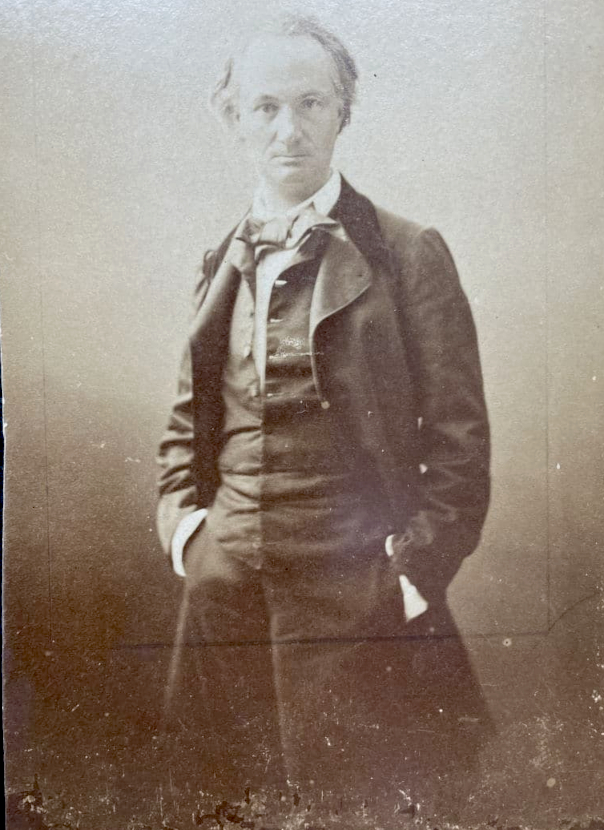
Baudelaire looking effortlessly cool & French in 1862 by Félix Nadar
Clearly for the protesters, ‘belonging’ is as much about people – a homogenous group of people – as it is about place. That’s the opposite of the vague kind of belonging that I sometimes identify with, the kind of thing expressed (very romantically) by Charles Baudelaire when he writes about ‘the flâneur’ in The Painter of Modern Life (1863). “To be absent from home and yet feel oneself everywhere at home; to view the world, to be at the heart of the world, and yet hidden from the world […] The spectator is a prince who rejoices everywhere in his incognito. … The lover of universal life enters into the crowd as into an immense reservoir of electrical energy. One might compare him, also, to a mirror, immense as that crowd; to a kaleidoscope endowed with consciousness which, with its every movement, conveys the multiplicity of life, and the grace in motion of every element of that life.” Well, I rarely feel as enthusiastic as that, and I generally don’t like being in a crowd with a specific purpose, even a benign one like the audience at a concert. But on the other hand, though I rarely feel at home anywhere, I never feel like my home has been stolen or invaded, and I don’t feel threatened because I see or hear people who are different from me. So that’s nice.
Xenophobia is kind of stranger than misanthropy, which is at least understandable, because human beings can be destructive and unpleasant like no other species. But although humanity has apparently infinite variety on the personal level, that variety, though it seems to terrify some people, is on every other level, extremely limited. However many names we choose to give this geographical (rather than political) area; the British Isles, the United Kingdom, Scotland, Wales, England, Ireland, Northern Europe – the population is, -whichever newcomers may arrive, and wherever they arrive from – pretty homogenous, because the human race is pretty homogenous. I was interested to hear my vague gut feeling given scientific validity by the archaeologist Dr Helen Geake (on the Time Team podcast of 9th September this year.) In response to a question about the diversity of the population of Anglo-Saxon England (following the discovery of a skeleton with African ancestry in an Anglo-Saxon cemetery) she said, “I’m not wanting to say ethnically diverse, partly because […] there’s so little genetic variability between humans that I don’t think we have anything like ethnicities or races or whatever. I just don’t think that makes any sense when you look at the science. I think it’s more of a diversity of appearance and origin.” When you consider the inter-species variation between, say a lion (since I mentioned them before) and a housecat, or a chihuahua and a Saint Bernard, it’s clear that the gradations between human beings are far more subtle. And when it comes to people you feel an affinity with, you’re as likely to feel at home (that expression seems stranger the more you consider it) with someone you met by chance recently (or even met virtually online), as with someone you’ve known since you were a child. Interestingly (there’s a euphemism!) I read just this morning that a “Race Science Institute – ie debunked Nazi bullshit – funded by one of the world’s richest men is currently trying to be influential in UK politics.
mouldy football pitch by the fjord, Neskaupstaður, eastern Iceland, around 4.30 am
Randomly – although it’s the thing that made me think about writing all this in the first place – I don’t think I’ve ever had that ‘at home’ feeling more strongly than I did when walking in the outskirts of a small town in Iceland at 4.30 am one July, during a night where the ‘midnight sun’ felt more like perpetual dusk. Why should that be? I have no idea. The conditions were right I suppose – not unlike the flat grey day mentioned earlier. Iceland is very beautiful but although this stretch of road ran alongside a fjord at some points, it mostly wasn’t something so picturesque that you’d put it on a postcard. It featured details as apparently uninspiring (but weirdly loveable to me) as a mouldering football pitch and a school or some kind of municipal building. At one point there was a boat on a platform, which did give more of that sense of ‘elsewhere’. What did ‘at home’ feel like? You know it when you feel it I suppose – a kind of vaguely melancholy contentment that may partly have come from having had a few drinks plus 24 hours or so without sleep; it was comfortable and it didn’t feel like exhaustion.
that mildewed football pitch in more detail
If I tried to express that feeling to some of the protesters, quite possibly they’d say something like “If you like it so much why don’t you go and live there” (British people have a long history of telling people if they don’t like the country they can just leave, and yet they rarely feel like they themselves should leave if they don’t like the country). It occurs to me now that when racists, xenophobes or (popular current euphemism) “concerned citizens” scream at people to go back where they came from, when they wrap themselves in the flags of their own country and wield their national identity at people, what they are doing may partly be asserting how they feel about their home, but what they really want is for everyone they oppose to not feel at home. And when, at the best of times, ‘feeling at home’ is a fleeting and precarious emotion, that’s kind of a shitty thing to do.
Ignore the sensationalist headline; there are no confessions here, and I’m not a heathen, I’m an atheist. When I was a teenage atheist, one of my main issues with the idea of god had been neatly summed up well over a century earlier by Shelley in The Necessity of Atheism (1811):
If God wishes to be known, cherished, thanked, why does he not show himself under his favourable features to all these intelligent beings by whom he wishes to be loved and adored? Why not manifest himself to the whole earth in an unequivocal manner, much more capable of convincing us than these private revelations which seem to accuse the Divinity of an annoying partiality for some of his creatures? The all−powerful, should he not heave more convincing means by which to show man than these ridiculous metamorphoses, these pretended incarnations, which are attested by writers so little in agreement among themselves?
As an adult atheist I still think that, but I think a lot of other things too. I should possibly point out here that though I don’t believe in any deities, the god I primarily didn’t and don’t believe in was the Christian one, simply because that’s the one who most prominently didn’t and doesn’t exist in my own personal experience. My lack of any kind of religious belief is something I’ve given a lot of thought to over the years and mentioned many times in passing on this website. I’ve never written specifically about it, but several things I’ve recently come across made me want to. One is the slightly dubious, clickbaity claim that (as one headline put it) “God is back” and that Gen Z (or some such amorphous group) is embracing the Catholic church. I’m sure that to some extent that’s true, as the Catholic church is just as evident as always, the choosing of a new Pope is TV news etc, but it’s also true that there have been other, substantially similar news stories about Gen Z embracing astrology and conspiracy theories and feminism and anti-feminism and fretting about world war three. None of those things are mutually exclusive of course (most of them should be; maybe feminism & anti-feminism actually are), and what it seems to add up to is that kind of end-times malaise normally associated with the end of a century or millennium.
I feel like it’s necessary to take those kinds of stories with a pinch of salt though, simply because over the years I’ve read all kinds of similar stories about Gen X which occasionally apply to me and often don’t, but in either case I’ve never been asked my opinion in order to gauge it and neither I presume have most people. And since every generation seems to spawn its own Nazis, centrists, communists and anti-fascists and everything in between, its philanthropists, misanthropes and bystanders, its religious zealots, libertines and atheists (etc, etc, ad nauseam), it seems fair to assume that any theory about a generation, just like any theory about a gender, race or sexuality is going to involve the kinds of generalisations which, once really examined, make the whole theory redundant. Presumably, church attendances are on the rise, but does that mean that belief is on the rise, or just that the desire for belief – quite a different thing – is? Or both? Who knows.
Alongside that, not coincidentally, more and more (inevitably right wing) politicians have been yammering on at first in the USA and now here, about “Judeo-Christian” values. It seems that this is mostly because they don’t like foreigners and Islam and are immune to irony. Because in insisting on the values of two ancient foreign religions from what we now in the West call the Middle East and denying the very similar values of another, very similar (though not quite as ancient) religion also from what we now call the Middle East does seem ironic, especially when one is tying it in with one’s national identity. There’s been a growing rhetoric (again, on the right) that suggests that Christians are becoming an oppressed minority in the UK, which is both tiresome and laughable but nicely (and again not coincidentally) complements the growth of a men’s rights movement that claims feminism (which, like atheism has arguably only recently began to have a fairly minor influence if any on the power structures underlying British society) has ‘gone too far’ and all that fun stuff.
Although my attitude has changed over the years, I don’t think my views really have. I genuinely think that it’s terrible and damaging that all over the world people are punished or ostracised or oppressed or killed or made to feel bad about themselves for offending arbitrary rules established in the name of imaginary beings. And in a way worse, the idea that there are omniscient, omnipotent beings who would be offended by actions which they must have foreseen at the moment of creation but decided to allow anyway, in order to punish them.
That kind of thing seems to be the basis of a lot of atheist polemic. Sometimes I find it entertaining and (depending on the writer) interesting, but, even while still believing every word of it, and feeling that it’s worth insisting on if asked about my views, as a middle aged atheist I wonder about the usefulness of saying it polemically at all. Because – for me at least – the opposite of religious faith isn’t science and logic (though I do believe in those), it’s simply non-faith. And I’m not sure there’s much to learn from that.
It’s not an argument that strengthens any cause, let alone mine, but I have come to think that lack of belief in a god or gods is just as instinctive, reflexive and fundamental as faith in them is. My mother was a Christian in her youth (in an atheist household, oddly for the 1950s) to the point where she considered becoming a nun. During her life, she wavered from various kinds of Christianity, to Taoism and Buddhism and a kind of vague paganism, but – and I think this is the most important point – although she lost her faith in many belief systems over the years, she never lost her essential faith in some kind of benevolent god or spirit at the heart of creation. For me it’s almost the opposite.
I have always been very interested in religions from Animism to Zoroastrianism in the exact same way that I’ve always been interested in mythology (I don’t really distinguish between the two) and I find pretty much all religions to some degree fascinating. I love churches and places of worship, I love the atmosphere of ‘holy’ places (even pre-historic places we now assume were once sacred) and I love the imagery and paraphernalia of religions, in the exact same way I love art and history. But it’s good that I’ve never wanted to belong to a faith or to become involved with those mythologies, because I can’t remember a time when I ever believed in even the possibility that a deity of any kind was an actual, real thing. Santa Claus either for that matter, although presumably at some pre-remembered point I did believe in him (Him?)
I have no idea where my lack of faith came from but I can pinpoint when I first became aware of it. I went to three ordinary Scottish primary schools, which in the 1980s meant reciting the Lord’s Prayer every morning before the class started. Not surprisingly, I still remember most of it, though mysteriously I can’t work out which bit I thought in my childhood mentioned snot; I was quite deaf then, but I definitely remember a snot reference, which always seemed odd. In my memory that daily recital was just part of a greater daily ritual which also involved (in the early years) chanting the alphabet and (through all of Primary school) greeting the teacher in monotone unison (The phonetic version of Mrs expresses it more accurately) “GOOD MOR-NING ‘MI-SIZ WAT-SON” or whoever the teacher happened to be – seemingly there were no male Primary School teachers in my day.
I have surprisingly sharp memories of looking round the class during the morning prayer to see who else didn’t have their eyes closed – there were usually a few of us, and sometimes we would try to make each other laugh – but a key part of that memory for me is the sureness of the feeling that I wasn’t talking to anybody. The praying itself wasn’t something I questioned or minded – if anything I quite liked it. It didn’t feel at all ‘bad’ or rebellious not to believe, it just never occurred to me at any point that god was real and might be listening, any more than I remember feeling that the notes put up the chimney to Santa would be read by an old man with a red suit and white beard, or that the carrot for Rudolph would be eaten by an actual reindeer.
At school we went to church (I think) three times a year – at Christmas, Easter and (an anomaly) Harvest Festival – and so folk horror-ish paraphenalia like corn dollies are always associated with church in my mind. The sermons were boring, as were some of the hymns, although others, the ones where the kids invariably sang the wrong lyrics, were fun – but I liked (and like) churches. I liked the musty, chilly smell and the wooden pews and the acoustics and the stained glass windows and especially the holiday feeling of being at school but not at school. And, though they only came into school life at these times of year I liked the Bible stories too. It seems funny now, but until well into adulthood the image that the word ‘Palestine’ summoned in my mind was an illustration of Jesus wandering around in pink and turquoise robes; I presume it’s from some forgotten book of Bible stories. But to me, stories – sometimes good ones (in the case of the early days of Moses and the last days of Jesus, very good ones), sometimes boring ones, are all that they were.
But where does lack of belief come from? The same place, presumably as belief.
Bowie in 1976 by Michael Marks
In Word on a Wing (1976), one of my favourite David Bowie songs – also I think one of his most deeply felt and certainly one of his most open and revealing songs – Bowie, then in LA and in the middle of a drug-fuelled existential crisis but soon to withdraw to Berlin to live a relatively austere and private life, sings: Just because I believe Don′t mean I don′t think as well Don’t have to question everything in heaven or hell
For me, that sums up (non-blind) faith perfectly. Essentially, it’s what Keats (those romantics again!) summarised as ‘negative capability’ (“Negative Capability, that is, when a man is capable of being in uncertainties, mysteries, doubts, without any irritable reaching after fact and reason” – from an 1817 letter to his brothers) but applied to one of the most fundamental human impulses. I completely respect it and see what both Keats and Bowie mean by it, but it’s completely alien to me. Well, not completely: I don’t need to know how a jet engine works to travel by plane, I do indeed have ‘faith’ in it, but what the (nowadays many) commentators who characterise scientific belief as a kind of religious faith seem to overlook is that I don’t believe it because a scientist says it’s true, but because I can actually travel on a jet plane, and even before I did travel on a jet plane I could see that other people travelled on jet planes, that planes really do fly and engines really do work. Which seems like the build up to some kind of New Atheism gotcha of the ‘if God is real why doesn’t he just prove it’ type popular in the 2000s (essentially a more sneery version of the Shelley quote). but that’s not really me either. Although I am definitely an actual ‘speculative atheist’ and I suppose even an ‘atheist fundamentalist’ and though I genuinely do believe that the world and humanity would be better off without religion, I’m just not sure how much better off it would be.
It’s not that the New Atheists were wrong (or even new, thinking again of Shelley). Most of the arguments that were raised against them are easily picked apart. The idea that there is no morality without religion is so obviously wrong that it seems pointless even to argue against it. The same basics of morality (murder and stealing and cheating and lying are bad, treat people as you wish to be treated etc) are and have been all but universal, though not without different nuances, throughout history and throughout world cultures.
But the problem with lack of faith as certainty (and for myself I really am certain about it) is that its arguments, though more logical – at least up to a point, as we shall see – have precisely as much effect on the certainty of faith as the arguments of faith have on the certainty of non-faith. Logic is no help here.
From my point of view, in the certain absence of a god or gods, religion is purely human and therefore many of the (in themselves solid) arguments against it are kind of a cop-out. It’s not unreasonable to find it laughable that a supreme supernatural being should care what food you eat on which days, or what you wear or how you like to have your hair. It seems bizarre that an almighty creator who could presumably do whatever it liked, would take the time to tell humans which crops they prefer to have planted where or that male masturbation is bad rather than simply preventing the possibility of rule-breaking ‘at source’. But the omnipresent invisible elephant in the room is that whether or not a god really felt or feels strongly about these things, whether or not a god had them written down in words, they really were written down in words, by human beings, some of whom definitely did want these rules to exist and to be enforced. And it’s human beings that still enforce them. Also, it’s just as true that primarily secular or entirely secular societies also have rules and customs regarding things like clothing, food, hairstyles and even names, although they rarely come with threats of severe retribution and never with the threat of ongoing retribution after death. And yes, many of these customs – like the acceptable length of women’s skirts in western society – ultimately derive from religious directives, but any authoritarian society, not only theocracies or weird, nominally religious ones like Nazi Germany, but even states where religion is completely anathema like Stalinist Russia, Communist East Germany or the North Korea under its current regime are hardly relaxed about the individual’s freedom of expression.
Religious wars and religious persecution are bad, not because they are religious per se, but because wars and persecution are bad. Wars and persecution may often be provoked by religion, but surely if like me you don’t believe in god, then blaming that non-existent creature for religious wars is just euphemistic buck-passing bullshit? The Crusades were horrific, bloody and unjustifiable, but to blame “Christianity” for them, rather than Christians, that is, actual European human beings, is like blaming, or giving credit to, Tengri for Genghis Khan’s conquest of vast tracts of Asia, or suggesting that Jupiter, Neptune and co enabled the Romans to found their empire. “Catholicism” didn’t create the Spanish Inquisition any more than the concept of Nazism created the Holocaust or Islam as a belief system resulted in 9/11 or the Taliban. Left to themselves, religions, ideologies and philosophies don’t do anything; they just sit there. And they all have one common denominator, and it’s not a deity.
This morning, I saw that the Pope had made a statement that some policy or other of the current US administration is “un-Christian and un-American.” Well. I am glad to see anyone with any kind of authority challenging inhumane, intolerant and fascistic regimes. But those actions are only un-Christian insofar as Christ himself wouldn’t like them, according to the Bible. But Christ was one single man-god who acted a certain way and said certain things. All manner of atrocities are entirely in keeping with the actions of two millennia of Christians. As for un-American, again, the acts the Pope condemns are not compatible with the statements made by the founding fathers of the Unites States of America; but they are probably no worse than the actions carried out by those same founding fathers in their lives or many of the successive governments of the USA. Or indeed many, many other governments in the world. And, to be all New Atheism about it, when it comes to the welfare of children for instance, it’s not like the Catholic church itself has an impressive record. Does that mean the Pope shouldn’t condemn things or that American people shouldn’t try to hold their government to account using the egalitarian rules set down when the country was founded? Of course not; but invoking some kind of imaginary, ideal standard of behaviour really shouldn’t be necessary to do so. There’s human decency after all
Another (non-conclusive, because none of them are) argument for the human, rather than divine nature of religion is that the religions that have survived the longest and strongest in the modern world are those which are most compatible with it. The paternalistic, to varying degrees misogynistic Abrahamic religions all defer their ultimate spiritual rewards (but more on the non-ultimate ones later) until after death. They have no in-built expectation of much material happiness or contentment on this plane of existence and to varying extents they actually value hardship, while prioritising men within the earthly realm. Well, the paths that led us to 21st century culture, especially imperialism and capitalism, are fine with all that. Work and strive now, happiness comes later, unless you are one of the privileged few. Communism in theory isn’t fine with that, but naturally, having been formulated during the Industrial Revolution, when the vast mass of people were already oppressed by a tiny ruling class (itself a mirror image of the earlier rule of Church & monarchical elite vs peasant majority), it is defined by its opposition to capitalism. Early Communism therefore took hardship as a given (there is no proletariat without it) and, in lieu of heaven, deferred the payoff of universal prosperity and equality to some future time when the world revolution has been achieved and all opposition to itself removed. It’s a cliché to say that communism is itself a kind of religion, but the parallels are unignorably consistent; trust the leaders, put up with the shit now, eventually if we’re true to our cause it’ll all work out, if those heretics don’t spoil it.
On the other hand, various older kinds of religions, animism and ‘earth mother’ paganism and so on, value (quite logically) the need to look after the world we live in. It’s not that the religions of the book explicitly say not to, but they aren’t primarily concerned with this world – and imperialism and capitalism and even communism, which have other uses for the material world than care and stewardship, have historically all been fine with that. It’s somehow not very surprising that the aspects of non-Christian religions that became most taboo during the age of imperialism, and therefore attributed to “savage” or primitive cultures – human sacrifice, cannibalism, idol worship and so on – should be parts of Christianity itself. Without human sacrifice, even if it’s only the sacrifice of one special token human, there is no Christianity. The divinity of Christ kind of goes without saying – that’s what makes it a religion. But his humanity is what makes him more than just the old Testament god. And insisting on his humanity inevitably made the eating of his flesh and drinking of his blood controversial. But seriously, whether someone believes they are literally eating the flesh and drinking the blood of an actual human being or only symbolically doing so, it’s a cannibalistic ritual just as atavistic and visceral as any of the imagined horrors that the Christians of the crusading period or the Europeans who spread their faith across the world believed they had encountered. It doesn’t seem too fanciful to say that what really horrified those Christians was the discovery that things they saw as fundamental to their own civilisation might be just as fundamental to civilisations that they had to believe were inherently inferior in order to destroy them.
Monkey (1979) Buddhism & Taoism that was fun for kids
The fact that there are analogous stories to those in the Bible throughout history and world cultures (death, rebirth, sacrifice, enlightenment) suggests that whether or not one has any faith in these stories, they aren’t ‘just’ stories. In fact, a lesson that stayed with me (because it suits my personality I suppose) from the 70s TV show Monkey, based on Wu Cheng’en’s 16th century novel, Journey to the West – something like “winners make losers, therefore remove yourself from competitions” purports to be from a Taoist religious text. Eating the fruit of the tree of knowledge (I like to think a banana) and paying the unexpected price for it is, even as a mythological story, one that has real life analogies all through human history. I remember as a child when plastic coca cola bottles began to replace glass ones. It seemed futuristic and in a weird way utopian – lightweight like a can but resealable, far less risk to your drink if you dropped it than a glass bottle; less broken glass in the streets and parks. Whether or not scientists were already concerned with the problem of plastic’s lifespan or the sheer accumulation of it I don’t know, but kids weren’t, for a few years at least. Which has nothing to do with religion – but the attempt to do good turning out not only to be bad, but to be something that has to be dealt with and paid for down the generations is hardly an alien one. And in this case it was made worse not by religion, but by the inability or unwillingness of people under capitalism (myself included) to distinguish between convenience in the sense of people not having to waste half of their lives in drudgery and convenience in the sense of not having to get up to change TV channels. There’s probably a parable in there somewhere.
A favourite anti-atheist argument is the ‘intelligent design’/watchmaker one. It’s clearly an empty argument, but my counter arguments would only be convincing to an atheist – and not even to all atheists. The argument, put simplistically, that because a watch, or a computer, or anything human-made and complex didn’t just evolve on its own, but had to be consciously invented, therefore means that life, earth and everything else must have been consciously invented too requires an obvious leap of logic. The universe is not a machine, life is not the same as battery life.
The most complex things in our world seem to be human beings, and human beings also produce other human beings, often with no conscious thought and rarely with any kind of design at all. People are accidentally invented all the time. The idea that creation is accidental or ‘just happens’ is hardly a difficult one to grasp. The people that people produce are every bit as complex as their parents and grandparents, but only occasionally, and in the most superficial way, are they designed. Worse than that, logically, we know how humans are created, but even so it’s hardly unusual for them to be produced even when the people doing it very much desire not to do so. To look at the way that the most complex creations on earth are usually made and to label it “intelligent design” would be a strange thing to do, since it doesn’t necessarily include much intelligence or any actual design. Of course that doesn’t prove that things weren’t originally designed, but the gulf between organic living things and intelligently designed things as we experience them, even at the beginning of the AI age, is so fundamentally different that you might as well argue that a cat must have designed clouds because you once saw a cloud that was cat-shaped.
As mentioned in passing before, it’s popular among a certain kind of (usually, but not exclusively right-wing, American) Christian to compare ‘faith’ in science to faith in god, which is a false equivalence, for the jet plane kind of reasons mentioned above – but although I do believe science to be superior in every way to religion – because it learns from experience, for one thing – I do sometimes wonder whether it suffers from being (this sounds very different from how I mean it) homocentric (is ‘anthropocentric’ better? It sounds worse) in a similar kind of way. I remember learning (in a very basic way) about the big bang at school and asking the teacher, not unreasonably I think, *what* was supposed to have exploded and where that came from and being told “that isn’t a scientifically interesting question.” Well, quite possibly all the teacher meant is that at the current time any answer to that question must be pure speculation of a non-mathematical kind, but teen-me felt that it was basically “science works in mysterious ways” and he/I didn’t like that.
Somewhere in this article I had been going to say that Shakespeare was was as right as anybody when he wrote “Nothing will come from nothing” but now that I’ve reached this point I wonder whether being creatures that are born, who come from somewhere, who live for a while, who are subject to time and then who die and stop existing (or go somewhere else) shapes our understanding of everything. I do believe in the big bang because the evidence around us confirms its likelihood. The universe started, it expanded and at some point it will end. The idea of something that just is, forever, or that exists outside of time, whatever that would mean, seems as incomprehensible as non-existence does. That things, including human beings do stop existing is in one way obvious – but things breaking down, decomposing, changing from one form to another and (romantically) melding with the universe or (prosaically) enriching the soil or whatever is a process that is understandable. The personality and individual human consciousness switching off and simply not existing is the hard part to take in. As far as we can tell this isn’t a change in energy type, the electrical impulses that are us don’t seem go anywhere or do anything. But maybe that whole frame of reference; beginning, middle, end isn’t everything, it’s just the limits of human understanding. Which doesn’t, to me, imply the existence of any kind of creator or supreme being, just that there’s scope there for whatever you care to imagine but which you can never truly know. Keats would be fine with that.
Similarly, to apply logic to the existence of god will always be self-defeating, because logic is (as far as we know) a specifically human way of explaining the universe to its/our own satisfaction. The laws of physics and nature and mathematics do seem to work according to logic, which is very helpful for teaching and learning and science, but human beings themselves routinely defy logic in both profound and trivial ways. Many of the things that humans value most highly are completely resistant to logic, like art and god and love and money. Even something as humble as sports; one human being being able to run faster than another or play a game better than another is only dubiously something to celebrate, and if it is, then logically one might expect people to support only the best teams and athletes. If, alternatively it’s to do with identification with and loyalty to one’s own area, then fans might only be expected to support teams or athletes from the same geographical location as yourself, which is occasionally how it works, but just as often isn’t. There’s nothing especially logical about the enjoyment of a race or a game in which you aren’t involved for its own sake. Does that mean that logic is a faulty way of understanding the universe? I don’t know; but it is a faulty way of understanding human beings. The idea that god’s existence is a logical reality in a 2 x 2 = 4 way makes about as much sense as the position of the planets at the time of your birth dictating your future.
As Bowie implied, faith needn’t – and in many cases I’m sure doesn’t – preclude seriously considering the implications of one’s belief. But sometimes it does. I’ve never wanted to believe (I don’t really get why anyone would, if they don’t; which is my deficiency), but as an adult I have always wanted to understand people who do. And in general, I find it frustrating to try to do so, as two different but very similar anecdotes about my encounters with people of faith illustrate. I am aware though that these may say more about me than they do about the believers.
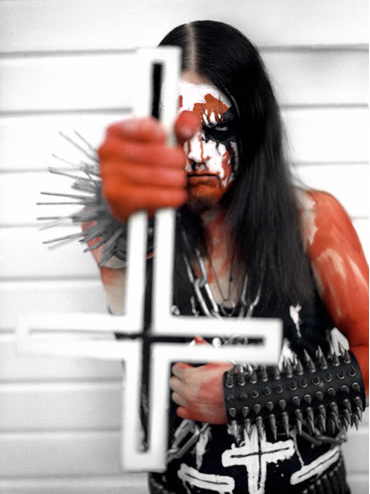
In my professional capacity I was once interviewing a prominent American black metal musician whose latest album went on about blasphemy a lot. Given that black metal encompasses everything from orthodox satanists to heathens and pagans and occultists and chaos magicians and nihilists, I asked what I thought was a reasonable question; what meaning does blasphemy have unless one believes in god? Doesn’t the concept of blasphemy essentially reinforce the religion it attacks by affording it some kind of legitimacy?* The musician’s response was the black metal version of these go up to eleven. I think what he actually said was “Everyone knows what blasphemy is.” And he was right I suppose, but he was also characterising his band as purveyors of simple shock and outrage to the very few people who are still shocked and outraged by blasphemy. Ho hum.*
The archetypal image of black metal, Nattefrost of Carpathian Forest, photo by Peter Beste
*this made me think of an occasion in high school where I muttered “of for god’s sake” or something like that and my maths teacher said “don’t blaspheme, William!” and I replied “it would only be blasphemy if god existed” and was given a punishment (lines). It was only years later than realised I deserved the punishment, not because of god, but because I was being a smart arse to a teacher – at the time I just felt righteously angry about the lines.
Likewise, a visit from some very pleasant Jehovah’s Witnesses left me with unexpected admiration for them, but also some frustration; they also left prematurely, which my younger self would have regarded as a victory. The respect was for their answer to the kind of question that seems like a typical smart-arse one, but I was genuinely curious. If there are only 144, 000 places in heaven in your religion (I had only recently learned that strange fact) and those are all spoken for already, why are you knocking on people’s doors trying to spread the word about your faith? I hadn’t expected their response, which was something like “Oh, we don’t expect to see heaven. Heaven is for god and the saints and angels, Earth is the paradise that god made for humans, it just needs to be fixed.” A version of Christianity that withholds the promise of paradise even after death was weird to me, but also impressive. Having a faith where you never expect to attain the best bit seems coolly ascetic, but also kind of servile, which it literally is. The fact that servility seems distasteful to me is I suppose my weakness not theirs.
I was less impressed with the response to what I felt and still feel is a serious question and not just a cynical gotcha; If god is all you say it is, all powerful, blah blah, then why create evil? There was a stock answer ready, which was to do with free will and choice, but even though there are holes to be picked in that too (the ‘free will’ of transgressors has nothing to do with the free will of their victims, what about their will?) – that wasn’t what I meant. What I was asking is, If you can do whatever you like, can see everything that has ever happened and everything that will ever happen, if you are capable, presumably, of endless satisfaction and happiness, why create ‘bad’ – or, more personally perhaps, why create even the concept of ‘things you don’t like’ at all? To that question, I got the Jehovah’s Witness version of “these go up to eleven” and a quick goodbye. But I genuinely wasn’t trying to catch them out, I really wanted to know what they thought about it, but apparently they didn’t think anything. Having said that, I can see now that I write about it, that interrogating your belief system for the benefit of a stranger who obviously isn’t going to be persuaded to join you is probably not all that attractive. Still, I didn’t knock on their door.
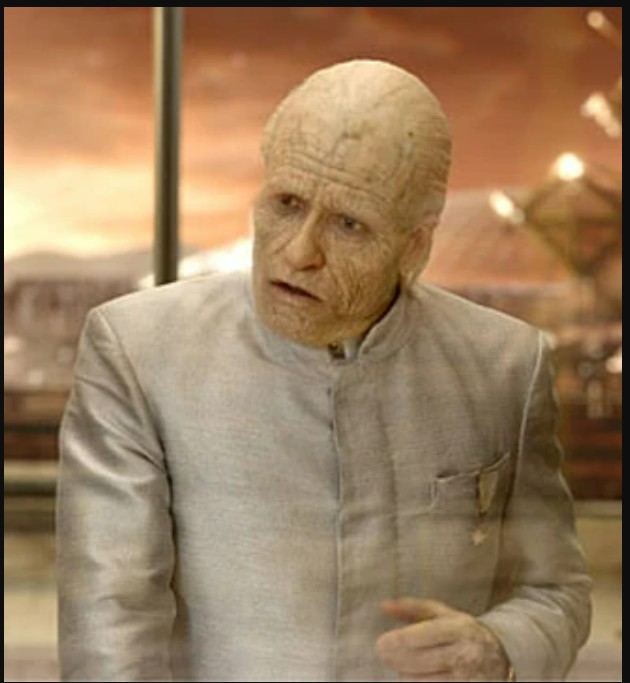
Guy Pearce as Peter Weyland in Ridley Scott’s Prometheus (2012) – something to aspire to?
So much of religion seems to me to be saying that that, whatever the wonders and horrors and joys and pains of life, it’s not enough and they want more. But again, that’s not exclusive to religious people. I recently saw an unsettling but also unintentionally funny video in which the PA of a shadowy, influential and incredibly wealthy figure was talking about transhumanism and his master’s ultimate Roy Batty/Weyland-from-Prometheus plan not to die at all. Which feels very sci-fi, but also very late Roman Empire. At the same time, my generation grew up with the rumour that Walt Disney’s head is in a refrigerator, awaiting medical science until he can be resurrected when the technology catches up enough. Rebirth and resurrection; there really is nothing new in human history.
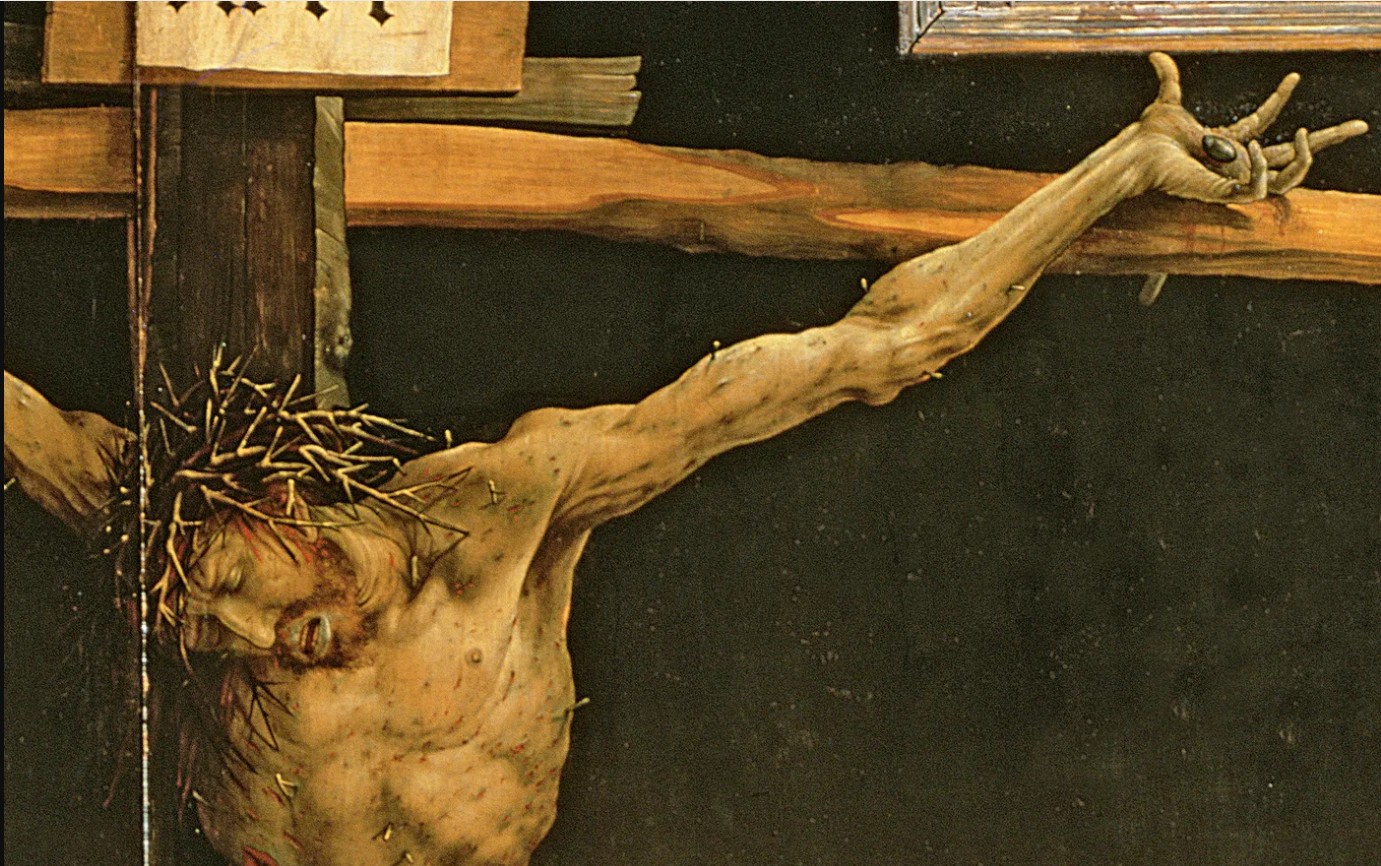
detail of the crucifixion from the Isenheim altarpiece (1512 – 6) by Matthias Grünewald
All a bit bleak, maybe; but if religion only offered oppression, judgement, condemnation and war then far fewer people would devote their lives to it. And if the negative aspects of religion all exist independently of religion, then so do the positive aspects, and without the same arbitrary punishment/reward structure underlying it.
Religion offers comfort to people in distress, it offers a sense of community and belonging, it offers contact to people who feel isolated. It offers various kinds of love. I can’t think of many artworks more moving than Matthias Grünewald’s crucifixion from the Isenheim altarpiece (1512-6), painted to comfort people who were suffering from skin diseases, by showing them the scourged Christ’s suffering, which mirrored their own. But just as the Quran didn’t issue a fatwa against Salman Rushdie and the Bible didn’t take babies from unmarried mothers and kill them and bury them in the grounds of institutions, neither do those books feed the poor, embrace the lonely, paint pictures or create a sense of community. Human beings do those things, and they do them regardless of religion. They do it in societies where religious beliefs aren’t based on the Judeo-Christian tradition and they do it in societies where religious beliefs are actively frowned on. After the dissolution of the USSR, few people were nostalgic about the food queues or the secret police, but many were nostalgic about the sense of community that came from masses of people being in the same situation together. And now that capitalism which, unlikely though it seems, is not always so far removed from Soviet communism, has created its own underclass and hierarchical power structure and pogroms and whatnot, people have also created their own communities, support groups, charities and friendships.
The one positive thing that faith offers that non-faith of my kind doesn’t, is a personal relationship with god – and that’s where we came in; you either believe or you don’t. I can completely understand that having a direct line to someone who knows you and understands you better than you know yourself, who accepts and forgives you could be nice and comforting. Maybe in pre-Christian or non-monotheistic societies that voice was the voice of the ancestors or the spirits of the trees and rivers. I can see how that would be nice too, but for myself I can’t imagine having such a thing or longing for it or even wanting it. For me, you either disbelieve or you don’t.
And maybe that’s really the strongest argument, not against faith, which there is no argument against, but against religions as institutions, as rules and directives of the kind that people are so keen to re-establish. Because if there’s one thing you can see, looking not just at the diversity of religions but at the diversity of beliefs within them, at the different ways that people relate to and communicate with their gods, it’s that god is just as personal and individual as any of its believers and disbelievers and so making an orthodoxy of it can only ever harm more people than it helps.