forgetting the fifth

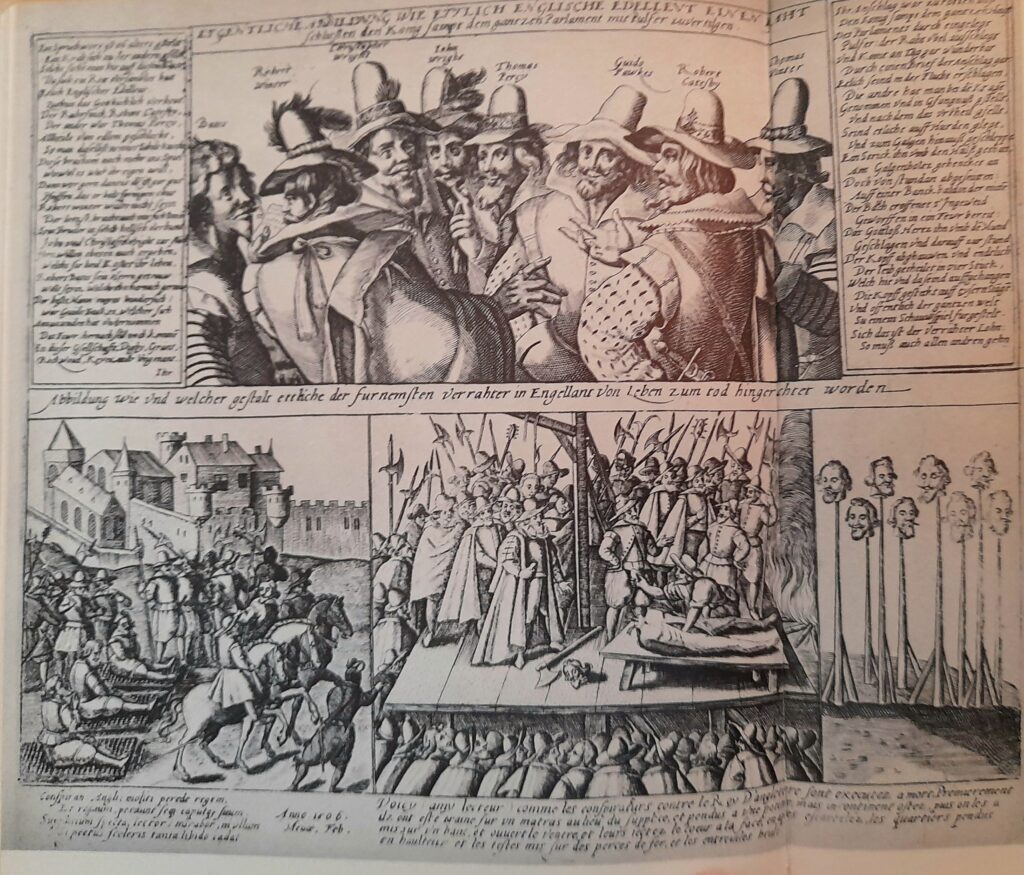
Crispijn van de Passe’s complete engraving including the arrest, torture and execution of the conspirators (1606)

When I wrote the first version of this a couple of years ago, I started by saying – though without a huge amount of confidence – that even now (or then) most British kids knew the first line of the rhyme that begins, Remember, Remember, the 5th of November, even if they didn’t know the rest of it. I’m even less sure that’s true now. The segue between Halloween and Christmas is imperceptible now, mostly because there is no segue to perceive. This year, for the first time that I’ve noticed (I’m not saying it was the first time it’s happened), shops put out their aisles of Halloween and Christmas junk simultaneously at the beginning of October. And – and this has probably happened every year for a while – Christmas-themed adverts began screening on TV on the first of November.

Traditions always come and go and it’s interesting to see how quickly they can become established – I deliberately didn’t use the phrase “the Christmas adverts” above, but it is now a thing, an annual event almost that is discussed in newspapers (themselves a sort of tradition whose days are surely numbered?) and on TV as if they are news. It seems ironic though that the phrase “spooky season” has become established in popular usage in almost the same way as ‘the festive season,’ at a time when the UK’s spookiest celebration has died away and the ‘season’ the phrase refers to is essentially one evening.

Kids not knowing more than the first (or first two –  “Remember, Remember, the 5th of November/Gunpowder, treason and plot”) lines of that old rhyme is nothing new: even when I was a child – at which point November the 5th was still a date that seemed on a par, magnitude-wise with Halloween (in fact in some ways Halloween felt like a warm-up for November 5th, which was more spectacular) I was extremely sketchy on where the verse goes after that and even now I’d have to look it up to find out.

 What I always liked about November the 5th as a child – not that I would have thought to put it this way – was its ambiguity. It was a celebration, clearly, but a celebration with something like Halloween’s horrific overtones. And Guy Fawkes was its star, but it would be wrong to call him its hero – you don’t burn heroes in effigy. But then calling him a villain doesn’t really work either. A villain that you’re introduced to, not by their evil deeds, like Dracula or Hitler, but by watching them, already defeated, being burned to death, can only be so scary. There was also a kind of veneration of the effigy – then just known as the Guy (which was vanishing even when I was quite young), where having a really good, lifelike Guy to burn made the night especially satisfying. So children kind of liked him. As a ritual, it was satisfying; Fawkes was not like Freddy Kruger or Jason Vorhees – once Guy was burned, he stayed burned, until next year. It’s obviously reactionary too – a ritual that celebrates the destruction of a rebel and the preservation of the status quo. But at the same time, the aim of the rebel was not some kind of egalitarian peasant’s revolt, but the replacement of a repressive Protestant monarchy with a repressive Catholic one; so it’s nicely complicated.

The burning is itself interesting – a kind of cleansing ritual that feels related to the 17th century in which Fawkes died – and most associated with the execution of witches. But although it’s period-appropriate, it’s notably not how the real Guy was killed. It was perhaps chosen for the slightly prosaic reason that it was related to another now-dead seasonal tradition; in the days before local councils in Britain sent squads armed with shovels and sacks around parks to tidy up and collect dead leaves, the leaves used to be swept into piles and burned. The smell of smouldering foliage was once as much a part of the autumn-to-winter transition as early sunsets and morning mists. In that sense, Guy Fawkes had almost become a surrogate elemental like the Easter Bunny; but a symbol not of Spring and rebirth/renewal but of the death of nature and the welcoming of winter as its dark days began to encroach. Being bound to the season and the ritual, annually entering the celebrations as a prisoner, defeated but not yet despatched, he could be seen as kind of a sad and sympathetic figure. But I’m getting ahead of myself.
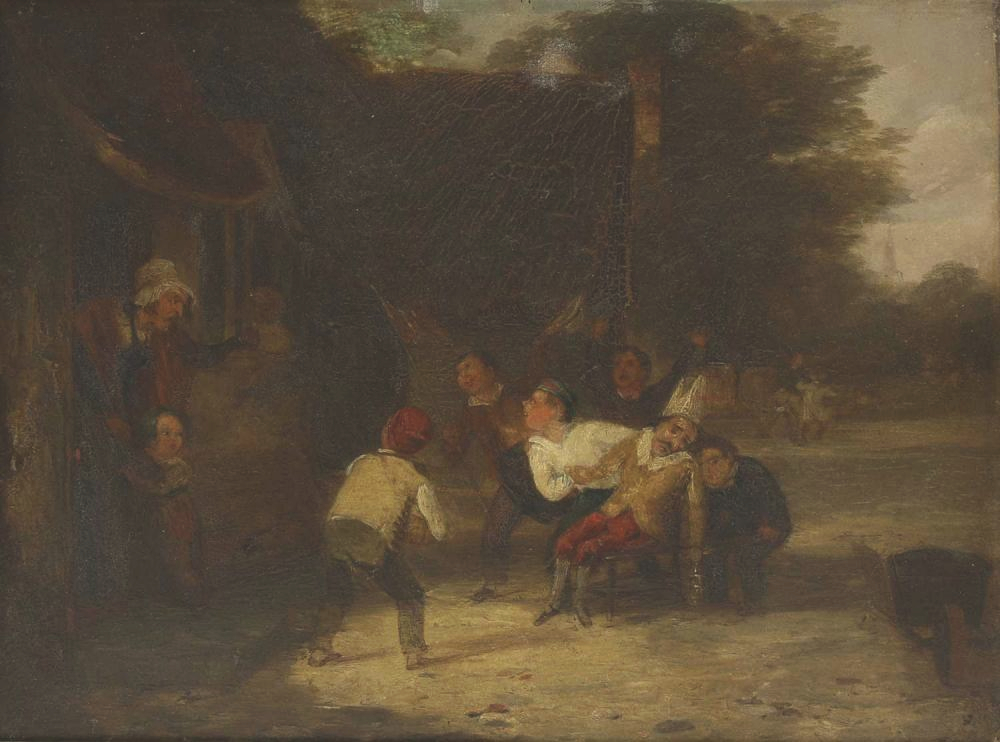
a murky, mid-19th century painting of children with a ‘Guy’, painted by Thomas Webster (1800 – 1886)
November the 5th – known variously, as late as the 1980s and among older people even today, as “Bonfire Night,” “Fireworks Night” and “Guy Fawkes Night” is no longer anything like as big as Halloween. Halloween itself is in some ways – commercially and in on online sense, socially – bigger than ever. At the same time, in the UK it’s become quite diminished as a folkloric, British celebration, reduced instead to an opportunity for adults to dress in a humorous/sexy way and for kids to the trade a stock phrase (or more romantically, a magic code) in return for some sweets. The November 5th I remember felt as ancient and immutable as Christmas, Easter or Yugoslavia – but like at least one of those it was actually in the late stages of a transitional and final phase – along, perhaps, with a more community-centric way of life more generally.

I thought I remembered the Ladybird book – a hugely popular series of small-format books for young children published from the 1940s to the 80s – devoted to the Gunpowder Plot, but now that I look it up I’m not so sure. The pictures look possibly familiar, but I don’t remember James I being referenced in the title and I don’t remember ever seeing Fawkes referred to as ‘Guy Fox’  as per the text. But the fact that I do remember having a Gunpowder Plot book and this not being it only testifies to the popularity of the story.
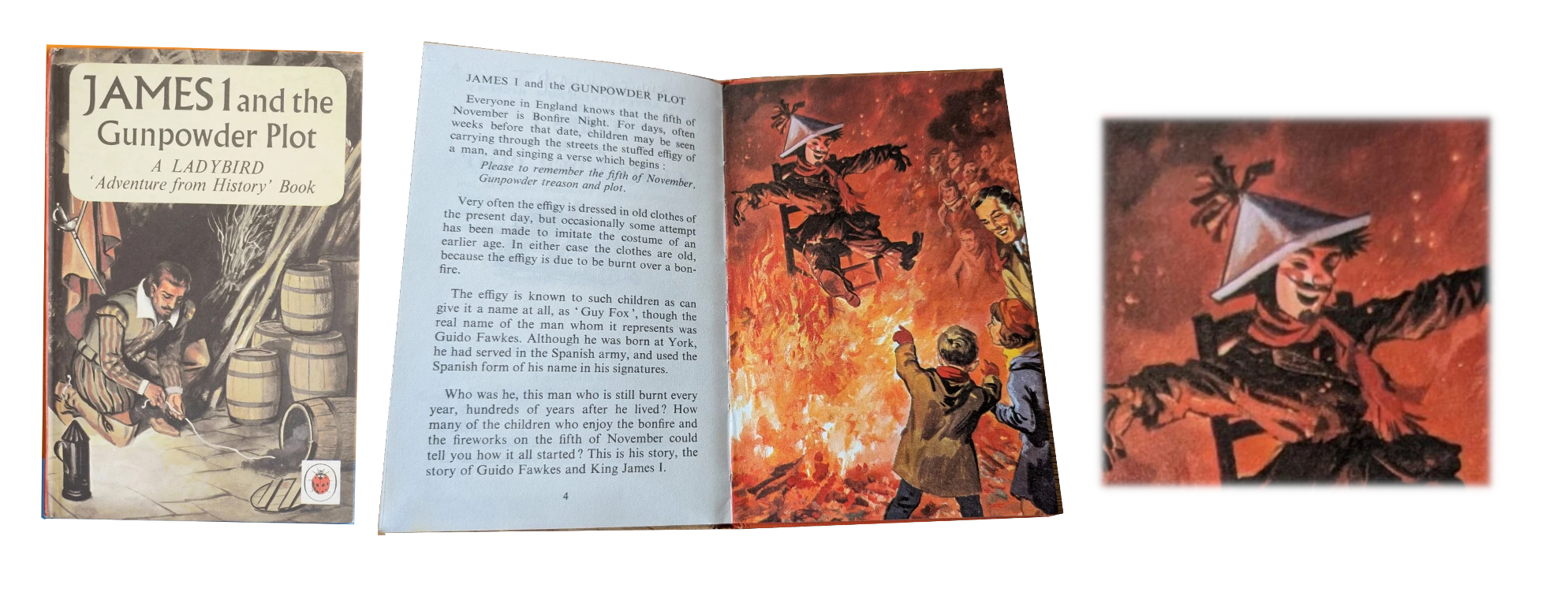
popular 1960s Ladybird book for young children
In my earliest memories of Bonfire Night, people tended to have bonfires in their gardens – not everyone (my family never did, even when we had a garden) – usually a few families would congregate in whichever friend or neighbour’s garden was biggest. Generally, there was an effigy of Guy Fawkes to put on the fire – by then really just any kind of human shaped figure. The 17th century costume was in all but the most extravagant cases limited to a tall paper hat, though I do remember once seeing shoes with cardboard, silver-painted buckles, which was a nice touch. Generally, some fireworks would be set off – a handful of rockets and maybe a Roman Candle (always a sadly inferior firework, to child-me) and a Catherine Wheel.

That’s the time – early 80s presumably – that my most vivid Guy Fawkes memories come from. Mostly they are cornily nostalgic memories; wrapping potatoes in foil and putting them in the edge of the bonfire – when they came out, they usually still had a raw-ish look, but occasionally were completely charred; both ways you could somehow taste the foil and yet they were delicious – or toasting marshmallows. There was that strange (sometimes slightly nauseating) sensation where the front of your face and body were almost too hot from the glare of the fire while your back was freezing from the November night air. Kids messed around (more or less carefully, or at least I don’t remember any burns or accidents) with sparklers, making shapes or trying to write things in the air.
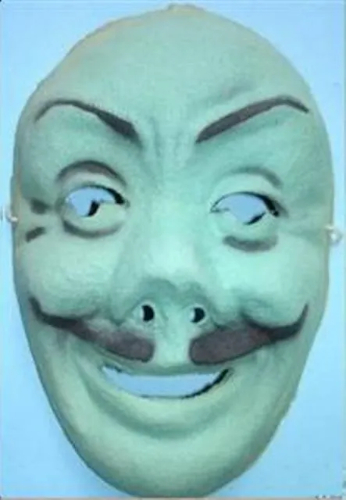
1960s Guy Fawkes mask of the type that inspired David Lloyd, artist of V for Vendetta
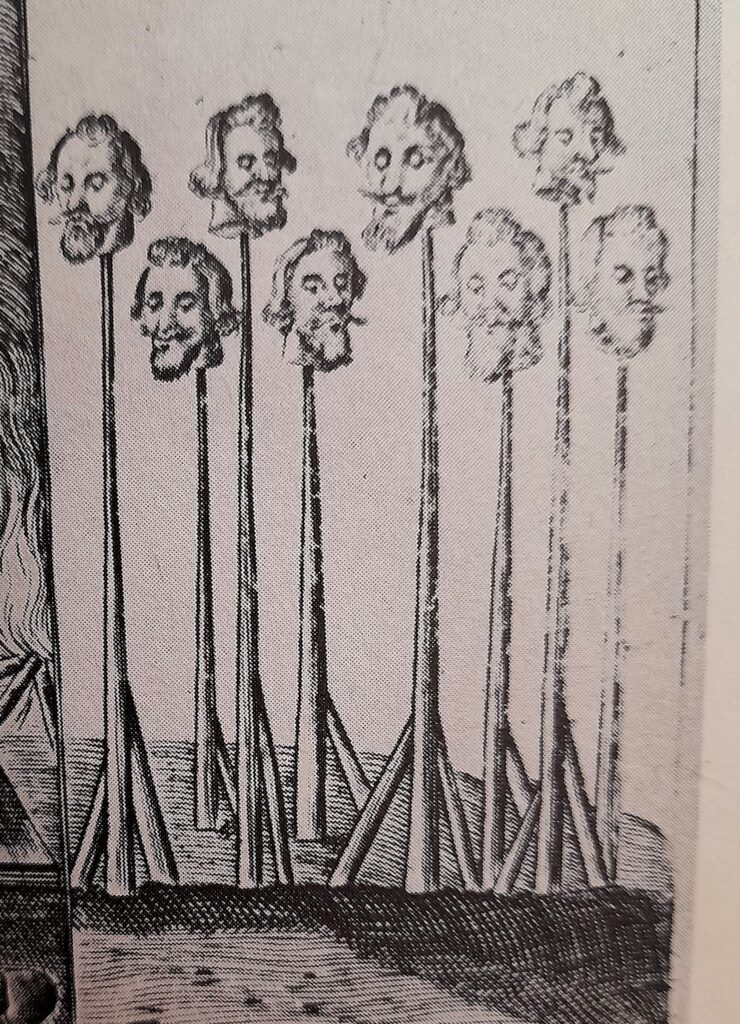
Less corny are the more peculiar, Wicker Man-like memories of watching the Guy itself as it caught fire; which makes me realise how rarely – thankfully – people watch a human (shaped) figure burst into flames. A surreal experience really – and the better or more realistic the Guy, the more exciting it all was; which is far more disturbing to consider as an adult than it ever was to watch as a child.  As mentioned above, the historical Guy Fawkes wasn’t executed by burning. He was sentenced to be hanged, drawn and quartered, but thankfully, due to the ineptitude (or possibly the mercy) of the executioner, he died during the hanging and so escaped the fate shared by three of his fellow conspirators on the 21st of January, 1606. They, like Fawkes were hanged, but they were cut down while still alive before having their genitals cut off and intestines pulled out (preferably while aware enough to see it), before being beheaded and cut into four pieces which were then prominently displayed in the city. All of which would all be a bit difficult to turn into an annual ritual for kids.

the ultimate fate of the Gunpowder Plot conspirators, as depicted by Crispijn van de Passe in 1606
But even if hanging a Guy had been less impractical, it would anyway be far less spectacular on a dark winter evening than burning one on a bonfire. But the burning of the Guy was the culmination of the Guy Fawkes celebration, not the totality of it. More so than Halloween, the lead up to November the 5th and the sense of growing excitement was a part of the whole occasion. For a week or so before the night itself, the bonfires would be built, most excitingly the big municipal ones. A pile of old furniture and assorted wooden rubbish and cardboard boxes would appear in the local park, getting bigger daily – this practice pretty much stopped during my teens when I was less interested, so my knowledge of where the stuff came from and who was involved in organising it is shadowy. Part of the ritual, at least in the 80s – prompted by the popular BBC kids’ TV show Blue Peter – was also the daily checking of the future bonfire for hedgehogs, to ensure that the only victim of the fire was a surrogate human.

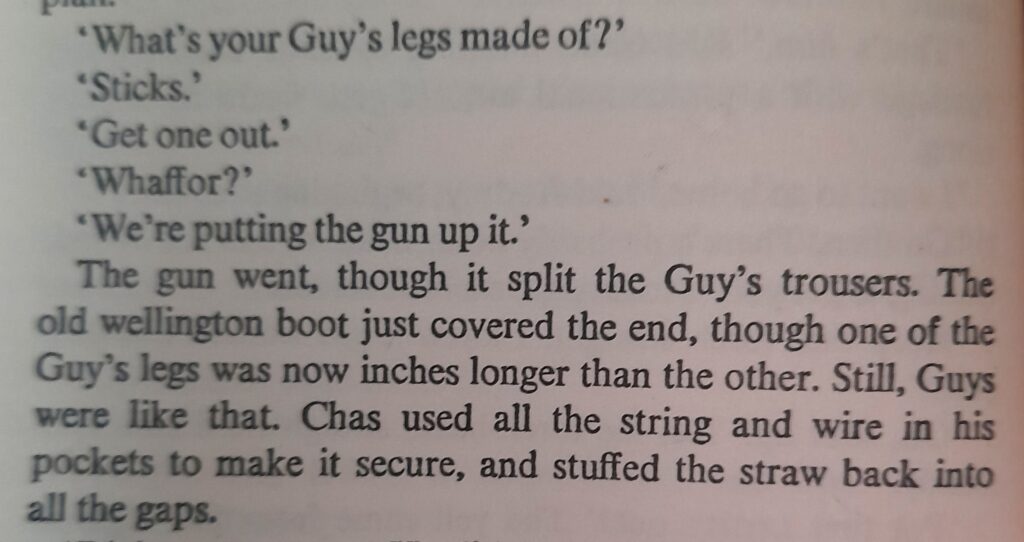
Guy Fawkes lore in Robert Westall’s The Machine Gunners (1975)
There was also the constructing of the Guy itself. I’m not sure now if I actually remember people going door to door asking for ‘a Penny for the Guy,’ in the build-up to Guy Fawkes Night, or if that’s something I just know about from books, TV and the reminiscences of my parents and other older people. This involved the highly unlikely-since-the-90s spectacle of kids or teenagers going door to door, collecting money or more often, old clothes in order to make the best possible effigy to burn. I do remember my parents donating old clothes for the purpose, but the circumstances are too vague to be sure. I do know that as I got older, the family bonfire parties and fireworks in the garden gave way to bigger and more spectacular (and therefore initially far more exciting) municipal fireworks displays and bonfires in parks. By the early 1990s, these were becoming less impressive and the Guy – the best or at least the most unique and strangest part of the whole thing – was often missed out altogether. Regulations about the use of fireworks got tighter – admittedly for good reasons – and fireworks themselves therefore became much harder to get and more expensive. And then at some point, more or less unnoticed by my teenage self, the whole thing just stopped happening. But bonfire/fireworks/Guy Fawkes night lives on in two strange ways.

Firstly, fireworks. For decades, November 5th was the occasion for fireworks in the UK and even though latterly New Year has taken that place, there seems to be some kind of residual racial memory in the country’s youth (not just its youth; the advertising of fireworks, albeit in a severely compromised way, still begins in October) and fireworks are randomly set off for the few days either side of November 5th – I saw/heard some last night. Somewhere, perhaps in the more aggressively conservative parts of the UK, there must still be council-run fireworks displays on the 5th too, but there definitely aren’t around here.
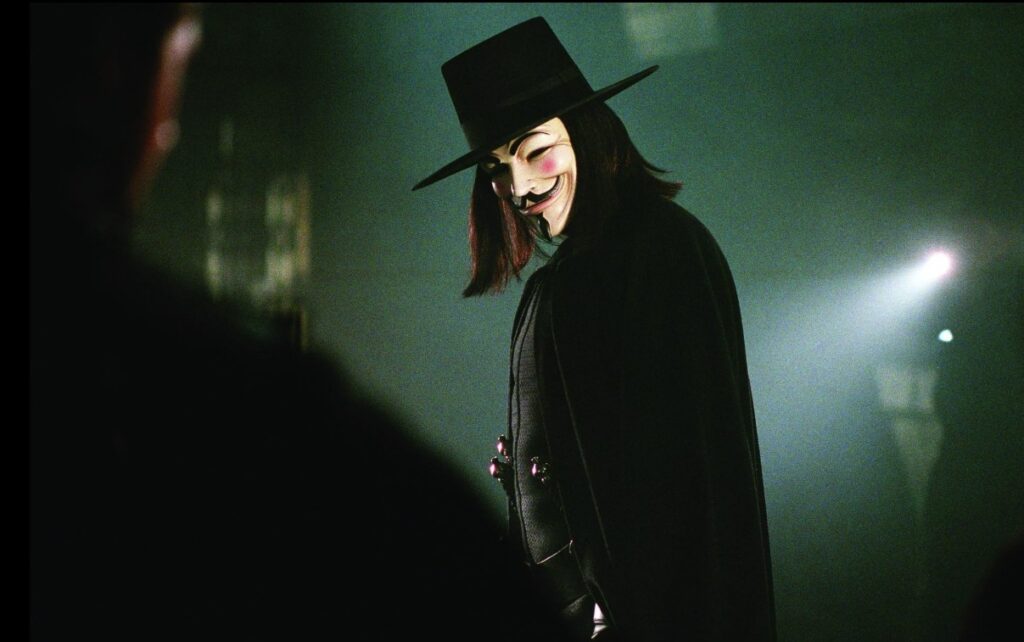
Hugo Weaving in Guy Fawkes regalia as V in V for Vendetta (2005)
Secondly, thanks to James McTeigue/the Wachowskis’ lame 2005 movie adaptation of Alan Moore and David Lloyd’s brilliant 1982-5 comic V For Vendetta and the subsequent appropriation of V’s mask by the ‘hacktivist’ group Anonymous, the iconic face of Guy Fawkes is more famous around the world now than it has ever been. V in the film looks perfect, and the excellent central performance by Hugo Weaving highlights what a missed opportunity it was – but never mind. The film has led to a strange situation where the traditional face of Guy Fawkes (see the Ladybird illustration above) is probably recognised by more people than at any time in history, whereas probably fewer people than ever before know who the mask represents. By the time I was a child, Guy Fawkes masks were no longer (as far as I remember) widely available in shops they had been in Moore & Lloyd’s youth, but children of my generation still have recognised the face (especially with the tall hat) as that of Guy Fawkes.

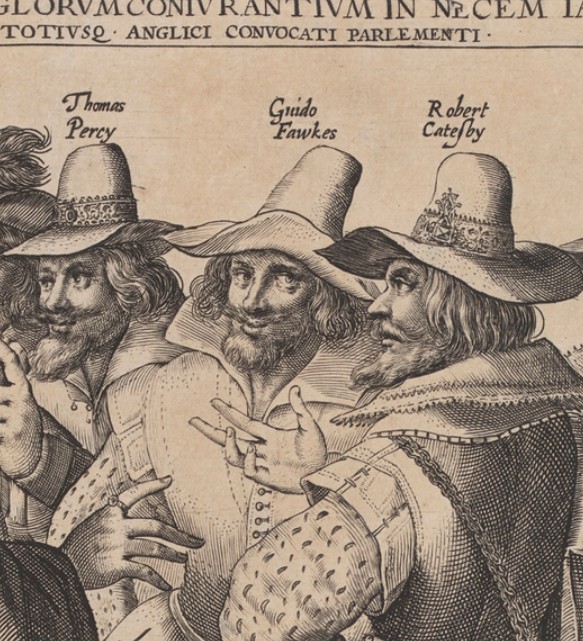
Guido “Guy” Fawkes (centre), c.1606, by Crispijn van de Passe
What everyone knew when I was a kid, and maybe children still know (?), is that Guy Fawkes was a criminal who was caught red-handed with a huge quantity of explosives an was tortured and executed for his part in a plot against the government and monarchy (which in the early 1600s were still inseparable). His capture meant that he became the most high-profile member – although not the leader – of a group who planned to destroy Parliament (specifically the House of Lords) with gunpowder and, in the process, kill the King (James VI/I).

I assume that the instantly recognisable smiling, moustached face immortalised in V ultimately derives from the famous print (c.1606) by the Dutch engraver Crispijn van de Passe, which shows eight of the thirteen conspirators involved in the Gunpowder Plot. It’s the only contemporary depiction of Fawkes, but it wouldn’t have been especially accurate; drawn for an audience in the Netherlands, it shows all of the conspirators with roughly the same face and the artist would never have seen the men himself. Thomas Bates, Robert Winter, Christopher Wright, John Wright, Thomas Percy, Guy Fawkes, the ringleader Robert Catesby and Thomas Winter all look like the archetypal Jacobean gentleman and, perhaps ironically, look very like the standard representation of that other 17th century folk anti-hero, the Witchfinder General Matthew Hopkins. They were wealthy gentlemen and probably looked much, in dress and general appearance, like the men who sat in judgement against them. Although the ‘Catesby Conspiracy’ is a familiar phrase from history books, only one of the men has a famous name – and only he was destined to be burned in effigy for three centuries. Why Guy? He wasn’t the most senior member of the conspiracy – but he was the one who was caught, with the gunpowder near the scene of the crime. And also he had the best and strangest name.

In V for Vendetta, the use of a Guy Fawkes mask for the story’s protagonist – a libertarian anarchist rebelling against a Totalitarian state – was a brainwave of artist David Lloyd which in retrospect seems so obvious that it’s surprising it wasn’t part of the original idea. But though Lloyd’s point of view (sorry, paraphrasing, I don’t have the book in front of me) was that Fawkes should be celebrated, not reviled for trying to blow up Parliament, that only goes so far. Guy Fawkes is fascinating because he’s one of the very few genuine anti-heroes in British history. The goal of Fawkes and his co-conspirators wasn’t the establishment of some kind of egalitarian co-operative, but the restoration of an absolutist Catholic monarchy; a Theocracy in which the King inherits some of the powers of God (specifically, the power to absolve sins – I was an adult before I discovered that ‘absolutist’ didn’t refer to the monarch’s political power).
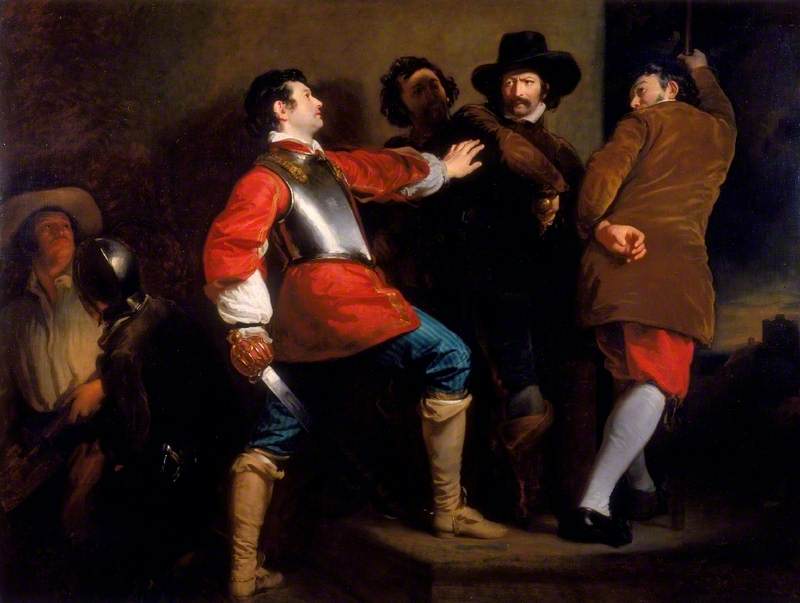
Henry Perronnet Briggs – The Discovery of the Gunpowder Plot and the Taking of Guy Fawkes 1820
Had the conspiracy succeeded, Fawkes probably wouldn’t be particularly famous himself, though Catesby might be. But the conspirators would be among the most important people in British history. They would no doubt be just as reviled by some as Fawkes has been, and also venerated by others, not as martyrs, but saints. And the Britain I’m living in now might well be a Britain where there was never a Civil War (and even if there had been, it wouldn’t have been the same one), that was never a constitutional monarchy – that maybe had no Act of Union and who knows, possibly no British Empire? Or again, a very different British Empire – but whatever, we would now be living in an unimaginably different present.

We can never know; so probably it is still worth remembering the 5th of November, in all its grotesqueness and ambiguity, neither as something to really celebrate or to mourn, but as one of those weird crossroads in history. And worth remembering poor old villainously-heroic Guy Fawkes, who probably foresaw some kind of strange new world, but not the one he would star so prominently in.
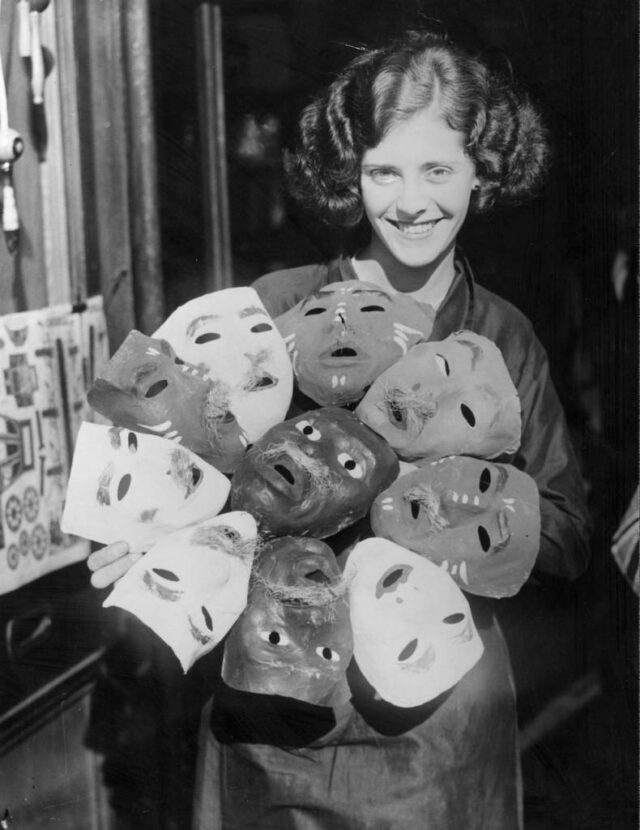
A shop assistant in Slough with a selection of Guy Fawkes masks, October 1934. (Photo by William Vanderson/Fox Photos/Getty Images)

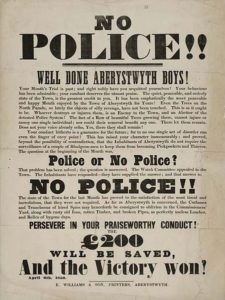
the law won – police academy and 80s pop culture

In the 2020s, the Police may feel beleaguered by the pressure to account for their actions and act within the boundaries of the laws that they are supposed to be upholding, but despite the usual complaints from conservative nostalgists about declining standards of respect, the question of ‘who watches the watchmen’ (or, ‘who will guard the guards’ or however Quis custodiet ipsos custodies? is best translated) is hardly new, and probably wasn’t new even when that line appeared in Juvenal’s Satires in the 2nd century AD.

In the UK (since I’m here), the modern police force (and quasi-police forces like the Bow Street Runners) have almost always been controversial from their foundations in the 18th century onwards – and not surprisingly so.

It’s probably true that the majority of people have always wanted to live their lives in peace, but ‘law and order’ is not the same thing as peace. The ‘order’ comes from the enforcement of the law, and ‘the law’ has never been a democratically agreed set of rules. So law and order is always somebody’s law and order, but  not everybody’s. As is often pointed out, most of the things which we currently regard as barbaric in the 21st century, from slavery and torture to child labour and the lack of universal suffrage, were all technically legal. ‘Respect for the law’ may not just be a different thing from respect for your fellow human beings, it might be (and often has been) the opposite of it; so it’s no wonder that the position of the gatekeepers of the law should often be ambiguous at best.
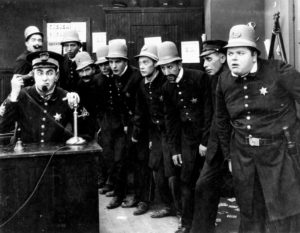
the Keystone Cops in the nineteen-teens

Popular culture, as it tends to do – whether consciously or not –  reflects this uneasy situation. Since the advent of film and television, themes of law enforcement and policing have been at the centre of the some of mediums’ key genres, but the venerable Dixon of Dock Green notwithstanding, the focus is only very rarely on orthodox police officers faithfully following the rules. Drama almost invariably favours the maverick individualist who ‘gets the job done’* over the methodical, ‘by the book’ police officer, who usually becomes a comic foil or worse. And from the Keystone Cops (or sometimes Keystone Kops) in 1912 to the present day, the police in comedies are almost invariably either inept or crooked (or both; but more of that later).

*typically, the writers of Alan Partridge manage to encapsulate this kind of stereotype while also acknowledging the ambiguity of its appeal to a conservatively-minded public. Partridge pitches ‘A detective series based in Norwich called “Swallow“. Swallow is a detective who tackles vandalism. Bit of a maverick, not afraid to break the law if he thinks it’s necessary. He’s not a criminal, you know, but he will, perhaps, travel 80mph on the motorway if, for example, he wants to get somewhere quickly.’ i.e. he is in fact a criminal, but one that fits in with the Partridgean world view

But perhaps the police of the 2020s should think themselves lucky; they are currently enduring one of their periodic crisis points with public opinion, but they aren’t yet (again) a general laughing stock; perhaps because it’s too dangerous for their opponents to laugh at them, for now. But almost everyone used to do it. For the generations growing up in the 70s and 80s, whatever their private views, the actual police force as depicted by mainstream (that is, mostly American) popular culture was almost exclusively either comical or the bad guys, or both.

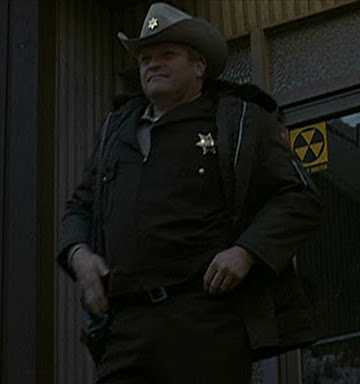
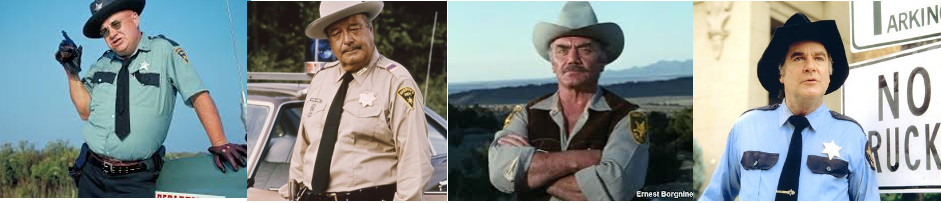
redneck police: Clifton James as JW Pepper (Live and Let Die), Jackie Gleason as Buford T Justice (Smokey and the Bandit), Ernest Borgnine as ‘Dirty Lyle’ Wallace (Convoy), James Best as Rosco P Coltrane (Dukes of Hazzard)
the same but different; Brian Dennehy as Teasle in First Blood

The idiot/yokel/corrupt/redneck cop has an interesting cinematic bloodline, coming into their own in the 1960s with ambivalent exploitation films like The Wild Angels (1966) and genuine Vietnam-war-era countercultural artefacts like Easy Rider, but modulating into the mainstream – and the mainstream of kids’ entertainment at that – with the emergence of Roger Moore’s more comedic James Bond in Live and Let Die in 1973. This seems to have tonally influenced similar movies like The Moonrunners (1975; which itself gave birth to the iconic TV show The Dukes of Hazzard, 1979-85), Smokey and the Bandit (1977), Any Which Way You Can (1980) and The Cannonball Run (1981) among others. Variations of these characters – police officers concerned more with the relentless pursuit of personal vendettas than actual law enforcement, appeared (sometimes sans the redneck accoutrements) in both dramas (Convoy, 1978) and comedies (The Blues Brothers, 1980), while the more sinister, corrupt but not necessarily inept police that pushed John Rambo to breaking point in First Blood (1982) could also be spotted harassing (equally, if differently, dysfunctional Vietnam vets) The A-Team from 1983 to ’85.

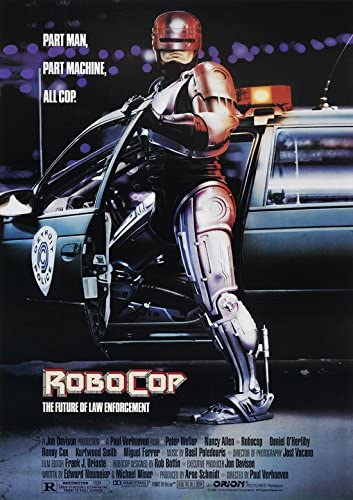
iconic movie; iconic poster

In fact, the whole culture of the police force was so obviously beyond redemption as far as the makers of kids and teens entertainment were concerned, that the only cops who could be the good guys were the aforementioned ‘mavericks.’ These were borderline vigilantes who bent or broke or ignored the rules as they saw fit, but who were inevitably guided by a rigid sense of justice that was generally unappreciated by their superiors. This kind of cop reaches some kind of peak in Paul Verhoeven’s masterly Robocop (1987). Here, just beneath the surface of straightforward fun sci-fi/action movie violent entertainment, the director examines serious questions of ‘law’ vs ‘justice’ and the role of human judgement and morality in negotiating between those two hopefully-related things. Robocop himself is, as the tagline says ‘part man, part machine; all cop’ but the movie also gives us pure machine-cop in the comical/horrific ED-209, which removes the pesky human element that makes everything so complicated and gives us instead an amoral killing machine. The film also gives us good and bad human-cops, in the persons of  Officer Lewis and Dick Jones. Lewis (the always-great Nancy Allen) has a sense of justice is no less keen than that of her robot counterpart, but her power is limited by the machinations of the corrupt hierarchy of the organisation she works for, and she’s vulnerable to physical injury. Jones (the brilliant Ronny Cox) is very aware of both the practical and moral problems with law enforcement, but he’s than happy to benefit personally from them.

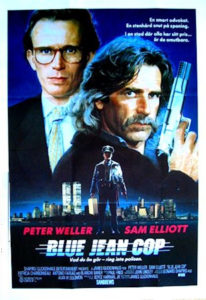
Part Man, Part Blue Jeans; All Cop

The following year, Peter Weller (Robocop himself) returned in the vastly inferior Shakedown, worthy of mention because it too features unorthodox/mismatched law enforcers (a classic 80s trope, here it’s Weller’s clean-cut lawyer and Sam Elliott’s scruffy, long haired cop) teaming up to combat a corrupt police force; indeed the movie’s original tagline was Whatever you do… don’t call the cops. And it’s also worthy of mention because its UK (and other territories) title was Blue Jean Cop, though it sadly lacked the ‘part man, part blue jean; all cop’ tagline one would have hoped for). Into the 90s, this kind of thing seemed hopelessly unsophisticated, but even a ‘crooked cops’ masterpiece like James Mangold’s Cop Land (1997) relies, like Robocop, on the police – this time in the only mildly unconventional form of a good, simple-minded cop (Sylvester Stallone), to police the bad, corrupt, too-clever police, enforcing the rules that they have broken so cavalierly. The film even ends with the explicit statement (via a voiceover) that crime doesn’t pay; despite just showing the viewer that if you are the police, it mostly seems to, for years, unless someone else on the inside doesn’t like it.

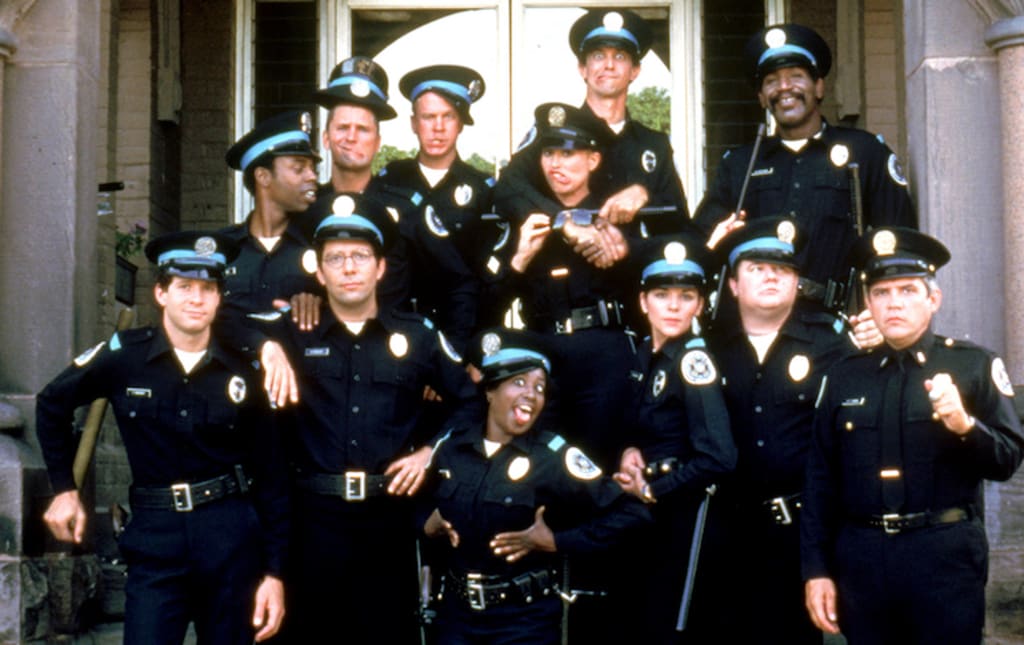
There’s always an ironic focus on ‘the rules’ – ironic because the TV and movie police tend to be bending them a-la Starsky and Hutch (and the rest), or ineffectually wringing their hands over that rule-bending, like the strait-laced half of almost every mismatched partnership (classic examples being Judge Reinhold in 1984’s Beverley Hills Cop and Danny Glover in Lethal Weapon, another famous ‘unorthodox cop’ movie from the same year as Robocop) or even disregarding them altogether like Clint Eastwood’s Dirty Harry. So, it’s no surprise that the training of the police and the learning of those rules should become the focus of at least one story. Which brings us to Police Academy.

the spiritual children of the Keystone Cops

Obviously any serious claim one makes for Police Academy is a claim too far. It’s not, nor was it supposed to be, a serious film, or even possibly a good film, and certainly not one with much of a serious message. But its theme is a time-honoured one; going back to the medieval Feast of Fools and even further to the Roman festival of Saturnalia, it’s the world upside down, the lords of Misrule. And in honouring this tradition, the film tells us a lot about the age that spawned it. Police Academy purports to represent the opposite of what was the approved behaviour of the police in 1984 and yet, despite its (not entirely unfounded) reputation for sexism and crass stereotypes it remains largely watchable where many similar films do not. But, more surprisingly, it also feels significantly less reactionary than, say the previous year’s Dirty Harry opus, Sudden Impact.

While it’s a trivial piece of fluff, Police Academy is notable for – unlike many more enlightened films before and since – passing the Bechdel test. Don’t expect anything too deep – not just from the female characters – but it also has having noticeably more diversity among its ensemble cast than the Caddyshack/National Lampoon type of films that were in its comedy DNA. Three prominent African-American characters with more than cameo roles in a mainstream Hollywood movie may not seem like much – and it definitely isn’t – but looking at the era it feels almost radical. At this point in Hollywood history, let’s not forget, the idea for a film where a rich white kid finds the easiest way to get into college is by disguising as a black kid not only got picked up by a major studio, but actually made it to the screen.

In that context, these three actors – Marion Ramsey, Michael Winslow and the late Bubba Smith could look back on a series of movies which may not have been* cinematic masterpieces, but which allowed them to use their formidable comedic talents in a non-token way. More to the point, their race is neither overlooked in a ‘colourblind’ way (they are definitely Black characters rather than just Black actors playing indeterminate characters) or portrayed in a negative sense. Police Academy is not an enlightened franchise by any means; the whole series essentially runs on stereotypes and bad taste and therefore has the capacity to offend pretty much everyone. But although there are almost certainly racial slurs to be found there, alongside (for sure) gross sexism, homophobia etc, the series is so determined to make fun of every possible point of view that it ends up leaving a far less bad smell behind it than many of its peers did; perhaps most of all the previously alluded to Soul Man (1986).
*ie they definitely aren’t

Despite its essential good nature though, there is a genuine, if mild kind of subversion to be found in the Police Academy films. With the Dickensian, broadly-drawn characters comes a mildly rebellious agenda (laughing at authority), but it also subverts in a more subtle (and therefore unintentional? who knows) way, the established pattern of how the police were depicted. Yes, they are a gang, and as such they are stupid and corrupt and vicious and inept, just like the police of Easy Rider, Smokey and the Bandit, The Dukes of Hazzard etc. Unlike all of those films and franchises though, Police Academy offers a simple solution in line with its dorky, good natured approach; if you don’t want the police to suck, it implies, what you need to do is to recruit people who are not ‘police material.’ In the 1980s those who were not considered traditional ‘police material’ seemingly included ethnic minorities, women, smartasses, nerds, and at least one dangerous gun-worshipper, albeit one with a sense of right and wrong that was less morally dubious than Dirty Harry’s. So ultimately, like its spiritual ancestors, Saturnalia and the Feast of Fools, Police Academy is more like a safety valve that ensures the survival of the status quo rather than a wrecking ball that ushers in a new society. Indeed, as with Dickens and his poorhouses and brutal mill owners, the message is not – as you might justifiably expect it to be – ‘we need urgent reform’, but instead ‘people should be nicer’. It’s hard to argue with, as far as it goes, but as always seems to be the case*, the police get off lightly in the end.

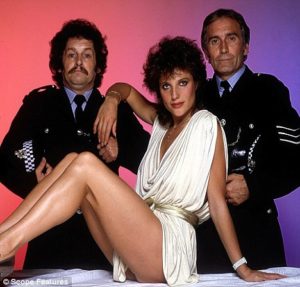
The Boys in Blue (1982). Christ

*one brutal exception to this rule is roughly the UK equivalent of Police Academy, the risible 1982 Cannon & Ball vehicle The Boys In Blue. After sitting through an impossibly long hour and a half of Tommy and Bobby, the average viewer will want not only to dismantle the police force, but  also set fire to the entire western culture that produced it.